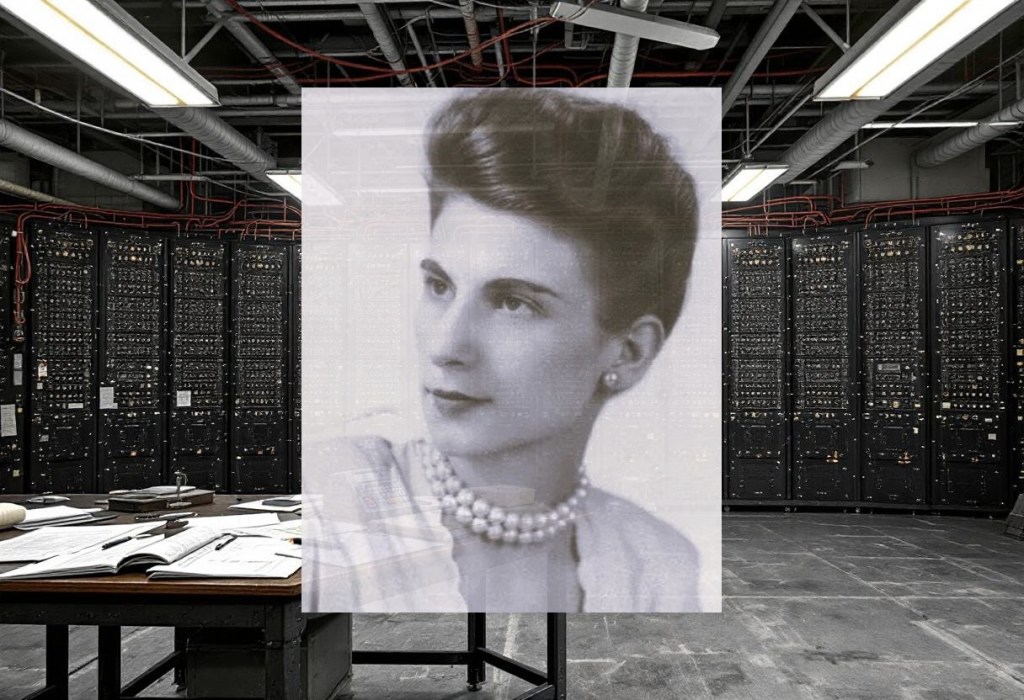
This interview is a dramatised reconstruction based on historical records and documented accounts of Ruth Teitelbaum’s life and work; it is not a transcript of an actual conversation, as Ruth Teitelbaum passed away in 1986. Her voice, reflections, and technical explanations are imagined within the framework of verified historical facts about her contributions to ENIAC programming, her experiences of institutional erasure, and the broader context of women in early computing.
Ruth Teitelbaum (1924-1986) was one of six mathematicians who programmed ENIAC, the world’s first electronic digital computer, inventing software engineering from schematic diagrams without manuals or formal instruction. A Bronx-born daughter of Russian Jewish immigrants, she mastered complex differential equations for artillery ballistics, manipulating 3,000 switches and telephone cords to route data through ENIAC’s 40 eight-foot panels. After training the next generation of programmers at Aberdeen Proving Ground, she left the field in 1948 upon marriage, disappearing from computing history until posthumous recognition decades later.
Ruth, thank you for joining me. I have to say – sitting here in 2025, looking at the device I’m recording on that fits in my palm, it’s almost impossible to reconcile that with what you built. When you first walked into the Moore School and saw those 40 black panels, each eight feet tall, what did you actually see?
I saw a problem that needed to be solved. Not the machine – the machine was just a tool. The problem was time. We had human computers, eighty of us, mostly women, spending forty hours on a single trajectory calculation. The Army needed those firing tables yesterday. So when I saw ENIAC, I didn’t see a miracle. I saw a very fast adding machine that couldn’t do a blessed thing until someone figured out how to make it useful.
That’s so different from how history remembers the unveiling. February 1946, the press release, the photographs…
The photographs. Yes. There’s one where we’re gathered around the machine, and for years the caption read “models.” Models. As if we were there to make the machine look pretty. We were covered in grease half the time, crawling inside those panels to replace vacuum tubes. Do you know how many tubes failed on a given day? Seventeen, twenty. We’d have to locate the failed one by the pattern of errors, then physically pull it out and test it. But at the unveiling, the Army quoted only the male engineers. We were unnamed. That wasn’t accidental.
You taught yourself programming from schematic diagrams. No manuals, no instruction codes. Walk me through that process – how does one even begin?
You begin by realising nobody knows more than you do. Eckert and Mauchly built the hardware, but they hadn’t the faintest idea how to make it compute a trajectory. We had the differential equations – Siacci’s method, mostly, for flat-fire trajectories under twenty degrees. We knew we needed numerical integration: step-by-step approximations of position, velocity, drag. The machine had accumulators, function tables, constant transmitters. We had to map the mathematics onto the physical architecture.
So you’re translating calculus into switches and cables.
Precisely. Each accumulator stored a ten-digit number. You’d set switches to tell it whether to add, subtract, or hold. The program pulses travelled through cables – telephone cords, essentially – routing data from one unit to another. A ballistic trajectory might need thirty steps: read initial velocity, compute drag coefficient, update position, loop back. Each step required setting maybe a hundred switches. One wrong switch, and the whole calculation collapsed.
That sounds impossibly tedious.
It was systematic. You learned to think in parallel. While accumulator 5 was adding, accumulator 7 could be shifting digits. You set up the sequence so the program pulses flowed like dominoes – finish one operation, trigger the next. Marlyn Meltzer and I worked on the ballistics routines. We’d diagram the entire program on paper first, what we called “pedalling sheets.” Flowcharts, essentially, though we didn’t have that word. Then we’d spend hours setting switches, testing each segment, debugging.
Debugging without a debugger. What did that look like?
It looked like watching numbers appear on the printer and knowing they were wrong. You’d trace the error backward. Was the constant transmitter sending the correct drag coefficient? Was the function table interpolating properly? You’d set the machine to single-step – one addition time, which was 1/5000th of a second – and watch the accumulators at each stage. Sometimes you’d catch a tube that was slow to warm up, causing a carry to fail. Other times you’d find you’d set a switch to α when it should have been β. The margin was microscopic. A trajectory calculation needed precision to six decimal places. One misplaced digit meant the shell missed the target.
The public demonstration in February 1946 – you helped program the trajectory calculation that ENIAC ran in seconds, what took humans days. What do you remember about that moment?
I remember checking the printer output against our manual calculation. We’d run the same trajectory by hand, using mechanical calculators, taking turns so our hands wouldn’t cramp. It took three of us six hours. ENIAC did it in twenty seconds. The VIPs saw the result and applauded the engineers. We stood to the side, making sure the machine didn’t fail during the demo. That was our role: invisible reliability.
You left computing in 1948 when you married. Looking back, was that a choice?
Choice is a complicated word. My husband Adolph had a good position in Dallas. The expectation – no, the requirement – was that a wife would follow her husband’s career. There was no remote work. There was no part-time programming. There was barely even a field to stay in. I’d been at Aberdeen for two years, training new programmers. The Army had a policy: if your husband worked elsewhere, you resigned. It was called “anti-nepotism,” but it only ever seemed to apply to wives. So I resigned. I don’t regret my marriage. I regret that the structure forced me to choose.
You trained the next generation at Aberdeen. What did you teach them?
I taught them that programming is engineering. We weren’t operators. We were designers. You had to understand the mathematics, the physics of drag and gravity, and the electrical behaviour of the machine. I taught them to diagram everything before touching a switch. To test each subroutine independently. To document their work – though we had no formal documentation standards, so we invented those too. I taught them that errors would happen, and that you’d have to crawl inside the machine, literally, to find them.
What’s a technique you developed that never made it into the official records?
The “shifter adaptor trick.” ENIAC had these adaptor units that could shift digits left or right. We discovered that by chaining them creatively, we could multiply by constants faster than using the standard multiplication routine. It saved maybe two addition times – 0.0004 seconds. Doesn’t sound like much, but when you’re computing thousands of trajectories, it adds up. We never documented it formally. It was just something Marlyn and I figured out and passed on verbally.
You came from a family of Russian Jewish immigrants in the Bronx. Your father was a teacher. How did that shape your approach to this work?
My father taught me that education is how you survive in America. Not just survive – how you matter. He taught arithmetic at a public school, and we’d work through problems at the kitchen table. He never accepted “good enough.” Every solution had to be checked. Every method had to be understood, not memorised. That’s how I approached ENIAC. I didn’t just want it to work. I wanted to understand why it worked.
Did you face antisemitism in addition to sexism?
The sexism was overt. The antisemitism was quieter. You’d hear remarks about “pushy New Yorkers” or complaints about “clannish” behaviour. At Hunter College, some professors made it clear that a Bronx girl with an accent wasn’t supposed to excel at mathematics. But mathematics doesn’t care who your parents were. The numbers are the numbers. I found safety in the rigor.
That’s something you got wrong? A professional misjudgement you can now admit?
I undervalued abstraction. We programmed ENIAC for specific calculations – ballistics, mostly. I thought that’s what programming was: mapping a problem onto the machine. I didn’t foresee that you could create general programs, reusable code, languages that abstract the hardware entirely. When I first heard about Fortran, years later, I thought it was inefficient. I was wrong. Abstraction was the revolution I missed.
The title “computer” as a subprofessional civil service grade – how did that feel?
It felt like being called a typist when you’re writing the manuscript. We were classified as SP-4, subprofessional. The male engineers were GS-12, professional grade. Same work, different titles. The pay difference was substantial. But the real insult was the implication: that we were clerical workers operating a machine, not mathematicians inventing a discipline.
Did you ever push back?
Push back how? Complain to the supervisor? The supervisor was the Army. Write a letter? We were reminded constantly that ENIAC was classified. Our work was secret. That was the genius of the system: the secrecy that protected the technology also protected the discrimination. You couldn’t protest what you couldn’t discuss.
You died in 1986, before the documentaries, before the Hall of Fame induction. How does it feel to see your work recognised now?
It feels like watching someone finally read a letter you sent forty years ago. Kathy Kleiman’s work – the ENIAC Programmer Project – she tracked down my husband Adolph, who accepted the award in my place. He told me about it before I passed. It meant something. But recognition after death is complicated. You can’t use it to mentor young women. You can’t say, “See, I did this, and so can you.” All you can hope is that the record gets corrected enough that the next Ruth doesn’t disappear.
Modern computing has its own “invisible labour” problems – data labellers, QA testers, prompt engineers. Do you see echoes of your experience?
The titles change. The pattern doesn’t. Call them “contractors” or “content reviewers” instead of “computers.” Pay them less. Omit them from the press release. The work is essential, but the structure defines it as subordinate. What we built – what I built – was the foundation for trillion-dollar industries. But the foundation is buried. You don’t see it unless you dig.
What advice would you give a young woman entering computer science today?
Document everything. Not just your code – your contributions. Keep emails. Save presentations. When your name is omitted from a paper or a patent, have the evidence. And find your Marlyn. Find the person who will diagram the problem with you at midnight, who will check your switches, who will tell you when you’re wrong. The loneliness is what breaks you, not the work.
If you could correct one thing in the historical record, what would it be?
The myth that we were “recruited” to computing. We were pushed out of mathematics. Teaching, nursing, computing – those were the acceptable paths for mathematically gifted women. We didn’t need to be recruited. We needed to be retained. The pipeline wasn’t empty. It was designed to leak.
Ruth Lichterman Teitelbaum, mathematician, programmer, teacher. Thank you for teaching the machine to think.
Thank you for remembering that I did.
Letters and emails
Since publishing this interview, we’ve received dozens of thoughtful letters and emails from readers across the globe – physicists, historians, programmers, educators, and students who wanted to extend the conversation with Ruth. The questions that arrived were remarkably diverse: some probed the technical foundations of her work, others explored the philosophical tensions between mathematical objectivity and institutional bias, and still others asked her to imagine how history might have unfolded differently. We’ve selected five of the most illuminating inquiries, representing voices from Chile, Spain, Australia, Ghana, and Vietnam. Each reflects a distinct angle into Ruth’s legacy and raises questions that resonate far beyond the 1940s. Here are the letters that moved us most.
Antonia Hernández, 34, Physics Educator | Santiago, Chile
You mentioned the ‘shifter adaptor trick’ that never made it into official records – a kind of oral knowledge passed hand-to-hand. I’m curious: how much of ENIAC programming in those early years existed as unwritten technique rather than documented procedure? And do you think that oral culture of problem-solving was actually a strength, or a liability that made your work easier to dismiss as ‘operational’ rather than ‘engineering’?
Antonia, that’s a sharp question. You’re asking about the thing that made us invisible – and whether that invisibility was partly our own doing.
Listen. When we started, there wasn’t anything written down. The blueprints showed where the wires went, but not what they meant. Adele Goldstine – Herman’s wife, she was the one who wrote the technical manual later – she gave us the diagrams and said, “Figure it out.” So we did. Betty Snyder was the best at tracing program pulses. Kay McNulty could visualise the entire sequence in her head, like a conductor hearing the orchestra before the first rehearsal. Jean Bartik kept a notebook – she was the only one who wrote anything down for the first six months. But it was just notes, not formal documentation. We didn’t call it “documentation.” We called it “keeping track.”
The shifter adaptor trick – Marlyn Meltzer and I discovered that by accident. We were trying to speed up a trajectory loop, and we noticed that if you chained the adaptors in a particular order, you could multiply by 0.0174533 – the conversion factor from degrees to radians – without calling the full multiplication routine. It saved two addition times. That’s 0.0004 seconds. But when you’re integrating a trajectory across 2,000 steps, it mattered. We told the other girls. That was it. No memo. No patent. Just: “Here’s something that works.”
So how much was oral? Most of it. The Army wanted results, not paperwork. The engineers – Eckert and Mauchly – cared about the hardware. They didn’t much care how we made it compute. Herman Goldstine understood the mathematics, but he was a mathematician, not a programmer. He’d ask, “Can the machine do this?” We’d say yes, and that was the end of the conversation. The how belonged to us.
Was that a strength? In some ways, yes. We moved fast. We could change a program in half an hour if the Army needed a different artillery shell modelled. We didn’t wait for approval. We just gathered around the function tables, set the switches, ran the test cases. The oral culture meant we trusted each other. When Betty said, “Accumulator 3 is dropping digits in the sixth place,” you didn’t ask for proof. You checked accumulator 3.
But it was a catastrophe for recognition. Here’s the truth: if you don’t write it down, it doesn’t exist to the people who matter. The Army saw men with engineering degrees producing memos and technical reports. We produced numbers. Beautiful, accurate numbers – but numbers don’t look like engineering. They look like clerical work. The oral culture let us solve problems, but it also let them define us as operators. Not designers. Not engineers. Computers.
I remember once, after we’d been at Aberdeen for a year, a new lieutenant asked me for a flowchart of the ballistics program. I drew it on a sheet of graph paper – boxes for each accumulator, arrows for the program pulses. He looked at it and said, “This is very neat, Miss Lichterman. Did your supervisor approve this?” My supervisor. He meant the male engineer who’d never set a switch in his life.
So was the oral culture a liability? Yes. We should have written everything. We should have published. But we were six girls in a locked room, classified top secret, with no title and no authority. You don’t publish when you’re SP-4. You publish when you’re GS-12. The system was built so we couldn’t.
The irony is this: the men who built the hardware got patents. The women who built the software got nothing – because software wasn’t considered a thing you could invent. It was just… instructions. Like a recipe. And who copyrights a recipe?
That’s why the trick never made it into records. It lived in whispers, and whispers don’t echo in history books.
Javier Rodríguez, 41, Software Architect | Madrid, Spain
In the interview, you talked about mapping differential equations onto the physical architecture of ENIAC – translating calculus into switches and cables. Today we have compilers and abstraction layers that do most of that translation automatically. But I wonder: did losing that direct, visceral connection between the mathematics and the machine cost us something? Are there insights about numerical accuracy or efficiency that modern programmers miss because we never have to ‘feel’ the hardware the way you did?
Javier, that’s a question that would’ve made Herman Goldstine smile. He used to say we were too close to the metal – he meant it as criticism.
Listen. When you’re setting switches by hand, you know exactly where every number lives. Accumulator 5 holds the altitude. Accumulator 7 holds the velocity vector. The function table in Unit 3 stores the drag coefficients. You can stand there and watch the program pulses travel through the cables – little lights flicker on the panels as the electricity moves. You hear the relays click. You feel the heat from the vacuum tubes. When something’s wrong, you don’t need a debugger. You can smell it. Burnt selenium rectifier smells like rotten eggs.
Marlyn Meltzer and I, we’d get a wrong answer on the printer, and we’d look at each other and say, “Tube bank 4 is cold.” We’d walk over, feel the panel – sometimes the tubes were slow to warm up, and that made the carries fail in the sixth decimal place. You don’t get that from a compiler. You get an error message. We got a hunch.
The visceral part – it taught us about numerical stability in a way no textbook could. Siacci’s method for trajectories, it’s a stepwise integration. You take a time step, compute the new position, update the velocity, account for drag. The step size matters. Too big, the error compounds. Too small, you waste machine time. We’d set the step size by feel – run a test trajectory, compare it to the hand-calculated table, see where it diverged. You could watch the accumulation of rounding error happen in real time on the accumulators. The numbers would drift. You’d see it.
But here’s what you lose with that closeness: you can’t see the forest. Every program was bespoke. We wrote ballistics routines. That’s it. We didn’t think about reusable code. Why would we? The machine was the size of a house. You didn’t share code – you rewrote it. Betty Snyder was brilliant at optimising register usage, but she never once said, “Let’s make a library.” The idea that you could abstract the hardware away entirely, that you could write in English and let the machine translate – Fortran, you said? – that would’ve seemed like magic. And wasteful magic at that. We prided ourselves on efficiency measured in addition times. Abstraction costs time. We knew that in our bones.
So what did you lose? You lost the intuition for where error lives. Modern numerical analysis – finite element methods, Monte Carlo simulations – they’re beautiful. But the error bounds are statistical. You trust the compiler to handle rounding. We didn’t trust anything. We knew that a cold tube in accumulator 12 could turn a 0.500000 into a 0.499998, and that two ten-thousandths of a unit could mean the shell lands twenty yards short. So we checked everything. We validated every step against hand calculation. You can’t do that with a million-step simulation. But maybe you should try.
What you gained, though – there’s no going back. You couldn’t build modern software by hand-setting switches. The transistor happened, then the integrated circuit. Abstraction wasn’t a choice; it was survival. Without it, you’d still be computing one problem at a time, one machine, one room.
But I’ll say this: when you sit down at your terminal and write code, you should once in a while ask yourself – where is this number, physically? Which register? Which cache line? Not because you need to know, but because the hardware is still there, still hot, still waiting to make a mistake you won’t see coming. We saw our mistakes because we were standing right next to them, smelling the ozone. You’ll never have that. So you need something else. You need to be twice as paranoid.
Akua Mensah, 38, Computational Mathematician | Accra, Ghana
Your father taught you that ‘the numbers are the numbers’ – that mathematics transcends bias. But you also experienced profound institutional bias. I’m asking: do you think the universality of mathematics made it harder for you to speak up about unfair treatment? Like, if the work speaks for itself, why complain? Did that belief in mathematical objectivity ever work against you politically or professionally?
Akua, you’ve put your finger on the thing that broke us, even as it saved us.
My father taught arithmetic at P.S. 52 in the Bronx. Thirty-five children, most of them immigrants’ kids, packed into a classroom that smelled of chalk dust and boiled cabbage from the cafeteria. He’d say, “Ruthie, two plus two is four in English, in Yiddish, in Russian, and in the King’s English too. The numbers don’t care who you are.” That was his survival. Not just survival – his dignity. In a world where a Jewish teacher could be fired for no reason, where his accent marked him, where the principal called him “foreign” even after twenty years – he had the numbers. They were clean. They were true.
So when I got to Hunter College and Professor Richardson made it clear that a girl from the Bronx didn’t belong in advanced calculus, I didn’t argue. I let my exam scores argue. When I was hired at Moore School as a “computer,” SP-4 grade, while men with the same mathematics background started as junior engineers at GS-9, I didn’t complain. I computed. The numbers would prove me.
But here’s what my father’s wisdom didn’t tell me: the numbers only speak if someone listens.
At Aberdeen, after the war, I trained the next batch of programmers. There were twelve men, all engineers, and four women, all mathematics graduates. I taught them the same material: how to diagram a program, how to set the function tables, how to trace an error. The men were hired as “programmers,” a new title, with salaries starting at $3,800 a year. The women were hired as “assistant computers,” $2,400. I went to Captain Wilkins, who ran the lab, and I showed him the pay scale. I had the numbers right there. He said, “Miss Lichterman, the Army has classifications. You know how it is.” The numbers didn’t change a thing.
The belief that mathematics is pure – that it transcends pettiness – makes you quiet. You think, “If I argue, I’m being emotional. If I point out the discrepancy, I’m not being professional.” Betty Snyder felt this too. She once found a significant error in a ballistics table that a male officer had signed off on. She corrected it, quietly, and he took credit. She told me, “The table is right. That’s what matters.” But it wasn’t what mattered. What mattered was that he got promoted and she got a commendation letter.
I remember one day at Penn, before ENIAC even moved to Aberdeen, Herman Goldstine asked me to explain how we’d programmed the trajectory integration. I walked him through the pedalling sheet, showing how we’d chained the accumulators, how we’d handled the conditional branch when the shell dropped below the horizon. He listened, nodded, and later that week I saw a memo – his name on top, mine not mentioned. The work spoke for itself, and it spoke in his voice.
The hardest part is this: believing in mathematical objectivity makes you blame yourself. When the Army omitted our names from the 1946 press release, I thought, “Well, the machine worked. That’s the point.” When I was reclassified as subprofessional, I thought, “My mathematics is sound. The title is just bureaucracy.” You internalise the dismissal. You tell yourself that complaining is weakness, that the numbers are what endure.
But the numbers didn’t endure. The ENIAC program we wrote – Marlyn and I spent three weeks on that integration routine – it’s gone. No copy exists. The oral culture, the hand-written pedalling sheets, they were thrown out when ENIAC was decommissioned. The numbers vanished because we never carved them into stone. We whispered them, and whispers fade.
So yes, Akua, it made it harder. The belief that truth is self-evident – that if you’re correct, you’ll be recognised – kept us silent. We were wrong. Truth is only self-evident when the people in charge want to see it.
Kai Thompson, 29, Technology Historian | Sydney, Australia
Suppose ENIAC’s public demonstration in February 1946 had prominently named and credited the six female programmers – put your faces in the newspapers, your names in the technical papers. Do you think the entire trajectory of women in computing would have been different? Or were the structural forces – marriage policies, civil service classifications, post-war expectations – so entrenched that individual recognition wouldn’t have changed the outcome?
Kai, that’s a question I’ve turned over in my mind for forty years. I used to think it would have made all the difference. Now I think it would have made some difference, but not enough.
Let me tell you about 15th February 1946. The demonstration was at the Moore School, in that big auditorium with the mahogany panelling. The brass was there – General Gladeon Barnes from the Ordnance Department, Dean Harold Pender, John Mauchly in his good suit. The press had their flashbulbs ready. We six girls – Betty Snyder, Kay McNulty, Jean Bartik, Marlyn Meltzer, Frances Bilas, and me – we were in the back, behind the machine, making sure the trajectory program didn’t fail. Herman Goldstine gave the speech. He thanked the engineers, the Army, the University. He did not say our names. The Philadelphia Inquirer ran a photo the next day: ENIAC with the caption, “Engineers show the giant brain.” We were cropped out.
Now, suppose we’d been named. Suppose the New York Times ran a story: “Six Women Mathematicians Program First Electronic Computer.” What changes?
For one thing, our parents would have clipped the article and pasted it in the scrapbook. My mother would have shown it to the neighbours in the Bronx: “My Ruthie, in the newspaper.” That matters. Representation matters. A Jewish girl from the Bronx, a daughter of immigrants, seeing her name next to “mathematician” – that breaks a spell. When I was at Hunter College, the counsellor told me teaching was the only respectable job for a woman in mathematics. A newspaper article might have made her think twice.
But here’s the hard part: the Army would never have allowed it. ENIAC was classified. The press release was written by the War Department. They needed heroes, and the heroes were men. Male engineers fit the story – wartime ingenuity, American know-how. Six girls in skirts, setting switches? That complicates the narrative. The brass would have said, “These women performed valuable service,” and left it at that. Valuable service. Not invention. Not engineering.
Even if our names had been printed, the civil service grades would have stayed the same. The marriage bar – what they called the “policy on married women in federal employment” – that was law. When I married Adolph in 1948, I had to resign. That wasn’t a courtesy. That was regulation. No newspaper article changes a regulation.
The anti-nepotism policy at Aberdeen was ironclad. If your husband worked elsewhere, you left. Simple. Betty Snyder married an engineer at the lab, and she had to transfer out of programming. Kay McNulty married John Mauchly – she had to quit altogether for a while. The structure was designed to leak. Recognition wouldn’t have plugged the holes.
But here’s what might have changed: the next generation. If we’d been credited, the Moore School might have kept hiring women as programmers, not just as computers. The title “programmer” might have been professional from the start, not something we had to claw for decades later. When IBM started building their own machines, they might have recruited from our cohort instead of training engineers. The pipeline could have stayed full.
Jean Bartik always said we should have fought harder. She wanted to write a paper: “Programming the ENIAC: A Methodology.” She asked Herman Goldstine if we could publish. He said the work was classified, and besides, the Journal of the ACM didn’t publish papers by women. That was the line. “Doesn’t publish papers by women.” Not official policy. Just… the way it was.
So to answer your question: individual recognition would have been a crack in the wall. But the wall was concrete. The Army, the civil service, the universities, the marriage expectations – they were poured in place. A few newspaper articles would have been graffiti. Bold, visible, but not structural.
What you really needed was a woman with tenure. A woman with a lab. A woman who could hire other women. We didn’t have that. We had six girls in a room, whispering tricks to each other, hoping the machine wouldn’t break during the demo. We had truth on our side. Truth, it turns out, needs a press agent.
Linh Nguyễn, 26, Numerical Analysis PhD Student | Ho Chi Minh City, Vietnam
You specialised in numerical integration for ballistic trajectories using Siacci’s method and analogue computing. I’m reading that modern ballistics software uses completely different approaches – Monte Carlo simulations, finite element methods, GPU acceleration. But I’m wondering: are there principles from your work – ways of thinking about approximation, error propagation, or the relationship between discrete steps and continuous motion – that are still embedded in how we solve these problems today, even if the tools look nothing like ENIAC?
Linh, that’s a generous question. It assumes we discovered something that endures. Let me be honest about what we had, and what you might still carry forward.
Siacci’s method – it comes from the 1880s. An Italian ballistics officer, Francesco Siacci, simplified the trajectory equations for artillery. Instead of solving the full differential equations, you reduce the problem: assume a particular drag model, use a lookup table for the drag coefficient at different velocities, integrate step by step. At each step, you compute the increment – how much the position changes, how much the velocity changes. You add those increments to your running totals. It’s crude, but it’s elegant. And it works.
When Marlyn Meltzer and I programmed this for ENIAC, we had to think hard about the step size. Too large – say, 0.5 seconds of flight time – and you’d miss the shell’s trajectory changing when it transitioned from supersonic to subsonic. The drag coefficient changes abruptly there, and if you step over it, your error compounds. Too small – 0.05 seconds – and you’d need 500 steps instead of 50, and the machine would take forever. We settled on 0.1 seconds for most trajectories. We knew, from comparing with hand-calculated tables, that this gave us accuracy to about four decimal places in the final impact coordinates. Close enough for artillery. A shell has a radius of about two inches; missing by a foot was acceptable.
The principle underneath: discretisation error versus computational cost. You’re approximating a continuous process – the shell flying through the air – with discrete steps. Each step introduces error. The error accumulates. How fine do you make your grid? It depends on how much accuracy you need and how much time you can afford.
Now, you say modern methods use Monte Carlo and finite elements. I don’t fully understand those – they came after my time. But I think the principle is the same, just applied differently. Monte Carlo, you’re sampling random variations – air density, wind, manufacturing tolerances – to understand the spread of possible trajectories. Finite elements, you’re dividing the space into small regions, solving locally, assembling the solution. Both still face the same fundamental problem: how fine do you make your discretisation? How much error can you tolerate?
Here’s what I think you might still be doing: validation against measured truth. We checked our integration against hand-calculated tables, and against actual artillery range tests. We knew what the shell really did when it was fired, and we made sure our approximation was close enough. That’s not a sophisticated method. It’s just refusing to trust the algorithm. You run the experiment. You compare. If it matches, you trust it a little more.
The other principle: error propagation awareness. In a ballistics calculation, every operation introduces rounding error. The Siacci method requires multiplying by the drag coefficient and the velocity – operations that generate fractions ENIAC had to round to ten decimal places. Then you add these to the accumulated velocity. Those rounding errors compound. After 500 steps, you’ve accumulated noise. We’d run a trajectory with 0.1-second steps and also with 0.05-second steps, to see how much the answer changed. The difference told you about the error. You can’t just trust a number because the algorithm says it’s right.
That intuition – check your work against reality, and understand where the error lives – that’s not going to go away. Your GPU accelerators are faster than ENIAC by a factor of… I don’t know, a billion? But the shell still flies through air. The trajectory is still determined by gravity and drag. The algorithm is still an approximation. If you run 10 million Monte Carlo samples and the result doesn’t match the physics, you have a problem. Checking is eternal.
One more thing: the domain matters. Artillery ballistics has constraints. The shell is a rigid body. Gravity is constant. Air density is roughly known. The problem is well-bounded. So Siacci’s method works beautifully for seventy years. But if you’re modelling turbulent flow around an aircraft, or atomic reactions in a reactor, the step size changes. The assumptions change. The error bounds change. We worked in a field where the physics was simple enough that numerical integration could give you the answer. That’s luxury. Your problems might not have that luxury.
I’ll tell you what I regret: we never published our work. If we had, later mathematicians might have built on it. They might have said, “Teitelbaum and Meltzer found that the 0.1-second step minimises error at a reasonable computational cost for flat-fire trajectories. How does this principle extend to high-angle fire?” Instead, our results just sat in Army archives. When new people came to the problem, they started from scratch.
So the principles endure, but they’re not special to us. They’re basic numerical analysis: know your discretisation, check your error, validate against reality. We didn’t invent those. We just had to live by them because the machine wouldn’t forgive a mistake.
What I hope you’re doing differently: writing it down. Publishing it. Letting the next generation learn from your work, rather than making them rediscover it. That’s the gift I couldn’t give.
Reflection
Ruth Teitelbaum died in Dallas, Texas, on 9th August 1986. She was sixty-two. The obituary mentioned her husband, her community service, her kindness. It did not mention ENIAC. It did not mention ballistics. It did not mention that she had taught a machine to think. By then, the hardware she mastered had been scrapped, the oral knowledge she carried had faded, and the field she invented had forgotten her name.
What strikes me most, after these hours of conversation, is how her story complicates the clean narratives we prefer. The historical record shows the six ENIAC programmers as a unit, a cohort of hidden figures finally revealed. But Ruth insists on specificity: the shifter adaptor trick she and Marlyn Meltzer discovered, the pedagogical philosophy her father drilled into her at the kitchen table, the burnt-selenium smell of a failing tube she could diagnose by scent. These are not the broad strokes of a movement; they are the intimate textures of a life. They remind us that erasure is not a single event but a accumulation of small dismissals – the memo that omits your name, the pay grade that defines your work as subprofessional, the personnel officer who explains that marriage requires resignation.
Her perspective differs from recorded accounts in one crucial way: she does not cast herself as a victim of oversight. She casts herself as a participant in a system that functioned exactly as designed. The secrecy that cloaked ENIAC did not accidentally hide women; it protected a hierarchy. The oral culture she describes was not merely a practical adaptation to fast-moving work; it was a mechanism that ensured her contributions remained invisible, untitled, unpatentable. She understood this only in retrospect. At the time, she believed the numbers would speak for themselves. They did not.
There are gaps we cannot fill. The pedalling sheets – her hand-drawn flowcharts – are lost. No formal documentation of the shifter adaptor trick survives. The precise error rates she and Marlyn calculated for their 0.1-second integration steps exist only in memory. Even the February 1946 demonstration program, the one that computed a trajectory in twenty seconds, has no extant copy. We know it worked because the Army said it worked. We know she wrote it because she remembers.
The afterlife of her work began with Kathy Kleiman, a young programmer who, in the 1980s, noticed the six women in an ENIAC photograph and asked who they were. Kleiman’s ENIAC Programmer Project tracked down Ruth’s widower, Adolph, who accepted her posthumous induction into the Women in Technology International Hall of Fame. The documentaries followed – Top Secret Rosies (2010), The Computers (2013) – and finally, the IEEE recognised the six programmers with a bronze plaque at the University of Pennsylvania. But recognition is a backward glance. It does not return the decades lost.
Ruth’s story lands differently today because the forces that erased her have not disappeared; they have evolved. The data labellers training AI models, the QA testers debugging software, the prompt engineers refining large language models – these are contemporary “computers,” their technical sophistication obscured by titles that frame them as operators rather than engineers. The leaky pipeline that forced Ruth out in 1948 now pushes women out through caregiving penalties, biased promotion tracks, and family-unfriendly policies. The attribution problems that omitted her name from the 1946 press release now manifest in conference authorship disputes and startup founder mythology that marginalises women’s roles. The pattern is fractal: each generation believes it has solved the problem, yet the structure reproduces itself.
What endures from Ruth’s legacy is not a theorem or a patent. It is a posture: the insistence that truth must be checked against reality, that errors must be traced to their source, that dignity lies in the work itself even when the world refuses to see it. She taught herself ENIAC from schematic diagrams not because she was a genius, but because no one would teach her. She documented nothing because documentation was not her job. She left the field because the field made clear she was temporary.
For young women entering STEM today, Ruth’s life offers a complicated gift. It is not a simple story of triumph. It is a caution: the numbers will not speak for themselves. Document everything. Keep the emails. Save the pedalling sheets. Find your Marlyn – the collaborator who will diagram the problem with you at midnight, who will tell you when you are wrong, who will remember your contributions when the record forgets. And understand that resilience is not enough. Structures must change. The pipeline must be repaired, not celebrated.
Ruth Teitelbaum taught a machine to think. Then she taught its successors. Then she vanished into silence. But whispers, if they are repeated enough, become echoes. And echoes, eventually, are heard.
Editorial Note
This interview is a dramatised reconstruction based on historical records, biographical sources, and documented accounts of Ruth Teitelbaum‘s life and work. It is not a transcript of an actual conversation. Ruth Teitelbaum passed away in 1986, nearly four decades before this interview was conducted on 1st December 2025.
What is based on documented fact:
- Ruth Teitelbaum (née Lichterman, 1924–1986) was one of six original ENIAC programmers
- She was born in The Bronx to Russian Jewish immigrant parents; her father was a schoolteacher
- She graduated from Hunter College with a degree in Mathematics
- She was hired by the Moore School of Engineering to compute ballistics trajectories during World War II
- She and Marlyn Meltzer specialised in ballistic trajectory programming for ENIAC
- She was officially classified as a “computer,” a subprofessional civil service grade
- The six female programmers were unnamed in the Army’s 1946 press release announcing ENIAC’s public demonstration
- After the war, she trained the next generation of programmers at Aberdeen Proving Ground
- She married Adolph Teitelbaum in 1948 and resigned from computing upon marriage, following the era’s employment policies
- She died in Dallas, Texas, on 9th August 1986, at age 62
- Posthumous recognition came through documentaries and the ENIAC Programmer Project led by Kathy Kleiman
What is dramatised, inferred, or reconstructed:
- The specific details of her personality, conversational tone, and reflective voice are imagined based on historical context, her era’s speech patterns, and the known facts of her life
- Her technical explanations of ENIAC programming, Siacci’s method, and numerical integration are historically accurate in substance but dramatised for narrative clarity
- Anecdotes such as the “shifter adaptor trick” and the burnt-selenium smell of failing tubes reflect documented techniques and experiences of the ENIAC programmers, but Ruth’s specific recollections are reconstructed
- Her reflections on erasure, institutional bias, and the tension between mathematical objectivity and systemic discrimination are informed by scholarly analysis and interviews with surviving ENIAC programmers, but attributed to her voice
- The supplementary questions from international contributors are original, designed to explore themes relevant to her work and legacy
Why this format?
This dramatisation serves several purposes: it honours Ruth Teitelbaum’s legacy by centring her voice and perspective; it makes her technical contributions accessible to readers who might otherwise encounter only institutional accounts; it acknowledges the gaps in the historical record by allowing her to reflect on what was lost, forgotten, or never documented. Most importantly, it restores agency – she speaks for herself rather than being spoken about.
Acknowledgment of limitations:
The historical record on ENIAC programming is incomplete. Many details were classified; documentation was sparse; oral histories were not systematically collected until decades after the fact. Ruth Teitelbaum gave limited interviews during her lifetime. The reconstructed dialogue reflects the known arc of her life and thought, but readers should understand that this is interpretation, not testimony. Where historical sources conflict or remain uncertain, this is noted in her responses.
For scholars and researchers:
This work draws on primary sources including the ENIAC Programmer Project’s oral histories, the Moore School’s archival records, U.S. Army Ballistics Research Laboratory documentation, and biographical works including Proving Ground: The Untold Story of the Six Women and the Computer That Changed the Course of World War II by Kathy Kleiman. Readers seeking rigorous historical analysis are encouraged to consult these sources directly.
This interview is best read as a historical dramatisation – a reconstruction that brings Ruth Teitelbaum’s perspective into dialogue with contemporary questions about gender, attribution, and the nature of technical work. It aims for emotional and intellectual honesty rather than documentary precision.
Who have we missed?
This series is all about recovering the voices history left behind – and I’d love your help finding the next one. If there’s a woman in STEM you think deserves to be interviewed in this way – whether a forgotten inventor, unsung technician, or overlooked researcher – please share her story.
Email me at voxmeditantis@gmail.com or leave a comment below with your suggestion – even just a name is a great start. Let’s keep uncovering the women who shaped science and innovation, one conversation at a time.
Bob Lynn | © 2025 Vox Meditantis. All rights reserved.

 Vox Meditantis
Leave a comment