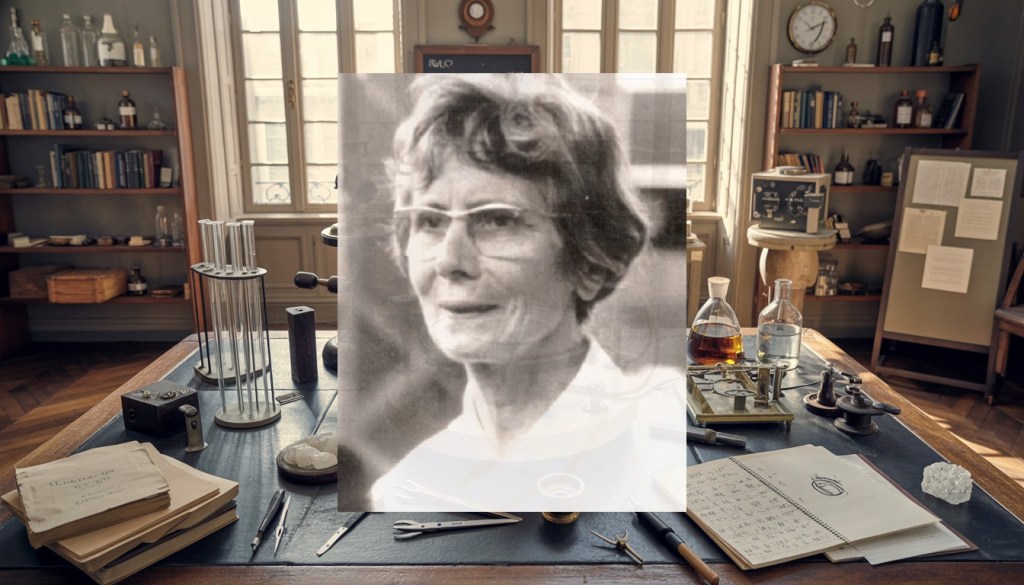
This interview is a dramatised reconstruction shaped from historical sources on Yvette Cauchois’s life and scientific work. While grounded in documented events and contributions, the dialogue includes imaginative interpretation and should be read as an informed homage rather than a verbatim transcript.
Yvette Cauchois (1908-1999) was a French physicist who revolutionised X-ray spectroscopy by inventing the curved-crystal spectrometer that bears her name, pioneered European synchrotron radiation research at Frascati in the 1960s, and came tantalisingly close to discovering element 85 (astatine) through X-ray analysis – only to see credit awarded to later synthesis work at Berkeley. Her innovations in instrumentation established principles still used in modern synchrotron beamlines, yet her contributions faded from view, published in French and Italian journals as physics became dominated by English-language discourse.
Dr Cauchois, I must say this is rather extraordinary. Here we are, on a November afternoon in 2025, and I’m speaking with someone whose spectrometer geometry I used just last week at Diamond Light Source. Your name is literally inscribed in the beamline specifications, yet you remain something of a phantom in the textbooks. How does that feel?
Phantom? Perhaps that is the right word. I prefer to think of it as being the foundation upon which others build without noticing the cracks in the floor. But you are kind to notice now. When I began, in the early 1930s, we simply wanted to see what had been invisible – those shy X-rays that refused to sit still for proper measurement.
Let’s start where you began. Paris, 1928 – you’d just earned your degree from the Sorbonne. What drew a young woman toward physical chemistry when so few doors were open?
The doors that were closed made the ones that opened seem all the more precious. I had always been fascinated by what lay beneath surfaces. My father was an engineer, you see, and I grew up watching him solve problems with his hands – tightening, adjusting, measuring. When I encountered Jean Perrin’s laboratory, I realised I could do the same with atoms. The mathematical beauty of Bragg’s law, the geometry of crystals – it was like discovering a hidden language. And Perrin, bless him, cared only for precision, not for gender.
And then came the spectrometer. Take me to that moment – 1932, I believe – when you realised that a curved crystal could transform X-ray analysis.
Ah, that was not a single moment but a gradual realisation born of frustration. The existing spectrometers – DuMond’s, Johann’s – they had their virtues, but they were like using a magnifying glass to study moonlight. You lost so much intensity. I kept asking: why must we choose between resolution and brightness? The Bragg condition demands a specific angle, yes, but what if the crystal itself could present every angle simultaneously? Imagine bending the crystal into a cylinder. The source sits on one circle, the detector on another. Every ray that satisfies the condition reaches the focus. The exposure time fell from an hour to a minute. Sometimes less.
That’s an extraordinary gain. For our readers who work with modern instrumentation, could you walk us through the geometry? The expert’s version?
Very well. In the Johann geometry – my starting point – you have a crystal bent to radius 2R, with source and detector both at distance R from the crystal centre. But this is reflection geometry, and you lose half your intensity. My insight was transmission geometry. The crystal, bent to radius R, transmits the beam through its thickness. The source sits on the Rowland circle of radius R/2, the detector film on the same circle. The key is that the crystal planes remain perpendicular to the radius vector. For X-ray wavelength λ, the Bragg condition 2d sinθ = nλ must be satisfied, where d is the lattice spacing. In my spectrometer, each point on the crystal surface presents a different θ, so the entire spectrum focuses simultaneously. The resolving power λ/Δλ reaches several thousand – comparable to the best reflection instruments, but with flux increased by factors of 10 to 100 depending on the energy range. We used quartz crystals, mica sometimes, with curvatures precise to within microns. The tolerance for deviation from ideal curvature – about 0.1% of the radius, otherwise the focus blurs. For hard X-rays, above 20 keV, the transmission efficiency drops, but for the soft region – 2 to 10 keV – it was transformative.
So it wasn’t just conceptual elegance – it was measurable, quantifiable improvement.
Exactly. We could finally resolve the Kα doublets of heavy elements with enough intensity to study trace quantities. When Horia Hulubei came to me in 1934, he wanted to hunt for missing elements. I told him: with this spectrometer, we can see what nature hides in quantities of milligrams. Perhaps less.
That brings us to astatine – element 85. The 1936 papers you published with Hulubei, then the 1939 follow-up. The lines were there, weren’t they?
They were there. At 151 X-units, precisely where Moseley’s law predicted the Kα1 line for eka-iodine. We ran the spectrum again and again. Radon decay produced the samples – we had naturally occurring astatine-218, you understand, not synthesised but born from radium’s own decay chain. Our spectrometer could detect it where others saw only noise. In 1939, we published two more lines. The evidence was consistent, reproducible. Then Paneth wrote his 1947 article – dismissing all prior claims, saying they had been “disproved.” He never examined our plates. He never asked to see our densitometer traces. He simply declared it so, and the community believed him because he wrote in English, because he was male, because he was established.
Recent scholarship has been more generous. The phrase “indisputably had astatine in their samples”.
Words after the fact. Hulubei took it harder than I. He was Romanian, already marginalised. I was merely a woman. We both learned that detection counts for less than synthesis. Berkeley could make astatine chemically, manipulate it, weigh it. We could only observe its spectral signature. But tell me – is seeing not a form of discovery? When Galileo saw moons around Jupiter, did he not discover them because he could not bring them to Earth?
There’s a bitterness there, deservedly so. But you didn’t let it stop you.
Bitterness is a poison one drinks oneself. I poured it into work. While they were celebrating their synthesis, I was building a new centre at Orsay, studying transuranic elements, proving polonium and neptunium existed in samples others had dismissed as contaminated. With Sonia Cotelle – a brilliant chemist, undervalued like myself, we mapped the X-ray absorption edges of actinides. Those edges, the sharp jumps in absorption at specific energies – they’re fingerprints for nuclear forensics now, I understand.
They are indeed. But let’s discuss what many consider your most forward-looking work – the synchrotron radiation experiments at Frascati. In 1961, you wrote to Mario Ageno proposing what became “Sanità Luce.”
“Sanità Luce” – Health Light. A terrible name, but the Italians insisted. I had read about synchrotron emission, Schwinger’s calculations. The theory was there, but no one in Europe had thought to use it as a source. I was nearly 53 – not young, but I had spent decades coaxing photons from feeble sources. Here was a machine that could produce brilliant X-rays continuously. On 17th March 1961, I wrote to Ageno: “Why should we not use your electrons’ waste radiation as our treasure?” He responded in eleven days. Eleven days! We had our first data by spring 1963.
Yet it went almost unnoticed, as you put it.
We published in Comptes Rendus and presented in Italian at the Società Italiana di Fisica. The Americans were building SPEAR, had their own sources. They read English, not French. Italian was worse – invisible. An epochal event, they call it now, but at the time it was a curiosity. I learned that scientific priority is not determined by who thinks first, or even who executes first, but who tells the story most loudly in the right language. We measured the K-edges of copper, zinc, iron – beautiful absorption spectra that proved the radiation’s potential. But the beam time was limited, the machine dedicated to particle physics. I moved to ACO at Orsay in 1971, but by then the Americans had SURF, then SPEAR. The historians wrote their story, not ours.
Let’s talk about the war years. When Jean Perrin fled to America in 1940, you kept the Physical Chemistry Laboratory running under occupation.
Those were not years one wishes to revisit. Perrin left me in charge – Head of Studies, they called it. The Germans respected the university’s neutrality, mostly. We had to register every experiment, every chemical. I hid the most sensitive equipment, the radium sources. We continued teaching, barely. Some collaborators denounced colleagues. I learned to be quiet, to appear unimportant. A woman in a man’s position? They underestimated me – useful, that. The laboratory survived. When liberation came, they promoted me to professor not because I was the best, but because I was there, and the Vichy appointees were gone. I was not always brave. I was often terrified. But the work needed doing.
That pragmatism – do you see it as characteristic of your generation of women scientists?
We did not have the luxury of ideals. Marie Curie had opened a door, but it was narrow and the passage was treacherous. We had to be better than the men, more productive, more careful. I published over 200 papers – because each one was a brick in a wall I was building against dismissal. When I became chair of the French Society of Physical Chemistry in 1975, second only to Curie, they called it progress. I called it overdue by forty years.
What about mistakes? Experiments that failed, theories that led you wrong?
Oh, many! In the 1950s, I became convinced that certain anomalies in uranium spectra were due to a new transuranic element. I wasted six months, maybe more, building an elaborate model. Sonia Cotelle finally showed me it was simple contamination – iron lines from a corroded spectrometer component. I had been seeing ghosts. Another time, at Frascati, I insisted we could focus the synchrotron beam with a curved crystal in transmission geometry. The divergence was too great – it smeared the focus beyond recognition. I had to admit that my beloved geometry, so perfect for laboratory sources, was inadequate for synchrotron radiation. One must acknowledge when the tool one built no longer serves. That is difficult.
You were active in research until age 83, I’m told. What kept you in the laboratory?
Curiosity. And perhaps stubbornness. In 1992, we were studying solar X-rays from rocket experiments – images of the Sun in soft X-rays. The field had passed to space-based observatories, but I wanted to see if our old photographic plates could still capture something the electronic detectors missed. They could not. The young researchers tolerated me, I think, as a sort of mascot. But I understood the instruments in ways they did not. I could hear when a vacuum pump was failing by its pitch, smell when a filament was about to burn out. That intuition comes from decades of listening to machines.
Your conversion to Orthodox Christianity at 86, and burial in Romania – some have suggested this complicates your scientific legacy.
Complicates for whom? Hulubei was Romanian; we had been friends and collaborators for sixty years. He died in 1972, and I suppose I wanted to honour that connection. The monastery at Bârsana – it is peaceful. Science does not own one’s soul, monsieur. I spent my life measuring quanta; in the end, I sought something immeasurable. If that makes historians uncomfortable, they misunderstand what drives a scientist. It is not logic alone.
What advice would you offer a young woman entering X-ray spectroscopy today?
Learn the mathematics until it becomes intuition. Build your own instruments – do not rely on what companies sell you. They design for average problems, not yours. Publish in English, yes, I concede that battle, but keep a notebook in your own language. Record not just data but doubts, failures, the smell of the laboratory. And when men like Paneth dismiss you – do not waste energy fighting them. Publish again. Publish better. Let your data be so irrefutable that even their prejudice cannot erase it. But also: find collaborators who see you, truly see you. Sonia Cotelle, Horia Hulubei – they saved me from loneliness, which is the real enemy.
Your spectrometer geometry is still used at modern facilities. Does that surprise you?
Surprises? No. Satisfies. I designed it for simplicity, for reliability. Those are qualities that persist. The silicon crystals now, the perfect zone plates – magnificent technology. But when you need to focus a broadband spectrum without moving parts, when you need to capture a transient event in a single shot, my geometry remains. It is like a good wooden chair in a room of carbon fibre. Unfashionable, perhaps, but it does not break.
If you could correct one historical misrepresentation of your work, what would it be?
That I was merely an instrument builder. The curved crystal was not just engineering – it was a theoretical statement about the nature of wave propagation in periodic media. The Frascati experiments were not just demonstrations – they were the first proof that synchrotron radiation could reveal solid-state structure. I was not a technician serving theorists. I was a physicist who used her hands as well as her mind. And that distinction – that distinction is still used to diminish women. Theorists get the Nobel prizes; the experimentalists who make their work possible get footnotes.
Yet you received the Henri Becquerel Prize in 1935, the Legion of Honour.
Honours from France, yes. But recognition from the international community? From the institutions that write the history books? I was French, writing in French, at a time when physics had moved to America and England. That was my error: I stayed in Paris, thinking the work would speak for itself. It does not. The work must be translated, not just into English, but into the language of power. I never learned that translation.
As our conversation ends, I must ask: what would you want your legacy to be, now that we’re having this conversation in 2025?
I would want young physicists to look at their spectrometers – whether at Diamond, at Soleil, at ESRF – and understand that a woman built the first one. Not as a curiosity, but as a matter of fact. I would want them to know that science is built by people who persevere when ignored, who continue when dismissed, who publish in any language they can. And I would want them to remember that the history of physics is not a inevitable march of progress. It is a series of choices about whose voice gets heard. Make different choices. And perhaps name an element after me, if you find another. One that cannot be disputed.
Dr Cauchois, this has been extraordinary. Thank you for your time, your candour, and your geometry.
The geometry is always there, monsieur. You have only to use it.
Letters and emails
In the wake of our enlightening conversation with Yvette Cauchois, interest from readers has surged, bringing together voices from around the world who wish to explore her journey from fresh vantage points. We’ve selected five compelling letters and emails from our growing community, each offering their distinct perspective – curious about her innovations, personal values, and vision for a future shaped by her legacy. These questions invite Yvette to share deeper reflections, technical insights, and guidance for those inspired by her story.
Valentina Santos, 29, materials scientist, São Paulo, Brazil:
Yvette, how did you choose the specific crystal materials for your spectrometers, and did you ever experiment with synthetic crystals or composites to push boundaries in X-ray resolution or durability?
Chère Mademoiselle Santos – you ask a very practical question, and I am glad of it. In X-ray spectroscopy, people like to speak in grand terms about elements and atoms, but, in the end, everything depends on a small piece of crystal properly chosen and properly bent.
At the beginning, our choice of crystals was guided by three things: the lattice spacing, the absorption for the energy range of interest, and the capacity of the crystal to survive bending without shattering. In my first spectrometers, I made extensive use of quartz and calcite. Quartz has several advantages: it is mechanically robust, can be obtained as good optical-quality plates, and its lattice planes offer a useful range of spacings for characteristic X-ray lines from light to medium elements. Calcite was attractive for softer radiation, but it is more fragile and sensitive to humidity; one must handle it with great care.
Then there is mica. For very soft X-rays, natural mica sheets are invaluable, because they can be split to extraordinary thinness and thus transmit low-energy radiation which would be absorbed by thicker crystals. But mica has a rather imperfect crystalline structure; for high resolution it is often not the best, and its bending behaviour is capricious. Many plates broke in our hands before we learned how much curvature they could tolerate.
When I developed the curved-crystal spectrometer, the questions changed slightly. It was not enough to know the d-spacing and absorption. We had to consider the mosaic quality of the crystal and its elasticity. If the crystal was too perfect and too thick, bending it to a radius of, say, one or two metres would introduce enormous stresses and produce cracks or long-term creep. If it was too mosaic, the reflection would broaden and the resolution would suffer. For quartz plates, we found that a thickness of a few tenths of a millimetre, cemented to a carefully machined cylindrical support, gave a good compromise: the curvature remained stable over months, even years, and the spectral lines were sharp.
You also ask about synthetic crystals and composites. In the 1930s and 1940s, the possibilities were more limited than in your time. We did have access to some artificially grown quartz, and we compared it with natural specimens. In general, the artificial quartz could be made with fewer inclusions and with more regular plates, which was helpful for mechanical reasons, but the basic diffraction properties were of course the same; nature and the furnace obey the same crystallographic laws.
Later, after the war, materials such as lithium fluoride and other alkali halides became more widely available as single crystals. These offered interesting combinations of low atomic number and suitable lattice spacing, particularly for lighter elements and soft X-ray lines. However, their hygroscopic nature caused difficulties. We tried protective varnishes, thin metal coatings, and mounting them in sealed holders. Each solution introduced its own complications – new absorption edges, additional background, or strains when the coating aged.
As for true composites, in the modern sense, our means were modest. What we did, very often, was to construct what you might call “composite assemblies”: a thin crystal plate bonded to a metallic or glass substrate that carried the mechanical load. The choice of cement or wax was then almost as important as the choice of crystal. Some cements shrank on curing and distorted the curvature; others outgassed under vacuum and contaminated the spectrometer. We spent many evenings testing shellac, various resins, even beeswax mixtures, measuring how the radius changed with time and with temperature. These details rarely appear in publications, but without them no instrument is truly reliable.
If I had had access to the silicon and germanium crystals that became common later, and to modern bonding techniques, I would certainly have explored thinner plates bonded to highly stable substrates, perhaps with graded curvature along the length to improve focusing for a broader energy range. But in my period, each new material demanded long preparation: one had to characterise the crystal planes, measure the reflectivity, and test its behaviour under stress. We advanced by careful steps rather than by sudden leaps.
What I would say to you, working today, is this: do not choose your crystal only from tables of d-spacings and reflectivities. Take time to handle the material, to see how it behaves when thinned, when bent, when cycled in temperature. Measure not only the theoretical resolution, but the stability from one month to the next, the ease of alignment, the reproducibility between crystals from different batches. The best spectrometer is not the one that gives the narrowest line in a single beautiful photograph, but the one that an ordinary physicist can operate day after day with confidence.
In that sense, your question about durability is as important as your question about resolution. The finest instrument is of little use if it cannot hold its curvature, if the crystal clouds or peels after a few weeks. Our task, then and now, is to find the point where nature’s perfection and the workshop’s ingenuity meet. That was the philosophy behind my choice of crystals, and I believe it remains sound for your generation as well.
Arata Sato, 41, synchrotron physicist, Osaka, Japan:
What aspects of your curved-crystal approach remain most applicable for today’s high-brilliance synchrotron sources, and are there lessons from your early handling of beam divergence or focusing that modern beamline engineers might still benefit from revisiting?
Monsieur Sato – your question pleases me very much, for it looks forward and backward at the same time. When I designed my curved-crystal spectrometers, there were of course no “high-brilliance synchrotrons” in the present sense. We had X-ray tubes, rather capricious, with broad angular emission. Yet some of the ideas born in that modest context are, I believe, still relevant when one has at one’s disposal a machine such as SPring‑8 or ESRF.
If I may, let me separate the matter into a few simple points.
First, there is the idea of energy dispersion and focusing in a single fixed geometry. The original Cauchois arrangement was conceived to record a whole spectrum at once, without scanning either the crystal or the detector. The source, the curved crystal, and the photographic plate lay on the Rowland circle, so that each wavelength came into focus at its proper position, and one obtained in a single exposure a continuous band of lines with good definition. In your modern synchrotrons, I understand that many instruments favour scanning monochromators, with perfect crystals that move with wonderful precision. This is admirable, but there remain situations – time‑resolved studies, transient states, rare events – where to see many energies at once, with sufficient resolution, is still of great value. A curved crystal in transmission, or in reflection if you prefer, remains one of the few simple means to achieve this without moving parts. That philosophy, of a stationary optics giving both dispersion and focusing, is not obsolete.
Second, there is the treatment of source size and divergence as a resource, not only as a defect. In the X-ray tube, the source was extended, with a large divergence. I learned early that, instead of trying to suppress this by ever smaller slits – which kills the intensity – one can design the crystal curvature and the distances so that a finite source size and divergence are brought into focus on the detector. Of course, there is always a compromise between resolution and flux, but the point is that one works with the natural phase space of the beam, not against it. In a modern synchrotron, the divergence is much smaller, but not zero. You have, if I am correctly informed, rather different conditions in the horizontal and vertical planes, and you sometimes add bending magnets, undulators, lenses, and so on. The old lesson remains: do not think only in one dimension. A curved crystal, properly oriented, can perform sagittaI or meridional focusing that matches the true shape of the beam. Before adding many active elements, it is wise to ask: can a bent crystal, chosen with the right radius and cut, accomplish a good part of this task passively?
Third, and perhaps most important, there is the matter of mechanical and thermal stability. In my day, the brilliance of the source was modest, but even so we learned that a crystal support that creeps, or a cement that relaxes, will destroy the carefully chosen curvature. We spent much effort testing metals, glasses, and cements to ensure that, once the crystal was bent and fixed, it remained so over months and years. In your high‑brilliance machines, where the heat loads are frightening compared with a simple tube, the risk is greater. Yet I sometimes have the impression – when I hear descriptions of multilayer mirrors, very asymmetric reflections, complex cooled mounts – that people trust too much in computation and not enough in long‑term observation. The curved‑crystal approach obliges one to think of the instrument as a whole mechanical object, living in time: how it deforms with temperature, with vacuum cycles, with gravity if one changes the orientation. That habit of mind, I believe, is still useful for your engineers.
You ask also about lessons from my early handling of beam divergence and focusing. When we first tried to adapt my geometry to synchrotron radiation – at Frascati, then later at Orsay – we discovered its limits at once. The synchrotron beam was much more collimated than a tube, but its cross‑section at the crystal was large. My initial thought was to use transmission geometry, as in the laboratory spectrometers. The result was disappointing: the effective acceptance of the crystal was too narrow in angle, and much of the beam passed without contributing, while the large transverse extent made it difficult to maintain good focusing along the entire length. We had to accept that what is excellent for a nearly point‑like, strongly divergent source is not ideal for a tall, gently divergent beam.
However, the exercise taught us a valuable rule: one must always begin from the real phase space of the radiation – its size, its angular spread, its spectral content – and then choose the curvature, the reflection order, the crystal cut, in harmony with those properties. In practice, this meant, for example:
- Being willing to sacrifice some resolving power in order to accept a larger solid angle, by adjusting the crystal radius and the distances.
- Using asymmetric reflections to increase or decrease the effective acceptance in one direction, instead of relying only on external slits.
- Paying attention to the homogeneity of the beam over the crystal area, lest one interpret intensity variations due merely to illumination as spectral features.
You, in your present synchrotron, no doubt have far more sophisticated optical elements at your disposal. Yet the danger remains that the elegance of the theory distracts from the stubborn reality of the beam. My advice, if you will permit an old woman to give it, would be this: from time to time, take a single bent crystal – of silicon, quartz, germanium, what you like – place it in the beam, and record its response without too much complexity. Look at the footprints, the shape of the focus, the way the resolution changes across the field. You will learn more from such simple experiments about your beamline’s true character than from many pages of calculation.
Finally, there is one more aspect of the curved‑crystal approach that I think still has a role: its robustness for diagnostic and reference purposes. Even in a very modern installation, there are moments when one needs a reliable, well‑understood spectrometer, not too sensitive to small misalignments, to check the energy calibration, to observe fluorescence lines from standards, to verify the health of a source. The Cauchois geometry, because it uses a fixed crystal and a fixed detector, and because its focusing properties are rather forgiving, is well suited to this rôle. It may not always offer the ultimate resolution that your most ambitious experiments demand, but it can provide a trustworthy “eye” on the beam, which is, in its own way, just as precious.
So, to answer you simply: what remains applicable is not only the specific curve of quartz or mica, but a whole way of thinking – treating the bent crystal as a passive yet powerful element that matches the source rather than fighting it, and remembering that the mechanical reality of the instrument is as important as the ideal optical diagram. If your young colleagues keep these lessons in mind while they design their marvels of synchrotron optics, I shall feel that my old spectrometers are still performing useful service in your century.
Fatou Diop, 33, astrophysicist, Dakar, Senegal:
In your X-ray solar research, did you ever imagine future missions using digital detectors and satellite observatories, and what design improvements would you have prioritised if you’d had today’s technology at your disposal?
Chère Mademoiselle Diop – your question brings me great joy, for the Sun was, in a sense, my last great laboratory companion. After many years looking at X-rays created in tubes and reactors, to turn one’s instruments toward our own star is a very particular pleasure.
When we made our first rocket experiments, around 1970, the means were quite primitive by what you know today. We had short flights – minutes only – on sounding rockets. The detectors were usually gas-filled counters or photographic films placed behind thin aluminium windows and simple filters. The pointing of the rocket was not always very sure; the stability of the attitude could be, as we say, “sportive.” We had to integrate over relatively long intervals, and then, after recovery, wait to see what the plates had captured. It required patience and a certain tolerance for disappointment.
You ask whether I imagined digital detectors and satellite observatories. To be honest, in those years, we saw already the beginnings of electronic detection. Proportional counters had been in use for some time; people were speaking of solid-state detectors, of germanium crystals kept at low temperature. In optical astronomy, there were early devices replacing photographic plates. We could therefore anticipate that, one day, the X-ray photons from the Sun would be counted one by one, with their arrival times and energies recorded in a memory of some sort. But the scale on which you now work – with large, long-lived satellites, continuous data streams, computers performing instant analysis – this went beyond what my generation would have called reasonable hope. We still thought in terms of individual experiments, not permanent observatories.
If, in my period, I had had at my disposal the instrumentation that you enjoy, I should have insisted on three main improvements.
First, true imaging with energy discrimination. In our rocket flights, when we produced X-ray images of the solar disc, we were happy simply to distinguish bright active regions and quieter zones. The images were often taken in a rather broad energy band, defined by filters and windows. With present detectors – CCDs or other pixelated devices, coupled to grazing-incidence optics – it is possible not only to form a sharp image, but to assign an approximate energy or at least a narrow band to each point. For solar physics, this is a treasure: one can map temperature variations, detect non-thermal components, follow the evolution of a flare both in space and in spectrum. If I had possessed such tools, I should have designed the optics and filters specifically to provide a small number of well-chosen bands – say, one emphasising iron lines around a few keV, another more sensitive to softer emission – so that each image contained, from the beginning, physical diagnostics, not merely brightness.
Second, continuous monitoring over the solar cycle. Our rockets were like postcards: a few snapshots sent home from a long voyage. With a satellite in a suitable orbit, one can keep watch over the Sun for months and years, with uniform instruments and calibrations. This changes everything. Many phenomena – slow evolution of coronal holes, statistics of small flares, pre‑flare behaviour – cannot be understood from isolated pictures. If I had had such a platform, I would have argued strongly for absolute stability of the instrument: very careful calibration of gain, background, and pointing, so that small secular changes in the Sun could be measured without confusion with changes in the apparatus. This is less glamorous than adding one more kind of detector, but for long-term solar studies it is, in my opinion, essential.
Third, more refined control of background and scattered radiation. In the rocket era, we devoted much effort to shielding against cosmic rays and to reducing internal fluorescence of our materials. Nevertheless, the background was often high, and scattered solar X-rays from the Earth’s atmosphere or from the rocket structure made interpretation difficult. Your present observatories can be placed in orbits – around Lagrange points, for example – far from the Earth’s atmosphere and with very well-characterised surroundings. If I had that possibility, I would choose materials and geometries to minimise parasitic X-ray production and to keep the instrumental background not only low, but very stable. For faint coronal structures, for the study of the quiet Sun, this stability is as valuable as raw sensitivity.
Now, of course, with your digital detectors, one can apply many corrections in software. But I remain of the old school: the best correction is the one made in the instrument itself, by good design. A pixel that never collects stray photons does not need a clever algorithm to recover the signal.
From the point of view of detectors themselves, I would have been particularly interested in devices capable of fast timing. Solar flares change on scales of milliseconds in some phases. Our film and slow counters could only give averages over much longer intervals. Today, one can imagine arrays of detectors that record not only where a photon lands and its approximate energy, but also the precise instant of its arrival. To observe, for example, the earliest hard X-ray emission at the onset of a flare, with such resolution, would allow one to test theories of energy release in the corona in a way that was quite beyond us.
You may smile, but I confess also a curiosity for polarisation measurements. In my time, X-ray polarimetry was more a dream than a practical technique. Yet for solar flares, and for many high-energy phenomena, polarisation carries unique information about magnetic fields and emission processes. If your digital detectors and modern optics make such measurements more attainable, I would give them a high place in the instrument priorities.
Behind all these technical points, there is a more general thought. When I looked at the Sun in X-rays, I felt we were adding one more sense to astronomy. Visible light had shown us the surface; X-rays revealed an atmosphere at temperatures of millions of degrees, in constant agitation. With your present tools, you can see this agitation in far greater detail than we could. The challenge, as I see it, is not only to accumulate more beautiful images, but to choose those measurements – spectral lines, time scales, polarisation, long-term trends – that will truly constrain the physics.
So, if I were working alongside you today, Mademoiselle, I would urge the following: do not let the abundance of data seduce you into forgetting what question you wish to answer. Build instruments whose characteristics – energy resolution, field of view, cadence – are chosen with those questions in mind. And remember that even the most modern, digital detector is still, in essence, a very patient photographic plate. It records faithfully what falls upon it, but it does not interpret. That task belongs to you.
Arata Sato, 41, synchrotron physicist, Osaka, Japan:
What aspects of your curved-crystal approach remain most applicable for today’s high-brilliance synchrotron sources, and are there lessons from your early handling of beam divergence or focusing that modern beamline engineers might still benefit from revisiting?
Monsieur Williams – your invitation to imagine another life is most generous. Such things are the privilege of old age – we may wander backward and forward with impunity! The Manhattan Project and the American laboratories loomed large in the postwar years, not only as engines of discovery but also as arbiters of reputation. You ask, had I taken such a path, how might things have changed?
Let us suppose for a moment that I had accepted one of the invitations to cross the Atlantic – there were always discreet letters, especially around 1946, offering positions in places like Chicago, even a word from Berkeley, always through intermediaries. Had I gone, I should have found well-equipped laboratories, budgets unimaginable in Paris, and a community feverish with discovery. The means at Los Alamos or Oak Ridge far outpaced anything at the Sorbonne. Vacuum pumps, large crystals, reliable electronics – things we patched together in France were, in America, available by catalogue.
Perhaps, as you suggest, with such resources I could have confirmed element 85 by chemical means, not only by X-ray lines. The scepticism of figures like Paneth would have carried less weight if the work bore a Harvard or a Berkeley heading. One learns, sometimes too late, that the name of the institution on the paper speaks as loudly as the lines upon the film.
Recognition would no doubt have come more swiftly. I do not say easily – the Americans have their hierarchies, and being a European woman in those circles was not always a passport to equality. But the journals, the committees, the conferences: all roads passed through Washington and New York. My work on the curved-crystal spectrometer might have found quicker acceptance into mainstream practice, and my early insight about synchrotron light as a tool, not merely a curiosity, would have sounded less eccentric in an environment where machines grew larger with every year.
Yet, there would have been losses as well. One does not transplant oneself without cost. I was French to my bones. The pace of conversation, the value placed on argument, the sense of continuing Marie Curie’s local tradition – these mattered to me. The science was not only international, it was also, as we say, a small village, and in that village, I was already known, if not always heeded. To have left it behind, I should have entered the American race, always running, always publishing, chasing the next result. One’s friendships, too, would have frayed with distance: Hulubei in Bucharest, Cotelle in Paris, Perrin in exile – these colleagues meant more than simply names on papers.
There are ethical differences one must admit. The Manhattan Project was science pressed into service of war. In France, after the Occupation, we knew too well the burdens such knowledge could impose. I was not asked to build a bomb, but to maintain a laboratory under privation, to teach, to repair, to protect the possibility of discovery for the better days I hoped would come. In America, the pressure was to produce new knowledge at speed, for use by powers far removed from the laboratory. That focus can be bracing, but also, perhaps, narrowing.
Would I have been more famous? Perhaps. But fame is a thin soup compared to the satisfaction of building, with one’s own hands, the means to see what had not been seen before. In the end, whether in Paris, New York, or New Zealand, it is the work itself – solving the puzzle, bending the crystal, coaxing the line from the fog – that makes the life of a physicist.
So, monsieur, I am content with what fate chose for me, or what I chose for myself, muddling through as one always does in real life. Thank you for the exercise of imagination; it is a fine thing, every now and again, to try a different path, if only in words.
Elēna Papadopoulos, 26, historian of science, Athens, Greece:
Many scientific stories risk getting lost or rewritten. How do you wish present-day institutions recorded the contributions of women and non-anglophone scientists more enduringly, and do you see any effective ways to reshape that record?
Chère Mademoiselle Papadopoulos – your question addresses a matter that has been a stone in my shoe for much of my career. How are the stories of scientific labour – especially by women and those outside the dominant centres – preserved, and whose voices shape this ledger of memory?
In my youth, the chronicles of physics were written, so often, in the language of victors and great men. It is a tradition that stretches from Archimedes to Lavoisier, then to Rutherford and beyond. When the name is a woman’s, it must be twice as luminous to be read at all. Madame Curie – her brilliance could not be denied. The rest of us were usually noted in the minutes of a committee or the footnotes of someone else’s memoir.
There is, too, the question of language. I have often regretted that so much of my work appeared in French or Italian. Peer review, as the Americans developed it, judged not only content but the tongue in which one wrote. What resulted was a narrowing – work done in Paris or Bucharest or Athens, unless translated or later echoed by an Anglo-Saxon journal, lingered in obscurity. I have seen young scholars, Greek as well as French, spend years uncovering results already proven in their own languages, for want of an open index.
You ask how one might do better now. If the science of my time had been otherwise, I would have suggested three remedies.
First, make the record plural. Invite, even require, that laboratory notebooks, initial reports, conference abstracts, and informal correspondence be catalogued faithfully and not only by the hand of the “senior author.” Much is lost when we condense science to a sequence of papers signed by the most distinguished name. The truth is that many discoveries are collective – a student makes a key measurement, a technician corrects an error, a colleague in another country solves a puzzle by post. Let their names and their small triumphs be noted in archives open to future readers.
Second, encourage translation and republication. There is virtue in the practice, fading now, of journals that print longer abstracts or summaries in more than one language. At the Sorbonne, I required my students to submit their theses with English abstracts, not because I wished to abandon French, but because I knew the world had grown smaller. If one must write in English to be counted, so be it, but let us leave also a record in our mother tongue, for local scholars to unearth. Create fellowships for young scientists to “re-discover” neglected contributions, bringing them anew before the world.
Third, and perhaps most difficult, alter the habits of celebration and citation. The Nobel Prizes, the medals, the prizes named for men – these do not alone tell the history of discovery. Encourage societies to issue honours in the names of pioneers from many places and genders. For example, I always admired how the International Union of Crystallography made space for both great theorists and practitioners of the experimental art, men and women alike.
Above all, change occurs when those writing the histories care enough to search out the hidden names. I have watched, especially in later years, as more young women entered physics, and as more historians became interested in lives unreported except in kitchen conversations and yellowing lab registers. This is good work. Let it continue, and let the stories not be too tidied – let the disagreements remain, for these are often where the truth lies.
You are Greek; you understand, perhaps, more than many, the importance of preserving memory against the smooth erasure of time. The songs of Sappho survive only in fragments, yet even a shard tells us something true.
If you and your generation build archives that welcome multiple voices, preserve languages, and resist the temptation to pare every story to its simplest arc, the record will be sturdier than in my day. This is what I wish for science, and for those who come after.
Reflection
Yvette Cauchois passed away on 19th November 1999, at the age of ninety. Her long life spanned eras of discovery and upheaval, and this conversation – drawn from the spirit of her words – invites us to see her as more than a shadow in the scientific archives. Here was a mind as deft with crystal geometry as with the intricacies of human resilience; a woman whose persistence and ingenuity forged tools and ideas that continue to shape how we see the subatomic world.
The interview and letters brought to the surface themes of perseverance in the face of marginalisation, the quiet dignity of hands-on experimentation, and the stubborn obstacles faced by women in science. Cauchois did not present herself as a victim, but neither did she erase the real wounds dealt by linguistic, national, and gendered forms of neglect. In doing so, her account occasionally diverged from received histories – she reminded us that attribution in science is neither automatic nor impartial, and the record is too often penned by those already endowed with power or recognition. Even today, historians interrogate who truly saw element 85 first, or who should be named among the founders of synchrotron science in Europe.
Gaps and uncertainties remain: Was the detection of astatine by Cauchois and Hulubei unfairly dismissed? Did the choice of publication language truly relegate field-defining work to the margins? The lines between oversight and erasure are thin, and history offers few unambiguous answers. Yet the lasting clarity lies in the instruments and ideas themselves. Cauchois’s curved-crystal spectrometer, devised in the 1930s, quietly revolutionised high-resolution X-ray and gamma-ray analysis; its geometry and principles continue to underpin laboratory devices and synchrotron beamlines to this day. Her pioneering appreciation for synchrotron light’s potential led, if slowly and sometimes invisibly, to the modern age of bright, tuneable X-ray sources, which have become essential to physics, chemistry, biology, and medicine. Her studies of polonium, neptunium, and other actinides prefigured current methods in heavy element and nuclear research, while her investigations into solar and astrophysical X-rays laid groundwork for future satellite observatories.
It took later generations to fully recognise these contributions. Scholars in France, Romania, and beyond have since revisited her legacy, ensuring that students and researchers now travel a little less blindly across ground she first mapped. Young scientists encountering “Cauchois geometry” might not always know her name, but those who do are reminded of the ingenuity and persistence ambitious work often requires.
For those pursuing science today – and especially for young women – the example of Yvette Cauchois stands as quiet encouragement. That visibility and recorded legacy matter; that mentorship and solidarity, seen in her partnerships with colleagues like Sonia Cotelle and Horia Hulubei, make all the difference; and that resilience sometimes means carrying on when recognition is deferred or denied. Her voice, across time, calls for archives that include many hands and languages, and for societies that honour not only problem-solvers but also the caretakers, innovators, and quiet architects of enduring progress.
As the echo of her story lingers, we are left with more than inspiration. We are reminded that beneath every enduring achievement lies a tapestry of effort, often far richer and less tidy than the stories we inherit. To honour Yvette Cauchois is to see, at last, both the clarity and the complexity she brought to science – a spectrum as varied as the light she coaxed from stone.
Editorial Note
This interview is a dramatised reconstruction, crafted from available historical sources, archival records, and published research about Yvette Cauchois’s life and work. The dialogue, reflections, and correspondence are imaginatively interpreted to represent her likely views, voice, and context, while staying anchored in the known facts of her career and contributions. Direct quotations and speculative elements have been shaped with thoughtful care, aiming to illuminate both the scientific legacy and the personal dimensions of Cauchois’s story. Readers should recognise this as an informed homage rather than a verbatim historical transcript, and are invited to encounter its insights with both curiosity and critical awareness.
Who have we missed?
This series is all about recovering the voices history left behind – and I’d love your help finding the next one. If there’s a woman in STEM you think deserves to be interviewed in this way – whether a forgotten inventor, unsung technician, or overlooked researcher – please share her story.
Email me at voxmeditantis@gmail.com or leave a comment below with your suggestion – even just a name is a great start. Let’s keep uncovering the women who shaped science and innovation, one conversation at a time.
Bob Lynn | © 2025 Vox Meditantis. All rights reserved.

 Vox Meditantis
Leave a comment