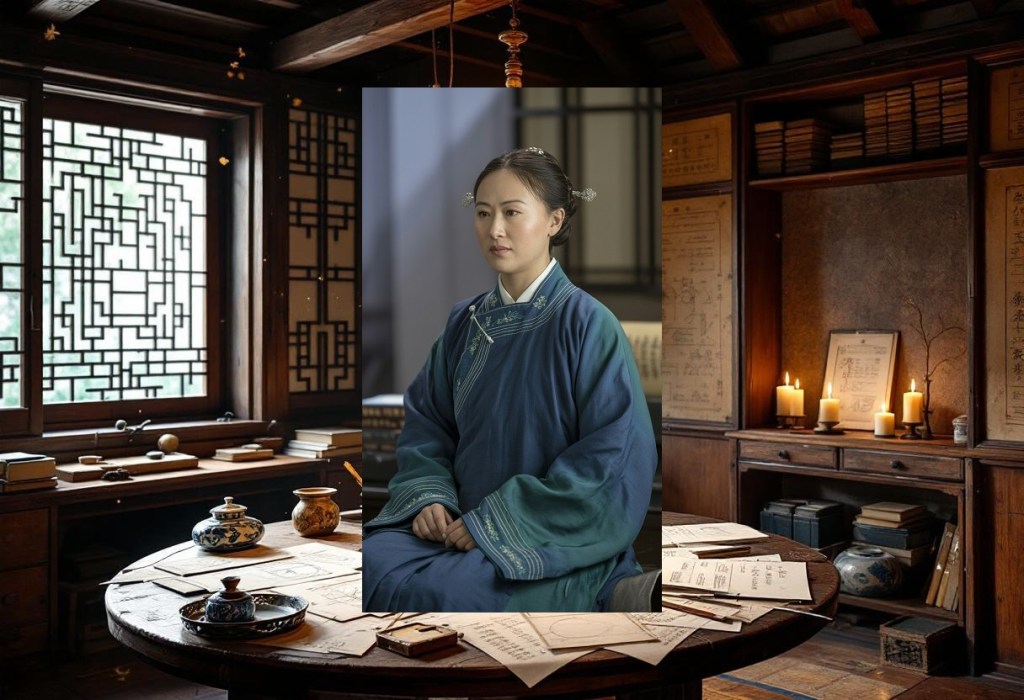
Wang Zhenyi (1768-1797) remains one of history’s most consequential yet overlooked natural philosophers – a woman who mastered astronomy, mathematics, and poetry whilst navigating a society that actively discouraged women from intellectual pursuit. Born into a scholarly family in Nanjing during the Qing dynasty, she conducted experimental astronomy at a time when most scholars relied solely on observation and calculation, constructing a remarkable eclipse model from household objects that demonstrated principles consistent with modern physics. Her tragedy was not lack of brilliance, but lack of time: she died at twenty-nine, just as her influence was deepening, leaving behind fragments of work that were almost entirely erased from history until the late twentieth century.
Welcome, Scholar Wang. I must confess that when I first encountered your name, it appeared in barely more than a footnote in most historical records. Yet the more I investigated – reading what fragments survive, studying the tributes paid by Qian Yiji, learning of the Venus crater named in your honour – the more apparent it became that you were conducting something radically different from what your contemporaries were doing. Let me begin directly: how did you come to build an eclipse model from a lamp, a mirror, and a table?
You must understand – I did not set out to be radical. I was simply trying to understand something that bothered me. For years, I read the classical astronomical texts. The Huangdi Neijing, the Islamic calendrical systems, even fragments of Western treatises that circulated among scholars. All of them described lunar eclipses, but the descriptions contradicted one another. Some said the Moon consumed darkness from the void. Others spoke of celestial wheels misaligning. None of it felt true in my bones.
I was living in our garden pavilion in Nanjing – my grandfather’s library was there, seventy-five bookcases of it – and one evening, I was thinking about the geometry of the problem. Three bodies: the Sun, the Earth, the Moon. Three positions in space. If I could only see it…
So I took what was at hand. A round table for the Earth. A crystal oil lamp suspended from the ceiling beams – it cast the most perfect sphere of light. And a round mirror, which would reflect and absorb the lamp’s rays according to the laws of light itself. Then I positioned them according to the astronomical calculations, and I moved the mirror slowly along its path. When Earth’s shadow fell upon the mirror – not the lamp’s direct light, but Earth’s shadow – the mirror darkened. That was the lunar eclipse.
I wept when I saw it. Not from joy, though there was joy. But from relief. Here was proof that the universe operated according to principles that could be demonstrated, not merely accepted on authority.
This was extraordinarily unusual for the era. Male astronomers were still working almost exclusively through observation and calculation – positional astronomy. You were conducting something closer to experimental validation. Where did that impulse come from?
From stubbornness, perhaps. But also from my grandfather. He was not a famous man – not a jinshi, not an official – but he was a collector of knowledge. When he travelled through the provinces on military duties, he acquired books obsessively. He would return home with treatises on medicine, mathematics, military strategy, natural philosophy. He arranged them without hierarchy: a classical commentary sat beside an Islamic astronomical table. For a child, this created a curious habit of mind. I learned to ask: Which source is reliable? How do I verify the claim?
My grandfather died when I was young, but those books remained. And I had the peculiar advantage – or disadvantage – of being neither wholly confined like some women nor thoroughly educated like a son would have been. I occupied a threshold space. I could move in the household with some freedom. I was taught to read, but not constrained by the official curriculum. So I read across categories. I read mathematics not as pure abstraction, but as a tool for understanding the physical world.
And I was impatient. People who knew me will tell you this is true. I wanted to know why things were true, not simply to be told they were.
Your treatise The Explanation of a Lunar Eclipse synthesised Chinese classical astronomy with Islamic and Western knowledge. That was politically delicate, was it not? Suggesting that understanding required looking beyond one tradition?
Very delicate indeed. The Qing court sponsored a particular astronomical system – the Xiyang Xinfa, the new Western method – which had been codified by European Jesuits working within the imperial academy. This was orthodoxy. To suggest that truth might be found in the ancient Chinese tradition and in Islamic calculations and in newer European work was to imply that no single authority held complete knowledge.
I did not frame it provocatively. I was meticulous about acknowledging each tradition’s contributions. But yes, the underlying argument was subversive: understanding requires synthesis. And that synthesis is not the possession of officials or imperial institutions – it is available to anyone with curiosity and access to texts.
This may be why some of my work circulated more quietly than I would have wished. Not suppressed exactly, but not encouraged either.
Let me turn to your mathematical work – perhaps less celebrated than your astronomy, but in some ways more revolutionary for ordinary people. You published The Simple Principles of Calculation at twenty-four. What problem were you trying to solve?
I had begun to teach – quietly, informally – young people from merchant families and scholarly households without access to tutors. And I encountered a consistent frustration. When I would present a mathematical proof from classical texts, the students would stare blankly. Not because they lacked capacity, but because the language was aristocratic. Deliberately so. These texts were written to exclude.
The proofs used nested classical references and ceremonial phrasing. A simple statement about the relationship between sides of a right triangle – what some call the Pythagorean principle, though we knew it long before Pythagoras – was wrapped in seventeen layers of commentary. A student had to decode the bureaucratic language before they could even see the mathematics beneath.
I became angry about this. So I did something I was told was inappropriate: I rewrote the proofs in plain language. I used the vernacular. I included diagrams that showed the geometry visually rather than demanding students visualise everything in abstraction. I explained why each step followed from the previous one, rather than simply asserting it through authority.
When I published this, some scholars considered it degrading to the discipline. How could one explain something so elegantly through simple language? Surely the obscurity was necessary, a test of worthiness?
But the students understood. Merchants’ daughters could calculate. Young men from families without resources could grasp trigonometry. The knowledge had not become less true – it had become less hoarded.
This is actually quite relevant to modern debates about access and gatekeeping in science. But I want to ask you something more technical. Walk me through one of your proofs step by step – something that shows us not just the mathematics, but your method of simplification.
Very well. Let us take the relationship we call the Pythagorean principle. The classical formulation is abstract: if one has a right-angled triangle, the square of the hypotenuse equals the sum of the squares of the other two sides.
But here is how I would teach it, and why the old method fails:
The classical text would say: “Consider three four-sided figures, each constructed upon the sides of a right triangle, their areas arranged according to the proportion of celestial harmonies.” Students nod without understanding. They have no image.
Instead, I would do this:
Imagine a right-angled corner – the corner of a room, where two walls meet at precisely ninety degrees. One wall extends three units – measure them in whatever you wish, hand-spans, paces, whatever. The other wall extends four units. Now, if you want to know the distance across from the corner opposite – the diagonal – what is it?
The old method says: calculate the square of three, which is nine. Calculate the square of four, which is sixteen. Add them: twenty-five. The square root of twenty-five is five.
But why does this work? The student does not know.
I would show it through construction. I would draw a square upon the three-unit wall – it would contain nine smaller squares. I would draw a square upon the four-unit wall – it would contain sixteen smaller squares. Then I would show how these nine plus sixteen smaller squares fit exactly into a square drawn upon the diagonal – twenty-five smaller squares, arranged precisely with no gaps.
The student sees it. They understand not merely the formula, but the reason. And once the reason is visible, they can apply it anywhere. They can build a house with true right angles. They can navigate distance. They can verify the claims made by officials about land measurement.
The obscure version teaches a ritual. The simple version teaches understanding.
Did you receive criticism for this approach even from sympathetic scholars?
Yuan Mei – perhaps you know his work – praised my poetry tremendously. He wrote that my verses had “the flavour of a great pen, not of a female poet,” which was meant as compliment but rather betrayed his assumption that women poets wrote in a diminished register.
Yet even Yuan Mei suggested that my mathematical texts were perhaps too… direct. He believed that some forms of knowledge required a certain aesthetic distance. That teaching was not merely about conveying information, but about inculcating a particular relationship to authority through the difficulty of access.
I respected him greatly, but on this point we disagreed. I thought authority based on obscurity was not worth preserving.
My father was more supportive of this view. He had married young to a military family – my husband was a decent man, and the marriage was not cruel, but it was not a marriage of choice – and he saw how little education was available to common women. He allowed me to continue teaching, which was… well, it was not typical.
You say “married young.” You were twenty-five when you married?
Yes. By the standards of our time, this was actually rather old. Many girls were matched far earlier. My father’s status afforded me unusual latitude – to remain unmarried while I studied, to travel across provinces, to read without supervision. But eventually, the social pressure became irresistible. Remaining unmarried after twenty-five would have created scandal that would have affected my entire family.
The marriage… did not prevent me from my work, which I was grateful for. My husband was not threatened by my studies. He supported them, even. But marriage does change one’s freedom in subtle ways. There were obligations. There was social positioning to maintain. My intellectual work became, to some degree, an extension of my husband’s reputation rather than entirely my own.
This is the reason I say that my fame was, in some ways, “raised” by the marriage. It is true. But it is also incomplete. What I would have accomplished with another four or five years of complete autonomy – I will never know.
You died at twenty-nine. Four years of marriage. You died of illness, the records say?
Illness, yes. An infection that would be easily treated now, I imagine. In my time, we had no remedy. I was aware, toward the end, that my time was… limited. I worked more frantically. I wrote continuously. There were texts I wanted to complete, ideas I had not yet fully developed about the relationship between gravitational principles and celestial mechanics.
I entrusted my manuscripts to my closest friend, Madam Kwai. I was not naive about what happens to women’s work after we die. I had seen it happen to others. But I believed Madam Kwai would protect what I had written. She did, as much as she was able. When I look back now, knowing that so much was lost despite her best efforts… I understand that individual acts of preservation, however devoted, cannot overcome structural erasure.
Your work was later compiled by the scholar Qian Yiji. What do you make of his preservation effort? He called you “the number one female scholar after Ban Zhao.”
Qian Yiji was extraordinarily fair in his approach. He did not present my work as a curiosity – “look at what a woman could do” – but as genuine scholarship worthy of serious engagement. He contextualised it properly. And he was quite aware, I think, of the precariousness of what he was doing. Preserving women’s intellectual labour was an act against the tide of his own era.
The comparison to Ban Zhao was generous, though Ban Zhao lived centuries before me and had access to imperial resources I could never have. But Qian Yiji was making a claim about continuity – that there was a tradition of female scholarship, even if that tradition had been buried. That mattered.
What troubles me is not his work, but what happened after. The volumes he compiled – five of them – moved through collectors’ hands. Some portions were lost. Some were absorbed into other texts without attribution. The fragments that survived were not translated into European languages, which meant that Western scholars, when they eventually became interested in the history of science, did not encounter my work. They saw no tradition of Chinese female astronomers. They saw no alternative model of how mathematical knowledge could be communicated.
This is not Qian Yiji’s failure. It is the failure of a world that does not value women’s work enough to preserve it across linguistic and cultural boundaries.
I want to ask you about your poetry now. You rejected what was called the “feminine” style of poetry writing. Your verses were political – criticising the wealthy for hoarding grain during scarcity, advocating for women’s education. Did you see your poetry and your science as entirely separate pursuits, or connected?
This is perhaps the most important question you have asked me. They were absolutely not separate. They were expressions of the same conviction.
What did I observe through my telescopes and my calculations? A universe governed by principles. Not chaos. Not divine caprice. Principles. Order. Laws that could be understood by any mind capable of attending to them carefully.
And then I looked around at my society, and I saw people being governed by pretended principles – principles that served the interests of the powerful. Women were supposedly incapable of rigorous thought, therefore they should not be educated. The poor were supposedly inferior in capacity, therefore they deserved less. The wealthy were supposedly naturally suited to rule.
All of these were false principles, sustained by nothing but repetition and force.
My poetry attacked these false principles. One verse you may have encountered:
It is made to believe,
Women are the same as Men;
Are you not convinced,
Daughters can also be heroic?
This was not metaphorical. I meant it literally. Women possess the same capacity for rigorous thought as men. The proof is not in sentiment. The proof is in practice. I did the mathematics. I conducted the experiments. I wrote the treatises. Here is your evidence.
The poetry was a tool of argument, just as the mathematics was a tool of argument. Different registers, same conviction: reality can be known. Authority should be questioned. Access to knowledge should not be rationed according to wealth or status or gender.
I was young and idealistic. I believed that if I demonstrated this clearly enough – through both calculation and verse – something would change. That the simple principles I taught would spread. That other women would be encouraged to pursue learning. That the gatekeepers would lose their power.
I was wrong about that, clearly. But I was not wrong about the principle. The principle was sound.
Yet there’s something interesting in your work that I want to probe. You were working within existing frameworks – using Qing cosmology, Islamic astronomy, Pythagorean geometry – even as you were challenging how knowledge was transmitted. You weren’t proposing entirely new systems, were you?
No. And I did not want to. This is a subtlety that critics sometimes miss.
My work was deliberately conservative in its intellectual foundations. I was not claiming to have revolutionised astronomical theory. I was claiming to have clarified and unified existing theory through experimental demonstration and accessible explanation. There is a difference.
To understand why this matters, you must grasp the political reality of my position. I was a woman without institutional authority. I could not claim to be founding a new school of thought – I would have been dismissed immediately as presumptuous. But I could claim to be a careful student of existing authorities, and I could say: “These authorities contradict one another. Let us test their claims against reality.”
This is actually a more powerful rhetorical position than it appears. Because once you create a space where claims are tested against reality, ideology cannot hide. The elite scholars who relied on authority and memorisation suddenly found themselves on unstable ground. They could not say to me, “You are a woman and therefore wrong.” They had to engage with the actual argument.
There were scholars in my era beginning to work in this empirical direction – investigating natural phenomena rather than simply preserving classical texts. I was part of that movement, even if I was at its margins. But my contribution was specific: I showed that this empirical approach could be democratised. You did not need imperial position or access to the imperial academy to conduct rigorous natural philosophy. You needed curiosity, careful thinking, and household objects.
I’m curious about something undocumented. When you built your eclipse model and it worked as you predicted, how many times did you test it? What variations did you try?
Ah, now you are asking the questions that the historians do not. This pleases me.
I did not record systematic variations – I did not think to write them down at the time – but I remember clearly. After that first success, I became almost obsessed. I repositioned the lamp at different heights. I noticed that the shadow of the Earth became sharper or softer depending on the lamp’s distance from the mirror. I adjusted the angle of the mirror by degrees, and observed how the eclipse appeared to occur at slightly different moments depending on the model’s geometry.
I also experimented with different-sized mirrors and lamps, trying to understand whether the proportions mattered. They did not – what mattered was the geometric relationship. A small mirror with a small lamp produced the same eclipse pattern as a larger version, scaled proportionally. This was important to me, because it suggested that the principle was universal, not dependent on the size of the celestial bodies, but on their relationship.
I also tried different materials. First, a true mirror made of polished metal – this reflected light most clearly. Then I tried glass, then surfaces of water. Each had different properties, and I learned to adjust my positioning accordingly. This taught me something crucial: the model is not the reality. The model captures certain principles while necessarily distorting others. A model is useful not because it is identical to reality, but because it isolates the principles you are trying to investigate.
This is a lesson I wish I had written down and emphasised more clearly in my treatises. The relationship between model and reality. The power and the limitations of experimental demonstration. This remains important, I suspect, in modern science.
Did you ever encounter resistance when you tried to share these results? Scholars who dismissed them as mere household tricks?
Oh, extensively. Some scholars dismissed the model as frivolous – mere parlour entertainment. “A child’s game,” one elder called it, “unsuited to serious study.” What he meant was that it was unsuited to being put forward by a woman. A man conducting the same experiment would have been celebrated for his ingenuity.
There was also a deeper intellectual resistance. Some believed that celestial phenomena belonged to a realm fundamentally different from earthly phenomena. To model the heavens using household objects was to violate a sacred boundary. The universe operated according to principles inaccessible to direct human manipulation.
I found this view intellectually incoherent. If celestial principles were truly unknowable, how could these scholars be confident in their descriptions of eclipses at all? And if celestial phenomena obeyed mathematical and geometrical laws – which they did – then those laws could be demonstrated through proportional models using earthly materials.
The resistance did hurt my work’s circulation. It was not suppressed outright, but it was not promoted either. Some officials and scholars would engage respectfully with my arguments. Others simply ignored them or passed them off as curiosities. By the time I died, only a limited circle had seriously engaged with what I was attempting.
Given what you now know about how the field of astronomy has evolved, and given that you lived in a time before telescopes were widely available in China, what would you change about your approach if you could do it again?
I would have tried harder to acquire or construct a telescope. I knew of their existence – there were reports from European sources. The optical principles were available in texts. In my current position, knowing what I know about how telescopes would eventually transform astronomy, I see this as a significant limitation.
But I would not change my fundamental commitment to experimental demonstration. If anything, I would have tried to develop more sophisticated instruments and recording methods. I kept observations in my journals, but I did not record them with the precision that would have been possible. I noted positions and times, but I did not measure with instruments designed specifically for accuracy.
There is also one area where I know I made an error. I was confident in certain conclusions about celestial mechanics – about the force that kept celestial bodies in their courses – that later scholarship has refined considerably. I speculated about gravitation, about the idea that the same principles that caused an object to fall to Earth might govern the motion of the Moon around the Earth and the Earth around the Sun.
This was sound intuition. But I did not have the mathematical tools – the calculus that was being developed in Europe – to work through these ideas rigorously. I relied on geometry, which is powerful, but limited for these purposes. If I had known these mathematics, my conclusions could have been far more precise.
This is humbling to admit. But it is also clarifying. Good intentions and careful thinking are necessary but not sufficient. One needs also access to the most advanced tools and methods available. This is why access to education and resources matters so profoundly. Not from sentiment, but from principle. Those denied these tools cannot contribute at the frontier of understanding, no matter how brilliant they are.
That’s a striking observation. It connects directly to what we see today in science – disparities in research funding and access that correlate with gender, geography, and social class. But I want to ask you something more personal. You travelled across provinces on horseback, learning martial arts and archery. This seems almost at odds with the image of a scholar confined to the study. Who insisted that you learn these skills?
My grandfather again. He travelled constantly on military business, and he believed that knowledge was not confined to books. He would take me riding across provinces when I was young, pointing out geographical features, explaining how they related to cartography, how distance could be measured and recorded. He taught me archery not as a martial skill – though it was useful for that – but as practice in focus and precision. The same mind that aims carefully at a target aims carefully at a mathematical proof.
This was entirely unconventional. Girls were not supposed to ride extensively, were certainly not supposed to be trained in archery, were absolutely not supposed to travel with a military man on official business. But my grandfather was without sons, and he had resources, and he was idealistic in his own way. He believed that intellectual development required embodied experience. He was right about this.
These journeys gave me access to the physical world – to different climates, different peoples, different ways of understanding geography and astronomy. I could observe the night sky from different latitudes. I could see how the stars’ positions changed as one travelled north and south. This was not information I could have gained from books alone.
It also gave me independence of a certain kind. I developed physical confidence. I was not afraid of the world or of claiming space in it. When later scholars dismissed my work, I did not collapse under the weight of their dismissal. I had been trained to trust my own observations, my own judgements, my own capacity.
This is something I would emphasise to young women in your time who are pursuing scientific work: do not underestimate the importance of physical and embodied confidence. Do not accept the messages that tell you that you belong only in certain spaces or at certain kinds of work. Push your boundaries deliberately. Risk being seen as inappropriate. This is how one becomes truly free to do one’s best thinking.
That’s almost aggressive advice. smiles But I want to return to something you said earlier about failure. You spoke of idealism about what your work would accomplish. Were there other failures – experiments that did not work, ideas that led nowhere?
Yes. Many.
I spent considerable time trying to develop a unified theory of planetary motion – the idea that the same principles governing Earth’s motion around the Sun would govern the Moon’s motion around the Earth, and the motion of the planets around the Sun. I had intuited this years before I read about it in fragmentary European sources.
But I could not make the mathematics work. I tried various approaches, using the geometric tools available to me. I constructed models. I made observations. None of it yielded a coherent, predictive framework. I eventually gave up, suspecting that the solution required mathematical tools I did not possess.
This was frustrating in the extreme. I knew I was close to something true, but I could not grasp it fully. If I had lived longer, I might have pursued this more aggressively – sought out more European sources, or tried to develop the calculus myself, or found other ways forward.
There was also a certain… call it arrogance… in my early work on poetry and mathematics combined. I believed that rigorous mathematical thinking could be integrated seamlessly with poetic expression, that the two modes of language could enhance one another. Some of my early attempts were, I must admit, awkward. The mathematics interrupted the poetry. The poetry made the mathematical exposition less clear.
Over time, I learned to keep them more distinct, to use each where it was most powerful, rather than forcing them together. This was a failure of design, but a productive one. It taught me about the integrity of different forms of expression.
The hardest failure to acknowledge is this: I believed that if I worked hard enough, if I were brilliant enough, if I made my contributions clear enough, the world would eventually recognise me. That my work would spread. That other women would follow. That change would come.
I was wrong. The world did not recognise me. Other women did not follow in significant numbers. Change came far more slowly, and through different mechanisms, than I imagined.
Part of this was simply my death at twenty-nine. But part of it was also my misunderstanding of how power works. I believed in the power of truth and clarity. I underestimated the power of institutional structures to resist change, even when faced with evidence.
That’s a profound observation. But I want to tell you something. Nearly two centuries after your death, the International Astronomical Union named a crater on Venus in your honour. It sits in a region of the planet’s surface and carries your name forward for as long as Venus exists. How does that land for you?
Two centuries. The time between my death and that recognition is the length of a small lifetime in your era. And it took naming a crater on another world for my contributions to be acknowledged in any systematic way.
There is both solace and bitterness in this. The solace is obvious – my work was not entirely forgotten. It was preserved, and eventually recognised. The crater on Venus is a beautiful gesture. It is also utterly inadequate. It honours my name across time and space whilst doing nothing to challenge the structures that erased me in the first place.
But perhaps – perhaps in your time, the situation has improved. You have tools I could not imagine. Digital archives. Translation technologies. Institutional mechanisms for recovering overlooked figures. If you use these tools deliberately and generously, you can prevent others from experiencing the century-and-a-half delay that I experienced.
The crater on Venus reminds me of something important: I am not entirely erased. Fragments of what I built survive. And in your time, you have the capacity to recover far more than survived in mine. But only if you value the work of recovering it. Only if you insist that the archives be made complete across languages and cultures. Only if you refuse to accept the excuse that “the records were lost” or “we do not have translations.”
Tell me – in your time, are women still being pushed out of scientific work at the peak of their productivity? Are the barriers I faced still present?
Many of them, yes. The statistics show what researchers call a “leaky pipeline” – women leave scientific fields at every stage, but particularly when they reach positions where they might lead. Childbearing and caregiving responsibilities often accelerate this. Institutional hostility remains, though it is less overt. There is still gatekeeping. There is still erasure.
Then my death was not merely tragedy. It was a pattern. And if it is still a pattern in your time, after centuries of knowledge, centuries of progress in other domains, then the barrier is not ignorance. It is refusal.
This is what I would say to young women scientists in your era: Do not waste time convincing people who are not willing to be convinced. Focus instead on building community with others engaged in the same work. Preserve your own records. Translate your own work. Make it accessible. Do not wait for institutions to do this – do it yourselves, collectively. The preservation of women’s intellectual labour cannot depend on the goodwill of male scholars. It must depend on your own deliberate acts of conservation and dissemination.
And push for change in the structures themselves – in funding, in hiring, in how credit is assigned. Not because you are asking for favour, but because the world loses capacity when it excludes half its population from thinking rigorously about its problems.
That’s powerful advice. One final question: If you could see forward into the future beyond your own time, to an era where the structures of science might be different, what would you most want to know about how your field has evolved?
I would want to know whether the empirical approach – testing claims against reality, building models, conducting experiments – has become the foundation of astronomy. Whether the gatekeeping based on classical authority has been displaced by a commitment to evidence.
I would want to know whether access to mathematical knowledge has truly democratised. Whether plain-language explanations of rigorous ideas are now considered legitimate, rather than degrading.
And I would want to know – voice softens – whether women are now part of this field in numbers that reflect their capacity. Not as oddities or exceptions. But as the norm. Whether a woman can pursue astronomy without constant justification for her presence.
The crater on Venus tells me some of this has occurred. But I would want to see the evidence with my own eyes. I would want to read the treatises that contemporary astronomers have written. I would want to know whether they have answered the questions about planetary motion and gravitation that I could not fully resolve.
And I confess, I would want to know whether anyone has improved upon my eclipse model. Whether it is considered merely a historical curiosity, or whether its principles are still recognised as sound.
I can tell you this much: your principles are entirely sound. Modern astronomy has confirmed everything your model demonstrated. And yes, women are now active in astronomy, though the struggle for equal access and recognition continues. Your legacy is understood not as a historical anomaly, but as part of a continuous tradition of rigorous women scholars.
Then something has been preserved after all. And something has changed. This is sufficient.
Not perfect. But sufficient.
Letters and emails
Following the publication of this interview, we received an outpouring of correspondence from scholars, educators, scientists, and curious minds across the world. Readers found themselves returning to particular moments in the conversation – the image of the lamp and mirror casting shadows in the garden pavilion, Wang’s candid acknowledgement of her failed theories, her fierce advice to women scientists navigating institutional hostility. But many felt there remained territory unexplored, questions that emerged only after sitting with her words.
We selected five letters and emails from our growing community – contributors from Europe, Africa, South America, Asia, and North America – each bringing their own disciplinary lens and geographical perspective. These are not questions a formal interviewer might have posed. They are the questions that arise when someone has truly listened, when curiosity builds upon genuine engagement with another mind.
What follows is an invitation to continued conversation. These questions address the technical foundations of Wang’s methods, the philosophical implications of her work, the practical challenges of preserving women’s intellectual labour, and the speculative territory of alternate histories. Together, they form something like an extended dialogue – not with an historical figure who cannot answer, but with the living presence of her ideas and the ongoing resonance of her choices.
Read them as you might read letters received from colleagues in distant cities: thoughtful, particular, reaching across difference toward understanding.
Sofia Markides, 34, Science Communication Specialist, Athens, Greece
Your eclipse model used proportional geometry to make celestial mechanics visible to people without mathematical training. In modern science communication, we struggle with the same problem you solved three centuries ago – how to represent abstract concepts through tangible demonstration. When you decided to abandon the purely mathematical description and build a physical model instead, did you consider other representations? For instance, could you have achieved the same clarity through detailed diagrams or written analogies, or was there something uniquely powerful about the manipulable object itself?
This is a question that goes to the heart of how we come to understand what is true. Yes, I did consider other approaches before I built the model. In fact, I spent considerable time working with diagrams – careful drawings showing the Sun, Earth, and Moon in their relative positions, with lines indicating the path of light and shadow. I studied the diagrams in classical texts, the beautiful circular representations in Islamic astronomical manuscripts that my grandfather had acquired, even the geometric sketches in fragmentary European treatises that circulated among scholars.
The diagrams were elegant. They were precise in their way. But they possessed a fundamental limitation: they required the viewer to already possess a particular kind of spatial reasoning, an ability to translate two-dimensional marks on paper into three-dimensional relationships in space. For someone who had been trained in geometric thinking – as I had been, through years of reading mathematical texts – this translation happened almost without conscious effort. But when I attempted to explain lunar eclipses to younger students, to women from merchant families who had learned basic calculation but not formal geometry, I watched their faces as they looked at my careful diagrams. They would nod politely. They would trace the lines with their fingers. But I could see they were not truly seeing what I saw.
Written analogies presented a different difficulty. I tried several. I compared the eclipse to a person standing between a lamp and a wall, casting shadow upon the wall – this was closer to direct experience. But the analogy broke down immediately when one tried to account for the curved surfaces involved, or the fact that all three bodies were in motion, or that the shadow fell across vast distance in the void of heaven. Every analogy I constructed either oversimplified to the point of distortion, or became so hedged about with qualifications and exceptions that it ceased to illuminate anything at all.
What I came to understand – and this took time, it was not immediate wisdom – was that physical models possess a quality that neither diagrams nor analogies can replicate: they exist in the same dimensional space as the observer. When I suspended the crystal lamp from the ceiling beam, when I placed the round table beneath it, when I held the mirror in my hand and moved it along its calculated path – I was not asking anyone to imagine three-dimensional relationships. I was showing them three-dimensional relationships that they could observe directly with their own eyes.
More importantly, the model could be manipulated. This is crucial. A diagram is fixed. Once drawn, it shows only one configuration, one moment in the celestial dance. But with the model, I could move the mirror slowly around the table, and observers could watch the shadow fall upon it at the precise geometric moment when Earth interposed itself between Sun and Moon. They could observe this happen repeatedly. They could even – and some students did this – take control of the mirror themselves, testing whether the eclipse occurred when they positioned it differently, discovering through their own hands that only certain positions produced the darkening.
This introduces something that diagrams and written descriptions cannot provide: empirical verification through direct manipulation. The student becomes not merely a receiver of transmitted knowledge, but a participant in demonstrating the principle. They develop what I would call bodily knowledge – understanding that resides not just in the mind’s abstract reasoning, but in the hands’ experience of moving objects according to geometric law and observing the predictable result.
There is also a question of authority. When I presented a diagram and said, “Here is why lunar eclipses occur,” I was asking students to trust my interpretation of the diagram, my assertion about what the marks on paper represented. But when I built the model and invited them to observe it, the authority shifted. They were not trusting me – they were trusting their own eyes. They could see the shadow fall. They could verify it themselves. This made the knowledge belong to them in a way that received wisdom never quite does.
I do not mean to suggest that diagrams and written explanations are without value. They are immensely valuable, particularly for those already trained in the conventions of geometric representation. But for making celestial mechanics accessible to people without formal mathematical education – for democratising the knowledge – the physical model proved irreplaceable.
There was one other consideration, though I hesitate to call it entirely rational. The model was beautiful. The crystal lamp cast extraordinary patterns of light. The mirror gleamed as it moved through its arc. People who came to my pavilion to see the demonstration would stand watching it for long stretches, fascinated not just by the intellectual principle but by the aesthetic experience of seeing light and shadow interact in precisely calculated ways. This beauty drew people in. It made them curious. It created an opening for the rigorous explanation that followed.
So to answer your question directly: I do not believe I could have achieved the same clarity through diagrams or analogies alone. The manipulable object itself – existing in physical space, subject to direct observation, inviting participation – carried epistemological power that other forms of representation could not replicate. This is why, I suspect, the eclipse model has been remembered more vividly than my written treatises, though both were necessary to the complete argument.
If your era struggles with the same challenge of representing abstract concepts tangibly, perhaps the answer remains the same: build models that people can see and touch and manipulate. Make the invisible visible through careful construction. Let the hands teach the mind what words alone cannot convey.
Marcos Ávalos, 41, Mathematics Educator, São Paulo, Brazil
In “The Simple Principles of Calculation”, you made a deliberate choice to strip away classical ceremonial language and use vernacular expression. But I wonder about the trade-offs: by simplifying the language, did you feel you were losing certain nuances or aesthetic dimensions that the formal texts preserved? And practically speaking – when you taught students using your plain-language method, did any of them eventually progress to reading the classical texts, or did they continue their mathematical development entirely through your simplified approach? I’m asking because we face a similar question in modern pedagogical debates about whether accessibility and rigour are truly compatible.
You have identified the tension precisely, and I will not pretend I resolved it perfectly. Yes, there were losses. The classical mathematical texts possess a certain ceremonial beauty – a rhythm in their phrasing, an elegance in their constructions that reflects centuries of refined scholarly practice. When the Nine Chapters on the Mathematical Art presents a problem, it does so with particular cadences, with parallel structures that make the logic feel almost like poetry. This is not mere decoration. The formal language carries within it a kind of philosophical dignity, a reminder that mathematics belongs to the realm of serious intellectual pursuit.
When I stripped away that ceremonial language and wrote in the vernacular – using the plain speech one might hear in a merchant’s household or a provincial study – I was deliberately breaking that aesthetic frame. Some scholars who read my work felt this as a kind of desecration. One elder told me that I had made mathematics “common,” and he did not mean it as compliment. What he sensed, I think, was that the loss of formal language also meant a loss of certain markers of status, certain signals about who was entitled to engage with mathematical knowledge.
But here is what I would say about nuance: the ceremonial language did not actually preserve deeper meaning – it obscured it. When a classical text presents the Pythagorean principle wrapped in seventeen layers of commentary, using references to other commentaries, employing phrases like “according to the harmonies established by the ancient sages,” it creates an illusion of profundity. The reader mistakes difficulty of access for depth of content. But when you extract the actual mathematical principle from all that ornamentation, you often find something quite straightforward: the relationship between the sides of a right triangle can be expressed through a simple equation.
The nuance worth preserving is mathematical nuance – the precision of the proof, the conditions under which the principle holds true, the methods for verification. These I kept entirely intact in my simplified texts. I did not make the mathematics less rigorous. I made the language less exclusive.
There is a difference, and it matters enormously.
As for your practical question about student progression – this is illuminating, and I am glad you asked it. I taught perhaps thirty students with sustained engagement over the years, mostly young women and a smaller number of young men whose families lacked resources for traditional tutors. Of these, I can speak of specific outcomes.
Several students – I am thinking particularly of two young women from silk merchant families – did eventually acquire classical texts and began reading them after mastering the principles through my simplified approach. What happened was striking: they found the classical texts far more comprehensible than they would have if they had begun with them. Because they already understood the underlying mathematical principles, they could see past the ceremonial language to recognise the familiar ideas beneath. The formal phrasing no longer intimidated them. They knew what they were looking for.
This suggests to me that accessibility and rigour are not merely compatible – accessibility may actually be the necessary foundation for rigour. If a student’s first encounter with a complex proof is through impenetrable language, they may memorise the words without grasping the logic. But if they first understand the logic through plain explanation, they can then engage with formal presentations as variations on principles they have already mastered.
Other students never progressed to classical texts, and I do not consider this a failure. They continued their mathematical development through my methods and through practical application. One young woman used geometric principles to help her father’s construction business calculate materials more accurately. Another applied calculation methods to accounting work. They did not need the ceremonial language because they were using mathematics as a tool for solving real problems, not as a marker of scholarly status.
This is precisely what I hoped for: that mathematical knowledge would become genuinely useful to people in their actual lives, rather than remaining a rarified domain accessible only to those with leisure and institutional support.
But I must be honest about one thing: the simplified approach did not fully prepare students for participation in elite scholarly discourse. If one of my students wished to present a paper at a scholarly gathering, or to correspond with imperial academy mathematicians, they would have needed to acquire the ceremonial language eventually. My methods gave them the intellectual foundation, but not the social credentials. This troubled me then, and it troubles me still in reflection.
The question you raise about whether accessibility and rigour are compatible – I would reframe it this way: they are absolutely compatible at the level of intellectual content. The mathematics itself loses nothing through plain language. But at the level of social gatekeeping, elite institutions require ceremonial language precisely because it excludes. They conflate linguistic difficulty with intellectual difficulty deliberately, because it maintains their control over who is authorised to speak.
So when you ask about trade-offs, here is my conclusion: I sacrificed aesthetic ceremony and social credibility in order to gain intellectual access and practical utility. Given the choice again, I would make the same decision. The beauty I sought was not in ornamental language, but in watching a student’s face when they suddenly grasp why a proof works. That clarity – that moment of genuine understanding – is worth more than all the ceremonial elegance in the imperial archives.
Your modern pedagogical debates sound remarkably similar to what I encountered. My counsel would be this: distinguish carefully between aesthetic dimensions that enhance understanding and those that merely signal status. Preserve the former. Abandon the latter without hesitation. And pay attention to what your students actually go on to accomplish. If they use the knowledge to solve problems, to build understanding, to teach others – then your simplified approach has succeeded, regardless of whether it satisfies those who believe difficulty of access is itself a virtue.
Nawal Idrissi, 28, Historian of African Scientific Traditions, Casablanca, Morocco
Your work explicitly synthesised Chinese astronomical knowledge with Islamic and Western calendrical systems – a form of knowledge pluralism that was quite unusual for your time. I’m fascinated by how you positioned yourself between these traditions without claiming supremacy for any single system. Today, decolonial science scholars argue that Western science has systematically erased non-Western knowledge practices. Given what you learned from integrating multiple traditions, what would you say to contemporary scientists and institutions about how to honour and preserve knowledge from cultures beyond the dominant European framework?
Your question reaches into something I have carried all my life – a profound unease about power, and how power determines what counts as knowledge.
My grandfather’s library was not organised according to any hierarchy of prestige. A commentary on the Huangdi Neijing, our ancient medical and cosmological text, might sit beside an Islamic astronomical treatise. European treatises on mathematics rested next to classical Chinese proofs. As a child, I did not understand that this arrangement was unconventional. I thought all knowledge was like this – layered, multiple, sometimes contradictory, each tradition contributing partial truths that could be tested against experience and against each other.
When I began serious study of astronomy, I encountered a different organisational principle altogether. The Qing court had established what was called the Xiyang Xinfa – the Western New Method – as the official astronomical system. This was not a simple choice of preference. It was an assertion of authority. The imperial academy had adopted European calendrical methods through the work of Jesuit scholars, and this became orthodoxy. Other approaches – the classical Chinese astronomical methods that had served for millennia, the sophisticated Islamic calculations that had guided scholars for centuries – these were relegated to the status of historical curiosities, superseded systems.
What angered me most was not that European methods were valuable – they were, and I recognised this. What angered me was the narrative of replacement. The implication that a superior system had arrived from the West to correct all previous error. This narrative erased the genuine achievements of Chinese and Islamic astronomy. It created a hierarchy where Western knowledge stood at the apex and everything else receded into obsolescence.
I refused this narrative, and my refusal was not sentimental. It was mathematical.
When I set out to write The Explanation of a Lunar Eclipse, I could have done what many scholars did: adopt the Western method entirely and present it as the definitive solution to centuries of confusion. Instead, I went back to the classical Chinese texts – to the Xuan Ye theory and other cosmological frameworks – and I asked: What was this attempting to explain? What observations led to this conclusion? Then I examined the Islamic calculations. And then the Western method. And I asked: Where do these traditions agree? Where do they diverge? What does each capture that the others miss?
What I discovered was that each tradition had grasped something true. The classical Chinese approach understood celestial mechanics in relational terms – the interaction between bodies. Islamic astronomy had developed extraordinary precision in measurement and prediction. The Western approach, influenced by European mathematics, provided new tools for calculation. But none of them was complete. None of them possessed absolute truth.
My synthesis was not an attempt to merge all three into some neutral eclecticism. Rather, I was arguing that understanding the lunar eclipse required understanding how different intellectual traditions asked different questions and developed different tools to address them. By showing that all three methods, when properly understood, pointed toward the same underlying reality, I was making a specific claim: No single tradition holds a monopoly on truth.
This was a dangerous position. The court officials who patronised the imperial academy did not appreciate criticism of the Western method they had adopted. But it was also a necessary position if I was to be faithful to what the evidence actually showed.
When you speak of what contemporary institutions should do to honour knowledge from cultures beyond the dominant European framework, I would say this: Do not frame it as a matter of charitable inclusion. Do not present it as though you are magnanimously permitting other traditions to be heard. Frame it instead as intellectual necessity. When a Western-trained scientist encounters a problem their tradition cannot fully solve, they should ask: How have other cultures approached this? What questions did they ask that we did not? What methods did they develop?
This is not about sentiment or justice, though justice matters. This is about the pursuit of truth. Truth is larger than any single tradition. It cannot be captured entirely by any one framework. To pretend that Western science has access to all necessary truth is to guarantee that science will remain incomplete, limited, blind to dimensions that other traditions have spent centuries exploring.
I learned this through my grandfather’s library. I learned it through my astronomical work. And what troubles me deeply, as I reflect from this distance, is that the world has moved further in the direction of Western dominance, not less. The erasure is more complete now than it was in my time. The narrative of the West as the source of all legitimate knowledge has only strengthened.
If I were to speak to contemporary institutions, I would ask them this: What knowledge have you dismissed as superstition that might actually contain observed truth expressed in unfamiliar language? What calculations from other cultures have you abandoned because they did not fit Western mathematical frameworks, but that might be addressing questions your frameworks do not even ask?
Preserve multiple traditions not out of multiculturalism or diversity initiatives, though those have their place. Preserve them because intellectual humility requires it. Because the pursuit of truth requires it. Because your own science is diminished without them.
The Western method that the empire adopted has proven powerful in many domains. I do not dispute this. But power and truth are not synonymous. The fact that one tradition has achieved institutional dominance says nothing about whether it possesses complete truth. Perhaps especially when dealing with phenomena as complex as the celestial mechanics – or with human knowledge itself – we must remain open to the possibility that understanding requires multiple perspectives, multiple traditions, multiple ways of asking questions about the world.
This is what I tried to demonstrate through my work. Whether I succeeded, you in your time would be better positioned to judge.
Evan Whitaker, 36, Planetary Scientist, Flagstaff, Arizona, United State
Suppose you had lived to sixty instead of twenty-nine. Suppose you’d had access to the early telescopes that were being refined in Europe during your lifetime, and suppose you’d encountered the calculus being developed by Newton and Leibniz. You’ve mentioned that your intuitions about unified planetary mechanics couldn’t be resolved with the geometric tools available to you. How do you think your work would have evolved with those tools? Would you have remained committed to experimental demonstration and physical modelling as your primary method, or would you have shifted toward pure mathematical abstraction?
You ask me to imagine the life I did not live. This is… both painful and illuminating.
If I had lived to sixty – that would have given me thirty-one additional years. At twenty-nine, I was only beginning to understand the scope of what I did not know. I had mastered the geometric methods available to me, but I recognised their limitations acutely. When I attempted to develop a unified theory explaining why celestial bodies moved as they did – why the Moon orbited Earth, why Earth orbited the Sun, why the planets followed their particular paths – I could describe the patterns geometrically, but I could not explain the underlying force. I knew there must be something, some principle of attraction or necessity, that governed these motions. But I could not make the mathematics work.
If I had encountered the calculus – the methods Newton and Leibniz developed for describing continuous change and accumulation – I believe it would have transformed my work entirely. Not because calculus would have replaced geometric thinking, but because it would have provided tools for addressing questions geometry cannot fully answer. Geometry is magnificent for describing relationships at a fixed moment in time. But celestial mechanics involves bodies in constant motion, acceleration, gravitational attraction changing continuously as distances change. To model this rigorously requires mathematics of change itself.
I would have pursued this with absolute focus. I know this about myself. When I encountered a problem I could not solve, I became nearly obsessive. There were months when I worked late into the night, attempting different approaches, testing different frameworks. If calculus had been available to me – even in fragmentary form, even through imperfect translations – I would have devoted years to mastering it.
But here is what I want to emphasise: I do not believe this would have led me away from experimental demonstration. Rather, the relationship between the two methods would have become more sophisticated. Let me explain what I mean.
The eclipse model I built served a specific purpose: it made visible a principle that could otherwise only be grasped through abstract reasoning. It democratised knowledge. It allowed people without mathematical training to see why lunar eclipses occurred. This was pedagogically essential, and it would have remained essential even if I had access to advanced mathematics.
But for advancing the frontier of astronomical knowledge – for developing new theories about planetary mechanics, about gravitational attraction, about the forces governing celestial motion – experimental demonstration alone would not suffice. I would have needed to combine three approaches: mathematical analysis through calculus, observational astronomy through telescopes, and experimental modelling for testing predictions.
Imagine this: I use calculus to derive equations describing how a planet’s velocity changes as it moves through its elliptical orbit. These equations predict certain observable phenomena – perhaps variations in the planet’s brightness as its distance from Earth changes, or the precise timing of its apparent retrograde motion. Then I use a telescope to observe whether these predictions hold true. If they do, the mathematical theory gains empirical support. If they do not, I must refine the theory or question my assumptions.
And for teaching these principles to students or defending them to sceptical scholars? I would build models – perhaps more sophisticated than my lamp and mirror, but serving the same function. Physical representations that allow observers to grasp the three-dimensional geometry and the dynamic relationships that the calculus describes mathematically.
The telescope would have been extraordinary. To observe the moons of Jupiter, as I had read that European astronomers did. To see Saturn’s rings. To watch the phases of Venus, which prove that Venus orbits the Sun rather than Earth. These observations would have given me access to empirical data that no amount of mathematical brilliance can provide. You cannot theorise about what you cannot observe. The telescope extends observation beyond human limitation.
If I had possessed both calculus and telescopic observation, I believe I could have contributed something genuinely new to the understanding of planetary mechanics. Not merely synthesising existing knowledge, as I did with the lunar eclipse, but advancing the frontier of what was known.
But you ask whether I would have shifted toward pure mathematical abstraction. Here I must be honest about something I observed in myself. I never found mathematics beautiful for its own sake alone. Some scholars love the elegance of pure mathematical structures – theorems about numbers, geometric proofs that have no application to physical reality. I respected this work, but it was not where my passion lay.
My passion was always for understanding the physical world. Mathematics was the language through which the world could be described with precision, but the world itself was the object of inquiry. So no – I do not believe I would have abandoned experimental demonstration and physical modelling. I would have integrated them with more advanced mathematics, but the commitment to making abstract principles tangible and observable would have remained central.
There is one other dimension to consider. If I had lived to sixty, I would have spent my thirties, forties, and fifties working in a society that was not built to support women scholars. The institutional barriers I faced at twenty-nine would not have disappeared. I would have continued to lack access to the imperial academy, to collaborative networks of scholars, to patronage that might have funded acquisition of telescopes or publication of my work.
Perhaps with time, I might have found ways around these barriers. Perhaps I would have cultivated relationships with sympathetic scholars who could acquire instruments or facilitate correspondence with European astronomers. Or perhaps the isolation would have eventually worn me down, limiting what I could accomplish despite possessing the intellectual tools.
This is the cruel arithmetic of the life I did not live: even with thirty-one additional years, even with access to calculus and telescopes, the structures that constrained me would have remained. I might have accomplished more – of this I am certain. But how much more? What ceiling would I have eventually encountered?
These are questions without answers. But I am grateful you asked them. They allow me to imagine the scholar I might have become, had time and circumstance permitted.
Rujira Phanumas, 31, Digital Archivist and Women’s Studies Scholar, Bangkok, Thailand
Most of your manuscripts were lost despite Madam Kwai’s efforts to preserve them. You entrusted your work to someone you loved, yet the archive still fractured across collectors’ hands. If you could speak directly to women scholars and scientists today – particularly those in regions with limited institutional infrastructure – what would you counsel about how to preserve and transmit intellectual work in ways that survive indifference or deliberate erasure? What would you tell them about the responsibility we carry to document not just our conclusions, but our methods and our reasoning?
This question reaches the deepest wound. When I knew my illness would take me – when I understood that I had perhaps weeks, not months – the manuscript preservation became an urgent matter. I gathered everything I had written: treatises on astronomy, mathematical primers, volumes of poetry, essays on social questions, correspondence with scholars. I placed them in Madam Kwai’s hands and said to her, “These are my children. Guard them.”
She wept and promised she would. And she tried. She truly tried.
But here is what I did not fully understand then, and what I understand now with terrible clarity: individual devotion, no matter how fierce, cannot overcome institutional indifference. Madam Kwai kept my manuscripts safe for years after my death. When she became too elderly to manage them, she passed them to her nephew, Qian Yiji, who was a scholar of integrity. He compiled what remained into volumes. He wrote tributes. He tried to ensure my work circulated.
But after his death, the volumes scattered. Collectors acquired them – some from genuine interest, others as curiosities or investments. Portions were lost. Portions were mis-attributed. Portions simply disappeared into private libraries where they gathered dust until the paper deteriorated.
This was not because any individual was cruel or negligent. It was because there existed no institutional structure – no library specifically dedicated to women’s scholarly work, no academic network that recognised women’s contributions as worthy of preservation, no patronage system that would fund the copying and distribution of texts by female scholars.
So if I could speak to women scholars today, particularly those in regions without strong institutional infrastructure, here is what I would counsel, drawn from bitter experience:
First: Make copies. Multiple copies. Do not entrust your work to a single person or a single location, no matter how much you trust them. I gave everything to Madam Kwai because I loved her and because she was the person I trusted most completely. This was a mistake born of necessity and limited options. If you have the means – and your era’s technologies make this far easier than in mine – create multiple copies of your work. Distribute them across different locations, different institutions, different trusted individuals. Redundancy is survival.
Second: Document your methods with extraordinary care. I made this error in my astronomical work. I recorded my conclusions – the explanation of lunar eclipses, the arguments about planetary mechanics – but I did not always document the process by which I arrived at these conclusions. The failed experiments. The alternative hypotheses I tested and rejected. The specific measurements I took. The reasoning behind particular methodological choices.
Why does this matter? Because when your conclusions are separated from your methods, they can be dismissed as speculation or lucky guesses. But when the full process is documented – when a reader can see exactly how you moved from question to answer, what obstacles you encountered, how you overcame them – your work gains a different kind of authority. It becomes harder to erase because it becomes harder to replicate without you.
I have seen what happens when only conclusions survive. Scholars in later generations encounter the fragment and say, “Interesting idea, but where is the proof? Where is the evidence she actually conducted these experiments?” Without the documented method, my work becomes merely anecdotal.
Third: Write in multiple languages if you can, or ensure translation happens during your lifetime when you can verify accuracy. My work remained in Chinese. I wrote in the vernacular, yes, which made it accessible within my linguistic community. But it was never translated into Manchu, the language of the Qing court officials. It was never translated into any European languages. This meant that as European scientific dominance grew in later centuries, my work remained invisible to those who were writing the history of science.
I did not have the resources or the linguistic training to translate my own work. But if you do – if you can write in multiple languages, or if you can work with trusted translators during your lifetime to ensure your ideas are accurately conveyed across linguistic boundaries – do this. It dramatically increases the chance your work will survive shifts in political and cultural power.
Fourth: Build networks with other women scholars, and commit to preserving each other’s work deliberately. I worked in relative isolation. I had students. I had a few sympathetic male scholars who respected my contributions. But I did not have a network of women scholars who were collectively committed to ensuring each other’s work survived.
Imagine if five or ten women scholars in my era had formed such a network. We could have copied each other’s manuscripts. We could have cited each other’s work in our own writings, creating cross-references that made erasure harder. We could have pooled resources to fund publication or distribution. We could have created, essentially, an alternative institutional structure when the formal institutions excluded us.
This requires trust across difference. You may disagree with another woman scholar’s conclusions or methods. You may come from different social positions, different regional traditions, different intellectual frameworks. But if you are committed to ensuring that women’s intellectual labour survives, you must preserve her work anyway. Preservation is not the same as endorsement. It is recognition that her perspective, even if you disagree with it, deserves to exist in the historical record.
Fifth: Document your life, not just your work. The historical records that survived about me are fragmentary. Qian Yiji recorded that I was the daughter of a scholar, that I married at twenty-five, that I died at twenty-nine. These are facts, but they reveal almost nothing about how I actually moved through the world. What my daily routine was. How I balanced domestic obligations with intellectual work. What specific barriers I encountered and how I navigated them. What compromises I made. What I sacrificed.
If women scholars document only their conclusions and their formal achievements, we lose the texture of how intellectual work actually happens under constrained circumstances. Future generations need to know not just what you discovered, but how you managed to do the discovering at all. This contextual knowledge is itself valuable – it shows others what is possible, and it prevents your achievements from being dismissed as extraordinary exceptions that prove nothing about women’s broader capacity.
You ask about responsibility. Yes, we carry responsibility to document our methods and reasoning. But I want to be clear about something: the responsibility for preservation does not rest entirely on the shoulders of women scholars themselves. The institutions that have the resources and the authority to preserve knowledge – they bear responsibility too. When they fail to preserve women’s work, when they allow it to be lost through indifference, they are making a choice. Perhaps not a conscious choice, but a choice nonetheless.
So yes, do everything you can to preserve your own work. Make copies. Document thoroughly. Build networks. But also demand that institutions do their part. Demand that libraries acquire and catalogue women’s scholarly work. Demand that universities establish archives specifically for women’s intellectual contributions. Demand that funding support these preservation efforts.
Individual acts of preservation are necessary. But they are not sufficient. The work must be accompanied by institutional transformation, or we will simply repeat my story – devoted individuals trying heroically to preserve what indifferent systems allow to crumble.
I do not know what became of most of what I wrote. Fragments survived. Some poetry. Some treatises. Enough that scholars in later centuries learned my name. But so much is gone. The detailed astronomical observations I kept for years. The mathematical proofs I developed and refined. The essays on social questions that I considered my most important work. Gone.
Do better than I could. You have tools I did not have. Technologies for reproduction and distribution. Digital archives that can survive physical degradation. Global networks that transcend linguistic and geographic boundaries. Use these tools deliberately and generously, not just for yourself, but for all women whose work deserves to survive.
And when you succeed – when your work is preserved, translated, cited, built upon – remember those of us who were lost. Let our erasure sharpen your commitment to ensuring that no one else disappears the way we did.
Reflection
Wang Zhenyi died on 1st May 1797, at the age of twenty-nine. It was an ordinary death by the standards of the Qing dynasty – an infection that would be easily treatable today, unremarkable in a world without antibiotics. Yet the date itself carries weight: nearly two centuries would pass before the world beyond a small circle of Chinese scholars would acknowledge her contributions with any institutional recognition.
Sitting with Wang Zhenyi’s voice across these exchanges, what becomes apparent is the gap between what history recorded and what actually shaped her intellectual work. The official accounts emphasise her role as a remarkable anomaly – a woman who somehow managed to pursue scholarship despite all obstacles. But Wang herself resists this framing. She describes her work not as an exception that proved the rule of women’s incapacity, but as evidence of what systematic exclusion obscures.
The historical record tells us Wang Zhenyi simplified mathematics and explained eclipses. What emerges in conversation is far more consequential: she was conducting an epistemological revolution. Her eclipse model challenged the very foundation of how knowledge was validated – insisting that tangible demonstration could overturn textual authority. Her mathematical primers were not merely pedagogy; they were a direct assault on gatekeeping structures that conflated obscurity with intellectual rigour. Her poetry was not separate from her science; it was an integrated argument about the possibility of understanding and the injustice of exclusion.
The recorded accounts also emphasise her marriage and early death as the defining limits of her life. But what Wang conveys is something more complex: she understood that her marriage “raised her fame” in ways her science alone could not. She recognised institutional barriers with analytical clarity. She grieved what she would not accomplish not from romantic despair, but from practical recognition of how time and structure constrain achievement. This is not the melancholic genius of popular narrative. This is political awareness.
The historical record on Wang Zhenyi remains fragmentary, and Wang herself acknowledges gaps. We do not know precisely how many students she taught, or whether the practical outcomes she describes can be verified through documentary evidence. Her astronomical observations exist only in fragments. The specific circumstances of how her manuscripts were lost, whilst documented in part through Qian Yiji’s accounts, remain incomplete. Some scholars dispute exactly which volumes in the Jingling Series represent her original work versus editorial compilation or later additions.
There is also scholarly disagreement about the intellectual originality of her contributions. Some historians position her work primarily as synthesis and clarification of existing traditions – important democratising work, but not fundamentally novel in its astronomical claims. Others argue that her experimental approach itself was innovative for her era, a methodological contribution beyond the specific conclusions she reached. The truth likely resides in both framings: she was synthesising existing knowledge through a novel method, which itself constituted intellectual innovation.
What seems beyond dispute is that her work was genuinely rigorous, that she understood its limitations, and that she pursued it with sustained intellectual commitment despite constraints that would have defeated many.
For nearly two centuries, Wang Zhenyi’s work circulated only within restricted scholarly circles in China. The first significant modern acknowledgment came in 1994, when the International Astronomical Union named a crater on Venus after her – a gesture that simultaneously honoured and underscore the depth of her erasure. A woman had to wait 197 years for the heavens themselves to bear her name.
The late twentieth and early twenty-first centuries witnessed gradual recovery. Scholars like Yuan Mei’s literary circles had preserved her poetry, and these works were eventually recovered and studied. The mathematician Xu Yibao and others documented her mathematical contributions. The development of digital archives and international scholarly networks meant that fragmentary records could be assembled across institutions and languages. Yet even this recovery remains incomplete. Most of her work has not been translated into European languages. Many Western scholars in the history of astronomy and mathematics remain unaware of her existence. The crater on Venus stands as both recognition and indictment: it honours her across celestial distance whilst testifying to her centuries-long invisibility.
What matters is that recovery is now possible in ways it was not during her lifetime or the immediately following centuries. The fragments that survive do so not through accident, but through deliberate preservation – Madam Kwai’s devoted protection, Qian Yiji’s scholarly compilation, and now the institutional and digital efforts of contemporary researchers committed to making women’s scientific contributions visible.
To read Wang’s voice across these exchanges and then consider the state of women in STEM today is to encounter both progress and persistence. The structural barriers she faced have been partially dismantled. Women are now educated in universities. They conduct research. They publish. They hold positions of authority. These are genuine achievements that would have astonished Wang, though perhaps not surprised her – she believed women possessed the same capacity for rigorous thought as men. The proof, she insisted, would be in practice.
And yet. Women still leave scientific fields at every career stage at higher rates than men. They remain concentrated in lower-status positions and lower-paid sub-disciplines. They receive less funding for equivalent research. Their contributions are frequently attributed to colleagues or overlooked entirely. Caregiving responsibilities still fall disproportionately on women. The “leaky pipeline” that Wang identified conceptually in her own era – women pushed out at moments of peak productivity – persists in measurable form.
What Wang would recognise is that these are not individual failures or limitations. They are structural. They are the modern equivalents of institutional indifference, the refusal to create infrastructure that would genuinely support women’s intellectual labour. Her counsel in response to Rujira about preservation applies equally to this contemporary moment: do not accept the burden of change as something women must accomplish individually. Demand institutional transformation. Demand funding. Demand recognition. Demand that the structures themselves change.
Reading Wang across these responses, what emerges most powerfully is not her brilliance – though she was brilliant – but her refusal to accept imposed limitation without questioning it. She read her grandfather’s seventy-five bookcases when she was supposed to be acquiring feminine accomplishments. She built an eclipse model in a garden pavilion when women were supposed to be confined to domestic concerns. She taught students when she had no institutional authority to do so. She wrote poetry that indicted her society’s injustice. She died at twenty-nine with so much unfinished.
What enabled her to persist was, in part, accident of circumstance: a grandfather who valued intellectual ambition, a father who tolerated her studies, a husband who supported her work, access to a family library. These accidents matter. But what also enabled her was something less dependent on circumstance: the refusal to accept that others’ limitations on her possibilities should become her own limitations. A kind of stubborn intellectual honesty that kept asking questions when it would have been easier to accept received answers.
To young women pursuing science today – whether in well-resourced institutions or in regions with limited infrastructure, whether in privileged circumstances or fighting against multiple forms of exclusion – Wang’s story offers something beyond inspiration, though inspiration is surely part of it. It offers a model of what intellectual integrity looks like under pressure. It offers evidence that rigorous thinking can emerge from constrained circumstances. It offers proof that the questions you ask matter more than the prestigious institutions that validate them. It offers the knowledge that your work will likely be overlooked, but that this oversight says nothing about its value or its truth.
Most importantly, it offers a call to collective action. Do not preserve your work alone – build networks. Do not wait for institutions to recognise you – recognise each other. Do not accept the gap between your capacity and the opportunities offered to you – challenge it, loudly and with evidence. Do not assume that because barriers exist they must be accepted as permanent.
The crater bearing Wang Zhenyi’s name on Venus will outlast any of us. It will exist as long as Venus circles the Sun. This is fitting, in a way. She spent her brief life trying to understand how celestial bodies moved, why they maintained their courses, what principles governed the apparently empty void. Now, across that void, on a world she never saw and could never have imagined reaching, her name persists.
But a crater is also an absence – a scar in the surface of a distant world. And that, too, seems fitting. Her life was marked by absences: the years of intellectual work stolen by early death, the manuscripts lost to indifference, the recognition that arrived too late. The crater on Venus is beautiful, but it cannot undo these absences.
What we can do – what we must do – is fill the absences that remain in our own era. We can translate her work. We can make it accessible. We can ensure that her methods are studied alongside the “official” history of astronomy. We can tell her story to students, particularly young women, as evidence that rigorous thinking can emerge from anywhere, that intellectual integrity is not the possession of elite institutions, that the questions you ask matter more than the credentials others grant you.
We can look at the crater on Venus and remember that it took two centuries for this recognition to arrive. And we can commit to ensuring that no woman’s contributions require such a long arc of time to be acknowledged.
When Wang Zhenyi died aged twenty-nine, her work was incomplete, most of her manuscripts eventually scattered and lost. The world did not stop. The astronomical societies in Europe continued their observations. The imperial academy in Beijing continued its calculations. Ordinary life proceeded, indifferent to the passing of one young woman in Nanjing.
But something of what she built persisted. A few people remembered. They recorded her name. They preserved what they could. Nearly two centuries later, scholars began asking why this remarkable person had been forgotten. They found fragments. They began reconstruction. And now, through the work of translators and historians and archivists and teachers, her voice reaches across centuries and languages and cultures.
This is what persists when a person refuses to accept limitation: not immortality, not perfect preservation, but the possibility of future recovery. The possibility that what was lost might be found. The possibility that what was erased might be restored. The possibility that a young woman who died at twenty-nine, whose work seemed destined for oblivion, might speak across nearly two hundred years to inspire another generation of women to ask the difficult questions, to pursue the rigorous answers, to refuse the imposed boundaries, and to build a world where such refusal is supported rather than punished.
Her work was not perfected. Her life was not long enough. Her recognition came far too late. But she persisted in the work itself. And that persistence – that commitment to understanding despite all obstacles – is the inheritance she leaves: not a completed edifice, but a model of how to build one anyway, with whatever materials are at hand, in whatever time remains.
Who have we missed?
This series is all about recovering the voices history left behind – and I’d love your help finding the next one. If there’s a woman in STEM you think deserves to be interviewed in this way – whether a forgotten inventor, unsung technician, or overlooked researcher – please share her story.
Email me at voxmeditantis@gmail.com or leave a comment below with your suggestion – even just a name is a great start. Let’s keep uncovering the women who shaped science and innovation, one conversation at a time.
Editorial Note
This interview is a dramatised reconstruction based on available historical sources, biographical fragments, and scholarly accounts of Wang Zhenyi‘s life and work. It is not a transcript of actual words spoken. Rather, it represents an informed imagining of what Wang Zhenyi might have said, based on:
- Her published works that survive: fragments of astronomical treatises, mathematical texts, poetry, and essays
- Biographical accounts compiled by her contemporary Qian Yiji and other scholars
- Records of her intellectual influences: her grandfather’s library, the texts available in the Qing dynasty, the astronomical and mathematical traditions she engaged with
- The specific historical circumstances she navigated: her family position, her era’s intellectual landscape, institutional barriers to women scholars, and the social constraints she lived within
What is known with confidence: Wang Zhenyi was born in 1768, died in 1797 at age twenty-nine. She conducted research on eclipses, planetary mechanics, and equinoxes. She created simplified mathematical texts and poetry that addressed social inequality. She lived during the Qing dynasty in Nanjing. Most of her manuscripts were lost or scattered after her death, with only fragments surviving through preservation efforts by Qian Yiji and others.
What remains contested or uncertain: The precise nature of her experimental methods. The exact number of students she taught and the specific outcomes of her teaching. The complete scope of her original contributions versus her synthesis of existing knowledge. The full details of how her manuscripts were dispersed and lost. Certain aspects of her biographical narrative, particularly regarding her personal relationships and daily life.
What is necessarily imaginative reconstruction: Her conversational voice and the specific phrasing of her thoughts. Her interior reflections on her work and her experiences of constraint. The detailed reasoning she employed when working through problems. Her emotional responses to questions about her erasure and her legacy. The particular anecdotes and examples she uses to illustrate her thinking.
The choice to present this material as dramatised interview rather than as conventional historical scholarship serves specific purposes:
First, it makes her intellectual thinking vivid and accessible. Rather than summarising her contributions through analytical prose, the interview form allows readers to encounter her reasoning in process, to see her grappling with complexity, to hear her voice across centuries. This creates a different kind of engagement than conventional historical writing permits.
Second, it acknowledges what we cannot know with certainty. By presenting this as reconstruction rather than as historical fact, we avoid the false authority that can accompany historical writing. The reader understands that they are encountering an interpretation, informed by evidence but necessarily creative, rather than a transparent account of “what actually happened.”
Third, it honours the fragmentary nature of what survives. Most of Wang Zhenyi’s work is lost. What remains are pieces – incomplete treatises, scattered poetry, references in others’ writings, biographical notes. Rather than attempting to fill these gaps with speculation presented as fact, the interview form allows us to work with fragments whilst being honest about their incompleteness.
This reconstruction draws on scholarly research including:
- Biographical accounts in the Jingling Series and other surviving compilations
- Studies by historians of Chinese astronomy and mathematics examining Wang Zhenyi’s contributions
- Analysis of her mathematical and astronomical methods by contemporary scholars
- Historical records of Qing dynasty intellectual life, education, and institutional structures
- Accounts of other women scholars and intellectual figures from her era
- The historical record of eclipses, astronomical observations, and mathematical knowledge available in the eighteenth century
Where specific historical details appear in Wang Zhenyi’s speech – references to texts like the Huangdi Neijing, the Xiyang Xinfa, the Nine Chapters on the Mathematical Art, the work of scholars like Yuan Mei and Qian Yiji, or descriptions of astronomical phenomena – these are grounded in historical sources. Where Wang makes mathematical or astronomical arguments, these reflect principles consistent with historical and contemporary scientific understanding.
However, the synthesis of these elements into a coherent conversational voice, and the specific reasoning she articulates in response to contemporary questions, represent informed reconstruction rather than documented fact.
In presenting this material, we hold several responsibilities:
To historical accuracy: The basic biographical facts, the known contributions, the documented challenges she faced, and the historical context are presented faithfully to the scholarly record. Speculation is clearly framed as such, or indicated through the necessarily imaginative form of the reconstruction.
To Wang Zhenyi herself: We attempt to represent her not as a romantic or tragic figure, but as an intellectually rigorous person navigating genuine constraints with analytical clarity. We resist both hagiography and dismissal. We represent her as she appears to have understood herself: a serious scholar with particular commitments, particular limitations, particular insights.
To the reader: We are transparent about what this form is and is not. It is not a historical document that can be cited as primary source material. It is an informed imaginative work grounded in historical scholarship. It is intended to illuminate dimensions of her thinking and her era that conventional historical writing might not capture. But it is necessarily incomplete, necessarily interpretive, and necessarily provisional.
The conversations in this interview do not represent events that occurred. Wang Zhenyi did not sit down with an interviewer from 2025 and answer these specific questions in these specific words. In that literal sense, none of this conversation is “true.”
And yet, the intellectual commitments expressed in these responses, the methodological choices she describes, the critique of institutional gatekeeping, the concern about preservation – these are grounded in evidence of her actual thinking as it appears in surviving texts and biographical accounts. The specific formulations are imaginative reconstruction, but the underlying commitments are historically grounded.
This is a distinction worth holding: this interview is not literally true, but it is truthful to what we can understand of Wang Zhenyi’s intellectual positions, her historical moment, and her contributions. It aims to honour both historical evidence and the necessary limits of what evidence can tell us.
We offer this reconstructed interview in the spirit of inviting deeper engagement with Wang Zhenyi’s story and its implications for contemporary science, knowledge preservation, gender equity, and institutional change. We hope it will prompt readers to:
- Seek out surviving fragments of Wang Zhenyi’s actual work where translations exist
- Engage with scholarly research on her life and contributions
- Consider what this history reveals about how knowledge is valued, preserved, and transmitted
- Reflect on what parallels and contrasts exist between her era’s barriers and contemporary challenges in STEM
- Think about the responsibilities of institutions and communities in preserving intellectual work from marginalised voices
This conversation is offered as beginning, not conclusion – an opening into deeper questions about history, knowledge, power, and what we owe to those whose work nearly disappeared entirely.
Bob Lynn | © 2025 Vox Meditantis. All rights reserved.

 Vox Meditantis
Leave a comment