Tuesday, 5th November 1912
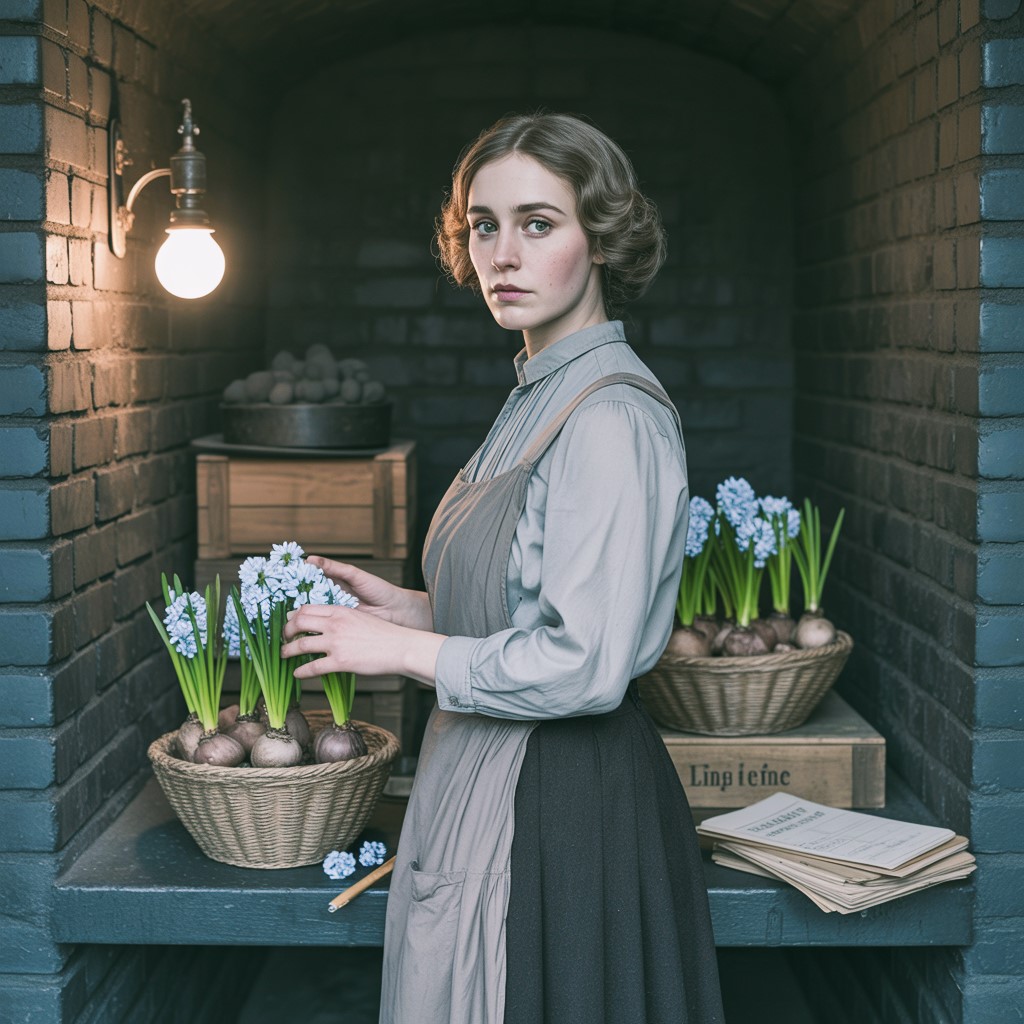
I am writing this in the coal cellar, where the air stays cool enough for my purpose and the noise from the street – squibs and shouts and the rattle of tin cans – does not press quite so hard upon one’s concentration. The children are upstairs with their aunt, who has taken them to see the bonfire on the waste ground. I declined to go. There is work yet to finish, and besides, I have seen enough of fires.
The hyacinth bulbs I set in bowls last week are showing the first pale tips through the fibre. I have arranged them on the stone ledge near the grating, where what little daylight reaches this space may encourage them. It is a slow business, forcing bulbs. One must judge the temperature, the moisture, the weeks of darkness required before they may be brought up into the light. There are manuals for such things, though I learnt chiefly by trial and the advice of Mrs Hicks, whose parlour is never without blooms even in January. She says it is all in the timing and the patience to let roots establish themselves unseen.
I have been reading the evening paper by the light of the gas bracket. The news from the Balkans grows grimmer – Adrianople besieged, the Turks falling back, thousands dead or wounded in battles whose names I cannot pronounce. One reads such things and wonders what the mothers in those places are doing tonight. Perhaps they too sit in cellars, though not by choice. The American election takes place today; by tomorrow’s paper we shall know whether it is Mr Taft or Mr Wilson or Mr Roosevelt. It seems a strange system, their method of choosing, but no stranger than much else one reads.
The children’s schoolwork lies on the crate beside me. Arithmetic copy-books, spelling lists, a composition on “The Gunpowder Plot” which my eldest has written in a fair hand but with rather too much relish in describing the torture of the conspirators. I shall speak to him about that. It is one thing to understand history and another to dwell upon cruelty. He is clever – cleverer than I was at his age – but cleverness without judgment is a dangerous plant to let grow unchecked. The Board School does well enough with facts and sums, but the shaping of character falls to the home.
Do you need time?
I found that question on a handbill outside the Temperance Hall yesterday. It was advertising lectures on household management and the betterment of the working classes, and I suppose it was meant to ask whether one had time to attend. But it lodged in my mind. Do I need time? Time for what, precisely? There are twenty-four hours in each day, and one uses them or wastes them as one will. The difficulty is not the quantity but the quality – time to think is not the same as mere hours passing. In the cellar, with the noise of Bonfire Night muffled by brick and earth, I have found a pocket of it. Time enough to force bulbs, to check sums, to read of wars across the sea, and to set down these observations. Whether I need it or merely take it, I cannot say with certainty. But I have claimed it nonetheless.
My mother used to say that a child’s mind is like a garden: one must weed, water, and wait. I think of that often when I correct their lessons or answer their questions. My eldest asked last week why the sky is blue. I did not know the answer with any scientific precision, but I told him we should look it up together in the encyclopaedia at the public library. That is what I wish to cultivate in them – not the mere acquisition of facts, but the habit of inquiry. The hunger to know. It is a hunger I feel myself, though there was precious little time for its feeding when I was young.
The bulbs will bloom in December if all goes well. White and purple, filling the parlour with scent. By then the children will be practising carols, and there will be the usual preparations to manage. But for now, in this underground space, with the roots reaching down into darkness and the tips reaching up toward the light they have not yet seen, I find a certain satisfaction in the waiting. One cannot hasten growth. One can only provide the conditions and trust to the working of nature.
The children are returning – I hear their feet on the pavement above, and my sister’s voice cautioning them to mind the steps. I shall go up now and hear about the bonfire, and see that their hands and faces are washed before bed. The cellar can wait. The bulbs will not hurry on my account.
Edwardian Britain, on the eve of the First World War, frames this 5th November 1912 diary, when Bonfire Night customs mingled with news of the First Balkan War and the U.S. presidential ballot between Taft, Roosevelt, and Wilson. The First Balkan War saw the Balkan League drive Ottoman forces from much of Europe, sharpening great‑power tensions that helped set the stage for 1914. British domestic life in 1912 featured gas‑lit homes transitioning to electricity and Board School education expanding literacy, while newspapers carried maps and casualty tallies from the Balkans and foreign elections. Within two years, Britain entered a global conflict that transformed the home front through mobilisation, aerial raids, conscription, and rationing, reshaping civilian routines like those glimpsed here.
Bob Lynn | © 2025 Vox Meditantis. All rights reserved.

 Vox Meditantis
Leave a comment