What will your life be like in three years?
Tuesday, 4th November 2025
The mind keeps trying to draft a future as if it were a meeting agenda, yet today’s light behaved more like weather – moving across rooms in a way that suggested what might be possible if one kept showing up long enough. Three years, then, feels less like a blueprint and more like a tide pattern: repetition with a slow drift, the reliable rhythms that – almost imperceptibly – change the shoreline. The day asked for patience with that kind of arithmetic.
Yesterday’s little invention – Harbouring Day – left a helpful aftertaste of proportion. Maggie’s proofs for the museum language came back this morning exactly as hoped – warm without condescension – and the sanctuary cards looked almost like furniture once set beside the lamp, their verbs doing quiet, practical work. The chairs obeyed a gentler angle. It turns out a room can be taught to welcome. Rajesh confirmed again that our Thursday swap still holds; sometimes kindness is simply calendars keeping faith with each other. Small adjustments that make bigger promises plausible.
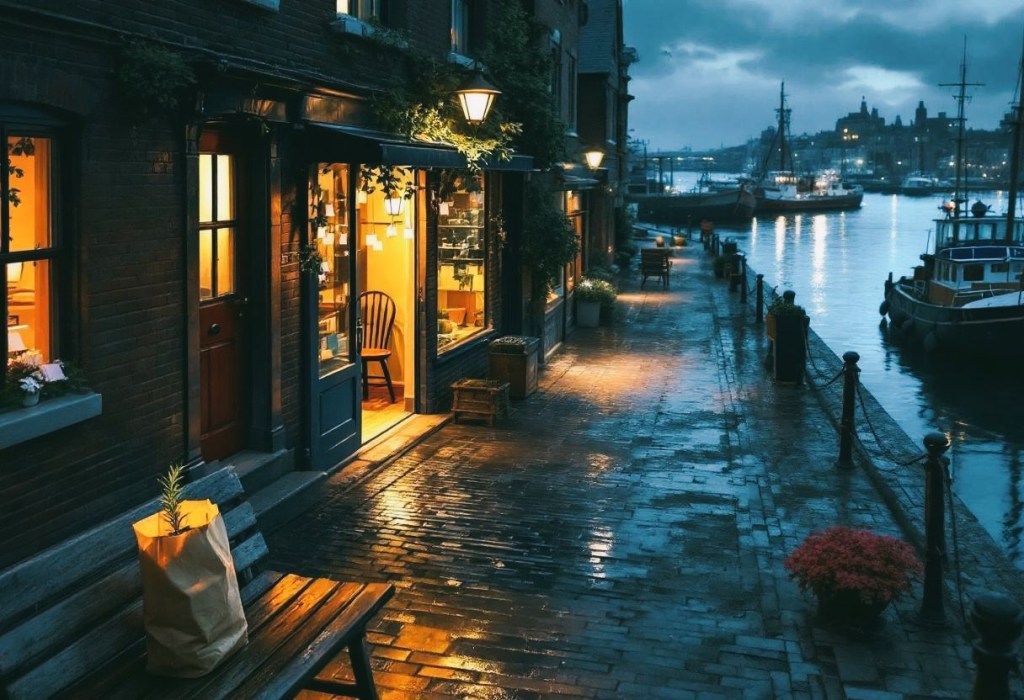
Between sessions, the harbour did its usual civic service of reminding one not to be theatrical. Marcus placed a cup at my corner table and left milk within reach without requiring an answer, a courtesy that notices how people are before it asks who they should be. Tom’s gait had one extra beat in it – not a complaint, only a revision – and somehow that registered as the neighbourhood’s version of minutes taken and approved. Attention, offered lightly, still counts.
If there was a hinge in the day, it came near dusk. I had finally committed to the Tuesday watercolour class I’ve walked past for months, intending to arrive, sit like a sensible beginner, and let pigment teach me about being less defended. When I reached the community centre on Harbour Street, a neat paper triangle on the door announced a burst pipe and immediate closure. The room I’d braced for – easels like elbows, the comfortable hum of people failing together – had vanished. Someone muttered “typical,” and began to scatter. I stood there, surprised by the force of my own disappointment. Routine had been disrupted before it even had the chance to become one.
Then Dan appeared – Dan of Riverfront Books, conspirator to minor acts of culture – and suggested, with the air of a man proposing tea rather than a coup, that we transplant the evening to the shop’s back table. “Paper dries,” he said, “books endure damp less politely.” We decamped – five of us and a box of half-pans – under a sky that had decided to be useful rather than decorative. The impromptu classroom smelled of paper and glue and the kind of quiet that doesn’t scold.
There, in that borrowed hour, something practical shifted. Without the instructor’s choreography, we were forced into the old neighbourhood economy: mutual aid, small jokes, the admission of inexperience as passport rather than shame. My brush hand was clumsy in a way I have spent a life avoiding, and the first wash bloomed across the page like a confession. Jenny would have been pleased; it was the sort of slight overwhelm she trusts me to survive.
Halfway through, David arrived, rain-soft and apologising for nothing, looking for a programme he’d left with Dan. Someone made room at the table because that’s what tables are for. When asked what we were attempting, the answer was both accurate and more than it seemed: “Beginnings.” He stayed long enough to point out that my shadows were all telling the same story, which is not untrue in other domains. Then – without performance – he asked whether I’d like company for Thursday’s rehearsal run-through at the museum, “if your new hours allow it.” It’s astonishing how ordinary a new chapter can sound when spoken at bookshop volume. Yes felt like matching the key, not announcing an aria.
Standing later at the window – brush rinsed, page drying in a way neither entirely obedient nor entirely feral – the day’s quiet thesis came into focus. If three years from now has a shape, it’s likely built from these unshowy increments: chairs angled toward welcome; Thursdays protected so quiet is more than aspiration; a practice that metabolises rather than consumes; an evening where paint behaves like humility and companionship doesn’t require a speech. The kind of life that accrues from repeating small true things until they hold.
The unexpected interruption did its benevolent mischief. A burst pipe is not an omen – only plumbing – but it pressed on the part of me that still queues experiences in tidy rows. The preference for structure is not a flaw; it simply needs to share the room with flexibility. Maggie’s pilot hours will need contingencies as much as signage. The sanctuary cards can carry a script for rain as well as silence. Generosity, if it’s to last, must be built with hinges.
People threaded the day the way they usually do when one pays attention. Kevin’s note about next month’s river clean-up waited in the inbox with its familiar invitation to turn care into choreography. Father Walsh sent a photograph of the boardwalk’s evening blues and no commentary, which is its own liturgy. Jenny’s hold request for a slim volume about pigments arrived with librarian economy: a promise between strangers that a book will be returned and begun again. It’s difficult not to see these as a municipal chorus rehearsing a piece they know by heart.
As for the arithmetic of future tense: by this time in 2028, the museum’s quiet hours could be simply what Thursdays are called, the cards as ordinary as doorstops. The harbour walk might have acquired a companionable second pace, unhurried and unadvertised. The consulting room could be a fraction kinder on the nervous system because the Keeper has accepted that showing up requires time offstage. There may be more soup in the freezer and fewer heroic rescues in the diary. The town will still argue with itself and the tide will still win on schedule. And perhaps – this is the tender wager – the ordinary courage practised today will have repeated enough times to become temperament.
None of that is prophecy. It’s only the day’s modest evidence scaled forward, like extending a line on graph paper without pretending to be the weather. The brush lies drying on its cloth, the page has settled into something that looks accidental until you remember the patient work underneath, and the inbox holds a rehearsal invitation beside a timetable that makes room for it. That will do for a Tuesday. The future can be built from this size of plank.
Catherine
Bob Lynn | © 2025 Vox Meditantis. All rights reserved.

 Vox Meditantis
Leave a comment