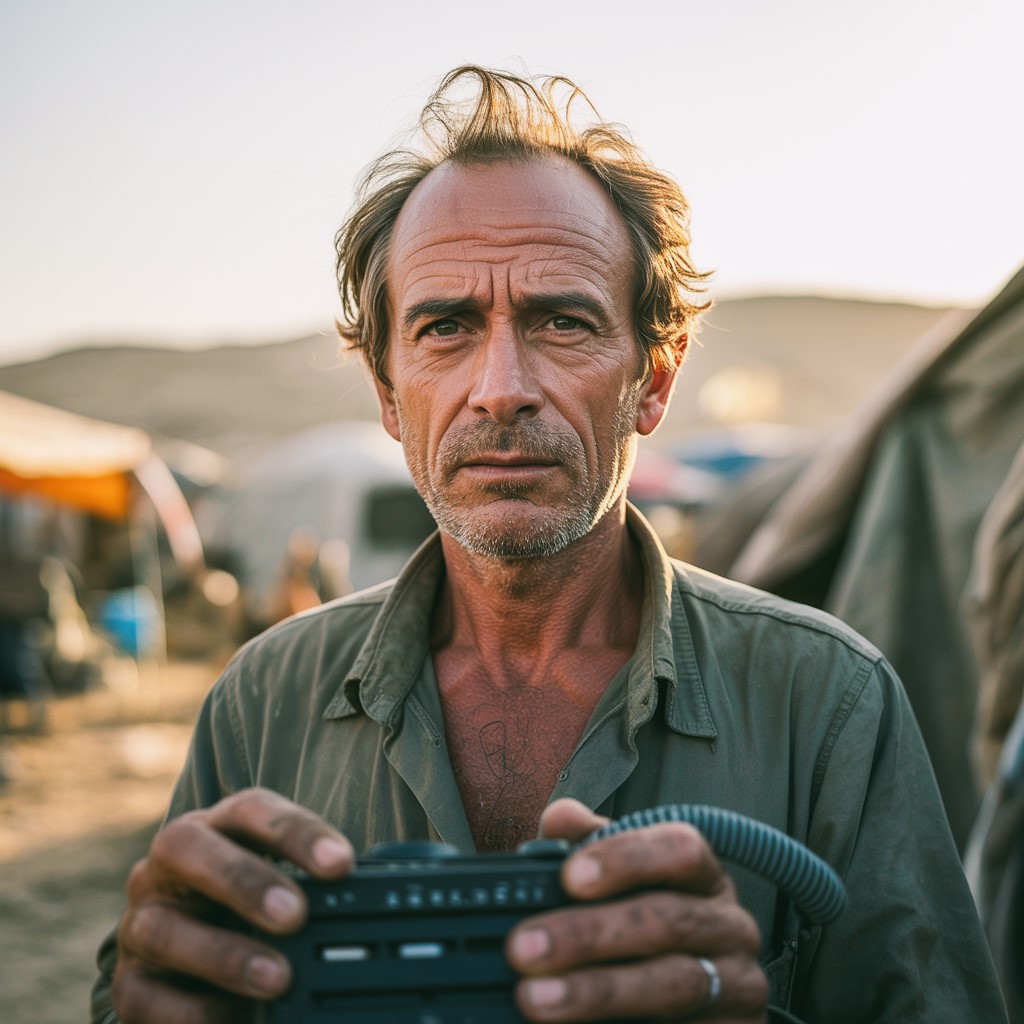
Tuesday, 2nd November 2038
Al-Hasakah Province, Northeast Syria
The shelling stopped three days ago. Now there’s only the wind through the rubble, and the steady tapping of Nura’s cane as she picks her way between the aid tents. She’s seventy if she’s a day, and she walked seventeen kilometres to reach us. I watched her arrive this morning, a small figure against the grey hills, and felt something in my chest I’d thought long dead.
I came here to be alone. After Marseille, after the collapse of the desalination network and everything that followed, I wanted only silence. For two years I lived in the abandoned observatory at Jabal al-Druze, cataloguing stars and speaking to no one. But the fighting pushed south, and the UN relief coordinator found me – God knows how – and asked if I’d help with the field network. “You know systems,” she said. “You know how to make things work when nothing works.”
So here I am, sixty-three years old, threading ethernet cables through bomb-damaged schools and showing grandmothers how to charge their phones from the solar batteries. Not quite the hermitage I’d planned.
The curious thing is, I don’t mind.
Someone asked me yesterday – one of the younger volunteers, couldn’t be more than twenty-five – what my favourite websites were. The question caught me off guard. When did anyone last ask me about preferences, about the small pleasures that make us who we are?
I thought about it whilst splicing fibre-optic cable this afternoon. The old sites are mostly gone, of course. The Archive Collective still runs, patched together by volunteers across three continents, preserving what we can of the lost web. I check it most evenings when the generator’s running. There’s something humbling about seeing fragments of the world we built – concert listings from 2029, recipe blogs, forum arguments about football matches – all carefully tagged and stored against the day someone might care again.
The other place I visit is the Mesopotamian Agricultural Recovery Network. Sounds deadly dull, I know. But they’ve got folks from sixty countries sharing seed stock information, irrigation methods, soil remediation techniques. There’s a woman in Baghdad who worked out how to grow tomatoes in forty-eight-degree heat. A farmer in Erbil who’s cross-breeding drought-resistant wheat. They’re not waiting for the world to fix itself. They’re doing it, one plot at a time.
That’s what I try to explain when the young ones ask why I’m here. We’re all chained to each other, whether we admit it or not. I thought I could break those bonds, live in my tower and watch the stars wheel overhead. But the chains aren’t constraints – they’re what keep us human. They’re what brought Nura walking seventeen kilometres. They’re what keeps that woman in Baghdad sharing her tomato secrets with strangers.
This evening I helped set up the community mesh node. Forty families can now message relatives, access medical databases, register for ration cards. Small things. A boy of eight showed me a photo of his grandmother in Qamishli – alive, smiling, holding his baby cousin. He started crying, and I held him until he stopped. His thin shoulders under my hands. The weight of him, trusting.
I think about the words we use. “Humanitarian crisis.” “Conflict zone.” “Displacement.” All true, all inadequate. What I see is Nura teaching three young mothers how to purify water using charcoal and sand. I see the Syrian engineer and the Kurdish medic arguing cheerfully about the best way to rig a wind turbine. I see people who’ve lost everything making tea for each other in the evening, sharing bread, singing.
The stars are particularly bright tonight. From my tent I can see Orion rising, the same stars I watched from the observatory. But I’m not alone anymore. I can hear voices, laughter, a baby crying. Someone’s playing a violin – badly, but with feeling.
Tomorrow the supply convoy arrives. We’ll offload solar panels, antibiotics, water filters. I’ll show the new arrivals how to use the satellite link. We’ll keep building these fragile chains, one connection at a time.
It’s enough. More than enough.
For the first time in years, I think I might belong somewhere.
Late 2030s Syria and its borderlands saw intermittent fighting, fragile ceasefires, and humanitarian responses shaped by protracted civil conflict and regional rivalries that began in 2011 and evolved through shifting alliances, foreign interventions, and de facto autonomous zones. Aid operations frequently relied on improvised power, satellite links, and community mesh networks to restore communications after infrastructure collapse, while displacement strained towns such as Qamishli and wider Al-Hasakah. International agencies and local NGOs coordinated convoys for medical supplies, water filtration, and solar kits, sustaining camps between flare-ups. Subsequent years featured continued reconstruction efforts, climate-stressed agriculture initiatives, and periodic violence that complicated returns, leaving a patchwork of governance and long-term recovery needs.
Bob Lynn | © 2025 Vox Meditantis. All rights reserved.


 Vox Meditantis
Leave a comment