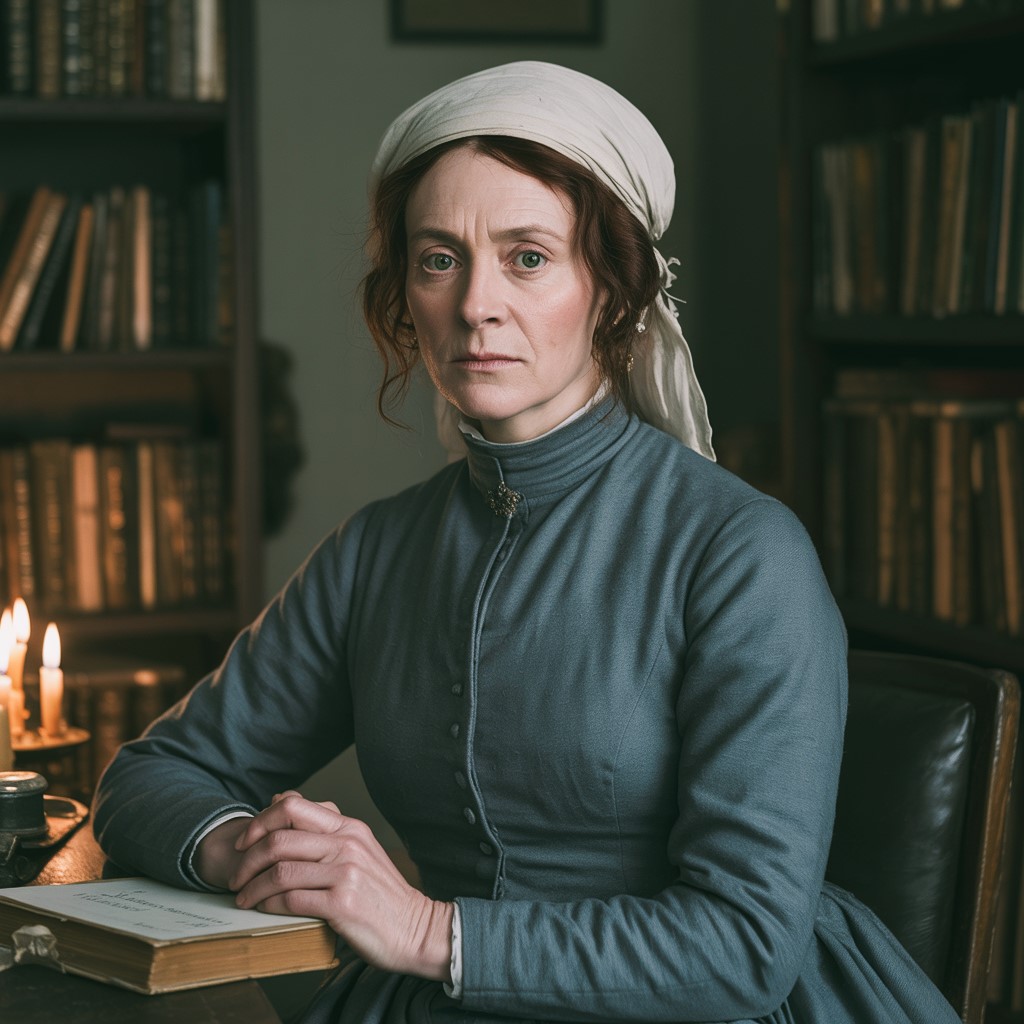
Thursday, 1st November 1792
The refuge I have made of Mrs Devereaux’s small library affords me some hours of quiet, though the very walls seem to press upon me this evening. A candle gutters at my elbow; I have not troubled the servants for more, and the coal is too dear now to warrant a fire in this chamber. The draught beneath the door reminds me that winter approaches, and with it the close of another year – another door shutting upon all that I have laboured to preserve.
I came here three months past, when the house in Bloomsbury was let to strangers and my brother’s affairs made it prudent for me to withdraw. This room, scarce twelve feet square, holds what remains of my father’s library and the commonplace books I have kept these twenty years. The path that brought me hither was not one I should have chosen, yet I find myself grateful for the solitude, even as it weighs upon my spirits.
The intelligence from France grows more terrible with each week’s gazettes. The reports of September’s massacres – those dreadful accounts of prisoners put to death in the streets of Paris – have left me quite overcome. That a nation might cast off its monarch and proclaim itself free, only to descend into such barbarity, fills me with a dread I can scarcely name. Mr Burke was not wrong, though I resented his vehemence when first I read his strictures. Mrs Wollstonecraft’s rejoinder, which I studied with such attention last winter, now seems to me the reasoning of one who has not witnessed how swiftly the opened door of liberty may become a threshold into chaos.
Yet I confess I am not occupied solely with distant horrors. My thoughts turn continually to what shall remain when I am gone – what mark, if any, I shall leave upon this world. I have no children to carry my name forward, no husband to remember me in his prayers. The volumes I have annotated, the translations I have made from the Latin and the Greek, lie in this chamber unregarded save by myself. I have spent my best years in pursuits that the world accounts unwomanly, and now, at forty-three, I find myself asking whether any of it has signified.
Were I able to return to some earlier season of my life and walk that path afresh, which should I choose? The question has haunted me this day, perhaps because it is the feast of All Saints, and I have been remembering those who have gone before. I believe I should wish to stand once more in my father’s study at Bath, in the year 1774, when I was but twenty-five and he was yet in health. Those winter mornings when we read Plutarch together, and he would pause to explain some point of history or grammar – those hours were the happiest I have known. I had not yet understood that such communion between minds was rare, that most women should never taste such freedom. The door to learning stood wide for me then; I had not yet learned how few such doors remain ajar.
But no – I would not re-live that year, for then I should have to endure again his death and all the long decline that followed. Better perhaps to let the past rest where it lies, a closed chamber I may visit in memory but cannot re-enter.
The streets below grow quiet as the hour advances. I hear the watchman’s cry, and the rattle of a late coach upon the stones. Tomorrow I must write to my cousin in York, to enquire whether there is any hope of selling the last of Father’s books. The bookseller in Paternoster Row has already declined them, saying there is no market now for works of scholarship in dead tongues. Everything must be modern, sensational, political. The measured wisdom of the ancients finds no purchasers.
I have lit a second candle that I might continue writing, though I know not what purpose this serves. Perhaps it is only that I cannot bear to lay down my pen – to close this book and extinguish the light, to pass through the doorway of sleep into another tomorrow. So long as I write, I exist; my thoughts have form and weight. When I am gone, these pages may survive me. Some future hand may turn them and wonder who I was, what I thought and felt upon this All Saints’ Day in the year 1792.
The paths we walk in this life are not always of our choosing, but we must walk them nonetheless. And when we come at last to that final threshold – that door which opens only inward – we can only hope that what we have carried with us, the small treasures of learning and conscience, may prove sufficient light for the passage.
The candles burn low. I must away to bed.
Late eighteenth-century Europe saw the upheavals of the French Revolution, including the abolition of the monarchy on 22th September 1792 and the September Massacres weeks earlier, which alarmed observers across Britain and Ireland. British newspapers, sermons, and coffee-house debates relayed news of France’s military fortunes, such as the unexpected French stand at Valmy (20th September 1792), which checked Prussian advance and buoyed revolutionary confidence. In the weeks following this diary’s date, the French won at Jemappes (6th November 1792), occupying much of the Austrian Netherlands and intensifying British anxieties. These developments contributed to Britain’s drift toward war with France, formally declared in early 1793, and to domestic crackdowns on radicalism, including prosecutions of writers and strengthened loyal associations.
Bob Lynn | © 2025 Vox Meditantis. All rights reserved.

 Vox Meditantis
Leave a comment