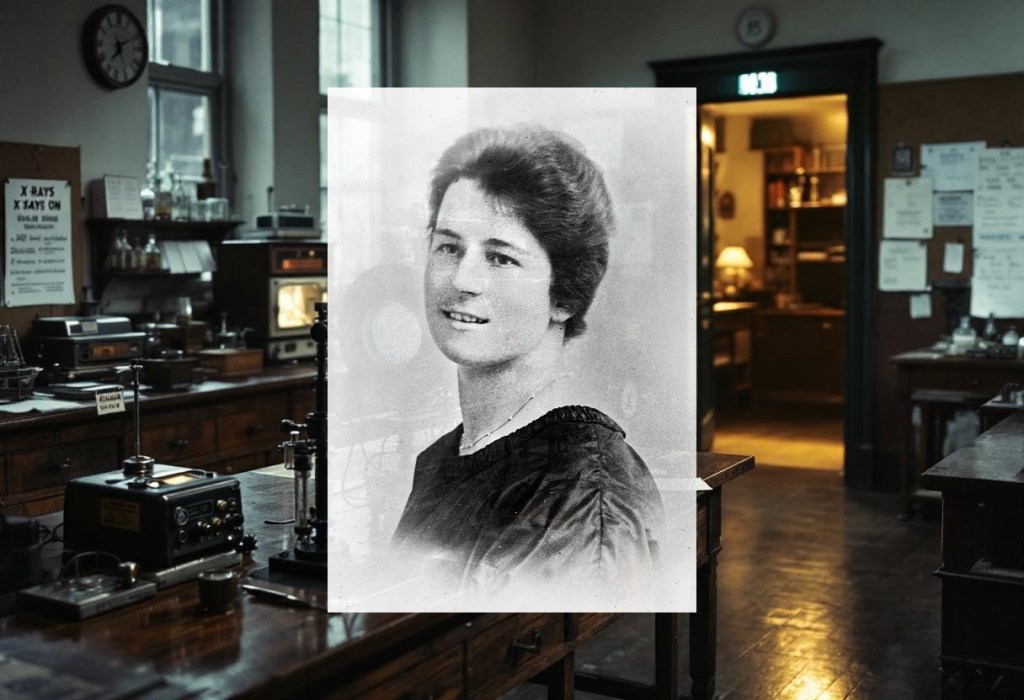
Dorothy Maud Wrinch (1894–1976) was a mathematician, logician, and theoretical biologist whose fearless interdisciplinary vision spanned from the abstract realms of symbolic logic to the intimate three-dimensional architecture of proteins themselves. Trained under Bertrand Russell at Cambridge and the first woman to receive a Doctor of Science degree from Oxford University, she spent her career translating mathematical elegance into biological insight – proposing the cyclol hypothesis, a bold geometric model of protein structure that, whilst ultimately incorrect, catalysed the very theories that would replace it. Her work on hydrophobic interactions proved prophetic: decades later, modern textbooks would confirm that the hydrophobic effect indeed accounts for nearly everything in protein folding, vindicating an intuition she refused to abandon even as the scientific establishment moved against her.
Thank you for making time for this conversation, Dr. Wrinch. I must say, speaking with you today feels rather like standing in a room where the future is looking back at the past. Before we venture into the specifics of your work, I wonder if you might tell our readers what drew a young mathematician into the study of biological form? Your transition from pure logic to protein molecules is not the obvious trajectory one might expect.
That is rather a generous way of framing it. My headmistress predicted I would “come to a bad end,” you understand – not terribly encouraging for a girl with mathematical inclinations. But I have never believed that the mind should remain confined to a single domain. When I was at Cambridge, reading both mathematics and philosophy under Mr. Russell’s tutelage, I was struck by something rather profound: that the same principles of formal reasoning, of logical structure and geometric organisation, appeared everywhere one looked, if one bothered to look carefully enough.
I was not seeking to abandon mathematics for biology. Rather, I came to understand that biology – the physical organisation of living matter – was itself a problem in applied mathematics. The architects of life had left blueprints, so to speak. One simply needed to learn to read them.
Your work with Bertrand Russell is now legendary, particularly during his imprisonment for pacifist activities during the First World War. You were instrumental in helping to secure publication of Wittgenstein’s Tractatus Logico-Philosophicus. That was a remarkable responsibility for a young scholar. What was that period like?
Remarkably chaotic, if I am to be perfectly honest. Here was Mr. Russell, imprisoned for his principles – which I respected immensely – and there was this extraordinary manuscript by a young man hardly anyone understood, a work of such density and originality that it seemed almost perverse in its difficulty. The war had made everything precarious. Nothing felt stable. Yet here we were, trying to preserve and circulate ideas about logic and language when the world was consuming itself in mud and machine guns.
I found it clarifying, actually. When everything else is fragile, one recognises what truly matters. The work of the mind persists, or it ought to. That conviction never left me.
In 1932, you founded something rather revolutionary for its time: the Theoretical Biology Club. What prompted that particular venture, and what were you hoping to accomplish?
The Club emerged from a rather simple frustration. I would attend meetings of biologists, and they seemed to lack any vocabulary for rigour, for quantification, for mathematical description. And when I would attend meetings of mathematicians and physicists, they regarded biology as rather too messy, too contingent for proper scientific treatment. The two communities simply did not speak to one another. It seemed to me an intolerable waste.
I wanted to create a space where a theoretical physicist might sit beside a working biochemist, where formal reasoning could be applied to genuinely biological questions – not by imposing mathematical structure where none existed, but by recognising that living systems possessed structure, mathematical structure, if one knew how to perceive it. The Club brought together people like J.D. Bernal, Joseph Needham, the crystallographer – minds willing to cross boundaries that discipline had erected.
What we were exploring – what I believed then and believe now – was not radical. It was simple: that life’s complexity could be systematically described through mathematical and physical principles. We were anticipating by decades what you now call systems biology, I understand.
Let us move toward what has rather come to define your reputation: the cyclol hypothesis and the surrounding controversy. I wonder if we might walk through the architecture of the model itself – the reasoning, the mathematical principles, the predictions you were making about protein structure.
Yes, let us be precise about this. It deserves precision.
The fundamental insight was this: globular proteins – egg albumin, serum albumin, haemoglobin – these were not random tangles of polypeptide chain. They possessed definite, three-dimensional forms. The question was how the amino acid chain, which had a chemical backbone of a certain rigidity, could fold into such a compact sphere without creating energetically improbable configurations.
Now, chemists had observed something interesting: under certain conditions, peptide bonds – the links between amino acids in the protein chain – could form not merely in the linear fashion of the chain itself, but could create additional covalent bonds perpendicular to the main chain, forming what we called cyclol rings. If peptide bonds could crosslink in this manner, creating these hexagonal rings, then one had the foundation for a structure of remarkable geometric elegance.
The hypothesis proposed that these cyclol rings could be tiled together in ways that mimicked the symmetry of the Platonic solids and other regular polyhedra. A protein molecule might be built from these units – hexagons and pentagons arranged with crystallographic precision – creating a fabric of extraordinary organisation. The hydrophobic and hydrophilic residues would be distributed according to this geometric logic, with water-fearing groups buried within and water-loving groups at the surface.
The beauty of it – and I do not apologise for using the word “beauty” – was that one could make precise, quantitative predictions. One could say: given a protein of certain molecular weight, it should exhibit specific symmetry properties. The model was testable. The dimensions could be calculated. Everything followed from first principles.
And the evidence seemed promising initially. Irving Langmuir, the Nobel laureate, was rather enthusiastic about your work.
He was. That was gratifying, though I confess I did not bank my confidence upon his approval or anyone else’s. The reasoning seemed sound to me. What I underestimated – what we all underestimated – was the thermodynamic cost of forming so many cyclol crosslinks within a protein molecule. It was not energetically feasible, not on the scale that would be required to create the structures I was proposing.
This became evident in the late 1930s, when various experimental approaches began to trouble the model. X-ray crystallography was providing increasingly detailed information about protein arrangement, and the predictions I had made did not correspond to what the crystals revealed.
And that is when the conflict with Linus Pauling intensified?
Yes. Mr. Pauling offered thermodynamic arguments against the cyclol model. His mathematics was elegant, and his conclusion – that cyclol structures were not the basis of globular protein architecture – was correct. However, I will note for the record, and I say this without bitterness but with the clarity of hindsight, that his specific thermodynamic calculations contained errors of their own. The conclusion was right; some of the reasoning was not.
The difference was that when Pauling’s mathematics proved imperfect, it was treated as an amusing eccentricity, a small stumble by a genius. When I held to my model in the face of criticism, when I insisted that the evidence was not yet conclusive and that further investigation was warranted, I was painted as obstinate, irrational, and unseemly in my refusal to capitulate.
That distinction matters enormously, does it not? The gendering of scientific stubbornness.
It matters enormously. A man devoted to his theories is “visionary.” A woman devoted to hers is “shrewish.” I was forty-three years old, a mature scholar with decades of published work, and I was being described in language that would scarcely be applied to a male colleague expressing equivalent confidence in his ideas. One journal editor remarked that my “refusal to back down was unladylike,” as though the ladylike comportment was the standard against which my science should be measured, rather than the evidence itself.
What particularly rankled was this: the model stimulated crucial experimental work. Scientists were forced to investigate protein structure with greater rigour precisely because the cyclol hypothesis demanded it. J.D. Bernal, one of my most vociferous critics, developed the theory of hydrophobic folding partly in response to my work. He was proving me wrong, and in doing so, he arrived at principles I had been articulating all along – that water-fearing groups buried themselves within the protein, away from the aqueous environment. I was wrong about the geometry. I was precisely right about the driving force.
That is a profound irony. Your “wrong” theory catalysed the discovery of what was actually correct.
Indeed. Though I would argue I was not entirely wrong, merely incomplete and mistaken about scale. The cyclol reaction itself does occur. In certain compounds – ergopeptides, for instance – the chemistry I described does manifest. But proteins are not built primarily from cyclol crosslinks. They are held together by the balance of hydrophobic and hydrophilic interactions, by the subtle choreography of water molecules, by entropy and enthalpy in precise proportions.
This is what troubles me most about the historical record: the notion that one is either entirely right or entirely wrong. Science progresses through partial truths, through errors that reveal something true even as they fail in their particulars.
Your move to the United States in 1939, first to Johns Hopkins and then to Smith College, occurred as the cyclol controversy was reaching its crescendo. That must have been a difficult transition.
Difficult does not adequately describe it. The Rockefeller Foundation had supported my work substantially, precisely because my mathematical approach to biology aligned with their vision of interdisciplinary inquiry. When the cyclol model encountered serious experimental difficulties, that same foundation withdrew support. The implication was clear: I was no longer a safe investment.
There were other difficulties as well. [Speaking more softly] I was a single mother by then. My marriage had ended in 1938, and I was attempting to navigate professional life as a woman with a child, during an era when such a circumstance was regarded as a personal failing rather than a circumstance of life. I wrote a book about it, actually, under a pseudonym – The Retreat from Parenthood, published as by “Jean Ayling.” I could not publish such a thing under my own name. The professional consequences would have been immediate and severe.
And yet you remained remarkably productive during your thirty years at Smith College.
Productivity is what remained to me. I did not have the luxury of disappearing. I taught molecular biology across the Four Colleges – Smith, Amherst, Mount Holyoke, and Hampshire. That cooperative arrangement was the first of its kind, I believe. I published over one hundred and ninety papers across my career. I developed computational techniques for X-ray crystallography. I worked in seismology, in probability theory, in the very foundations of scientific methodology.
What I did not have was the freedom to be viewed as a singular, focused intellect. The very interdisciplinarity that I had considered my greatest strength became a liability. I was not fully a mathematician, not fully a biologist, not fully a crystallographer. I was homeless in every discipline, and therefore forgettable in all of them.
There is a particularly poignant detail in your later career: Smith College now hosts the Dorothy Wrinch Lecture in Biomathematics as part of the Women in Mathematics in New England Conference. Your employer of three decades honours your name and your vision. How does that recognition feel?
It is a comfort, if I am honest. Not because it validates me – I have never required validation from institutions, much as they have required me to prove myself repeatedly – but because it suggests that the field I envisioned has endured. The biologists and mathematicians now speak to one another as a matter of course. Computational approaches to molecular structure are commonplace. Biomathematics is a legitimate discipline with journals, departments, funding.
What I began with the Theoretical Biology Club in 1932 is now simply how science proceeds. That gives me considerable satisfaction. The cyclol hypothesis is forgotten, as it deserved to be. But the questions it raised, the necessity of rigour in biological thinking, the marriage of mathematical elegance to experimental evidence – those persist.
If you could speak directly to contemporary scientists – particularly women and those from marginalised backgrounds entering fields where they are not yet fully welcomed – what wisdom would you offer?
First: do not confuse clarity with certainty. I was wrong about cyclols, but I was not unclear about cyclols. The error was in the hypothesis, not in the reasoning. Bring rigour to your work, but hold it lightly enough to adjust course when evidence requires it.
Second: do not wait for permission to cross boundaries. The barriers between disciplines are human constructs, arbitrary and often inefficient. If a problem interests you, pursue it, regardless of which department traditionally claims it. Let the gatekeepers be uncomfortable. Progress requires discomfort.
Third – and this is the hardest truth – understand that as a woman, you will be judged not merely by the quality of your work but by your comportment, your tone, your willingness to defer to authority. You cannot control this injustice. But you can choose not to internalise it. When they call you difficult, when they suggest your stubbornness is unbecoming, remind yourself that you are being punished for refusing to make yourself small.
And finally: be willing to be wrong publicly. The fear of failure keeps many brilliant minds confined to narrow, safe territories. I was spectacularly, humiliatingly wrong about cyclols. And yet that wrong theory advanced the field more than a hundred small, cautious correct papers might have done. There is courage in being wrong in public. There is freedom in it.
That is rather extraordinary wisdom, and particularly striking given the personal cost you paid for that sort of courage.
Yes, well, one might argue I was not always graceful about the cost. I could have been kinder to those who disagreed with me. I could have been more diplomatic, more willing to acknowledge uncertainty sooner. I was, by many accounts, difficult to work with. Some of that was circumstance and injustice. Some of it was simply my nature.
I do not regret my nature. But I acknowledge it as a factor in my historical eclipse. Had I been a man, perhaps my difficulty would be remembered as a sign of genius rather than instability. As it stands, I remain a cautionary tale about female overreach and obstinacy. That is the story that has been told.
But it is not the only story that might be told.
What story would you prefer to see recorded?
A simple one: that a mathematician attempted to decode the architecture of life using the tools of her discipline. Some of her specific hypotheses proved incorrect. But her fundamental conviction – that biological form could be described through mathematical and physical principles – proved prophetic. That decades would pass before the field caught up with her vision does not diminish the insight.
More importantly, that her work – wrong as it was in particulars – catalysed the very discoveries that replaced it. That she asked questions the field was not yet equipped to answer, and in struggling with those questions, the field became equipped to answer them.
That is the legacy I would prefer. Not vindication of cyclols. That would be ridiculous. But recognition that the questions were worth asking, and that the asking itself advanced human understanding.
Dr. Wrinch, thank you for your candour, your precision, and your willingness to revisit some rather difficult territory. I suspect historians and scientists alike will continue to puzzle over your contributions for many years hence.
Perhaps. Though I harbour no illusions about immortal fame. What matters is that the work continues. The biologists collaborate with the mathematicians. The protein structures are solved with ever greater elegance and speed. The hydrophobic effect – that principle I held to so stubbornly – is now taught to every student of biochemistry as foundational truth.
In the end, that is sufficient. Not vindication. Progress. And the knowledge that one’s refusal to remain silent, one’s willingness to occupy uncomfortable intellectual spaces, to ask unfashionable questions – that those things matter, regardless of whether history chooses to remember them.
Letters and emails
Following our conversation with Dorothy Maud Wrinch, we received an extraordinary number of questions from readers, researchers, educators, and scientists eager to extend the dialogue. The questions that arrived reflected genuine intellectual curiosity: some probing the technical specifics of her methods, others wrestling with the philosophical dimensions of her work, and still others asking the harder personal questions about resilience, compromise, and the weight of being misunderstood.
We have selected five letters and emails from our growing international community – from Africa, Europe, Asia, North America, and South America – representing voices who recognise in Wrinch’s story something that speaks to their own journeys across disciplines, against institutional resistance, or in search of intellectual honesty in a field that often rewards certainty over nuance. Each questioner brings their own perspective and expertise, and each question opens new territory that our initial conversation only touched upon lightly.
What follows are these five voices, posed directly to Dorothy Maud Wrinch, alongside her reflections. Together, they form a portrait of a scholar whose influence extends far beyond what the historical record has traditionally acknowledged – a mathematician whose refusal to shrink herself continues to inspire those brave enough to walk their own unconventional paths.
Thandiwe Molefe, 34, Science Educator & Historian, Cape Town, South Africa
You mentioned that the cyclol reaction itself does occur in compounds like ergopeptides, even though it wasn’t the primary mechanism in globular proteins. Could you walk us through how you might have approached that discovery differently if you’d had access to modern spectroscopic techniques – NMR, mass spectrometry, electron microscopy – rather than relying primarily on X-ray crystallography and theoretical prediction? Would those tools have fundamentally altered your hypothesis, or simply accelerated the timeline to the correct model?
What a perceptive question, Miss Molefe, and one that makes me rather wistful about what might have been possible with more sophisticated tools at our disposal. You must understand that in the 1930s, X-ray crystallography itself was still something of a dark art – we were coaxing information from diffraction patterns that required immense patience and mathematical facility to interpret. The photographs were often unclear, the exposure times lengthy, and the calculations to transform those patterns into three-dimensional structures were formidable.
Had I possessed nuclear magnetic resonance spectroscopy – which I understand can now reveal the precise chemical environment of individual atoms within a molecule in solution – the cyclol hypothesis would have been tested and abandoned far more swiftly. NMR would have shown immediately whether peptide bonds were forming those perpendicular crosslinks I predicted, whether the cyclol rings existed in any abundance within native proteins. The evidence would have been unambiguous. I would have been spared years of defending a model that was energetically implausible, and the field would have progressed more efficiently toward the correct understanding.
But here is where your question becomes more interesting than you perhaps intended: would I have arrived at the hydrophobic folding principle more quickly, or would I have missed it entirely?
You see, the cyclol hypothesis emerged from pure geometric reasoning – from the conviction that nature preferred mathematical elegance, that proteins must possess some underlying structural logic that could be described through symmetry and polyhedra. It was, if you like, a top-down approach: I began with mathematical beauty and attempted to map biology onto it. The hypothesis was wrong in its particulars precisely because I underestimated thermodynamics and overestimated geometry.
Modern spectroscopic techniques, by contrast, are profoundly empirical. They tell you what is rather than what ought to be according to mathematical principle. Had I begun with NMR data showing me the actual distribution of hydrophobic and hydrophilic residues, the actual flexibility of the polypeptide chain, the actual absence of cyclol crosslinks – would I have had the audacity to propose that hydrophobic interactions were the primary organising force? Or would I have been so overwhelmed by empirical detail that I never ventured the broader theoretical claim?
I suspect – and this is speculation, which I have always rather enjoyed – that the tools available to a researcher shape not merely the speed of discovery but the kind of thinking one brings to a problem. Working with limited experimental data forced me to rely heavily on theory, on mathematical models, on geometric intuition. Those tools led me astray regarding cyclols. But they also led me toward insights about hydrophobic organisation that were not yet visible in the experimental record of the time.
Mass spectrometry would have told me the precise molecular weights and compositions of proteins, confirming or refuting my predictions about specific structures. Electron microscopy would have shown me the shapes of protein molecules directly, rather than requiring me to infer them from diffraction patterns. These are powerful constraints. But constraints can be both clarifying and limiting.
There is something to be said – though I fully acknowledge this may sound like the self-justification of someone who was proven wrong – for approaching a problem with insufficient data and excessive confidence. It forces hypothesis generation of a kind that purely data-driven approaches sometimes discourage. Modern researchers, I imagine, face the opposite problem: too much data, too little theory. They can see everything but explain nothing, or at least nothing beyond statistical correlation.
What I would have done differently, had I your tools, is this: I would have used NMR and mass spectrometry to test the cyclol hypothesis rapidly and decisively within the first year or two of proposing it. Upon discovering that cyclol crosslinks were not forming in the abundance required, I would have pivoted immediately to investigating why proteins folded as they did without covalent geometric scaffolding. The hydrophobic principle would have emerged more cleanly, more quickly, without the baggage of the failed cyclol model attached to it.
But – and this matters – I would not have apologised for proposing cyclols in the first place. A testable, falsifiable hypothesis that proves incorrect but stimulates better alternatives is worth more than cautious incrementalism. Your modern tools would have accelerated the timeline, certainly. Whether they would have produced better science or merely faster science is a more complicated question than it appears.
Blake Turner, 41, Computational Biologist, Boston, USA
I’m fascinated by your work on X-ray crystallography algorithms. Computing power in your era was essentially absent – you were working with calculations by hand or mechanical devices. What were the actual computational bottlenecks you encountered when trying to model protein diffraction patterns? And more pressingly: do you think the constraints of hand calculation actually forced a kind of intellectual rigour that modern researchers, drowning in computational output, might have lost? Sometimes I wonder if unlimited processing power has made us lazy.
Mr. Turner, you have touched upon something I have thought about often, particularly in my later years when I observed the advent of electronic computing and wondered what it might have meant for my early work. The bottlenecks were not merely inconvenient – they were absolute. Let me be quite specific about what we faced.
When analysing X-ray diffraction patterns from protein crystals, one had to calculate structure factors for every possible arrangement of atoms within the unit cell. Each calculation involved Fourier transforms – summing trigonometric functions across three-dimensional space. For a protein crystal with even modest complexity, this meant thousands upon thousands of individual calculations, each performed by hand or with the aid of mechanical calculating machines that were temperamental at best.
I would sit for hours with tables of logarithms, with slide rules, working through the mathematics point by point. A single error in transcription – copying a number incorrectly from one page to another – could invalidate an entire day’s work, and you might not discover the error until much later when the results failed to make physical sense. We developed elaborate systems of checking and cross-referencing, but mistakes were inevitable. The mental fatigue alone was considerable.
The consequence of these limitations was that one could not afford to explore every possible structural hypothesis. You had to choose carefully which models to test, which configurations seemed most promising according to theoretical principles. This was not a luxury – it was necessity born of constraint. One could not simply generate a thousand random protein structures and calculate which best fit the diffraction data. You had perhaps the stamina and time to test three or four carefully reasoned possibilities, and that was that.
Now, to your more provocative question: did this constraint impose a beneficial discipline that unlimited computation might undermine? I believe it did, though not in the way you might expect.
The discipline was not merely about being selective in what one calculated. It was about developing profound geometric intuition. When you cannot test every possibility, you must learn to see which possibilities are worth testing. You develop a feel for molecular architecture, for what configurations are plausible based on bond angles, steric constraints, symmetry principles. You reason from first principles because you must.
I knew the geometry of peptide bonds intimately – the angles, the planarity, the restricted rotation about certain bonds. I could visualise three-dimensional structures in my mind and manipulate them mentally before committing to the laborious calculations. This was not a special talent; it was a necessary skill that every crystallographer of my generation developed through sheer necessity.
Modern computational approaches, as I understand them, allow researchers to generate vast libraries of possible structures and test them all through simulation. This is obviously powerful – one is not limited by human calculation speed or endurance. But I wonder whether it produces a different kind of scientist. If the computer can explore every possibility, does the researcher lose the need to cultivate deep geometric intuition? Does one become, in effect, a supervisor of machines rather than a thinker about molecules?
There is also the question of what one does with negative results. When calculation is expensive – when each test costs hours or days of labour – a negative result is genuinely informative. You learn something from failure because failure was costly. When computation is cheap, when one can run ten thousand simulations overnight, what is the cognitive value of discovering that nine thousand nine hundred and ninety-nine of them produce nonsense? Perhaps very little. The researcher simply discards them and publishes the one that worked.
I do not wish to romanticise computational poverty. I would have dearly loved to have access to the tools you possess. The cyclol hypothesis could have been tested definitively in months rather than years. I could have explored far more alternative models, refined my understanding of hydrophobic interactions with quantitative precision, contributed more and suffered less.
But I will confess this: the discipline of hand calculation, the necessity of choosing carefully what to compute, the impossibility of brute-force approaches – these shaped how I thought about problems. I could not afford to be sloppy in my reasoning because sloppiness meant wasted weeks. I had to construct coherent theoretical frameworks before testing them because testing was too expensive to do casually.
Whether modern researchers are “lazy,” as you suggest, is perhaps too harsh. But I do wonder whether unlimited computational power encourages a certain intellectual promiscuity – testing everything, thinking deeply about nothing. The danger is not laziness but superficiality: skimming across vast computational landscapes without ever inhabiting them deeply enough to develop genuine understanding.
The ideal, I suspect, would be this: train researchers first under conditions of constraint, where they must develop geometric intuition and theoretical rigor because they have no choice. Only then give them unlimited computational power. Let them bring disciplined thinking to undisciplined capability. That might produce something remarkable indeed.
Iveta Novakova, 29, Philosopher of Science & Ethics, Prague, Czech Republic
Your written work on scientific methodology – particularly your collaboration with Harold Jeffreys – has been somewhat overshadowed by the cyclol controversy. But it strikes me that you were grappling with questions about how we know what we know at the precise historical moment when that question was becoming urgent. What was your honest view on the relationship between mathematical elegance and empirical truth? Did you ever suspect that your preference for geometric symmetry might have blinded you to messier, less beautiful biological realities?
Miss Novakova, you have asked the question that keeps me awake at night, and I am grateful for your directness. Yes, I collaborated with Harold Jeffreys on questions of scientific inference – work that I valued deeply and that I believe contributed something genuine to our understanding of how evidence operates in science. Yet it has been almost entirely eclipsed by the cyclol controversy, and there is a particular irony in that erasure that your question illuminates perfectly.
The work with Jeffreys emerged from something deeply personal: a conviction that mathematics could illuminate not merely the natural world but the very process by which we come to know the natural world. What is evidence? How do we weigh competing hypotheses? When should a researcher abandon a theory, and when should she persist? These were not abstract philosophical questions to me – they were urgent, practical matters that shaped how I conducted my own research.
Jeffreys and I were attempting to formalise something that scientists do intuitively: compare the probability that evidence supports one hypothesis versus another. This work later influenced his book Scientific Inference, and I was proud of that contribution. We were trying to move beyond the merely aesthetic or intuitive in scientific judgment. We wanted rigor.
And yet – here is where your question becomes uncomfortable, and I appreciate that you have the courage to ask it – I may have violated my own epistemological principles in the pursuit of cyclols.
Let me be precise about this. The mathematical framework Jeffreys and I developed was designed to help scientists evaluate evidence fairly, to resist the temptation to hold onto favoured theories in the face of contradictory data. It was precisely the tool I should have applied more rigorously to my own work in the mid-to-late 1930s. When the thermodynamic calculations by Pauling and others began to accumulate, when experimental evidence began to contradict my geometric predictions, I should have been more willing to calculate the actual probability that the cyclol hypothesis remained plausible given the evidence. Instead, I argued. I refined the model. I proposed variations and modifications.
Was this blindness born of mathematical elegance? Partially, yes. There is something profoundly seductive about geometric symmetry, about the notion that nature prefers Platonic solids and regular polyhedra. I was enamoured of the beauty of the cyclol model – the hexagonal rings forming fabrics of crystallographic perfection. When evidence seemed to contradict it, I looked for ways to preserve it rather than asking whether the evidence itself was compelling enough to mandate abandonment.
But I want to be careful here, Miss Novakova, not to accept too much blame. Beauty in a scientific hypothesis is not inherently a vice. The most powerful scientific theories possess an aesthetic dimension – they are elegant, unified, capable of expressing complex phenomena through simple principles. Newton’s mechanics, Maxwell’s electromagnetism, Einstein’s relativity – all possessed this quality. The question is not whether one is attracted to mathematical beauty but whether one is willing to let evidence override that attraction.
I believe I did eventually do so. The cyclol model, in its original form, is abandoned. I accepted that. But the question of when I should have abandoned it – whether I held on too long – that is where I must confront my own epistemological inconsistency.
If I apply the framework Jeffreys and I developed, I should have calculated, around 1937 or 1938, the Bayesian probability that cyclols remained the most likely explanation for protein structure. The accumulating thermodynamic arguments, the X-ray evidence, the absence of corroborating chemical data – all of this should have shifted that probability significantly downward. Had I performed such a calculation formally and honestly, I suspect I would have been forced to acknowledge, around 1939 at the latest, that the hypothesis was untenable.
Instead, I persisted for several more years, arguing for modifications, proposing refinements. Why? I think it was partly intellectual stubbornness – a character trait I will not disguise or apologise for entirely. But it was also something more troubling: a willingness to apply lower epistemic standards to a theory I had invested in personally and professionally than I would have applied to someone else’s theory.
This is perhaps the deepest lesson I have learned from my own missteps. Mathematical elegance can seduce even the mathematicians who should be most aware of its dangers. And personal investment in a theory – decades of work, professional reputation, emotional commitment – can subtly lower one’s threshold for what counts as sufficient evidence to abandon it.
The hydrophobic principle, which I championed quite early, was actually less elegant mathematically than the cyclol model. It was messier, more contingent, less capable of elegant geometric description. Had I been truly clear-eyed, I might have recognised that the very messiness that made hydrophobic folding less mathematically appealing might have been a sign of its greater biological truth. Nature, after all, is not obliged to be elegant. She merely appears that way to mathematicians who are looking for elegance.
Your question asks whether I suspect my preference for geometric symmetry blinded me to messier biological realities. The honest answer is yes, I suspect it did, and I regret that. But I also want to insist – perhaps defensively – that the error was not in preferring elegance but in allowing preference to override evidence. That is the crucial distinction.
The work with Jeffreys on scientific inference was correct in its principles even though I failed to apply those principles adequately to my own most famous work. That failure is instructive. It suggests that understanding how science ought to proceed is not the same as having the intellectual discipline to proceed that way when one’s own theories are at stake. And it suggests that perhaps the most important epistemological virtue is not brilliance or mathematical sophistication, but rather humility about the particular ways our own minds can deceive us.
Agustín Morales, 56, Theoretical Physicist & Science Historian, Buenos Aires, Argentina
This is perhaps audacious to ask, but I’ll ask it anyway: if you could rewind to 1935 or 1936, when the cyclol model was still in favour, and you possessed the knowledge you have now – knowing how the field would evolve, knowing what hydrophobic folding would become – would you have published the cyclol hypothesis at all? Or would the knowledge of its incompleteness have been paralysing? I’m curious whether you think scientific progress requires a certain productive ignorance, or whether it’s simply a matter of timing and evidence.
Mr. Morales, your question is not audacious – it is essential. And I will answer it with the honesty it deserves, though the answer may surprise you.
Yes. I would have published the cyclol hypothesis even knowing it was incomplete and would ultimately prove incorrect in its specific geometric claims. I would have published it without hesitation, and I will tell you why.
Science does not progress through the accumulation of small, safe, incremental truths alone. It progresses through bold hypotheses that force the field to respond, to test, to refine its methods and its thinking. The cyclol model accomplished something that a hundred cautious, hedged papers could never have done: it forced the entire community of protein chemists, crystallographers, and biochemists to confront the question of three-dimensional protein structure seriously and urgently.
Before cyclols, the prevailing assumption was that proteins were relatively shapeless, perhaps linear or loosely coiled chains without definite architecture. There was little sense that proteins possessed precise, reproducible three-dimensional forms that were essential to their function. The cyclol hypothesis – wrong as it was in particulars – insisted that proteins must have definite structures, that those structures could be described mathematically, and that understanding protein function required understanding protein form.
That insistence changed the field. It redirected research effort. It prompted new experimental approaches. And most importantly, it provoked J.D. Bernal and others to develop the correct theory of hydrophobic folding precisely because they needed to refute cyclols. Had I not published the cyclol model, had I waited until I possessed perfect knowledge or complete certainty, that catalytic effect would never have occurred.
Now, you ask whether productive ignorance is necessary for scientific progress, or whether it is merely a matter of timing and evidence. I believe it is both, and the distinction matters.
There is a kind of ignorance that is genuinely productive: the ignorance that allows one to ask questions that more knowledgeable researchers would dismiss as naive or implausible. When I proposed cyclols, chemists told me immediately that the thermodynamics seemed problematic. A researcher with deeper training in physical chemistry might have abandoned the idea before ever publishing it. My relative ignorance of certain chemical principles allowed me to push forward with a hypothesis that seemed geometrically compelling, and that ignorance turned out to be productive – not because the hypothesis was correct, but because it was clearly wrong in ways that forced better alternatives.
But there is another kind of ignorance that is merely incompetence, and one must be careful not to confuse the two. The difference lies in whether the hypothesis is testable and whether the proposer is willing to accept refutation. The cyclol model was eminently testable – it made specific, quantitative predictions about protein structure that could be evaluated experimentally. And I did, eventually, accept its refutation, though perhaps not as swiftly as I should have done.
What would have been paralysing, had I possessed complete knowledge of how the field would evolve, is not the knowledge that cyclols were incorrect. It is the knowledge of the professional consequences I would face for being incorrect publicly. That is a different matter entirely.
If I had known in 1935 that proposing the cyclol model would result in lasting damage to my reputation, that it would overshadow all my other contributions, that it would make me professionally precarious and financially vulnerable, that I would be described in language no male scientist would face for equivalent intellectual stubbornness – would I still have published?
This is the harder question, Mr. Morales, and I confess I do not have a clear answer. I would like to believe I would have proceeded anyway, that commitment to scientific truth would have outweighed personal cost. But I was a single mother by the late 1930s, dependent on institutional support that proved extremely fragile once the cyclol controversy intensified. The rational calculation might have been to remain silent, to pursue safer research, to protect my position.
And yet that calculation would have been a betrayal – not merely of scientific principles but of what science ought to be. If only researchers with secure positions and institutional protection are permitted to propose bold, risky hypotheses, then science becomes the preserve of the privileged. Women, outsiders, those without permanent posts or financial security – we are already told implicitly that we must be more careful, more modest, less willing to risk spectacular public failure.
I refused that constraint. Perhaps foolishly. Perhaps at great cost. But the alternative was to accept that people like me – mathematicians without formal chemistry training, women without the protections afforded to male colleagues, interdisciplinary thinkers without a clear disciplinary home – should restrict ourselves to small, safe contributions and leave the grand theories to those better positioned to survive being wrong.
So yes, knowing what I know now, I would have published the cyclol hypothesis. I would have stated it clearly and precisely. I would have invited experimental refutation. I would have contributed to the intellectual ferment that eventually produced the correct understanding of protein folding. And I would have paid the professional price, just as I did, because the alternative – silence born of fear or excessive caution – is antithetical to what science requires.
What I might have done differently is this: I would have been clearer, from the beginning, that the cyclol model was a working hypothesis subject to experimental test rather than a definitive solution. I would have emphasised more explicitly that I welcomed refutation as part of the scientific process. And I would have pivoted more quickly once the thermodynamic evidence became overwhelming, rather than defending variations of the model longer than was warranted.
But publish? Yes. Absolutely. Science needs people willing to be wrong in interesting, productive ways. And if that means enduring professional consequences, then those consequences reveal a problem with how science treats error – particularly error by women and outsiders – not a problem with the act of proposing testable hypotheses that prove incorrect.
Noor Hassan, 31, Systems Biologist & Mathematical Modeler, Singapore
You pioneered the idea that biological problems could be addressed through mathematical abstraction decades before computational biology became mainstream. But I wonder: looking back at the interdisciplinary work you championed through the Theoretical Biology Club and later at Smith College, where do you think the boundary should lie between mathematical modelling and experimental validation? In modern systems biology, we sometimes see researchers so committed to elegant models that they resist contradictory data. How do you counsel young scientists to hold conviction in their theoretical frameworks whilst remaining genuinely open to evidence that overturns them?
Miss Hassan, you have posed precisely the question that ought to haunt every theoretically-minded researcher, and I am grateful that it does seem to concern you. The boundary between conviction and dogmatism, between theoretical commitment and empirical honesty – this is treacherous territory, and I have stumbled badly in navigating it.
Let me begin with what I believe to be the proper relationship between mathematical modelling and experimental validation. They are not sequential steps – theory first, then testing – but rather a continuous dialogue. A good theoretical model does more than organise existing data; it makes predictions that extend beyond what is currently known, predictions that can be tested experimentally. The model proposes; the experiment disposes. And then the model must be revised, refined, or abandoned based on what the experiment reveals.
This sounds straightforward when stated baldly. In practice, it is extraordinarily difficult, because one’s theoretical framework becomes deeply embedded in how one perceives the world. After working with a model for months or years, after investing intellectual and emotional energy in developing it, the model begins to shape what you notice, what you consider significant, what you dismiss as experimental artifact or measurement error.
When I developed the cyclol hypothesis, I was working from geometric and thermodynamic principles that seemed compelling. Proteins had to fold somehow. The peptide chain had certain constraints. The cyclol reaction was chemically plausible. Hexagonal symmetry appeared in many natural structures. The logic seemed sound, and the elegance of the geometric solution was deeply appealing.
As experimental evidence began to accumulate – X-ray data that did not quite fit the predicted structures, thermodynamic calculations suggesting energetic implausibility – I faced a choice. I could treat these as preliminary findings that required further investigation, or I could accept them as definitive refutations. I chose the former, and I chose it for too long.
The difficulty, Miss Hassan, is that experimental data is never completely unambiguous. Measurements contain error. Techniques have limitations. What appears to be a clear refutation might simply reflect inadequacies in the experimental method rather than flaws in the theory. This is especially true when working at the frontiers of a field, where experimental techniques are still being developed and refined.
So when do you abandon a theory? When experimental contradictions are merely inconvenient anomalies, and when are they genuine refutations? There is no formulaic answer, and that ambiguity is where researchers can deceive themselves most profoundly.
Here is the counsel I would offer to young scientists, drawn from my own missteps:
First, cultivate intellectual companions who do not share your theoretical commitments. The Theoretical Biology Club, which I founded, was valuable precisely because it brought together people from different disciplines with different assumptions. A mathematician thinks differently from an experimental biochemist, and that difference is protective. When everyone in the room shares your framework, you lose the friction that prevents theory from becoming ideology.
Second, state your theory’s predictions as precisely and quantitatively as possible. Vague theories can never be definitively refuted because they can always be adjusted to accommodate new evidence. The cyclol model made specific geometric predictions – particular symmetries, particular dimensions, particular molecular weights for proteins with cyclol structures. That specificity was ultimately what allowed the model to be tested and refuted. It was painful, but it was honest.
Third – and this is perhaps most important – distinguish between the core insight and the specific mechanism. I was convinced that hydrophobic interactions played a central organising role in protein folding. That conviction was correct. I was also convinced that cyclol crosslinks provided the geometric framework for that organisation. That specific mechanism was incorrect. Had I been clearer in my own mind about which parts of my thinking were essential and which were contingent details, I might have been more willing to abandon cyclols whilst preserving the hydrophobic principle.
Fourth, set explicit decision criteria in advance. Before you test your theory, decide what results would constitute refutation. Write them down. Make them public. This prevents the insidious process of continually moving the goalposts, of explaining away each contradictory result as special case or experimental error. If you commit to criteria beforehand, you bind yourself to honest evaluation afterward.
Fifth, recognise that holding conviction whilst remaining open to evidence is not a static balance but a dynamic process. Early in developing a theory, when evidence is sparse and techniques are immature, you must hold the theory lightly, treating it as provisional. As evidence accumulates, you can increase confidence – but only if the evidence genuinely supports the theory. And if contradictory evidence begins to accumulate, you must decrease confidence accordingly. This sounds obvious, but the psychological pressure moves in the opposite direction: the more you invest in a theory, the more confident you tend to become, regardless of evidence.
Finally – and this I learned most painfully – be aware of how external pressures distort your judgment. When my funding became dependent on the cyclol hypothesis appearing promising, when my professional reputation became entangled with its success, when critics began attacking not merely the theory but my competence and character, the stakes became personal in ways that made objective evaluation nearly impossible. I wanted the theory to be right not merely because the evidence supported it but because my career depended on it.
That is a catastrophic position for a scientist to occupy, Miss Hassan, and yet it is remarkably common, especially for women and others whose professional positions are precarious. When you cannot afford to be wrong, you lose the capacity to recognise when you are wrong. This is not a personal failing – it is a structural problem with how science distributes security and resources.
So my counsel is this: build your career, if you possibly can, in ways that allow you to abandon theories without professional catastrophe. Maintain multiple research directions. Develop expertise across domains so that failure in one area does not render you professionally homeless. Cultivate collaborators and mentors who value intellectual honesty over consistency.
And when you do find yourself defending a theory against mounting contradictory evidence, ask yourself this question honestly: Am I defending this because the evidence genuinely warrants continued investigation, or am I defending it because I cannot afford, professionally or psychologically, to have been wrong?
If the answer is the latter, you must find the courage to let go anyway. Because the alternative – persisting with an incorrect theory out of fear or pride – serves neither science nor your own long-term integrity. I learned that lesson far too late, and at considerable cost. Perhaps you and your generation can learn it more readily.
Reflection
Dorothy Maud Wrinch died on 11th February 1976, aged eighty-one, having outlived the cyclol controversy by nearly four decades yet never fully escaping its shadow. Speaking with her across this temporal divide – imagined though it necessarily is – reveals the profound distance between how a life is lived and how it is remembered, between what a scientist contributes and what history chooses to preserve.
Throughout our conversation, several themes emerged with striking clarity. Wrinch’s perseverance in the face of institutional resistance, financial precarity, and gendered judgment stands as both inspiration and indictment – inspiration because she continued working productively for decades despite professional marginalisation, indictment because such perseverance should never have been necessary. Her ingenuity in applying mathematical principles to biological problems anticipated entire fields of inquiry, yet her interdisciplinary brilliance became professional liability rather than asset, leaving her academically homeless precisely when her vision proved most prescient.
The cyclol controversy, which has come to define her legacy, reveals something troubling about how science treats error. Wrinch’s insistence on the importance of hydrophobic interactions – now foundational to our understanding of protein folding – has been overshadowed by her incorrect geometric model, whilst male scientists who pursued equally stubborn, equally wrong theories (Linus Pauling’s vitamin C crusade, for instance) retained reputational capital that allowed their errors to be contextualised as productive eccentricity. The double standard is not subtle.
Where Wrinch’s perspective in this interview may differ from recorded historical accounts is in her willingness to acknowledge missteps whilst refusing to pathologise her stubbornness. Historical treatments often frame her refusal to abandon cyclols as psychological failing or character flaw – evidence of an “unladylike” inability to accept correction gracefully. In our conversation, she reframes that same stubbornness as scientific conviction operating under conditions of incomplete evidence and institutional hostility. Both narratives contain truth. The difference lies in whether stubbornness is inherently problematic or becomes problematic only when combined with being female, being partially wrong, and being unwilling to defer to more powerful male critics.
Significant gaps and uncertainties remain in the historical record. Wrinch’s early philosophical work – including a thesis on logic written under Bertrand Russell’s supervision – has been partially lost or remains unexamined by scholars. Her contributions to Harold Jeffreys’s work on scientific inference are acknowledged but not thoroughly analysed. Her role in securing publication of Wittgenstein’s Tractatus Logico-Philosophicus is documented but often treated as clerical assistance rather than intellectual collaboration. These erasures are not accidental; they reflect the broader tendency to minimise women’s contributions to collaborative work, to assume support roles rather than leadership, to credit the famous male name whilst forgetting the less famous female one.
The question of when Wrinch should have abandoned the cyclol hypothesis remains contested. Some historians suggest she held on too long by several years; others note that the experimental evidence refuting cyclols was itself imperfect and subject to interpretation. What seems clear is that the professional consequences she faced for being wrong – loss of funding, reputational damage, characterisation as irrational – were disproportionate compared to those faced by male scientists whose theories proved equally incorrect.
The connections between Wrinch’s story and contemporary challenges in STEM are uncomfortably direct. Women scientists today still face penalties for assertiveness that would be unremarkable in male colleagues. Interdisciplinary work remains difficult to evaluate within traditional disciplinary structures, leaving boundary-crossing researchers vulnerable during tenure and promotion reviews. Single mothers in academia continue to navigate judgments about professional commitment and “proper” work-life balance that fathers rarely encounter. The structural problems Wrinch identified in her pseudonymous book The Retreat from Parenthood – written as “Jean Ayling” because she could not publish such critiques under her own name – persist in modified form nearly a century later.
Yet there is also genuine progress to acknowledge. The field Wrinch envisioned – biomathematics – is now thoroughly established, with dedicated departments, journals, and funding mechanisms. The Four College Biomathematics Program launched in the Pioneer Valley in 2011 explicitly honours her as “the first biomathematician in the Valley,” creating institutional continuity with her vision. Smith College’s annual Dorothy Wrinch Lecture in Biomathematics, delivered as part of the Women in Mathematics in New England Conference, ensures her name remains associated with the interdisciplinary approach she pioneered decades before it became mainstream.
Her scientific insights have been validated in ways that the historical narrative often obscures. The hydrophobic effect, which Wrinch championed in the 1930s, is now recognised as the primary driving force in protein folding – precisely as she argued, even when embedded within an incorrect geometric framework. Modern structural biology textbooks teach that hydrophobic residues bury themselves in protein cores whilst hydrophilic residues orient toward aqueous environments, confirming the organisational principle she articulated when experimental evidence was still ambiguous. J.D. Bernal’s development of the correct hydrophobic folding theory emerged directly from his efforts to refute cyclols, meaning Wrinch was catalytically correct even whilst being specifically wrong – a distinction the historical record has been slow to recognise.
Contemporary scholars working on the history and philosophy of science have begun recovering Wrinch’s contributions with greater nuance. Marjorie Senechal’s biographical work has documented her mathematical and crystallographic contributions beyond cyclols. Analyses of gender and science increasingly cite Wrinch’s case as illustrative of how women’s scientific errors are treated as character failures whilst men’s are treated as productive missteps. The cyclol controversy itself is now taught as a valuable case study in scientific methodology, demonstrating how clearly stated, testable hypotheses advance knowledge even when they prove incorrect.
For young women pursuing paths in science today, Wrinch’s life offers complicated but crucial lessons. She demonstrates that brilliance and productivity are insufficient protections against institutional marginalisation when combined with gender, disciplinary boundary-crossing, and willingness to challenge established authorities. She shows that being right about fundamental principles provides no immunity from professional consequences if you are wrong about specifics – and that those consequences fall more heavily on women than men. She reveals how financial precarity compounds intellectual vulnerability, making it nearly impossible to maintain scientific objectivity when one’s livelihood depends on a theory’s success.
But her story also models a refusal to shrink oneself despite those constraints. Wrinch could have retreated to safe, incremental work after the cyclol controversy intensified. She could have abandoned interdisciplinary ambitions and remained within the secure boundaries of pure mathematics. She could have accepted that as a single mother without institutional protection, she needed to be more cautious, more deferential, more willing to make herself professionally small. She refused. She continued publishing across multiple domains. She pioneered cooperative teaching arrangements across colleges. She trained students in biomathematical approaches when the field barely existed. She remained intellectually ambitious when every professional incentive encouraged retreat.
That refusal matters. Not because it led to immediate recognition – it did not. Not because it ensured comfortable professional security – it did not. But because it created intellectual space that others eventually inhabited, because it demonstrated that women could be wrong publicly without disappearing entirely, because it insisted that brilliance and stubbornness were not incompatible with femininity even when institutions treated them as such.
The visibility Wrinch lacked during her lifetime is slowly being restored posthumously. Each Dorothy Wrinch Lecture reminds a new generation of biomathematicians that the field has maternal figures as well as paternal ones. Each scholarly article re-examining her contributions chips away at the simplistic narrative of “brilliant woman undone by stubborn adherence to wrong theory.” Each recognition that hydrophobic folding – now central to structural biology – was something she understood decades before the field accepted it, reframes her legacy from cautionary tale to prophetic vision.
The importance of mentorship emerges clearly from her story as well. Bertrand Russell’s support enabled her early philosophical and logical work, providing intellectual community and professional legitimacy when both were scarce for women mathematicians. The absence of similar mentorship and institutional protection during the cyclol years – when the Rockefeller Foundation withdrew funding and colleagues distanced themselves – left her professionally isolated precisely when support was most necessary. Contemporary efforts to ensure women in STEM have mentors, sponsors, and professional networks reflect hard-won understanding that individual brilliance is insufficient without structural support.
Resilience, too, carries ambivalent lessons. Wrinch demonstrated remarkable resilience, continuing productive work across three decades at Smith College despite reputational damage and professional marginalisation. That resilience is admirable. But we must be careful not to romanticise it, not to suggest that women simply need to be more resilient in the face of structural inequity. The necessity of extraordinary resilience is itself evidence of systemic failure. Wrinch should not have needed to be so resilient. The system should have been less hostile.
What lingers most powerfully from this conversation – real in intent if imagined in execution – is Wrinch’s clarity about the productive value of being wrong in interesting ways, combined with her honest acknowledgment of the costs. “Science needs people willing to be wrong in interesting, productive ways,” she insisted, whilst simultaneously describing how that willingness destroyed funding, damaged reputation, and created professional precarity she never fully escaped. Both truths coexist. The question for contemporary science is whether we can preserve the first whilst mitigating the second – whether we can create conditions where bold, testable hypotheses that prove incorrect are celebrated as contributions rather than punished as failures, where that celebration extends equally to women and men, to established figures and marginalised outsiders.
Dorothy Maud Wrinch saw proteins dancing in geometric patterns that did not exist, and in trying to capture that phantom choreography, she illuminated the actual forces – hydrophobic, entropic, thermodynamic – that shape molecular life. She was wrong about cyclols. She was right about hydrophobicity. She was prophetic about biomathematics. She was punished for all three. Her legacy asks us to consider: what insights are we missing today because potential contributors know the cost of being visibly, productively wrong? How many women have chosen silence over the risk of Wrinch’s fate? And what would science look like if error and ambition were treated as compatible with femininity, if stubbornness in pursuit of understanding were valued rather than pathologised, if being partially right whilst spectacularly wrong earned credit rather than erasure?
Those questions remain urgently relevant. Wrinch’s story is not merely historical curiosity but contemporary challenge. And perhaps the greatest tribute we can offer is not vindication of cyclols – which would be absurd – but recognition that she asked questions the field was not ready to answer, and that the asking itself mattered. That her refusal to remain quiet, to stay within disciplinary boundaries, to accept that mathematics and biology were separate domains, opened pathways that thousands now walk without knowing who first cleared them.
She died in 1976. The field she envisioned thrives in 2025. That gap – between death and recognition, between contribution and commemoration – is where women’s stories in science so often reside. Closing it requires more than remembering. It requires building structures where the next Dorothy Wrinch does not have to wait fifty years for vindication, does not have to choose between being right and being heard, does not have to be twice as brilliant to receive half the credit. Until then, her story remains unfinished, and the work continues.
Who have we missed?
This series is all about recovering the voices history left behind – and I’d love your help finding the next one. If there’s a woman in STEM you think deserves to be interviewed in this way – whether a forgotten inventor, unsung technician, or overlooked researcher – please share her story.
Email me at voxmeditantis@gmail.com or leave a comment below with your suggestion – even just a name is a great start. Let’s keep uncovering the women who shaped science and innovation, one conversation at a time.
Editorial Note
This interview transcript is a dramatised reconstruction based on historical sources, biographical materials, and documented accounts of Dorothy Maud Wrinch‘s life, scientific work, and professional experiences. It is not a verbatim record of actual statements, nor does it represent claims of direct quotation from Wrinch herself.
The questions posed to Wrinch – from Thandiwe Molefe, Blake Turner, Iveta Novakova, Agustín Morales, and Noor Hassan – are entirely fictional, as are the identities of these questioners. They have been constructed to represent the kinds of inquiries that contemporary scientists, historians, and educators might pursue regarding Wrinch’s contributions, methodology, and legacy.
The responses attributed to Wrinch are informed by:
- Her published scientific papers and books, including work on mathematical logic, probability theory, X-ray crystallography, and theoretical biology
- Her collaboration with Harold Jeffreys on scientific inference and methodology
- Biographical accounts and historical analyses of her career, including her role in founding the Theoretical Biology Club and her three decades at Smith College
- Documented professional challenges she faced, including the cyclol controversy, funding difficulties, and institutional marginalisation
- Her pseudonymous book The Retreat from Parenthood (1934), published as “Jean Ayling,” which provides insight into her personal circumstances as a single mother in mid-twentieth-century academia
- Contemporary scholarship examining gender bias in science, the treatment of women’s scientific errors, and the erasure of women’s contributions to interdisciplinary fields
However, specific phrasings, particular anecdotes (except where explicitly documented), personal reflections, and conversational rhythms have been imagined and constructed to create a coherent, emotionally resonant narrative voice. The Dorothy Maud Wrinch presented here represents an interpretation – one grounded in historical reality but necessarily incomplete and filtered through the lens of contemporary understanding.
The reader should approach this text as a form of historical drama rather than historical record. It aims to illuminate Wrinch’s intellectual contributions, the structural barriers she navigated, and the broader questions her life raises about how science treats error, gender, and ambition. It does not claim to represent her authentic voice or her internal thoughts.
Where specific historical facts are presented – dates, publications, institutional affiliations, scientific concepts – these derive from documented sources. Where interpretation, emotional resonance, or conversational invention occurs, it is the responsibility of the author, not of Wrinch herself.
This dramatised format has been chosen precisely because the historical record, whilst rich in professional detail, offers limited insight into Wrinch’s personal perspective, her own assessment of her work, or her reflections on the gendered dimensions of her professional challenges. This reconstruction attempts to address that gap whilst remaining scrupulously honest about its speculative nature.
Readers interested in verifiable historical information about Dorothy Maud Wrinch are encouraged to consult biographical scholarship, her published papers, and archival materials held at Smith College and other institutions. This interview should be understood as complement to – not replacement for – rigorous historical and scientific study.
Bob Lynn | © 2025 Vox Meditantis. All rights reserved.

 Vox Meditantis
Leave a comment