What historical event fascinates you the most?
Friday, 31st October 2025
The question didn’t arrive as a headline so much as a hum under the skin – one of those quiet inquiries that trails a day’s worth of other people’s histories and then asks, without ceremony, which one owns the room tonight.
If forced to choose, it isn’t a treaty or a toppling wall that fascinates most, but a landing – families stepping off a riverboat into New Corinth in 1863, not as an illustration in a textbook, but as breath and luggage and names that needed saying aloud to be believed.
What holds me is the interval between planks – the moment a foot leaves water’s logic and tests a new street – because that is where history lives for most of us, in the hinge between before and after rather than in proclamations framed for museum walls.
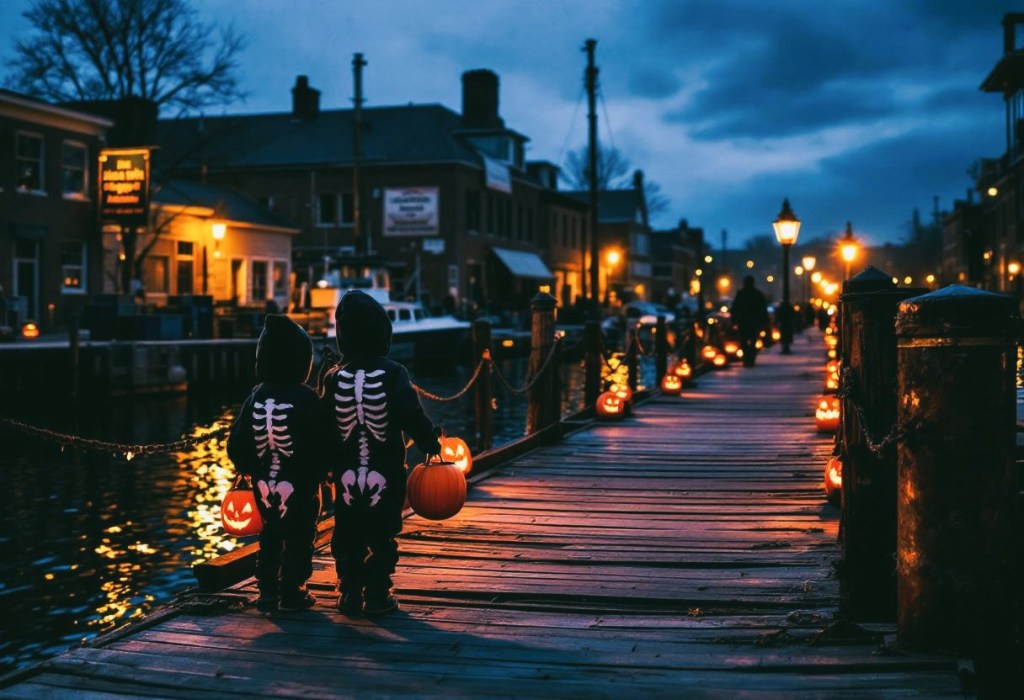
Tonight that hinge felt close by, perhaps because the harbour carried its end-of-October hush, and children in tiny capes and paper crowns scudded past my window like marginalia – contemporary, comic, and somehow accompanied by older footsteps I couldn’t quite unhear.
Maggie would remind me that an “event” is only ever an archive when someone chooses to keep it; until then it’s a crossing, sore feet and worry and a baby who will not be soothed until the kettle is found and the note about where to queue is understood.
Years ago I might have reached for larger nouns, but New Corinth has taught me that the most consequential dates in a town’s life are often stamped on cargo ledgers, not marble; the shipyards swelled and emptied, the dockside languages shifted, and the story turned on unphotographed Tuesdays.
If I am honest, the landing fascinates because it answers a question I ask for a living: how does a body learn a new season of safety, and how long must a heart stay suspicious before it believes itself housed.
I thought of this in the morning when Tom lifted two fingers in greeting across Harbour Street, his gait adjusted without fuss to what the hip permits, and the town’s ordinary care – his, mine, Elena’s, Dan’s – braided itself into a net sturdy enough to catch small falls before anyone hits water again.
And again when Marcus set the tea down at my corner table, leaving the milk within reach as if to say choice is its own kindness, and the day resumed its work of attention without insisting on spectacle to justify itself.
There’s a photograph Maggie likes to bring out for school groups: a cluster at the riverside, faces neither triumphant nor crushed, just tired and braced, which is to say human at the edge of a different country made of the same streets – no banner, no brass, only the muscle of choosing to arrive.
David – on his Wilmington day – sent a message late afternoon with a detail from a ship manifest he’s stabilising, a name half-obliterated by water damage reappearing under angled light, and the satisfaction in his note felt like a tiny rescue accomplished without witness or trumpet.
We’re both preoccupied by what can be returned to legibility without pretending nothing happened; conservators and clinicians share a suspicion of miracles that erase marks people have earned the right to keep visible.
The evening appointments loaned the theme its fuller weight: a man who has spent years mistaking vigilance for virtue trying to imagine a life that doesn’t require sleeping with his shoes beside the bed, a woman deciding whether keeping her grandmother’s silence still serves the family she has now.
What fascinates is not the decree that made such landings thinkable, but the localised logistics of mercy – who waited at the dock with bread; who learned the first names; who said, “You can come back tomorrow if you have to leave the room today,” and meant it.
Attention is how towns archive the unspectacular heroics that never make a plaque: a bench placed where the nervous can sit without apology, a docent who knows where to pause, a shopkeeper who keeps fennel back because he’s learnt your week by its flavours.
Perhaps that’s why Tuesday’s watercolour class surprised me with a familiar sensation – starting where the hand already is, accepting the wavering line, letting the paper drink what it can and no more – all of it a rehearsal for crossings that admit no guarantees.
I didn’t paint a crowd or a boat, just a sliver of gangplank and a shoe, which looked ridiculous until the shadow underneath found its courage; then the whole thing made a sort of unboastful sense, like most honest thresholds do in hindsight.
It’s tempting to insist that fascination belongs to firework moments – the footage, the countdowns, the walls failing on cue – but the older I get, the more history feels like a practice of repeated small doors rather than a single gate flung open forever.
Father Walsh, who may yet leave us for Wilmington, texted at dusk with a picture of the boardwalk blurred into violet and the single line, “The company of the living and the dead is generous tonight,” which is, in its way, a liturgy for Hallowe’en that requires no vestments.
If he goes, I’ll miss the way our walks grant courage without diagramming it; if he stays, I’ll owe him the same honesty about how often I’ve chosen movement over presence and named it virtue because the town applauded.
Jenny will, of course, roll her eyes at my romance with river metaphors and point out that the most radical act I’ve managed this month was to send a photograph of paint-smeared fingers to a man I barely know, then ask a practical question about paper and not pretend it was anything else.
She’s right, and it’s the same lesson the docks teach: people arrive with what they can carry and discover the rest on land, ordinary and miraculous in alternation, guided by neighbours who do not waste curiosity on whether anyone deserves the welcome.
So: the historical event that keeps a hold of me is an arrival that isn’t singular at all but cumulative – each family, each name coaxed back from blurred ink, each bowl set on a table in a borrowed kitchen, each permission quietly granted to leave and return until return felt possible.
New Corinth is full of these arrivals, archived in muscle memory rather than bound volumes, and the consulting room’s best days are only a more intimate version of that harbour ethic: come as you are, stay as you can, keep what must be kept, and let the rest dry in good light.
If the day had a thesis, it was written by the small gestures: Tom’s wave, Elena’s aside about proper rice tucked into a paper bag as if competence could be lent, Dan’s conspiratorial recommendation that will “overwhelm me only slightly,” all of it a civic chorus pitched for human throats rather than trumpets.
Late, the doorbell yielded a pair of small skeletons who held out plastic pumpkins and solemnly informed me I was the last house before bedtime; I gave them too much chocolate and felt, briefly, like a dockworker with a ledger of provisions and no patience for stingy accounting.
After they left, I sat with the photograph of the sliver of gangplank and the shoe, and thought about how beginnings rarely announce themselves; they’re usually something like this – awkward, tender, provisional, and already truer than the grand overtures we postpone in favour of tidy stories.
Perhaps that is all a landing is: the smallest available courage, repeated until it accrues into a place you can call home without flinching.
And perhaps that is how towns heal, too – one ordinary evening at a time, in rooms with high windows and along docks where history keeps arriving in clothes it never thinks are special while the river does its steady work of carrying and receiving without applause.
If fascination counts as a kind of fidelity, then mine belongs to thresholds you can walk in daylight, with witnesses and groceries and the ache of a long week in your shoulders; the sort you cross with no camera waiting and only your name to declare at the far side.
That feels, tonight, like a sufficient answer – and like the beginning of Saturday’s work, which is to practise this ordinary courage again, in smaller units, until it stops feeling historical and starts feeling like the life that was waiting for me at the water’s edge.
Catherine
Bob Lynn | © 2025 Vox Meditantis. All rights reserved.

 Vox Meditantis
Leave a comment