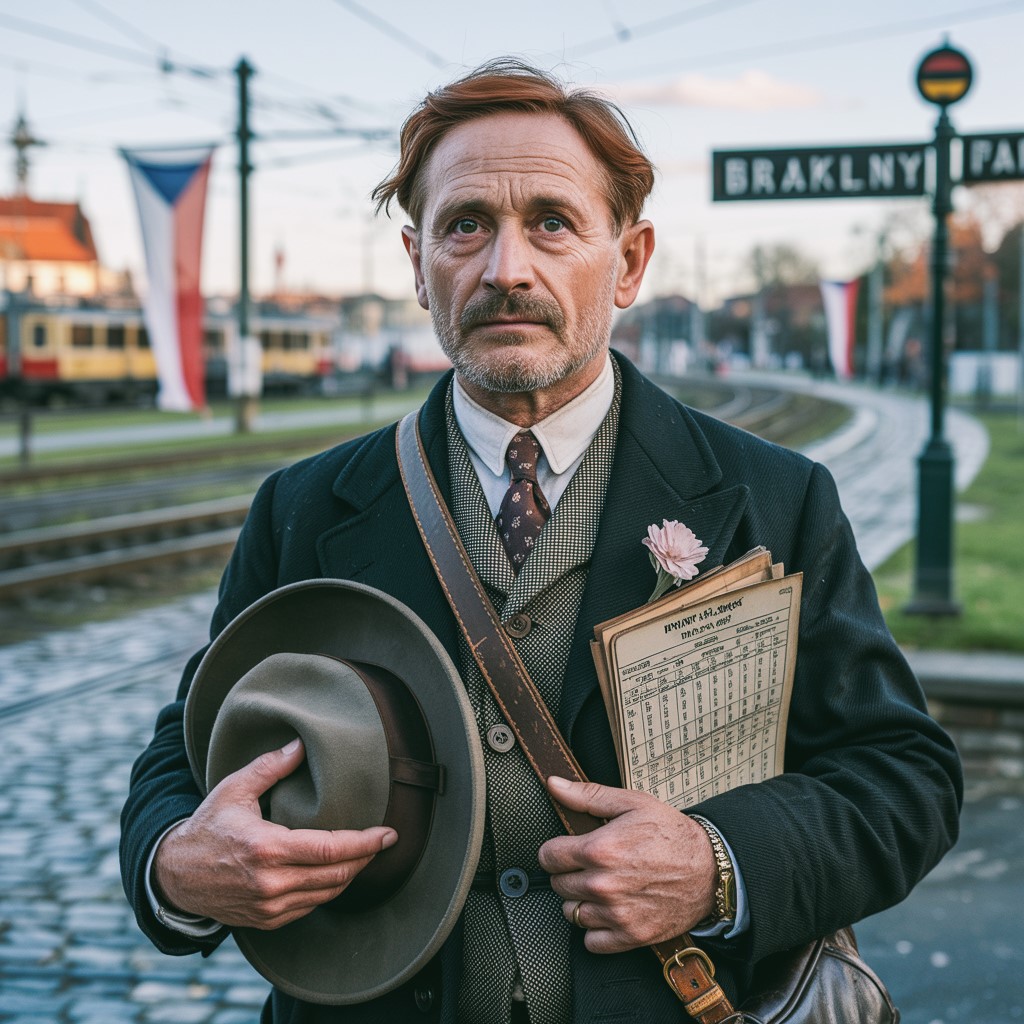
28th October, 1928 – Brno – at the crossroads by the Pražská road
The trams have been running full all day, bell after bell clanging down from the Exhibition gates, and still the crowds do not thin. I stood here at the junction for near an hour this afternoon, watching the lorries turn towards Vienna and the carts piled with folded pavilion canvas labour past towards the goods yard. Ten years to the day since the republic was proclaimed, and tonight the Exhibition closes its doors. A man feels the weight of such turnings.
The air smells of coal-smoke and roasted chestnuts, and everywhere the red-white-blue bunting snaps in the wind. I saw the Sokol lads march past in their grey shirts, straight as rails, and the Legionnaires with their medals catching the autumn light. The brass band struck up Kde domov můj, and I confess my throat grew tight. We have come through fire, and the wheels keep turning.
I had meant to catch the 16.45 to Olomouc, but the jubilee procession held up the trams and I missed the connection. No matter. A man learns patience in this trade. I walked instead to the crossroads here, where the macadam splits four ways and the signposts point to Prague, Vienna, Bratislava, and home. A fitting place to take stock.
The Exhibition has been a wonder. Electric lights strung across the pavilions like stars brought down to earth, and the machinery hall full of looms and presses that seemed almost to breathe. I sold forty bolts of damask to a buyer from Bratislava, settled an old account with a glassworks agent from Bohemia, and paid in full what I owed the dyers’ guild. Fair dealing is the only coin that does not tarnish. I saw also a woman at the fairground gates, selling paper flowers to raise money for the war widows’ fund, and I bought a dozen. One cannot forget.
This evening, as I waited by the crossing, a hawker came past with a satchel of chapbooks and penny dreadfuls. He was a Galician, I think, by his accent, and he had a queer little volume of Eastern tales – genies and wishes and palaces of brass. He read aloud to draw custom, and folk gathered round despite the cold. One story told of a merchant granted three petitions by a djinn of the desert, and the hawker asked us what we should ask for, were we so blessed.
I thought on it whilst the tram-wheels clattered and the coinage jingled in my pocket – those Czechoslovak koruny with the lion stamped in the centre, round as fate. If I were granted three petitions, I should ask thus:
First, that the rail lines and the roads remain open, that goods and folk may move freely across borders without the vexations of tariff and permit that have so plagued us since the War. A man who trades in fabric learns quickly that the world is a cloth woven of many threads, and if you pull one thread too tight, the whole unravels.
Second, that the seasons turn fair, that the harvests be sufficient and the markets steady. I have seen hunger, and I have seen the desperation that drives a man to cheat his neighbour. Let there be bread enough, and wool enough, and work enough for willing hands. Justice begins with a full stomach.
Third – and here I confess a more particular desire – that my son, who works now in the telegraph office in Prague, might one day take up the trade and learn the routes I have travelled. Not from duty, but because he sees worth in it. A man wishes to pass something on, that the wheel might turn and the cycle continue.
The hawker laughed and said I had no poetry in my soul, that I should have asked for a palace or a hoard of gold. But what use is gold that does not move? A merchant knows that wealth is in the turning, in the exchange, in the honest transaction repeated a thousand times over.
The light is fading now, and the lamps are being lit along the Pražská road. I can hear the band still playing in the distance, and the voices raised in song. Ten years. A decade gone and a decade beginning. The Exhibition will close tonight, but the trains will run tomorrow, and the lorries will carry their loads, and men will meet at crossroads and markets and railway halts to do their business as they have always done.
I shall walk back to my lodgings now and send a telegram to my son. The wireless in the hotel lounge will carry news of the jubilee speeches, and tomorrow I shall rise early to catch the first train north. There is a buyer in Šumperk who requires woollen goods before the first snow, and I have given my word.
The wheel turns. The seasons follow one upon another. The coins pass from hand to hand, each koruna earned by labour and spent in good faith, and each transaction – if it be honest – adds one small thread to the fabric of the common good. That is enough. A man need not wish for more than the chance to do his work well and to leave the world no worse than he found it.
God keep the republic, and God keep the roads open.
Set in the interwar First Czechoslovak Republic, the diary’s date – 28th October 1928 – coincides with nationwide celebrations of the state’s tenth anniversary of the 1918 independence, marked by parades and official salutes in Prague. In Brno, the Exhibition of Contemporary Culture, inaugurated on 26 May 1928 on new functionalist fairgrounds, closed that autumn after drawing over 2.5 million visitors and showcasing industrial and cultural achievement. The jubilee reflected confidence in President Tomáš G. Masaryk’s young republic and a flourishing public culture commemorated by artists such as Alphonse Mucha during the decade’s festivities. Subsequent events tempered this optimism: the 1929 Wall Street Crash brought a global depression, and within a decade German occupation reached Brno’s exhibition grounds, reshaping the republic’s fate.
Bob Lynn | © 2025 Vox Meditantis. All rights reserved.


 Vox Meditantis
Leave a comment