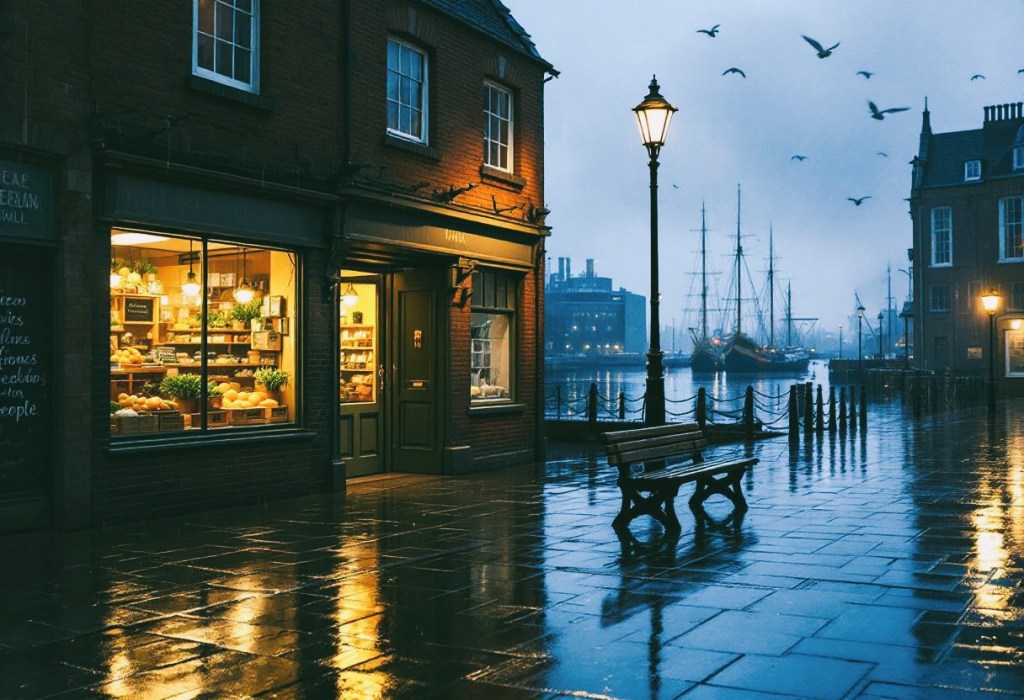
What alternative career paths have you considered or are interested in?
Friday, 24th October 2025
The question arrived while the Bartók was still settling in my bones – that long, descending phrase from Thursday night’s slow movement, the way it made sorrow sound like dignity. I’d come home to an empty flat warmed by the memory of someone washing dishes with unreasonable care, and woken Friday to find a new prompt tucked under the icebox magnet, waiting like a second cup of tea I hadn’t yet decided to pour.
What alternative career paths have you considered or are interested in?
Not a crisis, exactly. More an invitation to tilt the kaleidoscope and watch the same pieces make different sense.
Morning Consultation
The mechanic sat with his knuckles dark, speaking the old, familiar script: “I don’t know who I am when my hands aren’t black.” He’d left the garage that hollowed him and now felt unmoored, as though identity were a substance that came off with the engine grease. I nearly offered him a roadmap – sensible next steps, vocational assessment tools, the tidy scaffolding we build when vertigo sets in.
Instead I asked when he’d last felt like himself with dirty hands. His answer came soft and immediate: changing a neighbour’s alternator at dusk, her gratitude smelling of stew. There it was – the vocational compass hidden inside an ordinary sentence. We’re called by aromas before mission statements, by neighbourly thanks before job titles. I jotted one word in the margin: stew.
Between sessions I stood at the second-floor window watching the harbour become a graphite sketch, light probing a single cloud seam. I thought about my own scribbled list from breakfast – museum liaison, harbour chaplaincy, narrative medicine seminars, culinary circles, sketch mornings – and realised I’d been naming the same vocation in different rooms. Psychiatry translated into public furniture. Attention practised in a gallery instead of a consulting room. The discipline of listening, decanted into new vessels.
Civic Overture
By noon Elena had slid fennel and lemons across the counter with the conspiratorial softness of someone who knows more than she says. “Are you going to teach the cooking group?” she asked. I laughed it off, then didn’t. On the way out I paused by her window display – beans, onions, a chalked line about feeding people – and thought how many lives might improve with four calm dishes and a table that tolerates silence.
Jenny met me at Marcus’s café, scarf the colour of quince, bearing newsprint gossip: Maggie wants you for the museum pilot, Thursday afternoons, the board admires your “regrettable fondness for chairs.” We laughed, but the laughter had an aftertaste of yes. She’s right, of course. I am a chair person. I seat people.
At the Historical Society, Maggie produced the grant proposal like a polite knock on a closed door. Community Care in Cultural Spaces. Fifteen hours monthly, designing an “unoverwhelming” path through the Civil War exhibit, creating a leave-and-return ticket that tells people they’re allowed to step out and still belong when they step back in. The words struck a small, clear bell in my chest. Permission as architecture – exactly the sort of dignity I’ve practised for thirty years in a room with two chairs and a tissue box, now imagined as laminated cards and soft benches in a museum’s stillness rooms.
We walked the back stairs to storage, air thick with cotton and the ghost of starch. I could already see the curriculum: breathing in front of hard photographs, a docent’s script that includes the sentence, “Take your time; we will wait.” I could smell the pencil shavings.
Adjacent Doors
Priya hailed me from scaffolding on Harbour Street, high-vis vest bright against dull sky, still keen on that architects’ primer: how not to build panic into waiting rooms, how to design a bench that says, “Sit any way you like.” Two trades thinking in thresholds, both adjusting hinges so people move through more easily.
Dan had set aside a blue-covered text on museum pedagogy, paperclip marking the chapter on sanctuary spaces. The pleasure of being known to the marrow in an ordinary shop.
By evening I’d sketched not a career ladder but a lattice: core practice reduced slightly, museum pilot on Thursdays, community college seminar in spring, monthly culinary circle, Saturday sketch mornings once the light returns. Not reinvention. Reallocation. Less fortress, more harbour. A life with adjacent doors and no moat.
Sacramental Furniture
I found Father Walsh in the church narthex, shepherding folding chairs with beatific competence. When he asked about alternative careers, I said, “More like alternative expressions. Same vow, different verbs.” His eyes went merry. “The sacrament of chairs,” he said. “You’ve been presiding for years.”
We stood in companionable quiet, rain on stained glass making its gentle percussion, before he added, “You don’t have to change callings to change rooms.”
Walking home through harbour-night – lights caged in puddles, air tasting of tin and imprudent smoke – I passed the museum’s rain-black bricks and imagined, behind locked doors, a quiet bench waiting for breath, a docent practising the line, We’ll be here when you’re ready.
Before bed I wrote one sentence on an index card and slid it under the magnet, a second prompt to keep the first honest: You don’t need a new life; you need more doors into the one you have.
Then I listened to the harbour breathe – ropes creaking, rain easing, a gull making an after-hours complaint – and felt an old vocation loosen a notch to make room for its kinder, plural future.
Catherine
Bob Lynn | © 2025 Vox Meditantis. All rights reserved.

 Vox Meditantis
Leave a comment