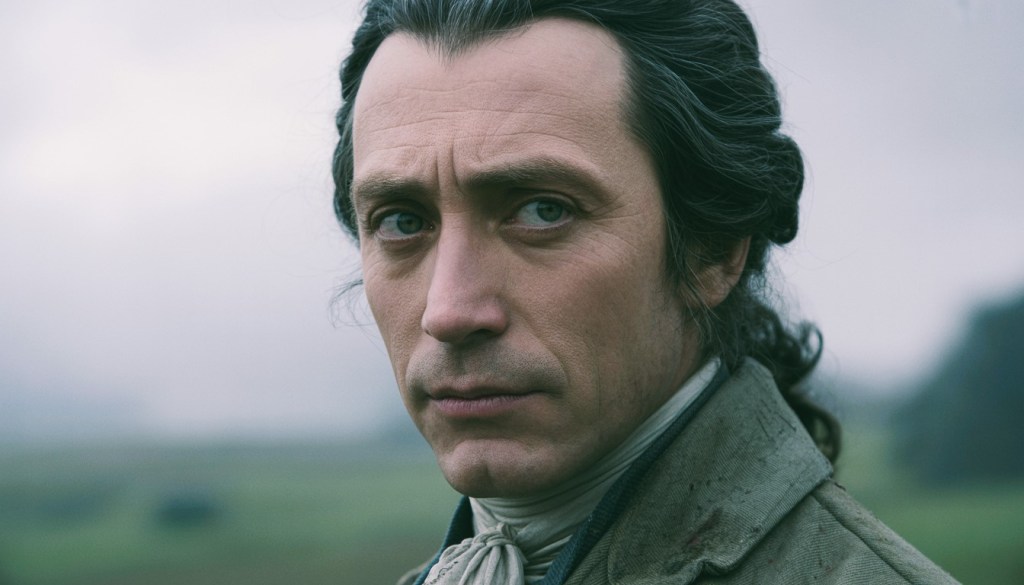
18th October 1772
I am sat upon a milestone at the crossing of the Lichfield and Burton roads, the damp October wind troubling the tails of my coat, and I confess I know not which path I ought next to take. The sky hangs low and grey as pewter, and the hedgerows drip with the morning’s rain. A carter pass’d me some quarter-hour since, touching his hat civilly enough, though his eyes betray’d that peculiar wariness country folk reserve for solitary gentlemen upon empty roads. I returned his greeting, yet felt – as I so often do – that I spoke to him across some chasm wider than the muddy track between us.
There is a malady of the spirit, I think, that hath no name in the common tongue, whereby a man may walk among his fellows and yet feel himself a stranger to their age. ‘Tis not melancholy in the customary sense, nor yet the enthusiasm of the Methodists, but rather a condition of perpetual remove – as though I carry within me the memory of another country, one that existeth not upon any map, nor in any charter’d territory of this realm. The philosophers speak of innate ideas; perhaps there are also innate longings, lock’d fast within the soul, for which no earthly key may be found.
I have been much preoccupied of late with the nature of friendship. In my portmanteau I carry three letters, all unanswered, from men whose regard I value above rubies. One writes from Edinburgh, where he attendeth lectures upon natural philosophy; another from a curacy in Shropshire, labouring amongst the poor; the third from London, where he hath lately been call’d to the Bar. Each presseth me to visit, each expresseth concern at my long silence, and yet I find I cannot take up my pen to respond. What should I write? That I carry them always in my thoughts, as a gaoler carries his ring of keys? That the lock upon my heart hath rusted with disuse, and I fear it will not open, even should I wish it?
The truth – which I confess here, in this place where no eye shall read it save my own – is that most men know me not at all. They see a gentleman of moderate means and education, civil in discourse, regular in his habits, neither extravagant nor miserly. They observe that I dress neatly, that I pay my debts, that I attend divine service with becoming gravity. What they do not perceive is the weight of years I carry – years that have not yet pass’d, years that may never pass, save in dreams and in that strange prescience that sometimes seizeth me when I walk these English lanes. I am older than my face; I am acquainted with losses not yet incurr’d. This is the secret I keep lock’d away: that I am simultaneously present and absent, a guest at a feast to which I was never properly invited.
A pedlar approach’d me just now, a woman of middling years with a basket of ribbon and thread. She offer’d to sell me a token for my sweetheart – “A pretty bit of lace, sir, French-work, very fine” – and when I declined, she peered at me with something like pity. “You’ve the look of one as walks a great distance, sir,” she said, “and finds no inn at the end of it.” I gave her threepence for her observation, which was more valuable to me than any ribbon, and she went upon her way, calling out her wares to the empty road.
The crossroads is a melancholy place, I find. It speaks of choices made and unmade, of paths taken and forsaken. Before me the Burton road runs north and east; behind me, the way I have come from Lichfield. To my left, a rutted track leads toward some nameless hamlet, its church spire barely visible through the mist. I might chuse any of these ways, or none. I might sit here until the evening draws in and the shadows grow long, and still not know which direction calleth to me. For I am bound by no appointment, expected at no hearth, answerable to no master save my own restless inclination.
Yet this freedom, which other men might envy, seemeth to me a kind of prison. I hold the keys to all doors, and therefore belong nowhere. I might enter any house as a guest, yet never as kin. The lock that guardeth true fellowship – that trust and common history whereby men become as brothers – remaineth shut to me, for I cannot give what is required: the simple gift of constancy, the willingness to abide in one place, among one people, for the span of a natural life.
A crow hath settled upon the signpost, regarding me with its bright, indifferent eye. The philosopher may discourse upon the rational soul and its distinction from the beasts; yet I wonder sometimes if that bird, which knows only the present season and the present necessity, is not happier in its unreflecting existence than I in my perpetual pondering.
The afternoon wanes. I must chuse. Yet even as I rise and brush the mud from my breeches, I know that whichever road I take will lead me only to another crossroads, another milestone, another moment of hesitation. The keys I carry will open no door that mattereth. The lock upon my heart will not yield.
Yet still I walk. For what else is given to mortal man, save to walk his appointed span upon this earth, and to hope – however faintly – that somewhere along the way he may chance upon that fellowship which maketh the journey endurable? If such companionship existeth for me, ’tis not in this age, I think. But I have not yet abandon’d the search.
The crow hath flown. I take it as an omen, though whether good or ill I cannot say.
Late Georgian Britain, on the eve of accelerating industrial and imperial change, frames the diary’s themes of travel, class, and moral self-scrutiny in 1772, a year marked by Lord Mansfield’s Somerset ruling, which undermined legal support for slavery in England though it did not abolish it across the empire. Rural roads, parish life, and lettered sociability shaped a gentleman traveller’s world, while Methodist revival and Anglican order contended for hearts and habits. Postal networks, turnpike trusts, and milestone wayfinding enabled broader movement and exchange of ideas. In subsequent decades, canal building, the early factory system, and abolitionist campaigns (culminating in the 1807 slave trade ban and 1833 emancipation) transformed Britain’s economy and conscience, deepening the tension between mobility and belonging that the diarist laments.
Bob Lynn | © 2025 Vox Meditantis. All rights reserved. | 🌐 Translate

 Vox Meditantis
Leave a comment