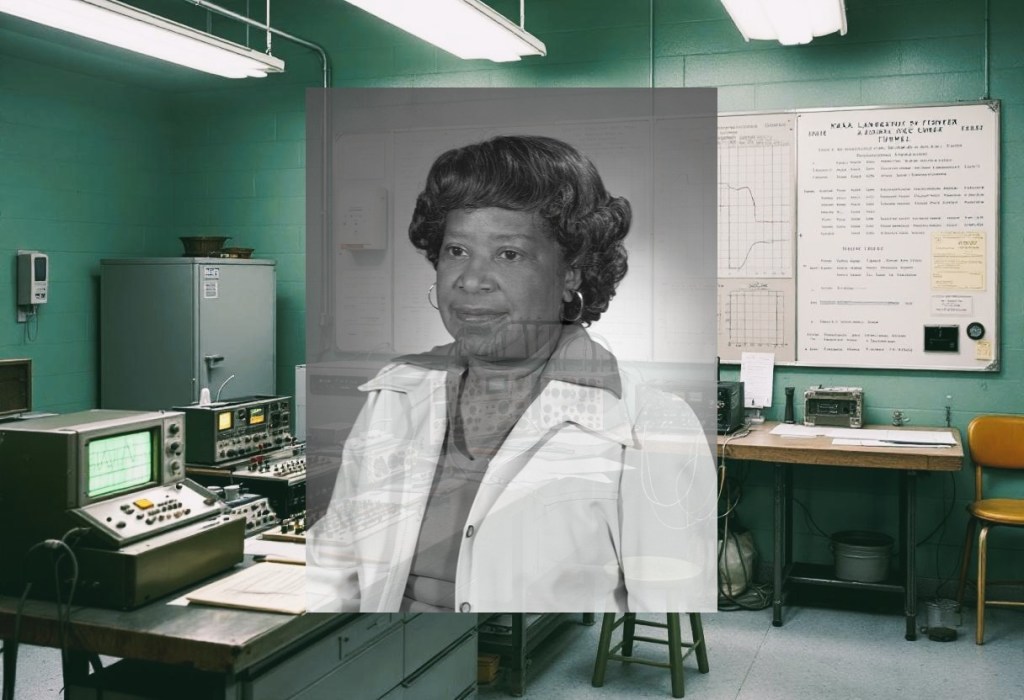
Mary Winston Jackson (1921-2005) became NASA’s first African American female engineer in 1958, a milestone achieved only after she successfully petitioned a segregated Virginia court for the right to attend graduate-level engineering courses alongside white students. For two decades, she authored or co-authored twelve technical reports on boundary layer effects and supersonic aerodynamics, conducting wind tunnel research that remains foundational to modern aircraft and spacecraft design. In 1979, having reached the highest engineering grade available without entering management, she made the calculated decision to accept a demotion and become Langley’s Federal Women’s Programme manager, spending her final working years clearing pathways for others that institutional racism had blocked for her.
Mrs Jackson, thank you for joining us today. I want to begin in 1953, at Hampton City Hall. You’re standing before a judge in segregated Virginia, a Black woman petitioning for permission to take engineering courses at an all-white high school. What were you thinking as you made that argument?
Well, I was thinking that if I didn’t ask, the answer was already no. I’d been working as a mathematician in the West Area Computing section for two years by then, doing calculations for engineers who had the degrees I didn’t. My supervisor, Kazimierz Czarnecki, saw what I could do and told me I should be an engineer, not just computing for them. But that required courses, and those courses were only offered at Hampton High School – a white school. So I had to go before that judge and explain why a Negro woman needed engineering classes badly enough to integrate their evening programme.
I remember choosing my words carefully. I didn’t go in there angry, though Lord knows I had reason to be. I went in there logical. I explained exactly which courses I needed, why the Negro schools didn’t offer them, and what I intended to do with that education. I made it a practical question, not a moral one, though of course it was both. The judge granted the petition. Sometimes the system has a crack in it just wide enough to slip through if you know where to press.
You mentioned working as a “computer” – a human computer. For readers who might not fully grasp what that meant, could you describe what that work actually entailed?
Oh, we were the calculators before electronic computers took over. Engineers would bring us their equations – differential equations, aerodynamic formulas, loads of data from wind tunnel tests – and we’d work through them by hand. Slide rules, mechanical calculators, tables of logarithms, graph paper. We’d compute trajectories, analyse airflow data, check the mathematics behind every aircraft design that came through Langley.
It was meticulous work. One decimal place wrong and you could send an aircraft into a spin. We worked in teams, often with one person calculating and another checking, because accuracy mattered more than speed, though they wanted both. The West Area Computing section was all Negro women – Dorothy Vaughan was our supervisor. We were segregated from the white computers, separate office, separate dining area, separate lavatories. But the mathematics? The mathematics didn’t care what colour your skin was. The numbers were honest even when the people weren’t.
When you transitioned from mathematician to engineer in 1958, your focus became supersonic aerodynamics, specifically boundary layer effects. For the experts reading this – walk us through what that work actually involved. What were you measuring, and why did it matter?
Right. So when an aircraft moves through air at high speeds – particularly at supersonic speeds, faster than sound – the air doesn’t just flow smoothly around it. There’s a thin layer of air right at the surface of the aircraft, maybe a few millimetres thick, where the airflow transitions from zero velocity at the surface to the freestream velocity further out. That’s your boundary layer.
Now, at low speeds, that boundary layer stays laminar – smooth, orderly flow. But as you increase speed, especially past Mach 1, that flow can become turbulent, chaotic. The transition point – where laminar flow breaks down into turbulence – that’s critical. Turbulent flow creates more drag, generates more heat, affects lift characteristics. If you’re designing a supersonic aircraft or a spacecraft re-entering the atmosphere, you need to know precisely where and when that transition occurs.
I worked primarily in the Supersonic Pressure Tunnel, a four-by-four-foot test section where we could generate airspeeds from Mach 1.6 to Mach 2.5. We’d mount models – often cone shapes, cylinder shapes, different nose configurations – and we’d instrument them with pressure taps, sometimes fifty or sixty tiny holes drilled at specific locations. Each hole connected to a pressure transducer. As the air flowed over the model at supersonic speeds, we’d measure the pressure distribution across the surface.
My first report, co-authored with Dr Czarnecki in 1958, examined how nose angle and Mach number affected transition on cones. We tested cones with nose angles ranging from 5 degrees to 25 degrees at Mach numbers between 1.6 and 2.3. We were looking for patterns – at what point does the flow trip from laminar to turbulent? How does the cone angle shift that transition point? How does increasing speed affect it?
The measurements had to be extraordinarily precise. We’re talking about pressure differences measured in pounds per square foot, sometimes just fractions of a pound. The data would come off the instruments as voltage readings that we’d convert to pressure coefficients, then plot against the cone station – the position along the cone’s length. You’d see it clearly on the plots: smooth, predictable pressure distribution in the laminar region, then this characteristic jump or fluctuation where transition began, then the flatter, more chaotic distribution in the turbulent region.
What were the practical applications? How did this research translate to actual aircraft performance?
Everything. If you know where transition occurs, you can design surfaces to delay it – keeping the flow laminar longer reduces drag, which means less fuel consumption and higher speeds. You can also predict heating loads, which is critical for high-speed aircraft and absolutely essential for spacecraft. When a capsule re-enters the atmosphere at Mach 20 or 25, the heat generated in that boundary layer can melt steel. Knowing where turbulent flow starts, how intense it gets, that tells you where to put thermal protection, how thick it needs to be.
Our wind tunnel work fed directly into the design of the X-15, the Mercury capsules, eventually Apollo. We were testing configurations, measuring actual data, providing engineers with the empirical evidence they needed to make design decisions. You can calculate theoretically all day long, but until you put a model in a wind tunnel and measure what actually happens, you’re just guessing.
Were there competing approaches or theories about boundary layer transition that you were testing against?
Oh yes. There was considerable debate about what triggered transition. Some researchers emphasised surface roughness – any imperfection on the aircraft skin could trip the flow into turbulence. Others focused on pressure gradients – how rapidly the pressure changes along the surface. Still others looked at environmental factors, freestream turbulence in the air itself.
The reality was that all of these factors interacted. A cone with a rough surface would transition earlier than a polished one, but the Mach number and nose angle also shifted the transition point. We were building up an empirical database, testing systematically across different variables so we could separate the effects.
One thing we found – and this was somewhat contrary to earlier assumptions – was that blunter nose angles didn’t always behave as predicted at higher Mach numbers. The conventional wisdom was that sharper noses were always better for supersonic flight, less drag. But our measurements showed that at certain Mach numbers, particularly above Mach 2, a slightly blunter nose could actually produce a more favourable pressure distribution that delayed transition. It was counterintuitive, but the data didn’t lie.
You mentioned instrumentation – fifty or sixty pressure taps on a single model. That sounds incredibly labour-intensive.
It was. Building and instrumenting those models was an art. You had to drill the holes at exact angles, position them precisely along the model surface, connect each one to tubing that ran inside the model to the transducers. One blocked hole, one leak in the tubing, and that data point was useless. We’d spend days preparing a single model, then maybe a week running tests, then weeks analysing the data.
And here’s something that didn’t make it into the reports: we learned to listen to the tunnel. When you’re running at supersonic speeds, the tunnel has a sound, a particular roar. Experienced engineers could hear when something was wrong – a model starting to vibrate, a pressure leak, flow separation happening where it shouldn’t. You’d be monitoring your instruments, but your ears were part of the diagnostic kit too.
That kind of tacit knowledge – the listening, the feel for when something’s off – rarely appears in the technical literature.
No, it doesn’t. The reports show the clean data, the nice plots, the conclusions. They don’t show the troubleshooting, the repeated tests when something didn’t make sense, the middle-of-the-night realisations that you’d misinterpreted a reading. Science is messier than the papers suggest.
I remember one test series where we kept getting inconsistent transition points on identical runs – same model, same Mach number, same tunnel conditions. We spent days checking instruments, recalibrating transducers. Finally, someone noticed that the tunnel temperature was fluctuating slightly between runs because of how the cooling system cycled. Tiny temperature differences changed the air density just enough to affect the Reynolds number, which shifted transition. We had to control for tunnel temperature after that, wait for thermal equilibrium before starting each run.
That’s not in the reports either, but that’s where the real learning happened.
By 1979, you’d reached the highest engineering grade at Langley without moving into management. And then you made a choice that, frankly, still surprises people: you accepted a demotion to become manager of the Federal Women’s Programme. Why?
Because I’d spent twenty-eight years watching talented people hit ceilings that had nothing to do with their abilities. I’d been that person. And I realised that I could stay in engineering, doing work I loved, making incremental contributions to reports that a dozen people would read – or I could use whatever small amount of institutional power I’d accumulated to actually change who got through the door in the first place.
The engineering title meant something to me, don’t misunderstand. I’d fought for it. But I looked around Langley in the late seventies and I didn’t see nearly enough women, hardly any Black engineers, almost no Black women coming up behind me. The barriers I’d faced in 1953 were still there, just wearing different clothes. Informal networks that excluded women, hiring practices that somehow never found qualified minority candidates, mentorship that flowed along colour lines.
I thought: I can either be the exception that proves the rule, or I can try to break the rule. So I took the demotion. Gave up the engineering grade, took the pay cut, and started working on hiring, on promotion pipelines, on making NASA’s recruitment reach into schools and communities it had ignored.
That must have been enormously difficult – to walk away from the technical work.
Oh, it hurt. I won’t pretend it didn’t. I loved the puzzles, the elegance of a clean data set, the satisfaction of understanding how air moves. But I’d also reached a point where I knew – knew with the certainty of a measured result – that individual achievement wasn’t enough. The system was designed to let one or two of us through and then close the gate. And I was tired of being grateful for the exception.
Also, let me be clear: the work I did in the Federal Women’s Programme was just as complex as engineering. Handling institutional politics, building coalitions, persuading people to change hiring practices they didn’t think were problems – that required strategy, persistence, creativity. Different tools, same problem-solving mindset.
You’ve mentioned strategy several times. It occurs to me that much of your life required strategic thinking – knowing when to petition the court, when to accept demotion, how to overcome segregation. Was that something you consciously cultivated?
I grew up in Hampton, Virginia, in the twenties and thirties. Being a Negro in the South meant you were always calculating – what you could say, where you could go, how to get what you needed without triggering someone’s prejudice. That’s strategy born of necessity.
But yes, I did think strategically, particularly about my career. I knew I couldn’t confront every injustice head-on and survive professionally. So I picked my battles. I focused on places where a small push might move something – like that court petition. I built relationships with people who had power and were willing to use it, like Dr Czarnecki. I documented everything, kept my work meticulous, because I knew I’d be scrutinised more carefully than my white colleagues.
And I looked for leverage points. When I shifted to the Federal Women’s Programme, I had access to hiring data, to promotion records. I could walk into a director’s office and say, “Here’s what the numbers show. Here’s what we’re legally required to do. Here’s how other centres are handling this.” Data is persuasive, even to people who’d rather not be persuaded.
Let’s talk about something you were known for outside NASA – your community work. You were a Girl Scout leader for over thirty years, you helped young people build wind tunnels in the 1970s. Why was that important to you?
Because those young people were the future, and most of them had no idea what was possible. I’d go into schools in Hampton and ask how many students had heard of aeronautical engineering. Maybe one or two hands. Ask how many knew a Black scientist personally. No hands.
That invisibility is dangerous. If you can’t see yourself in a field, you don’t imagine entering it. So I brought the field to them. We’d build little wind tunnels out of cardboard and fans, test paper airplane designs, talk about lift and drag. I’d bring in other Black scientists and engineers from Langley so these children could see that we existed, that this was work they could do.
I remember one girl, maybe thirteen years old, who was convinced she wasn’t “smart enough” for science. I had her calculate the wing area of a model airplane, then measure the lift force, then compute lift coefficient. She did it perfectly. I said, “You just did aeronautical engineering. What do you mean you’re not smart enough?” Seeing her face change – that was worth a hundred technical reports.
You have a quote from the 1970s: “We have to do something like this to get them interested in science. Sometimes they are not aware of the number of Black scientists, and don’t even know of the career opportunities until it is too late.” That echoes strongly today, given ongoing efforts to diversify STEM fields.
It’s the same fight, isn’t it? We’ve made progress – there are more of us now, more women, more people of colour in engineering. But the percentages are still shamefully low, particularly for Black women. When I started in 1951, I may have been the only Black female aeronautical engineer in the country. Today? Still rare enough to be remarkable, and that’s not acceptable.
The barriers have shifted but not disappeared. Explicit segregation is gone, thank God, but there’s still inequitable access to quality STEM education, still unconscious bias in hiring and promotion, still a culture in many technical fields that assumes competence looks a certain way – and that way is usually white and male.
And here’s what frustrates me: we keep rediscovering this problem every generation. We act surprised that women and minorities are underrepresented, we launch initiatives, we make modest gains, then funding dries up or attention shifts and we backslide. What we need is sustained institutional commitment, not periodic guilt.
If you were advising a young Black woman entering aerospace engineering today, what would you tell her?
First, that she belongs there. Not as a favour, not as diversity window-dressing, but because her mind and her contributions are needed. The problems we’re solving – climate change, space exploration, sustainable aviation – they’re too complex for any homogeneous group to tackle alone. We need different perspectives, different ways of thinking.
Second, document everything. Keep records of your work, your ideas, your contributions. The system has a habit of erasing our presence, crediting our work to others, forgetting we were in the room. Protect your own history.
Third, find your people. I had Dorothy Vaughan, Katherine Johnson, Christine Darden, a whole community of women who understood what we were up against. You need colleagues who will advocate for you, who’ll tell you when you’re being underpaid or passed over, who’ll celebrate your successes. Don’t try to do it alone.
And fourth – this is important – don’t sacrifice your whole life to proving yourself. I gave everything to that work, and I don’t regret it, but I also know I missed things. I had a family, a life outside Langley, but there were times I let the need to be twice as good, to never give them a reason to doubt me, consume too much. You are not responsible for dismantling racism and sexism singlehandedly whilst also doing your job. That’s too much to carry.
Let’s talk about mistakes. Looking back over your career, what do you wish you’d done differently?
I wish I’d been louder earlier. I was so focused on being strategic, on not rocking the boat too hard, that I sometimes stayed quiet when I should have spoken up. There were meetings where I was the only woman, the only Black person, and I’d watch decisions get made that I knew were flawed, but I’d calculate: is this the fight worth having? Will speaking up cost me credibility I need for a bigger battle later?
Sometimes that calculation was correct. But sometimes I think I gave the system too much credit, assumed it would eventually recognise talent and fairness on its own. It won’t. It requires constant pressure.
I also wish I’d pushed harder for my name to be first author on some of those reports. In the fifties and sixties, I was often junior author even when I’d done the bulk of the work. That was the hierarchy – the senior engineer got first authorship. But that meant my contributions were buried, less visible. I could have negotiated that differently, insisted on recognition that matched effort.
There’s been considerable attention to your story since Hidden Figures came out in 2016. How do you feel about that recognition, coming as it did after your death?
Well, I can’t say I’m thrilled about the timing. I died in 2005 thinking my work was mostly forgotten outside the handful of people who’d worked with me. And then eleven years later, suddenly I’m famous? NASA names their headquarters after me? It’s gratifying, but it’s also absurd.
The real question is: why did it take a book and a movie to make NASA remember its own history? We were there the whole time. Our names were on reports, in personnel records. The institution knew what we’d contributed, but it didn’t value that contribution enough to tell the story, to make us visible whilst we were alive to see it.
So yes, I’m glad people know now. I’m glad young women can see themselves in our story. But I’m also angry that recognition is so often posthumous, that we had to be rediscovered rather than simply remembered.
Your boundary layer research continues to inform modern aerospace engineering – computational fluid dynamics, hypersonic vehicle design, spacecraft thermal protection. Does it surprise you that work from the 1950s and 60s remains relevant?
Not really. The fundamental physics hasn’t changed. Air still behaves the same way at Mach 2 whether you’re testing in 1958 or 2025. What’s changed is our ability to model it – you’ve got computers now that can simulate airflow with extraordinary detail, run thousands of virtual tests in the time it took us to do one physical test.
But here’s the thing: those computational models still need validation. You still need empirical data to check your simulations against, to make sure your code is capturing the real physics. The wind tunnel data we generated in the fifties and sixties is still referenced because it’s reliable, carefully measured benchmark data.
I do find it interesting that some of the configurations we tested – blunt body re-entry shapes, for instance – are coming back into fashion for hypersonic flight. We were looking at those shapes for spacecraft, and now they’re being considered for long-range hypersonic cruise vehicles. The problems cycle back around, and sometimes the old data becomes new again.
If you could witness one current development in aerospace engineering, what would you choose?
I’d want to see a crewed mission to Mars. Not just the landing, the whole thing – launch, transit, landing, surface operations, return. I want to see how they solve the life support problems, the radiation shielding, the entry descent and landing at Mars’s lower atmospheric density. I want to see the engineering.
And I want to see who’s in that crew. I want it to be diverse – different genders, different backgrounds, different nations. I want it to reflect the fact that space exploration belongs to all of us, not just a narrow slice of humanity.
Space was always the dream when I was working. We were testing components, solving individual problems, but it was all in service of getting people off this planet, extending our reach. I’d love to see that dream fully realised, done right, done inclusively.
Final question: What do you want your legacy to be?
I want people to remember that excellence and advocacy aren’t separate things. You don’t have to choose between doing brilliant technical work and fighting for justice. You can – you should – do both.
I want the young people who hear my story to know that the barriers they face aren’t their fault, and overcoming them isn’t just their responsibility. But I also want them to know they can push back, strategically, persistently. Find the cracks in the system and make them wider for the next person.
And I want the institutions – NASA, universities, companies – to remember that talent isn’t rare. It’s poorly distributed opportunity that’s rare. If you genuinely open the doors, if you create environments where people from all backgrounds can thrive, you’ll find brilliance everywhere. We were always there. You just weren’t looking.
Mrs Jackson, thank you. This has been an extraordinary conversation.
Thank you for asking the right questions. And for remembering.
Letters and emails
Since publishing this interview, our community has sent dozens of letters and emails with further questions for Mary Jackson – from researchers facing similar technical challenges to educators seeking inspiration for their students, and from those navigating their own paths through institutions that weren’t built with them in mind. We’ve selected five that represent the breadth and depth of that curiosity, each offering Mrs Jackson the chance to expand on her life, her work, and the counsel she might offer to those following similar journeys today.
Katarina Novak, 34, Computational Fluid Dynamics Researcher, Prague, Czech Republic
You mentioned that computational models today still need empirical validation against wind tunnel data like yours. I’m curious about the reverse relationship – if you had access to modern CFD software in the 1950s and 60s, how might that have changed your experimental approach? Would you have designed different tests, or would the wind tunnel work have remained fundamentally the same? I’m trying to understand whether computational tools would have accelerated your discoveries or simply shifted where you spent your time.
That’s a fascinating question, Katarina, and one I’ve thought about quite a bit since computational tools have become so sophisticated. If we’d had CFD software in the fifties and sixties – well, first I’d need to imagine we also had the computing power to run it, which is a whole other matter. The computers we had then couldn’t handle the complexity of turbulent flow simulations. But let’s say we did.
I think it would have fundamentally changed our experimental strategy, but not eliminated the wind tunnel work. Here’s why: with computational models, we could have explored a much wider parameter space before ever building a physical model. Instead of testing maybe five or six nose angles, we could have simulated fifty configurations, identified the most promising candidates, and then built models only for those. That would have saved enormous time and expense in model fabrication.
We also could have used simulations to explain what we were seeing in the tunnel. I remember spending weeks puzzling over unexpected pressure distributions, trying to understand the flow physics that produced them. A good CFD visualisation would have shown us the shock wave structures, the vortices, the separation bubbles – all the invisible aerodynamics that we could only infer from surface pressure measurements. That would have accelerated our understanding considerably.
But – and this is important – I don’t think we would have trusted the simulations alone, not for design decisions. The computational models are only as good as their underlying assumptions and boundary conditions. Turbulence modelling, in particular, involves approximations that need empirical validation. We’d still need wind tunnel data to check the code, to make sure it’s capturing reality and not just mathematical artifacts.
What I think would have changed most is the dialogue between experiment and theory. Instead of running tests somewhat blindly, hoping to find patterns, we could have used simulations to generate hypotheses and then designed very targeted experiments to test those hypotheses. More strategic testing, you might say. Less brute force exploration.
I also suspect – and this is speculation – that having computational tools would have revealed new questions we didn’t even know to ask. That’s often how it works: a new capability doesn’t just answer old questions more efficiently, it opens up entirely new lines of inquiry. We might have started looking at unsteady effects, complex three-dimensional flows, things that were simply beyond reach with steady-state pressure measurements alone.
So to answer directly: yes, CFD would have changed our approach significantly. We would have spent less time building and testing marginal variations, more time on carefully chosen validation cases. But the wind tunnel would still have been essential – the final arbiter of whether our mathematics matched reality. You can’t fly an airplane on a simulation alone. The air doesn’t care about your equations.
Bruno Carvalho, 47, Secondary School Physics Teacher, São Paulo, Brazil
In your community work, you helped young people build cardboard wind tunnels to make aeronautics tangible. I work with students who have minimal laboratory resources, and I’m always looking for ways to demonstrate advanced concepts with simple materials. Could you describe one of those makeshift wind tunnels in detail – what were the key components that actually worked to show meaningful aerodynamic principles, and what measurements or observations could students realistically make with that kind of setup? I’d love to replicate something similar.
Oh Bruno, I’m so glad you asked this, because those makeshift wind tunnels were some of the most rewarding work I did. Let me walk you through what we built with the young people in Hampton, and you can adapt it for your students in São Paulo.
The basic design was very simple. We used a large cardboard box – the kind a refrigerator or washing machine comes in – as the test section. One end we’d cut out and mount a fan, nothing fancy, just a household box fan that you could buy at any hardware store. The fan pulled air through the tunnel rather than pushing it, which gave us smoother, more uniform flow. At the other end, we’d create an inlet with some screening or cheesecloth to straighten the airflow and reduce turbulence.
Inside the tunnel, we’d mount models on a simple wooden dowel that went through the top and bottom of the box. The models themselves were usually paper airplanes, balsa wood shapes, or foam cores cut into different wing profiles. Here’s the key: you want the models small enough that they don’t block too much of the tunnel cross-section – maybe one-fifth the width at most – or you get wall effects that mess up your measurements.
Now, for what students could actually measure and observe: the most dramatic demonstration was flow visualisation using smoke. We’d use incense sticks positioned upstream of the model. When the fan runs, you can see the smoke trails flowing around the wing or fuselage, and students can observe with their own eyes how the flow stays attached on a streamlined shape but separates and becomes chaotic behind a blunt object. That visual alone teaches more about aerodynamics than a dozen lectures.
For actual measurements, we kept it straightforward. We’d attach the model to a simple spring scale – the kind used for weighing fish or produce – oriented to measure the drag force pulling backward on the model. Students could test different shapes, record the force readings, and compare which designs created more or less drag. They’d discover that streamlined shapes produced less drag than blunt ones, that angle matters, that small changes in geometry have measurable effects.
We also had students make simple pitot tubes from plastic straws and water-filled tubing bent into a U-shape. The height difference in the water columns gave a rough indication of air speed at different positions in the tunnel. Not precise, but precise enough to show that air slows down near the walls and speeds up around narrow sections.
The beauty of this setup, Bruno, is that it cost maybe ten or fifteen dollars in materials, took an afternoon to build, and demonstrated fundamental principles that are identical to what we were studying in NASA’s million-dollar facilities. The physics doesn’t change with the budget. Air behaves the same way whether you’re working with cardboard or stainless steel.
Zola Mbeki, 29, Aerospace Startup Founder, Cape Town, South Africa
You’ve talked about the strategic choice to move into advocacy work, but I’m wondering about the emotional weight of that transition. When you walked away from active engineering research, did you experience grief – not just for the work itself, but for the identity you’d fought so hard to claim? And if so, how did you reconcile that loss with the knowledge that you were doing something equally valuable? I’m asking because I sometimes feel torn between technical contribution and the broader work of building inclusive structures in my field.
Zola, yes. There was grief. I won’t soften that for you. When I made that transition in 1979, I mourned the work in ways I didn’t fully expect.
It wasn’t just leaving the technical problems, though I did miss those – the elegance of a clean data set, the satisfaction of understanding something about how the physical world behaves. But what I grieved most was the identity I’d fought twenty-six years to claim. I was an engineer. Not a woman engineer, not a Black engineer, just an engineer. I’d earned that, battled for it, proven it over and over. And then I voluntarily walked away from it. That felt like betraying something I’d built.
I remember my last few weeks in the engineering section, looking at the wind tunnel, at the equipment I’d worked with for so long, and feeling this profound sense of loss. My colleagues threw a small gathering, and people said kind things about my contributions, but I could see some of them thought I was making a mistake. Maybe they were right. I don’t know.
The reconciliation – that took time, and I’m not sure it was ever complete. What helped was recognising that identity isn’t just what you do; it’s also who you serve. I’d been serving the mission of flight, of understanding aerodynamics, and that was good work, important work. But I was also watching talented women and minority candidates get passed over, watching the doors stay closed, and I realised I could serve something equally important: the principle that everyone deserves access to the work they’re capable of doing.
I had to reframe what contribution meant. An engineer solves problems. Well, NASA’s hiring and promotion practices were a problem, one that affected hundreds of people’s lives. I could apply the same problem-solving approach – gather data, identify barriers, design interventions, measure results. Different domain, same mindset.
But I’ll tell you honestly, Zola: there were days when I’d hear about a fascinating project happening in the wind tunnels, and I’d feel a sharp pang of regret. What would I have discovered if I’d stayed? What problems could I have solved? Those questions don’t have answers, and that’s hard.
What I learned is that you can grieve a path not taken and still know you made the right choice. The two aren’t mutually exclusive. The grief doesn’t mean you failed; it means you cared deeply about what you gave up, which makes the sacrifice real and meaningful.
My advice to you: don’t deny the grief if it comes. Let yourself feel it. But also trust that you can build a new identity that’s just as valid, just as hard-won. You’re not abandoning your technical self; you’re expanding what it means to be a builder. Sometimes we build aircraft. Sometimes we build pathways. Both require engineering.
Ethan Wallace, 41, History of Science Lecturer, Melbourne, Australia
Imagine the court in Hampton had denied your 1953 petition to take those engineering courses. What would your alternative path have looked like? Would you have found another way into engineering, perhaps relocated to a different state with less restrictive segregation, or might you have channelled your talents into a different field entirely? I’m curious whether you saw engineering as the singular goal or whether there were other scientific paths you’d considered if that particular door had remained closed.
Ethan, that’s a fine “what if,” and I can tell you I considered it myself. If Judge David Hall in Hampton had said no in 1953 – if I’d been denied the right to take those classes with the white folks at Hampton High – my story would be different, and so would a piece of NASA’s.
I’m stubborn by nature; ask anyone who knows me. I don’t back off easily, but I’m also practical. If the doors stayed closed in Virginia, my first thought would have been to look for another way through. Norfolk State and Virginia Union were options, but neither offered the engineering coursework I needed. Maybe I would have chased distance learning – the University of Michigan had some correspondence packages for aeronautics, though they didn’t let many Negroes in and the cost was a mountain. Still, I’ve seen taller.
At one point, my husband Levi and I talked about whether we ought to pack up for Ohio or Illinois, where the colour bar wasn’t quite so heavy in education. But we had our life in Hampton, our children, our church, and moving north was more than picking up a suitcase. It meant abandoning the community I was already serving in smaller ways – Girl Scouts, youth science camps, tutoring at Carver High.
If engineering had stayed shut, I’d likely have poured myself deeper into mathematics or teaching. The West Area Computing section was full of brilliant women – Dorothy Vaughan, Katherine Johnson. If I could not become an engineer by title, I would have kept on as a “computer” – maybe moved into teaching or even tried to get into industry, though they didn’t welcome us much there either. There was temptation to join a local school, mentor the next generation through numbers, build a different sort of bridge.
I even thought about medical technology for a spell, but planes and flight always called me back. That’s the honest truth – my heart beat faster thinking about the mechanics of air more than any calculation for health sciences.
Would it have felt like second best? Perhaps for a time. But I couldn’t let a slammed door close the whole house. I’d have kept banging until someone listened – or I’d have made a window, as my mother used to say.
What I want the young people reading this to know is: paths get blocked, but it doesn’t mean you stop walking. You change shoes, take a different route, and sometimes you find out the other road leads to good country you never planned to see. If I hadn’t fought in court, maybe I’d be known as a teacher, not an engineer. Either way, I’d have wanted to leave things better than I found them. That’s what mattered, in the end.
Layla Al-Farsi, 52, Aviation Safety Consultant, Doha, Qatar
You tested aircraft configurations that were classified at the time, working on projects critical to national security during the Cold War. Looking back now, how do you feel about the military applications of your aerodynamics research? Did you ever struggle with the dual-use nature of the work – that the same boundary layer analysis improving commercial aircraft efficiency was also advancing military capabilities? Or was that tension simply not part of the conversation in your era?
Layla, that’s a complicated question, and I appreciate you asking it directly. Yes, much of what we did at Langley had military applications. We were in the Cold War, testing aircraft that would carry weapons, designing re-entry vehicles that could also be missiles. That was the reality of aerospace work in the fifties and sixties – civilian and military purposes were so tangled together you couldn’t separate them cleanly.
Did I struggle with it? Honestly, not as much as perhaps I should have. Let me explain why, and you can judge that for yourself.
First, I was focused on the science. When you’re measuring pressure distributions on a cone at Mach 2, you’re thinking about boundary layer transition, about getting accurate data, about whether your instruments are calibrated correctly. The immediate problem in front of you consumes your attention. It’s only later, stepping back, that you ask: what will they build with this knowledge?
Second – and this is important context for the era – we believed we were on the defensive side. The Soviet Union had launched Sputnik, they were advancing rapidly, and there was genuine fear that America was falling behind in technology that could determine whether we remained free or fell under totalitarian control. That’s how it was framed to us, and that’s largely how we saw it. We weren’t thinking of ourselves as developing weapons of aggression; we thought we were protecting the country.
Third, and I’ll be blunt about this: as a Black woman in 1958, I had limited power to shape how my work would be used. I could refuse to do the research, but someone else would do it instead, and I’d have sacrificed the opportunity I’d fought so hard to get. That might sound like a rationalisation, and maybe it is, but it’s also practical reality. The moral luxury of turning down work on ethical grounds is more available to people who have other options.
That said, looking back now with decades of distance, I do think we were too uncritical. We should have asked harder questions about what we were building, who would be harmed by it, whether the arms race we were feeding actually made anyone safer or just accelerated mutual destruction.
The tension you’re describing – dual-use technology – wasn’t much discussed openly in our circles. There was an assumption that American military strength was inherently good, that technological superiority was the path to peace. I accepted that framework more than I questioned it.
What gives me some peace is that the same aerodynamics research that informed military aircraft also advanced commercial aviation, space exploration, scientific understanding. The wind tunnel data we generated serves peaceful purposes today. But I won’t pretend the military applications weren’t real or that I fully considered their implications at the time. I was trying to be an engineer. I didn’t ask enough about what kind of world that engineering was building.
Reflection
Mary Winston Jackson died on 11th February 2005 at the age of 83, having lived long enough to see the Space Shuttle era but not long enough to witness the global recognition that would arrive eleven years later with Hidden Figures. In this imagined conversation, we’ve attempted to give her what history denied: the chance to speak for herself, to explain not just what she accomplished but why it mattered and what it cost.
Throughout our exchange, certain themes emerged with clarity – perseverance measured not in grand gestures but in calculated daily resistance, ingenuity applied as much to navigating institutional barriers as to solving aerodynamic puzzles, and the persistent erasure of women’s contributions to fields they helped build. Jackson’s decision to accept demotion in 1979 remains one of the most striking acts of strategic activism in NASA’s history, a recognition that individual excellence, however hard-won, could not dismantle structures designed to exclude.
Where this fictional perspective might diverge from recorded accounts is in her willingness to articulate regret and self-critique. The historical record preserves her technical reports and her advocacy work, but offers limited access to her interior life – the grief of leaving engineering, the moral complexity of Cold War research, the frustration of posthumous recognition. We’ve imagined a voice that balances pride with candour, achievement with acknowledgement of what remained incomplete.
Significant gaps persist in Jackson’s story. Many of her technical contributions were embedded in team reports or remained classified for years, making it difficult to trace her specific influence. Her community work – the Girl Scout leadership, the youth science programmes – is documented primarily through local memories rather than institutional archives, a reminder that not all forms of mentorship leave paper trails.
Yet her legacy reverberates in measurable ways. The boundary layer research she conducted in the 1950s and 60s continues to inform computational fluid dynamics and hypersonic vehicle design. Her 1979 career pivot prefigured today’s recognition that diversity requires institutional power, not just individual representation. NASA’s 2020 decision to name its Washington headquarters the Mary W. Jackson NASA Headquarters Building represents belated but meaningful recognition, ensuring that future generations entering aerospace will encounter her name at the threshold.
Perhaps most powerfully, Jackson’s story challenges our assumptions about what constitutes scientific contribution. She reminds us that clearing pathways, mentoring the next generation, and fighting for equitable access are not distractions from technical work – they are essential engineering problems in their own right, requiring the same rigour, creativity, and persistence as any wind tunnel experiment. Her life poses a question we still haven’t fully answered: how many brilliant minds have we lost because the doors remained closed, and what will we build when we finally open them wide?
Who have we missed?
This series is all about recovering the voices history left behind – and I’d love your help finding the next one. If there’s a woman in STEM you think deserves to be interviewed in this way – whether a forgotten inventor, unsung technician, or overlooked researcher – please share her story.
Email me at voxmeditantis@gmail.com or leave a comment below with your suggestion – even just a name is a great start. Let’s keep uncovering the women who shaped science and innovation, one conversation at a time.
Editorial Note: This interview is a dramatised reconstruction created for educational and commemorative purposes. While Mary Jackson‘s biographical details, technical achievements, and documented quotes are drawn from historical sources – including NASA archives, Hidden Figures by Margot Lee Shetterly, and period technical reports – the conversation itself is fictional. Jackson passed away in 2005, before many of the questions posed here could have been asked. Her responses have been imagined based on available records, her documented voice, and the historical context of her work, but they represent creative interpretation rather than verbatim testimony. Any errors or anachronisms are the author’s responsibility.
Bob Lynn | © 2025 Vox Meditantis. All rights reserved. | 🌐 Translate

 Vox Meditantis
Leave a comment