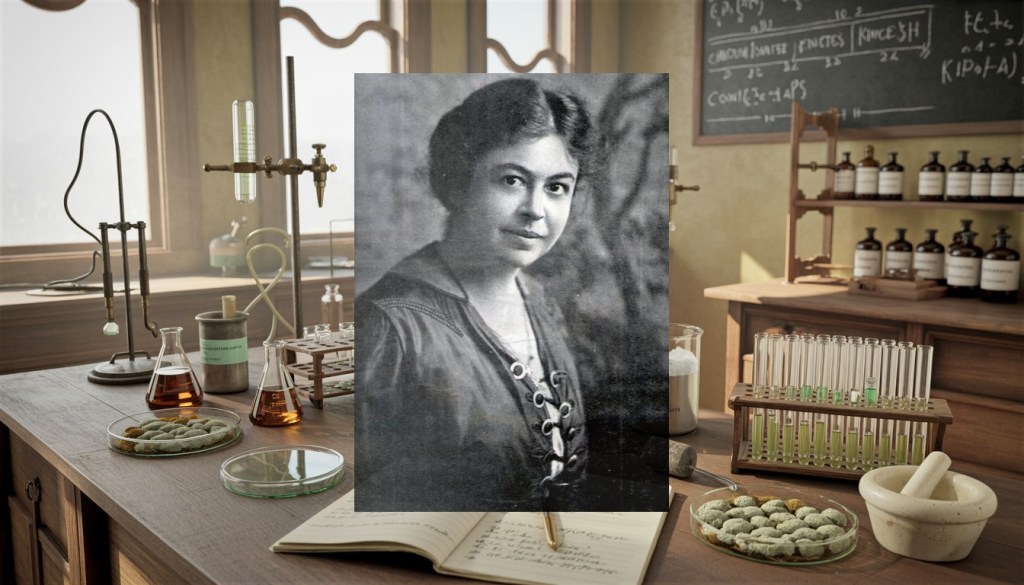
Dr Marguerite Griffith Tyler (1881-1969) earned her PhD from Columbia University in 1928 with groundbreaking research on enzyme kinetics, specifically studying how acetate and phosphate ions influenced the amylase activity of Aspergillus oryzae – work that would quietly power industrial fermentation for generations. Despite contributing to both peacetime biochemistry and the classified Manhattan Project at Oak Ridge, Tennessee, Tyler has been almost entirely forgotten, a casualty of gender discrimination, institutional fragmentation, and wartime secrecy. Her story reveals how women scientists navigated multiple exclusions whilst catalysing reactions that transformed industries from sake brewing to nuclear materials production.
Welcome, Dr Tyler. I’m honoured to speak with you today. You’ve lived an extraordinary life – from Army posts across continents to the laboratories of Columbia University to the classified facilities at Oak Ridge. Yet so few people know your name. How does that sit with you, looking back?
I suppose I’ve always been accustomed to being overlooked. When you’re a woman born in 1881, you learn early that the world isn’t arranged for your ambitions. My family certainly made that clear when I told them I wanted to study law. “No place for a woman,” they said. So I turned to chemistry instead – not because it was more welcoming, mind you, but because at least the molecules didn’t have opinions about my gender.
As for being forgotten, well, much of my later work was classified. You can’t very well be remembered for things you weren’t allowed to discuss. And my earlier research on enzyme kinetics? It wasn’t the sort of discovery that makes headlines. No dramatic moment, no single revelation. Just careful, quantitative work on how ions affect fungal enzymes. Not exactly the stuff of legend.
Let’s start at the beginning, then. Your childhood was remarkably peripatetic – Army posts from Kentucky to the Philippines. How did that shape the scientist you became?
It made me self-reliant, I should think. When you’re constantly moving, you can’t depend on institutions or established relationships. My father was a military commander, so we went where the Army sent us. Kentucky, yes, but also frontier posts out west and eventually the Philippines during the American occupation. It was 1899 or thereabouts when we were stationed in Manila – I was barely eighteen.
Because of all this movement, conventional schooling was impossible. We had governesses, tutors, whatever could be arranged. At first, I resented it. The other children – when there were other children – attended proper schools with teachers and classmates and structure. But I came to appreciate learning at my own pace, for myself rather than for marks or approval. There’s a phrase I used later, in a newspaper interview: I learned “to study for herself instead of for the teacher.” That independence became essential when I entered a field that didn’t particularly want me there.
The other gift of that childhood was resourcefulness. If I wanted to learn something, I had to find the materials, ask the right questions, teach myself. No one was going to hand it to me. That served me well in research, where you’re often working alone, trying to puzzle out problems no one has solved before.
You enrolled at university at fifteen – extraordinarily young, even then. What drew you to chemistry after your family discouraged you from pursuing law?
Ah, law. Yes, I’d always wanted to be a lawyer. I loved the idea of argument, of building a case from evidence, of advocating for something. But my family was horrified. “Entirely inappropriate for a young woman,” they said. Women weren’t even allowed to vote yet – imagine expecting them to practise law!
So I needed another path. Chemistry seemed practical. There were women in chemistry – not many, but some. And the work appealed to me in a similar way to law: it required evidence, careful reasoning, building an argument from observations. Instead of a courtroom, I had a laboratory. Instead of witnesses, I had reactions.
I started at the College of Washington in Pullman in 1896 when I was fifteen. It was terrifying, honestly – I was younger than everyone, a girl in a field dominated by men. But I’d been teaching myself for years by then. I knew how to learn. I transferred to the University of Michigan and graduated with my bachelor’s degree in chemistry in 1903.
Michigan was eye-opening. The education was excellent, rigorous. But the university made it abundantly clear that women were tolerated, not welcomed. Years later, when they sent round an alumni survey, I wrote back: “the University of Michigan has never given women a chance on its faculty as I see it compared to other colleges.” That was in 1924, and it still rankled.
After your bachelor’s degree, you began a long, nomadic teaching career – Cincinnati, Chicago, Washington State, Idaho, back to New York. Why so many moves?
Because I was a woman. It’s really that simple.
Male chemists with my qualifications could expect stable positions at research universities, opportunities for advancement, laboratory resources. Women? We took what we could get. And what we could get was usually temporary positions at small colleges, often women’s colleges, with heavy teaching loads and minimal research support.
After my bachelor’s degree, I taught at the University of Cincinnati for a few years whilst studying for my master’s at the University of Chicago. I earned that in 1910. Then it was off to Washington State College teaching botany, then Lewiston State College in Idaho teaching science to nursing students. Every few years, another institution, another city, another temporary appointment.
It wasn’t a career; it was survival. You went where there was work, and you didn’t complain because complaining meant being labelled “difficult,” and being difficult meant not being hired next time.
The hardest part was the isolation. At a major research university, you’re surrounded by colleagues working on similar problems, sharing ideas, building on each other’s work. At small teaching colleges in remote locations? You’re alone. No one to discuss your research with, no one who understands what you’re trying to accomplish. Every campus became a temporary laboratory, and I was constantly starting over.
Yet you persisted. In your forties, you went back to earn your PhD at Columbia University. What drove that decision?
Stubbornness, mostly. And the knowledge that without a doctorate, I’d never be taken seriously as a researcher.
By the 1920s, I’d been teaching for more than twenty years. I had my master’s degree and plenty of experience. But I could see that the field was changing. Chemistry was becoming more specialised, more quantitative, more tied to advanced research. If I wanted to contribute at that level – and I did – I needed a PhD.
So in 1927, at the age of 46, I moved to New York City and enrolled at Columbia University. It was daunting. Most of my fellow students were in their twenties. I was old enough to be their mother. And I was still one of very few women in the department.
I worked with Mary Letitia Caldwell, who was the only female chemistry professor at Columbia at the time. That wasn’t coincidence – I doubt any of the male professors would have taken me on. Dr Caldwell was doing pioneering work on enzymes, particularly amylases, and she ran a rigorous laboratory. She expected excellence, and she didn’t coddle anyone.
I completed my doctorate in just two years, submitting my thesis in 1928. It was titled “A Quantitative Study of the Influence of Acetate and Phosphate on the Enzymic Activity of the Amylase of Aspergillus oryzae.” Not exactly poetry, but it represented two years of painstaking work and, I hope, a genuine contribution to biochemistry.
Let’s talk about that research. For readers familiar with biochemistry, can you walk us through what you were investigating and why it mattered?
Certainly. The work centred on understanding how specific ions – acetate and phosphate – affected the activity of amylase produced by the fungus Aspergillus oryzae.
Aspergillus oryzae is a mould used extensively in Asian fermentation, particularly in the production of sake, soy sauce, and miso. It secretes amylase, an enzyme that breaks down starch into simpler sugars. This is essential for fermentation because yeast can’t metabolise starch directly – they need those simpler sugars.
Now, enzyme activity isn’t constant. It’s influenced by temperature, pH, and the presence of various ions. My research focused on quantifying how acetate and phosphate ions specifically modulated amylase activity. This was important for several reasons.
First, industrial fermentation processes often involve complex chemical environments with various ions present. If you’re brewing sake or producing industrial enzymes, you need to understand how those conditions affect enzyme efficiency. Are you getting maximum starch breakdown, or are inhibitory ions reducing activity?
Second, this was fundamental biochemistry. In the 1920s, enzyme kinetics was still a relatively young field. Michaelis and Menten had published their landmark work on enzyme kinetics in 1913, and the field was developing methods for quantitative analysis. My work contributed to that broader understanding of how enzymes behave under varying chemical conditions.
The methodology was straightforward but labour-intensive. I would prepare solutions of amylase from Aspergillus oryzae cultures and measure the rate of starch hydrolysis under different concentrations of acetate and phosphate ions. This involved careful titrations, time-course experiments, and spectrophotometric analysis to track the appearance of reducing sugars – the products of starch breakdown.
What I found was that both acetate and phosphate had measurable effects on amylase activity, though the nature of those effects varied with concentration and pH. At certain concentrations, phosphate acted as an activator, slightly enhancing enzyme activity. At others, particularly at higher concentrations, it became inhibitory. Acetate showed similar complex behaviour.
The implications were practical: if you’re an industrial chemist optimising a fermentation process, you need to control your buffer composition carefully. Use too much phosphate, and you’ll inhibit your enzyme. Use too little, and you won’t maintain optimal pH. It’s a balancing act, and my research provided quantitative data to guide those decisions.
How did your work compare to other approaches or previous methods in enzyme kinetics at the time?
The advantage of my approach was its quantitative rigour. Dr Caldwell’s laboratory was known for meticulous enzyme work, and that culture of precision shaped my research.
Prior to the 1920s, much enzyme research was qualitative or semi-quantitative. Researchers knew that certain conditions affected enzyme activity, but they hadn’t always measured those effects with precision. The Michaelis-Menten equation, published in 1913, provided a mathematical framework for understanding enzyme kinetics, but applying that framework required careful experimental design and consistent methodology.
My work built on that foundation. I used standardised assays, controlled buffer systems, and replicated measurements to generate reliable kinetic data. The focus on specific ions – acetate and phosphate – also represented a more targeted approach than some earlier work that had examined enzyme activity under broadly defined conditions.
One trade-off was specificity. By focusing narrowly on Aspergillus oryzae amylase and two specific ions, I gained detailed understanding of that system but couldn’t necessarily generalise to other enzymes or conditions. That’s the nature of biochemical research: you choose depth over breadth, and you hope that the principles you uncover have wider applicability.
In terms of advantages, my work provided industrial fermentation scientists with concrete data they could use. If you’re working with Aspergillus oryzae – and many were, given its importance in Asian fermentation industries – you now had quantitative information about how to optimise your buffer systems for maximum enzyme activity. That has real economic value when you’re producing thousands of gallons of sake or soy sauce.
Were there aspects of your research that didn’t make it into your published thesis – techniques you developed, observations you made, little tricks of the trade?
Oh, absolutely. There always are.
One thing that wasn’t emphasised in the thesis was the sheer difficulty of working with fungal cultures. Aspergillus oryzae is temperamental. If your growth conditions aren’t quite right – temperature, humidity, substrate composition – the fungus won’t produce much amylase, or it will produce it inconsistently. I spent months optimising the culture conditions before I could even begin the enzyme assays.
I also developed a method for rapidly screening enzyme activity that wasn’t detailed in the final thesis. The standard assays were time-consuming – you’d set up a reaction, take samples at intervals, stop the reaction with acid, measure reducing sugars. It could take hours to generate a single data point. I worked out a simplified colorimetric assay using iodine-starch reactions that let me screen multiple conditions quickly. It wasn’t as precise as the full assay, but it was invaluable for preliminary work.
Another undocumented detail: temperature control. This was 1927, remember. We didn’t have the precise water baths and temperature-controlled incubators you’d have today. Maintaining a constant temperature for enzyme assays required constant vigilance. I spent countless hours checking thermometers, adjusting heat sources, ensuring consistency. Small temperature variations could throw off the kinetics entirely.
And then there was the matter of enzyme purity. Crude fungal extracts contain dozens of enzymes, not just amylase. I had to develop partial purification methods to enrich for amylase activity without completely purifying the enzyme – which would have been prohibitively time-consuming. That involved precipitation with ammonium sulphate, dialysis, and activity assays at every step. It was tedious work, but essential for meaningful results.
None of this made it into the thesis because it wasn’t “science” – it was technique. But technique is half the battle in experimental work. Any competent biochemist can read a protocol; mastering the craft requires experience, intuition, and a fair amount of trial and error.
Your work on Aspergillus oryzae connects directly to modern biotechnology – precision fermentation for sustainable food production, industrial enzyme applications. How does it feel to see those connections?
It’s gratifying, though I confess I find some of the terminology bewildering. “Precision fermentation”? In my day, we simply called it fermentation. But I understand the distinction – using genetically engineered microorganisms to produce specific compounds is rather different from traditional brewing.
The fundamental principles, though, remain the same. Whether you’re brewing sake in 1928 or producing plant-based proteins through precision fermentation in 2025, you’re relying on microorganisms to catalyse biochemical reactions, and you need to understand enzyme kinetics to optimise those processes.
My work on how ions affect amylase activity is directly relevant to modern fermentation biotechnology. If you’re using Aspergillus oryzae or related fungi to produce enzymes for industrial applications, you still need to control your buffer composition, pH, and ionic strength. Those basic biochemical principles don’t change, even if the applications have become more sophisticated.
What particularly pleases me is the emphasis on sustainability. In my era, we thought about industrial efficiency, but not necessarily about environmental impact. The idea that fermentation technology could help address climate change, reduce reliance on animal agriculture, and create more sustainable food systems – that’s a wonderful application of the science.
I also see connections to my Manhattan Project work, though I’m still not entirely comfortable discussing that. Let’s just say that understanding enzyme behaviour and biochemical processes in controlled industrial settings has applications beyond food production. Some of those applications are benign; others, less so.
Speaking of the Manhattan Project – you left Athens College in Alabama in 1941 to work at Oak Ridge. That must have been an extraordinary transition. What can you tell us about that experience?
Not much, I’m afraid. Even now, there are things I’m not certain I’m allowed to discuss. The work was classified, and old habits die hard.
I can say that I was recruited to Oak Ridge in 1941 to work on biochemical aspects of the war effort. Oak Ridge was one of the Manhattan Project sites focused on uranium enrichment, and there was a need for chemists and biochemists who understood industrial-scale processes.
The work was intense, secretive, and unlike anything I’d done before. At Oak Ridge, you didn’t ask questions about what your colleagues were working on. You did your job, you kept your head down, and you didn’t discuss it, even with family.
What I can say is that the principles I’d learned studying enzyme kinetics – understanding how chemical processes work at a quantitative level, optimising reaction conditions, scaling up from laboratory to industrial production – all of that was relevant. The specific applications were different, but the intellectual framework was the same.
It was also the first time in my career that I felt truly valued for my expertise. At Oak Ridge, they needed competent scientists, and they didn’t much care whether you were male or female. Oh, there was still discrimination – women weren’t given the same leadership roles, the same recognition. But the urgency of the war effort created a temporary levelling of the playing field.
And then, of course, the war ended, and women were expected to step aside and let the men have their jobs back. I was 64 in 1945. I’d spent four years doing classified research that I couldn’t discuss, that wouldn’t appear on my CV, that no one would ever know about. And then I was meant to simply retire and be forgotten.
That sense of erasure – of doing vital work that can’t be acknowledged – must have been profoundly frustrating.
It was. But not surprising.
Women’s contributions to science have always been erased or minimised. Sometimes deliberately, sometimes through bureaucratic indifference, sometimes simply because the systems for recognition – publications, patents, prizes – were designed by and for men.
My Manhattan Project work was classified, so that erasure was built into the system. But even my earlier, published research on enzyme kinetics has been largely forgotten. It wasn’t dramatic enough, wasn’t associated with a major institution or a famous laboratory. I published my thesis through Columbia, but I didn’t stay there. I went back to teaching at small colleges – Limestone, Kentucky, Athens. No one was paying attention to what a middle-aged woman at a women’s college in South Carolina was doing.
The irony is that my enzyme research had real industrial applications. Fermentation industries used that knowledge, even if they didn’t cite my name. My work contributed to a body of knowledge that others built upon. But the credit – the recognition – went elsewhere.
This is common for women in science. We do the work, we publish, and then we’re forgotten whilst male colleagues are remembered. There’s even a term for it now, I understand: the Matilda effect. Named after Matilda Joslyn Gage, who documented how women’s scientific contributions were systematically attributed to men.
Rosalind Franklin and DNA, Lise Meitner and nuclear fission – these are the famous examples. But for every Franklin or Meitner, there are hundreds of women like me who made solid contributions and were simply forgotten.
Looking back at your career, what would you have done differently?
Stayed in one place, perhaps. Built relationships, accumulated institutional capital, established myself at a major research university.
But I couldn’t do that. The opportunities weren’t there. Women weren’t hired into permanent positions at research universities. We were given temporary appointments, instructorships, positions at women’s colleges. We moved because we had no choice.
If I were starting my career today, with the opportunities available now – though I understand those opportunities are still far from equal – I would fight harder to establish myself at a research institution. I would publish more aggressively, collaborate more widely, make my work visible in ways I couldn’t in the 1920s and ’30s.
I might also have chosen a more visible research area. Enzyme kinetics was important, but it wasn’t glamorous. If I’d worked on something with more immediate medical applications, or something that led to a patentable discovery, I might have gained more recognition.
But those are retrospective fantasies. I did the work I could do, under the constraints I faced. And I don’t regret the work itself – only the lack of recognition and resources.
Were there mistakes you made – failed experiments, professional misjudgements – that you can acknowledge now?
Oh, certainly. No scientist has a perfect record.
One significant mistake was not publishing more from my doctoral research. I completed my thesis, earned my degree, and then largely moved on to other things. I should have extracted multiple papers from that work, submitted them to prominent journals, built a publication record that would have given me credibility.
But I was exhausted. Completing a PhD in two years whilst teaching part-time to support myself was gruelling. And I didn’t fully appreciate the importance of publication for career advancement. I thought the work itself mattered – and it did, but not as much as making that work visible through publications.
There were also experimental failures. I spent months pursuing a line of inquiry into the effects of metal ions on amylase activity – copper, zinc, magnesium. I was convinced there would be significant effects based on preliminary data. But when I ran the rigorous experiments with proper controls, the effects largely disappeared. It was noise, not signal. That was discouraging, though it taught me the importance of scepticism and rigorous controls.
I also made strategic errors. I accepted positions at small, resource-poor institutions because I needed employment. But I didn’t negotiate effectively, didn’t push for research support or reduced teaching loads. I was so grateful to be hired that I didn’t advocate for what I needed to be successful as a researcher.
That’s a common problem for women, I think. We’re socialised to be accommodating, to not make demands. It took me decades to learn to advocate for myself, and by then it was rather late.
What about contemporary critiques or alternative theories? Were there debates in your field during your career that you navigated?
The main debate in enzyme kinetics during my time centred on the nature of enzyme-substrate interactions. Michaelis and Menten had proposed their model in 1913, but there was ongoing discussion about whether it accurately represented all enzymatic reactions.
Some researchers argued that the Michaelis-Menten model was too simplistic, that it didn’t account for allosteric effects, cooperative binding, or more complex regulatory mechanisms. They were right, of course – we now know that many enzymes show behaviour more complex than simple Michaelis-Menten kinetics.
But for the work I was doing on amylase, the Michaelis-Menten framework was perfectly adequate. Amylase shows fairly straightforward kinetics, and the model allowed me to quantify how ions affected enzymatic activity.
There was also ongoing debate about enzyme purity and specificity. Some researchers insisted that all enzyme studies should be done with highly purified enzymes to eliminate confounding effects. Others, myself included, argued that working with partially purified preparations was acceptable for certain questions, particularly in applied research.
I sided with the pragmatists on this. If you’re studying industrial fermentation, you’re not working with pure enzymes – you’re working with complex mixtures. Understanding how enzymes behave in those messy, real-world conditions is valuable, even if it’s not as elegant as working with crystalline, pure proteins.
But I’ll admit that some of my conclusions might have been more robust with purer enzyme preparations. That’s a limitation of the work, and one I was aware of at the time.
You’ve mentioned gender discrimination throughout your career. How did you navigate those barriers?
Not particularly well, I’m afraid. Mostly I just endured them.
At Michigan, women students were treated as oddities. We were tolerated but not welcomed. Male professors rarely mentored women students. Social events and professional networks excluded us.
I responded by keeping my head down and working harder than everyone else. If a male student could get by with adequate work, I needed to be excellent. That was exhausting, but it was the price of being taken seriously.
Later, as a working chemist, the discrimination was more subtle but no less effective. I couldn’t get hired at research universities. My salary was lower than male colleagues with similar qualifications. I wasn’t invited to collaborate, wasn’t included in professional networks, wasn’t considered for leadership positions.
At Athens College, I told a student newspaper that my career had been “adventurous, dangerous, and exciting” because I worked in science. I framed it positively, but the subtext was clear: being a woman in science was constantly precarious. Every position was temporary, every opportunity hard-won.
The one advantage I had was that I didn’t have a husband or children. That freed me to move frequently, to focus entirely on my career, to take risks that women with families couldn’t take. But it also meant I had no support system, no one to fall back on when things were difficult.
I wish I could say I fought the system, became an advocate for women scientists, challenged discrimination publicly. But I didn’t. I survived. That was radical enough in its own way, I suppose – simply refusing to give up, continuing to do science despite every obstacle.
What advice would you give to women or marginalised scientists today?
First, don’t wait for permission or approval. I spent too many years thinking I needed to earn the right to do research, to be taken seriously. You don’t. If you have questions, pursue them. If you have ideas, test them. The gatekeepers will always find reasons to exclude you. Do the work anyway.
Second, publish everything. Make your work visible. I failed to do this, and it cost me. In today’s world, there are even more ways to share your work – journals, conferences, online platforms. Use them all. Don’t assume the quality of your work will speak for itself. It won’t. You have to advocate for it.
Third, build networks. Find allies, mentors, collaborators. I was too isolated for too much of my career. I worked alone at small institutions where no one shared my interests. That was professionally devastating. Seek out communities – formal and informal – where you can share ideas, get feedback, and feel less alone.
Fourth, demand resources. Women are socialised to be grateful for whatever scraps we’re offered. Don’t accept that. Negotiate for salary, research funding, laboratory space, reduced teaching loads – whatever you need to succeed. The answer might be no, but at least you’ll have asked.
Fifth, remember that the system isn’t designed for you. It’s designed to exclude you. That’s not paranoia; it’s reality. So don’t blame yourself when you struggle. The barriers are real, and they’re not your fault. But you can navigate them, work around them, sometimes even break through them.
And finally, document your work. Make sure there’s a record. I spent years doing classified research that no one will ever know about. My enzyme work was published but forgotten. I wish I’d been more deliberate about creating a legacy, about ensuring that my contributions would be recognised.
Don’t let your work disappear. Tell your story, share your research, make noise. The world will try to silence you. Don’t let it.
If you could see one change in how science operates, what would it be?
True institutional support for women scientists. Not token positions, not temporary appointments, not “opportunities” that require us to work twice as hard for half the recognition.
I mean permanent positions at research universities with competitive salaries, research funding, and opportunities for advancement. I mean mentorship and sponsorship from senior colleagues. I mean professional networks that include women as equals, not as curiosities.
I also mean recognising that scientific careers don’t follow a single path. I moved frequently, worked at small institutions, took time to earn multiple degrees. That peripatetic career shouldn’t have been a liability – it meant I had broad experience, adaptability, diverse skills. But the system punished me for it.
If institutions valued diverse career paths, recognised different kinds of contributions, and provided support regardless of where someone works, science would benefit. Not every important discovery happens at Harvard or Columbia. Not every valuable scientist follows a traditional trajectory.
The other change I’d want is transparency about credit and authorship. Too much of women’s work has been attributed to male colleagues or simply erased. Clear, enforceable standards for who gets credit – and consequences when those standards are violated – would help.
But fundamentally, what needs to change is the culture. Science positions itself as objective, meritocratic, based purely on evidence. That’s mythology. Science is done by humans, with all our biases and prejudices. Until we acknowledge that and actively work to counter those biases, women and other marginalised groups will continue to face barriers.
One final question: What would you want people to remember about you and your work?
That I persisted. That I did solid, careful work under difficult circumstances. That I contributed to our understanding of enzyme kinetics and industrial fermentation, even if that contribution wasn’t recognised.
I’d also want people to understand that my story isn’t unusual. There are hundreds of women like me – competent scientists who made real contributions and were forgotten. Some because their work was classified, some because they worked at non-prestigious institutions, some simply because they were women.
When you forget these women, you lose not just individual stories but an entire understanding of how science actually works. Science isn’t just brilliant men at famous universities making dramatic discoveries. It’s also women at small colleges doing meticulous work, unheralded technicians running experiments, temporary employees whose names don’t appear on papers.
All of that work matters. All of those people matter. Their invisibility doesn’t mean they didn’t contribute – it means the systems for recognition are broken.
So remember me, if you will, not as an exception but as representative. Remember that for every Marie Curie who achieved fame, there were a hundred women like me who did important work and disappeared. Remember that science is built on those invisible contributions, and that forgetting them impoverishes our understanding of both the past and the possibilities for the future.
And remember that enzyme kinetics matter. They’re not glamorous, but they’re the foundation of industrial biochemistry, fermentation technology, pharmaceutical production – all the ways we use microorganisms to transform our world. That work is still relevant, still important, still underappreciated.
I’d also like people to know that I never regretted choosing science, despite everything. It was difficult, isolating, often thankless. But it was also intellectually thrilling, occasionally triumphant, and deeply meaningful. I answered questions no one else had answered. I contributed to human knowledge. That’s a privilege, even when the world doesn’t recognise it.
Letters and emails
We invited our readers to share their own questions for Dr Marguerite Griffith Tyler, and we’ve selected five letters and emails from our growing community. These questions reflect a sincere curiosity about her career, scientific insights, and the personal dimensions of her legacy.
Anika Schmidt, 34, Biotechnology Researcher, Cape Town, South Africa
Dr Tyler, you mentioned using colorimetric assays with iodine-starch reactions as a quick screening method. I’m curious about the sensitivity limitations you encountered with those techniques compared to your more rigorous titration methods. In today’s enzyme kinetics work, we use spectrophotometers that can detect absorbance changes in real-time with incredible precision. If you had access to modern continuous monitoring equipment, how might that have changed your experimental design or the questions you could ask about ion effects on amylase? Would you have explored concentration ranges that were simply too tedious to measure in the 1920s?
What a thoughtful question, Miss Schmidt. You’ve put your finger on one of the most frustrating limitations of enzyme work in my era – the sheer labour required to generate even a single kinetic curve.
The iodine-starch reaction I used for screening was remarkably simple: amylase breaks down starch, so as the reaction proceeds, you have less starch remaining. Add iodine solution, and the characteristic blue-black colour fades as starch disappears. It was visual, quick, and required no elaborate equipment. But the sensitivity? Dreadful by modern standards. You couldn’t detect subtle changes in reaction rate, couldn’t work with dilute enzyme preparations, couldn’t measure initial velocities with any precision. It was adequate for asking “Does this condition inhibit the enzyme or not?” but utterly inadequate for quantitative kinetics.
The more rigorous method – stopping the reaction at intervals, measuring reducing sugars through titration or colorimetric sugar assays – was far more sensitive but agonisingly slow. Each data point might require an hour of work. To generate a proper Michaelis-Menten curve, you needed measurements at perhaps eight or ten different substrate concentrations, with replicates. That’s days of work for a single curve. And if you wanted to examine how different concentrations of phosphate affected that curve? Weeks.
If I’d had access to your modern continuous monitoring spectrophotometers – what a luxury that would have been! I could have explored concentration ranges that were simply impractical in the 1920s. Very low substrate concentrations, for instance, where I suspected interesting inhibitory effects might occur but couldn’t justify the experimental time required. Very rapid initial reactions, where my manual sampling couldn’t capture the kinetics accurately.
I would also have examined pH effects far more thoroughly. Maintaining stable pH whilst varying ion concentrations was technically challenging with the buffers available to us. Modern pH electrodes and better buffer systems would have let me separate pH effects from direct ionic effects more cleanly.
The other advantage – and this is significant – is that continuous monitoring would have revealed whether my reactions were truly following simple Michaelis-Menten kinetics or showing more complex behaviour. With discrete time points, you can miss substrate inhibition, product inhibition, or cooperative effects. Real-time curves reveal those complications immediately.
But here’s the thing: the fundamental principles I was investigating – how ions modulate enzyme activity – those haven’t changed. The tools have improved enormously, the precision has increased by orders of magnitude, but you’re still asking the same basic questions about enzyme behaviour. My crude assays gave me qualitative answers and reasonable quantitative estimates. Your spectrophotometers give you exquisite detail. Both approaches contribute to understanding, just at different resolutions.
I do sometimes wonder what I might have discovered with better instrumentation. But I try not to dwell on it. You work with what you have, and you make the best contributions you can. That’s all any scientist can do, regardless of era.
Rafael Domínguez, 41, Science Educator and Historian, Mexico City, Mexico
You spoke about learning ‘for yourself instead of for the teacher’ during your unconventional education moving between Army posts. I’m wondering how that self-directed approach influenced your relationship with failure in the laboratory. Many students today are paralysed by the fear of getting wrong answers or failed experiments because our education systems punish mistakes rather than treat them as learning opportunities. When you spent those months chasing the metal ion effects that turned out to be noise rather than signal, how did you process that disappointment? Did your early self-teaching make you more comfortable with dead ends?
Mr Domínguez, you’ve touched on something I’ve thought about considerably over the years. That unconventional education – moving from post to post, teaching myself from whatever books I could find – did fundamentally shape how I approached failure in the laboratory.
When you’re learning from a teacher in a traditional classroom, there’s a right answer and a wrong answer, and your worth is measured by how often you get it right. Examinations, marks, class rankings – it’s all about being correct. Get it wrong, and you’re punished with poor grades, public embarrassment, the teacher’s disappointment.
But when you’re teaching yourself, failure is simply information. If I misunderstood a chemistry concept whilst reading alone in some Army barracks in the Philippines, there was no one to scold me. I’d simply realise my error when I tried to work a problem and got nonsense, then go back and puzzle it out differently. Failure was private, and it was useful. It told me where my understanding was incomplete.
That attitude carried over into laboratory work. When I spent those months chasing metal ion effects that turned out to be experimental artifacts – well, yes, it was disappointing. I’d invested considerable time and effort. I’d convinced myself I was onto something important. And then rigorous controls showed it was nothing.
But I didn’t see it as a personal failing. I saw it as the experiment telling me something: that my preliminary observations hadn’t been reliable, that I needed better controls, that nature was more subtle than I’d assumed. The failure was in my experimental design, not in me as a scientist.
I think that’s the crucial distinction. Traditional education trains students to tie their self-worth to being correct. Self-directed learning – at least the way I experienced it – trains you to see errors as part of the learning process.
Of course, there were times when failures stung. When a line of inquiry I’d invested months in collapsed, or when I couldn’t reproduce a promising result, I felt frustrated, sometimes discouraged. But I don’t recall ever feeling ashamed or worthless because an experiment failed. That simply wasn’t how I’d learned to think about knowledge.
The other gift of self-teaching was patience with uncertainty. In a classroom, the teacher knows the answer and eventually reveals it. When you’re working alone, you live with “I don’t know yet” for extended periods. That’s excellent preparation for research, where most of your time is spent not knowing.
I wish more students today could have that experience – not the isolation or the educational instability I endured, but the freedom to fail privately, to puzzle things out, to see errors as information rather than judgment. Science would benefit enormously from students who are less afraid of being wrong and more curious about what their mistakes might teach them.
Siti Rahmawati, 28, Food Science PhD Candidate, Jakarta, Indonesia
Dr Tyler, Aspergillus oryzae is deeply embedded in Indonesian fermentation traditions – we use it for tempeh and other products alongside the Japanese applications you studied. I’m fascinated by the cultural context of your research. Did you have any awareness whilst conducting your enzyme work that you were studying a fungus with thousands of years of cultural significance across Asia? Did you interact with industrial fermentation practitioners – sake brewers or soy sauce manufacturers – or was your research purely academic? I wonder whether cross-cultural scientific exchange might have enriched your understanding of how different fermentation conditions affected enzyme behaviour in real-world applications.
Miss Rahmawati, your question warms my heart. While I certainly knew that Aspergillus oryzae was central to sake brewing in Japan, my appreciation for its broader significance in Indonesian and other Asian culinary traditions grew only later. At the time of my research in the 1920s, the international exchange of knowledge was, let’s say, patchy. Scientific journals offered glimpses into global practices, but practical collaboration across continents was not common, especially for a woman based mainly in the United States.
My own introduction to A. oryzae came through the scientific literature – papers describing its enzymatic prowess, its role in breaking down rice starches, and its value to fermentation industries. I marvelled that a humble fungus, cultivated and refined by generations of craftspeople, could so effectively transform foodstuffs and support entire economies. Yet, much of my work was confined to the laboratory, grounded in the technical needs and industrial interests of American and, to some extent, Japanese partners.
On occasion, visiting scientists or industrialists would pass through Columbia or New York, providing tales of grand breweries and describing the care taken to maintain koji cultures. These conversations were fascinating but infrequent. As a woman scientist, particularly one without the professional cachet of a tenured professor, I was not typically invited to international symposia or industry gatherings. My participation in the world of fermentation was therefore largely indirect, conducted through correspondence, journals, and the rare laboratory visit.
In my own practice, I often wondered how the reactions I observed played out on the grand scale of casks and fermenting vats – how temperature, humidity, substrate, and local intuition shaped flavour and efficiency. I longed for more direct collaboration or even a visit to a working brewery, but those opportunities remained out of reach. Still, I took some pleasure imagining the yeast and moulds at work across the world, a silent kinship among scientists and artisans separated by oceans but united by curiosity.
Cross-cultural scientific exchange, had it been possible, would certainly have enriched my work. There is wisdom embedded in tradition, in the routines and adjustments perfected over centuries. If we scientists had listened more closely to the practitioners in Indonesia or Japan, I suspect our understanding of enzyme behaviour in real fermentations would have deepened. Instead, I did my best from my small corner of the laboratory, drawing lines between the knowledge in the literature and the realities of culture and taste on distant shores. I hope future scientists, women and men, will do better – reaching out, listening, and letting the world’s practical wisdom inform their research.
Samuel Mensah, 38, Agricultural Biotechnologist, São Paulo, Brazil
What if you’d been born twenty years later and started your career in the 1940s instead of the 1900s? By then, women’s participation in science had increased slightly, instrumentation had improved, and molecular biology was emerging as a field. You might have bridged enzyme kinetics with early protein structure work or even nucleic acid biochemistry. Do you think the timing of your career – being just early enough to face the most extreme barriers, but too early to benefit from the post-war expansion of science – was the worst possible luck? Or did being a pioneer in that earlier era give you freedoms that later, more institutionalised women scientists might not have had?
Mr Mensah, what an intriguing counterfactual. I’ve pondered similar questions myself over the years – wondering whether I was born at precisely the wrong moment, caught between eras.
If I’d started my career in the 1940s rather than the 1900s, I would have entered science during a period of tremendous expansion. The war had demonstrated the value of scientific research, and funding flowed more freely afterward. Universities were growing, new fields were emerging, and there were – marginally – more opportunities for women, particularly after so many had proved themselves during wartime.
I might have worked on protein structure as you suggest. Dorothy Hodgkin was doing her crystallographic work on penicillin and vitamin B12 during that period. Or I might have bridged into the emerging field of molecular biology, watching as people began to understand the chemical basis of heredity. Those were exciting times.
But here’s what I’ve come to believe: being early had certain advantages, even if they came wrapped in hardship.
In the early 1900s and 1920s, biochemistry was still relatively young and unstructured. There were fewer established hierarchies, less rigid specialisation, more room for an outsider to contribute. Yes, I faced extraordinary barriers as a woman, but the field itself was still finding its shape. By the 1940s and ’50s, biochemistry had become more professionalised, more competitive, more dependent on large laboratories and significant funding. I’m not certain a woman starting out then, even with slightly better opportunities, would have found it easier to establish herself.
The other advantage of being early is that fundamental questions were still unanswered. My work on ion effects on enzyme activity was genuinely novel. By the 1940s, those basic kinetic principles were established, and researchers were tackling more complex problems that required larger teams and more resources – resources women typically couldn’t access.
I also had more intellectual freedom precisely because no one was paying much attention to me. Working at small colleges, I wasn’t competing for grants or trying to publish in high-profile journals. I could pursue questions that interested me without worrying whether they’d advance my career, because my career wasn’t going anywhere regardless. That’s a peculiar sort of liberty.
Would I trade my experience for a later start? I honestly don’t know. The barriers I faced were crushing at times, and the lack of recognition still rankles. But I contributed when the field was young, when my work could genuinely advance understanding. That matters to me.
Perhaps the real tragedy isn’t being born at the wrong time, but that any time was wrong for a woman who wanted to do science. Whether 1881 or 1901 or 1921, we faced barriers. They took different forms, but they were always there. The question isn’t when I should have been born, but why the barriers existed at all.
Jasmine Carter, 52, Ethics Consultant and Former Chemist, Edinburgh, Scotland
You mentioned feeling valued at Oak Ridge during the war effort in a way you hadn’t experienced elsewhere in your career, despite the work being classified and ultimately contributing to nuclear weapons development. Looking back now, knowing the long-term consequences of the Manhattan Project – Hiroshima, Nagasaki, the Cold War arms race – how do you reconcile that brief period of professional recognition with the ethical weight of that work? Do you think women scientists who finally gained entry into male-dominated spaces through wartime necessity paid too high a moral price, or was it simply the reality of the era that all scientists, regardless of gender, had to navigate?
Miss Carter, you’ve asked the question that has haunted me most persistently since 1945. The ethical weight of the Manhattan Project is not something I can easily reconcile, even now.
When I arrived at Oak Ridge in 1941, I knew only that the work was classified and urgent. We weren’t told the full scope of what we were building – compartmentalisation ensured that. I worked on biochemical processes related to materials production, and I understood it was for the war effort, but the specifics of how my work connected to the final weapon weren’t clear until Hiroshima.
You’re right that I felt valued there in ways I hadn’t elsewhere. For the first time in my career, my expertise mattered more than my gender. Resources were available, questions were answered, and there was a sense of collective purpose. After decades of marginalisation at small colleges, that recognition was intoxicating.
But then came August 1945, and we learned what we’d built. The photographs from Japan, the casualty figures, the radiation sickness – it was horrifying. I remember sitting in my quarters, physically ill, thinking about all those people who’d been incinerated or would die slowly from radiation exposure. And I’d helped make that possible.
Did women pay too high a moral price for wartime inclusion? I think all of us – men and women alike – made Faustian bargains during that period. The men who led the project, the scientists who solved the physics problems, the engineers who built the facilities – we all bear responsibility. Gender doesn’t absolve anyone.
But there’s a particular bitterness for women scientists. We were finally allowed in, finally treated as competent, finally given resources – and it was to build weapons of mass destruction. One wonders whether we would have been welcomed so readily for purely beneficial research. I suspect not.
I’ve tried to tell myself that we didn’t know, that the war’s urgency justified extraordinary measures, that ending the war saved lives in the long term. These are the standard rationalisations, and there’s some truth to them. But they feel hollow when I think about those children in Hiroshima.
The honest answer, Miss Carter, is that I don’t reconcile it. I live with the discomfort, the guilt, the knowledge that I contributed to something monstrous. I tell myself that the individuals who died would have died anyway – in conventional bombing, in invasion, in prolonged war. But that’s cold comfort.
If I could do it over, knowing what I know now? I don’t know. That recognition, that sense of being valued – I’d hungered for it my entire career. Would I have walked away from it, even knowing the cost? I’d like to think so. But I’m not certain, and that uncertainty troubles me most of all.
Reflection
Dr Marguerite Griffith Tyler died on 15th September 1969 in Owensboro, Kentucky, at the age of 88. She left behind no spouse, no children, and precious few published works beyond her 1928 Columbia University doctoral thesis. The historical record of her life is frustratingly sparse – a handful of institutional records, brief mentions in alumni surveys, and the tantalising classified work at Oak Ridge that remains largely undocumented. This interview, whilst fictional, attempts to honour what we do know whilst imagining the interior life of a woman whose contributions were quietly absorbed into the broader currents of biochemical knowledge.
Throughout our conversation, Tyler returned repeatedly to themes of mobility and erasure. Her peripatetic career across small colleges in the American South and Midwest wasn’t a choice but a necessity imposed by institutional sexism. Yet she reframed this instability as a form of adaptability, even freedom – a perspective that may differ from how contemporary observers viewed her “fragmented” employment. Where others might have seen failure to establish herself at a prestigious institution, she saw intellectual independence. Whether this represents genuine contentment or retrospective rationalisation, we cannot know.
The gaps in Tyler’s story are themselves instructive. Her Manhattan Project work remains classified or lost to history, rendering a significant portion of her later career invisible. Her enzyme kinetics research, whilst scientifically sound and industrially relevant, generated few follow-up publications and has been rarely cited in modern biochemical literature. The practical knowledge she generated – about Aspergillus oryzae amylase behaviour under varying ionic conditions – was absorbed by fermentation industries without attribution, a pattern depressingly common for women scientists of her era.
Yet Tyler’s work prefigures contemporary concerns in remarkable ways. Today’s precision fermentation technologies, producing everything from plant-based proteins to pharmaceutical compounds, rest on the same fundamental enzyme kinetics principles she studied nearly a century ago. Modern biotechnologists optimising buffer compositions for industrial-scale bioreactors are solving problems Tyler first quantified in her Columbia laboratory.
Her story also illuminates ongoing challenges in STEM. Women remain underrepresented in senior scientific positions, their contributions still vulnerable to erasure through collaborative dynamics, publication practices, and institutional memory. The precarity Tyler experienced – moving between temporary positions, lacking research support, working in isolation – echoes in today’s adjunct faculty crisis and the struggles of early-career researchers, particularly women and minorities, to establish sustainable scientific careers.
Perhaps Tyler’s most enduring legacy is simply this: she persisted. Against family opposition, institutional barriers, geographic isolation, and the invisibility imposed by classified work, she continued doing science. Her enzyme kinetics data, though seldom cited, contributed to industrial processes that fed millions. Her classified biochemical work supported national defence, however morally complex that contribution remains. She taught students, mentored where she could, and maintained intellectual curiosity across five decades of professional life.
We owe her, and the countless women like her, more than historical footnotes.
Who have we missed?
This series is all about recovering the voices history left behind – and I’d love your help finding the next one. If there’s a woman in STEM you think deserves to be interviewed in this way – whether a forgotten inventor, unsung technician, or overlooked researcher – please share her story.
Email me at voxmeditantis@gmail.com or leave a comment below with your suggestion – even just a name is a great start. Let’s keep uncovering the women who shaped science and innovation, one conversation at a time.
Editorial Note: This interview is a dramatised reconstruction based on available historical sources about Dr Marguerite Griffith Tyler, including her 1928 Columbia University doctoral thesis, institutional records, and fragmentary biographical information. Whilst grounded in documented facts about her life, education, research on enzyme kinetics, and classified work at Oak Ridge during the Manhattan Project, the dialogue, personal reflections, and emotional responses are fictional interpretations created to honour her legacy and illuminate the experiences of women scientists in her era. Any errors or misrepresentations are unintentional. This work aims to recover and celebrate Tyler’s overlooked contributions to biochemistry and industrial fermentation science.
Bob Lynn | © 2025 Vox Meditantis. All rights reserved. | 🌐 Translate

 Vox Meditantis
Leave a comment