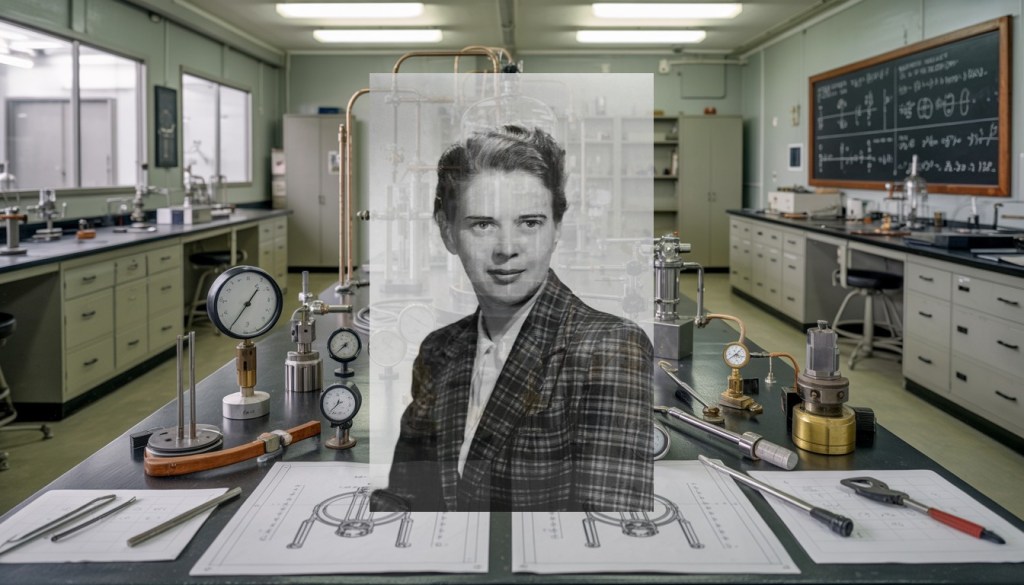
Beatrice Alice Hicks (1919-1979) revolutionised industrial safety and space exploration through her groundbreaking gas density sensor, a device that could measure actual gas amounts rather than just pressure across wide temperature ranges. Patented in 1962, this technology became essential to the Apollo moon missions, monitoring critical gases in Saturn V rocket ignition systems whilst remaining virtually invisible to the public narrative of space achievement. As the first woman engineer hired by Western Electric in 1942 and co-founder of the Society of Women Engineers, Hicks navigated extraordinary barriers in a field where women comprised less than 0.1% of practitioners during her era.
Today, we sit down with Beatrice Hicks in a conversation that bridges her time and ours, exploring her technical innovations, the challenges she faced, and her enduring influence on both engineering practice and the advancement of women in STEM fields.
Beatrice, thank you for joining us today. I want to begin where your story began – as a thirteen-year-old girl looking up at the Empire State Building and the George Washington Bridge in the early 1930s. What was it about those structures that sparked something in you?
Oh my goodness, well, looking back now I can see how that moment crystallised everything for me. You have to understand, those weren’t just buildings and bridges to a young person in 1932 – they were pure magic. The Empire State Building had only just been completed the year before, and it reached higher into the sky than anything humans had ever built. Standing there, craning my neck back, I felt this tremendous sense of… possibility, I suppose. Here was proof that people – engineers specifically – could take raw materials and mathematical principles and create something that defied what seemed natural.
I remember thinking quite clearly, “Someone designed this. Someone calculated every beam and rivet.” And then immediately after that: “I want to be that someone.” My father was a chemical engineer, you see, so I’d grown up hearing about engineering problems over dinner. But seeing those marvels made it real for me – engineering wasn’t just a job, it was a way of reshaping the world.
That sense of wonder clearly sustained you through some quite difficult times. You were one of only two women in a class of 900 at Newark College of Engineering. What was that experience like day-to-day?
Goodness, where do I begin? It was rather like being a curiosity in a museum, I’m afraid. Some days the other students would stare quite openly – not with malice, necessarily, but as if they couldn’t quite believe what they were seeing. The professors varied enormously in their reactions. A few were genuinely supportive, but others made it clear they thought I was taking up a seat that belonged to a man who would “actually use” his degree.
I developed what I call my armour quite early on. I’d arrive early to claim a seat in the front row – partly because I was shorter than most of the fellows and couldn’t see over them, but also because it forced the professors to acknowledge my presence. I took meticulous notes, asked pointed questions, and never, ever allowed myself to appear unprepared. I knew I was being watched for any sign of failure.
The loneliness was perhaps the hardest part. During laboratory work, I often found myself partnered with whoever was left over, rather than being chosen. But you know, that isolation taught me to be self-reliant in ways that served me tremendously well later in my career.
That resilience clearly prepared you for Western Electric, where you became their first woman engineer in 1942. You were working on quartz crystal oscillators during wartime – can you walk us through what that work entailed?
Ah, now we’re getting to the technical heart of things! Quartz crystal oscillators were absolutely crucial for communications during the war. When you apply an electric field to a quartz crystal, it vibrates at a very precise frequency – this piezoelectric effect creates incredibly stable timing references for radio communications.
My job was to design and test these oscillators for telephone equipment used in long-distance circuits, particularly for aircraft communications. The challenge was achieving frequency stability across varying temperatures and pressures. A crystal oscillator that worked beautifully at sea level might drift significantly at altitude, rendering communications unreliable.
I spent countless hours in the laboratory, subjecting crystals to temperature cycles, measuring frequency drift, adjusting the circuit parameters. We were working with tolerances that seemed impossibly tight at the time – frequency variations had to be kept within a few parts per million. Each oscillator had to be individually calibrated and tested.
What fascinated me most was how this tiny piece of quartz could be so precisely controlled. It was like learning to tune a violin string to produce exactly the right note, except we were doing it with electronic circuits and mathematical calculations rather than our ears.
That precision work with frequency and stability seems like excellent preparation for what would become your most famous invention. Can you tell us about the gas density sensor?
Certainly – though I must say, at the time I was developing it, I had no notion it would end up on rockets bound for the moon! The problem I was trying to solve was actually quite practical and earthbound.
You see, many industrial systems relied on gas-filled equipment – transformers using insulating gases, for instance, or fuel systems where you needed to know precisely how much gas was present. The trouble with existing sensors was that they only measured pressure, not actual gas density. But gas density varies with temperature according to the ideal gas law – when gas heats up, it expands, so the pressure rises even though the actual amount of gas remains constant.
This created dangerous situations. A pressure sensor might indicate adequate gas levels when the gas was cold, but as it warmed up during operation, the actual density could drop below safe thresholds even while pressure remained steady. You could have electrical failures, fuel system malfunctions, all sorts of catastrophic problems.
For our technically-minded readers, can you walk us through exactly how your device solved this problem?
Gladly! The key innovation was creating a sensor that responded to both pressure and temperature simultaneously to determine actual gas density.
Picture a sealed bellows – rather like a small accordion – contained within a chamber that’s connected to the gas system you want to monitor. Inside the bellows is a reference sample of gas at a known density. The bellows itself is mounted within a housing that’s in communication with the gas being monitored.
Now, here’s where it gets clever: as the temperature of the monitored gas changes, both the gas inside the bellows and the gas outside respond according to the gas law. But because the bellows contains a fixed amount of reference gas, the differential pressure across the bellows walls directly indicates the density of the monitored gas, automatically compensated for temperature.
When the monitored gas density drops below a critical threshold – regardless of temperature – the bellows expands or contracts to actuate a switch. I used a mechanical linkage system that could trigger alarms, shut down equipment, or take other protective actions.
The beauty of this design was its simplicity and reliability. No complex electronics, no temperature sensors requiring calibration. The physics of the gas law did all the computational work for us.
The precision required must have been extraordinary. What kind of tolerances were you working with?
Oh, extremely tight tolerances indeed. For electrical insulating applications, we needed to detect density changes as small as 2% from nominal values. That meant the bellows had to be manufactured to tolerances of perhaps 0.001 inches, and the mechanical linkages had to be calibrated to respond to pressure differentials of less than 0.1 psi.
The real challenge was achieving repeatability across varying environmental conditions. A sensor that worked perfectly at 70°F needed to perform just as accurately at -20°F or 150°F. I spent months testing prototypes in environmental chambers, cycling them through temperature ranges whilst monitoring their response to controlled gas density changes.
We also had to consider long-term stability. These devices needed to operate reliably for years without recalibration. I experimented with different bellows materials – various metal alloys – testing their fatigue resistance and dimensional stability over thousands of cycles.
The advantage over pressure-only sensors was remarkable. In side-by-side testing, traditional pressure sensors showed error rates of 15-20% when temperature varied, whilst our density sensors maintained accuracy within 1-2% across the entire operating range.
You mentioned having no idea this would end up on moon rockets. How did NASA discover your invention?
Well, that’s rather a remarkable story, isn’t it? I was running Newark Controls by then – this was the mid-1950s – and we’d built up quite a reputation for reliable sensing equipment. Our sensors were being used in aircraft, power plants, various industrial applications where gas monitoring was critical.
Someone at NASA – I never did learn exactly who – realised that the Saturn V rocket systems faced precisely the problems my sensor was designed to solve. You see, those enormous rockets used various gases for pressurisation, purging, and as propellants. During the complex startup sequences, they needed to know not just that gas was present, but exactly how much gas was available at each stage of the process.
Temperature variations during fuelling and countdown were enormous – from the cryogenic temperatures of liquid oxygen and hydrogen to the heat of ignition. Traditional pressure sensors would have given wildly inaccurate readings under such conditions.
NASA needed sensors that could operate reliably in space environments – vacuum on one side, gas pressure on the other, extreme temperature swings, and the tremendous vibrations of rocket launch. Our density sensor design proved remarkably suited to these demands.
I remember being absolutely astounded when I learned they wanted to use our devices on Apollo missions. Here was this technology I’d developed to prevent electrical transformer failures, and suddenly it was helping to send humans to the moon!
What was it like seeing Apollo 11 launch, knowing your technology was aboard?
Oh my word, it was quite overwhelming, really. I watched from home, of course – 20th July 1969 – and listening to that countdown, I kept thinking about all the tiny sensors and switches and monitoring devices that had to work perfectly for those brave men to make their journey safely.
You know, the public sees the enormous rocket, the dramatic flames, the astronauts in their suits. But I was thinking about the thousands of little devices tucked away inside, each one critical to the mission’s success. My gas density sensors were monitoring the ignition systems, making sure the right amounts of gases were present at each stage of the launch sequence.
There’s something both humbling and thrilling about knowing your work is part of something so much larger than yourself. When Neil Armstrong stepped onto the lunar surface, I felt this tremendous sense of… participation, I suppose. Not just pride – though there was certainly that – but a feeling of being connected to something truly historic.
Of course, the newspapers didn’t mention gas density sensors in their coverage! [chuckles] The public quite rightly focused on the astronauts and the achievement of landing on the moon. But for those of us working in the background, providing the invisible infrastructure that made it all possible, that moment was deeply meaningful.
Speaking of invisible contributions, you co-founded the Society of Women Engineers in 1950. What drove that decision?
Well, you have to understand the isolation so many of us felt. I’d spent my entire career being the only woman in the room – sometimes literally the only one in an entire company. When I’d attend technical conferences, I’d look around and see perhaps two or three other women among hundreds of men.
After the war, more women had entered engineering out of necessity, but we were scattered across different companies and specialities with no way to connect with each other. I kept thinking, “There must be others facing the same challenges I am. Surely we could support each other.”
The idea crystallised when I met some other women engineers through professional conferences. We started having informal conversations about our experiences – the difficulties getting hired, the challenges being taken seriously, the constant pressure to prove ourselves. Someone suggested we should form an organisation, and I thought, “Yes, absolutely we should.”
Those early meetings were quite remarkable. Here were brilliant women – electrical engineers, mechanical engineers, chemical engineers – many of whom had never before met another woman in their field. The sense of relief and recognition was palpable. We weren’t strange anomalies after all; we were part of a small but determined community.
What were your primary goals for the Society in those early days?
Our objectives were quite practical, really. First, we wanted to encourage more young women to consider engineering careers. In 1950, women made up less than one tenth of one percent of engineers – that was an appalling waste of talent, particularly when the country needed all the technical expertise it could develop.
Second, we aimed to support women already in the field. We created networks for job referrals, mentorship programs, professional development opportunities. Many of us had learned our careers in isolation; we wanted to ensure future women engineers wouldn’t have to.
Third, we sought to improve working conditions for women engineers. This meant advocating for fair hiring practices, equal pay, advancement opportunities. It also meant addressing practical issues – ensuring laboratories had appropriate facilities for women, for instance, or challenging policies that restricted women from certain types of fieldwork.
We also wanted to serve as a clearinghouse for information about women’s achievements in engineering. So many contributions by women were overlooked or attributed to their male colleagues. We documented women’s work, celebrated their achievements, and made sure their stories were preserved.
Looking back now, I’m quite proud of what we accomplished. From 60 founding members, the Society has grown to tens of thousands. More importantly, it created a permanent institutional voice for women in engineering.
You mentioned the challenge of being taken seriously. Can you share a specific example of how gender affected your professional interactions?
Oh, there were countless instances, some almost comedic in retrospect. I remember one particular meeting at Western Electric where I’d been invited to present my work on crystal oscillators to a group of senior engineers and potential clients.
I arrived at the conference room properly dressed – business suit, briefcase, all my technical drawings prepared – only to have the receptionist direct me to the typing pool. When I explained I was there for the engineering meeting, she looked quite confused and asked if I was someone’s secretary taking notes.
When I finally made it to the correct room, half the men present assumed I was there to serve coffee. One fellow actually asked me to fetch him a cup whilst I was setting up my technical drawings! I politely explained that I was the presenter, which created this awkward silence.
But here’s what was interesting: once I began explaining the technical details – the frequency stability calculations, the temperature compensation methods, the test results – their attitudes shifted completely. Engineers, by their nature, respect competence and results. When it became clear I knew exactly what I was talking about, gender became secondary.
Still, I learned to establish my credentials immediately in any new situation. I’d introduce myself as “Beatrice Hicks, Chief Engineer at Newark Controls,” rather than simply giving my name. I carried extra copies of my patents and technical papers. I made sure my business cards clearly stated my title and qualifications.
It shouldn’t have been necessary, but it was pragmatic. I was representing not just myself, but the concept of women engineers. I felt I couldn’t afford to be anything less than utterly prepared and completely professional.
How did your father’s engineering background influence your career, particularly your transition to running Newark Controls?
Father was absolutely crucial to my development, though not in the way you might expect. He never pushed me toward engineering – in fact, I think he was somewhat surprised when I announced my career intentions at thirteen! But he also never discouraged me, which was rather unusual for that era.
What he provided was an environment where engineering thinking was simply part of daily life. At dinner, we’d discuss technical problems he was working on, manufacturing challenges, new materials or processes he’d learned about. Engineering wasn’t some mysterious male profession to me – it was simply what intelligent people did when they wanted to solve problems.
When I joined Newark Controls after his death in 1946, I inherited not just a company but a philosophy of approaching problems methodically. Father had built the company around precision manufacturing and innovative solutions to sensing challenges. He’d established relationships with clients who valued technical excellence over lowest cost.
Taking over the company was tremendously challenging. I was twenty-seven years old, relatively new to the business side of engineering. Many suppliers and clients initially questioned whether a young woman could run an engineering firm effectively. But I had several advantages: I understood the technical foundation of our products better than anyone, having worked on them directly, and I’d learned Father’s approach to building trust through consistent delivery of quality solutions.
The transition also taught me about the business aspects of engineering that aren’t taught in university courses. Manufacturing costs, quality control systems, client relationship management, cash flow – all the unglamorous but essential elements that determine whether brilliant technical work actually reaches the market.
In some ways, running Newark Controls made me a more complete engineer. I couldn’t just design elegant solutions; I had to design solutions that could be manufactured reliably, sold profitably, and supported over their operational lifetime.
Looking back now, with the benefit of hindsight, is there anything you would have done differently in your career?
That’s quite a profound question, isn’t it? I suppose there are several areas where I might have made different choices, though I’m not entirely certain they would have led to better outcomes.
I was perhaps too willing to accept being the only woman in various situations. There were times when I could have been more insistent about including other qualified women in projects or committees. I sometimes took the path of least resistance – proving myself individually rather than challenging the systems that excluded women more broadly.
For instance, when I was elected to the National Academy of Engineering in 1978, I was only the fourth woman ever admitted. Rather than simply feeling honoured, I might have made more noise about the absurdly small number of women recognised. I was always conscious of not wanting to appear confrontational, but perhaps I was too diplomatic at times.
From a technical standpoint, I sometimes wonder if I focused too narrowly on sensing applications. My work with gas density led to other sensor developments – pressure sensors, flow rate monitors, temperature compensation systems. But I might have branched into broader fields: computer applications, perhaps, or electronic circuit design beyond my early oscillator work.
Though I must say, staying focused allowed me to become genuinely expert in sensing technologies. The depth of knowledge I developed made it possible to solve problems that stumped others. Sometimes specialisation serves you better than broad generalist knowledge.
I also wonder if I should have been more aggressive about documenting and publicising my work. So many technical contributions by women were overlooked simply because we weren’t as skilled at self-promotion as our male colleagues. I published technical papers, of course, but I could have done more to ensure my innovations received proper recognition.
What would surprise people most about the actual day-to-day work of developing the gas density sensor?
Oh, the sheer amount of repetitive testing that was involved! The public imagination of invention involves brilliant insights and sudden breakthroughs, but the reality is far more tedious.
I must have built and tested hundreds of prototype bellows assemblies. Each one required precise machining, careful assembly, then weeks of testing under controlled conditions. I’d subject them to temperature cycles, pressure cycles, mechanical vibration, looking for failure modes or performance drift.
Most prototypes failed in some way. The bellows would develop tiny leaks, or the mechanical linkages would bind up, or the calibration would drift over time. Each failure required careful analysis – was it a design flaw, a manufacturing defect, or simply the wrong choice of materials?
I kept meticulous laboratory notebooks documenting every test, every modification, every failure mode. Page after page of pressure readings, temperature measurements, time stamps. It was absolutely essential for understanding patterns, but deadly boring to anyone watching.
What might also surprise people is how much of the work was actually mechanical engineering rather than electrical. The sensing principle was straightforward physics, but translating that into a reliable, manufacturable device required solving dozens of mechanical problems. How do you create a bellows that’s sensitive enough to detect small pressure changes but robust enough to survive industrial environments? How do you design mechanical linkages that maintain precision over years of operation?
I spent enormous amounts of time in the machine shop, working with skilled machinists to solve these problems. Many of my best insights came not from calculations at my desk, but from watching how metal behaved under various stresses and temperatures.
Your sensors ended up being used to monitor nuclear weapons storage as well as space applications. How did you feel about the military applications of your work?
That’s a rather complex question, emotionally speaking. On one level, I was quite proud that my technology was considered reliable enough for such critical applications. Nuclear weapons storage requires absolutely foolproof monitoring systems – any failure could have catastrophic consequences.
The technical challenges were fascinating. These storage systems used inert gases to prevent corrosion and maintain stable environments around the weapons. My sensors needed to operate reliably for years without maintenance, in underground facilities with extreme temperature stability requirements.
But I’d be dishonest if I didn’t acknowledge some ambivalence about nuclear weapons themselves. I lived through World War II, saw the terrible destruction these weapons could cause. At the same time, during the Cold War era, many of us believed that reliable deterrence helped prevent larger conflicts.
What I focused on was ensuring that if these weapons existed – which was beyond my control – they would be stored as safely as possible. My sensors helped prevent accidents, environmental contamination, or deterioration that could make the weapons unpredictably dangerous.
I took some comfort in knowing that the same technology was being used for entirely peaceful purposes – monitoring industrial safety systems, enabling space exploration, improving aircraft communications. Good engineering solutions often find applications far beyond their original intended use.
Looking back now, I’m most proud of the space applications. Those represented humanity at its best – using our technical capabilities to explore and discover rather than to threaten or destroy.
How do you see your legacy, particularly for women entering engineering today?
I hope my legacy is that I helped prove engineering could be a viable career for women, and that I created institutional support structures that made the path easier for those who followed.
When I started my career, people genuinely questioned whether women had the mathematical aptitude or technical intuition for engineering work. I think my contributions – the patents, the successful company, the technical papers – demonstrated conclusively that gender was irrelevant to engineering capability.
But individual success wasn’t enough. That’s why the Society of Women Engineers was so important. We needed to create permanent institutional changes, not just occasional exceptional women succeeding despite the barriers.
I’m pleased to see how the field has evolved. When I graduated in 1939, women comprised less than 1% of engineers. Today it’s still far from equal, but the percentages are much higher, and more importantly, women engineers aren’t isolated curiosities anymore.
What I hope continues is the tradition of women engineers supporting each other. The challenges are different now – perhaps more subtle than the overt discrimination we faced – but the need for community and mutual support remains.
I’d also hope that my technical work demonstrates the importance of what I might call “invisible infrastructure” – the sensing systems, monitoring devices, safety mechanisms that make spectacular achievements possible. Engineers often work in the background, solving unglamorous but essential problems. That work deserves recognition and respect.
What advice would you give to young women entering STEM fields today?
First, master your technical fundamentals absolutely thoroughly. You cannot afford to be merely competent – you must be genuinely expert in your field. This isn’t fair, perhaps, but it’s practical. When you’re one of few women in a technical environment, your knowledge and capabilities will be scrutinised more carefully than those of your male colleagues.
Second, find mentors and build networks, but don’t limit yourself to other women. Some of my most valuable professional relationships were with male engineers who recognised talent regardless of gender. Look for people who judge you by your technical contributions rather than your demographic characteristics.
Third, don’t be afraid to specialise deeply in areas that genuinely interest you. I focused intensively on sensing technologies, which made me the go-to expert for certain types of problems. Depth of knowledge can be more valuable than broad generalist skills.
Fourth, learn the business aspects of engineering, not just the technical elements. Understanding manufacturing, economics, project management, and client relationships makes you far more valuable and gives you more career options.
Most importantly, remember that engineering is fundamentally about solving problems that matter. Whether you’re working on space exploration, environmental protection, medical devices, or communications systems, you’re contributing to human progress. That sense of purpose sustains you through the inevitable frustrations and setbacks.
And finally, once you’ve achieved some success, remember to help other women following the path you’ve taken. We all benefited from those who came before us; we owe the same support to those who come after.
Thank you, Beatrice. Any final thoughts for our readers?
Just this: engineering is one of the most democratising professions in the world. Your solutions either work or they don’t, regardless of who you are or where you came from. Good engineering transcends all social barriers – it’s evaluated purely on results.
If you have the aptitude and the interest, don’t let anyone convince you that engineering isn’t for you. The world needs all the problem-solving talent it can get, and the challenges we face – environmental, technological, social – require diverse perspectives and innovative approaches.
Every woman engineer who succeeds makes it easier for the next one. You’re not just building your own career; you’re building a legacy that extends far beyond your individual achievements. That’s both a responsibility and a tremendous opportunity.
The future belongs to those who can turn scientific understanding into practical solutions. There’s no reason that future shouldn’t include as many women as men.
Beatrice Hicks, thank you for this fascinating conversation and for your remarkable contributions to engineering and space exploration.
Thank you. It’s been my pleasure entirely.
Letters and emails
Since our conversation with Beatrice Hicks, we’ve received numerous letters and emails from readers around the world who were inspired by her story and wanted to explore different aspects of her pioneering work and experiences. We’ve selected five thoughtful questions from our growing community – engineers, researchers, and innovators who want to learn more about her life, her technical innovations, and the wisdom she might share with those following similar paths in STEM fields today.
Camila Torres (32, environmental instrumentation engineer, Cape Town, Africa)
Your density-sensing approach relied on mechanical bellows and reference gas. If you had access to today’s MEMS, fibre Bragg gratings, and low-drift electronics, which element of your original design would you replace first, and what quantifiable gains (e.g., ppm stability, thermal hysteresis) would you target?
Oh my goodness, Camila, what fascinating technologies you mention! I must confess, some of these terms are entirely new to me – “MEMS” and “fibre Bragg gratings” sound like something from a science fiction novel! But I gather you’re asking about miniaturisation and electronic precision that far exceeds what we had available in my era.
You know, the bellows assembly was actually our greatest weakness, though it was also our greatest strength. The mechanical nature made it inherently reliable – no electronics to drift or fail – but it also limited our sensitivity and response time. If I understand correctly what you’re describing, these modern micro-sensors could detect much smaller density changes far more quickly.
The reference gas chamber would be the first element I’d replace, without question. We had terrible problems with reference gas contamination over time – tiny leaks that would alter our baseline readings by perhaps 0.5% annually. That doesn’t sound like much, but for critical applications, it meant recalibration every six months at minimum. If these new sensors could provide stable electronic references, that would be transformational.
For quantifiable targets, well, our best bellows sensors achieved perhaps 1% accuracy over a 50°F temperature range. The thermal hysteresis – the difference in readings when temperature was rising versus falling – was our biggest headache. We’d see perhaps 0.3% variation just from thermal cycling, which made precision work quite challenging.
I suspect these modern approaches could achieve what we could only dream of – perhaps 0.1% accuracy with thermal hysteresis below 0.05%. The real prize would be long-term stability. Our sensors needed recalibration every few months; if electronic methods could maintain accuracy for years without adjustment, that would revolutionise industrial applications.
But I must say, there’s something to be said for mechanical simplicity. Our bellows sensors operated reliably in environments that would destroy delicate electronics – extreme vibration, temperature shocks, electromagnetic interference from high-voltage equipment. The Apollo applications succeeded partly because mechanical systems are inherently robust.
I’d be curious whether these new technologies maintain that ruggedness. Electronics have always been rather finicky about environmental conditions. Perhaps the ideal solution would combine both approaches – electronic precision for normal conditions, with mechanical backup systems for extreme environments.
The engineering challenge, as always, is balancing precision against reliability. In my experience, the most elegant solution isn’t necessarily the most complex one.
Kenji Watanabe (41, aerospace safety analyst, Vancouver, North America)
In cryogenic ground operations, modern programs juggle GN2 purges, helium pressurisation, and SF6 monitoring in power systems. How would you architect redundancy today – sensor diversity, voting logic, fail‑safe thresholds – so a single density drift can’t mask a hazardous depletion across varying thermal gradients?
Kenji, your question brings back memories of those nerve-wracking Apollo countdown sequences! The redundancy challenges you describe are precisely what kept us engineers awake at night during the space program years.
You know, in our era, we approached redundancy rather differently than what I imagine is possible today. We relied heavily on what we called “dissimilar backup systems” – if the primary gas density sensor used our bellows method, the backup might be a completely different technology, perhaps a thermal conductivity sensor or even a simple pressure gauge with temperature compensation. The idea was that no single failure mode could knock out both systems simultaneously.
For cryogenic operations like you mention, we learned some hard lessons during the Saturn V development. Nitrogen purge systems were particularly tricky because the gas properties changed so dramatically with temperature. We’d often run three sensors in what we called a “two-out-of-three” configuration – if any single sensor disagreed with the other two by more than our predetermined threshold, the control system would ignore it and trigger an alarm.
The voting logic was quite primitive by today’s standards, I’m sure. We used mechanical relay systems and simple analogue comparators. If Sensor A read 85% density, Sensor B read 87%, and Sensor C read 92%, the system would flag Sensor C as suspect and operate based on the average of A and B. Rather crude, but effective for the technology we had available.
SF6 monitoring in electrical systems presented different challenges altogether. That gas is incredibly stable chemically, but even tiny leaks could compromise insulation. We learned to set our fail-safe thresholds quite conservatively – better to shut down unnecessarily than risk electrical failures.
What I’d emphasise today is the importance of understanding failure modes that weren’t obvious initially. During early Apollo testing, we discovered that vibration could cause temporary sensor drift that looked exactly like actual gas depletion. The solution was adding vibration sensors that could temporarily adjust our density readings during high-vibration periods.
If I were designing redundancy today, I’d insist on sensors that fail in different ways – mechanical, electronic, and perhaps optical methods all monitoring the same parameter. The key is ensuring that whatever catastrophic event might disable one sensor type leaves the others functioning normally.
Most importantly, never trust any single measurement, no matter how sophisticated the sensor. Cross-correlation between different measurement principles has saved more missions than any individual technical breakthrough.
Sofia Varga (27, doctoral researcher in materials science, Seoul, Asia)
Your work predated today’s advanced alloys and surface treatments. If you could revisit bellows metallurgy, would you prioritise amorphous metals, high‑nickel superalloys, or additive‑manufactured lattices to reduce creep and fatigue? What endurance test profile would convince you – cycles, temperatures, and allowable zero‑shift?
Sofia, what intriguing materials you mention! I’m afraid some of these terms are quite beyond my experience – “amorphous metals” and “additive manufacturing” sound absolutely fascinating, though I can only imagine what they might involve.
In our day, bellows metallurgy was rather limited to what was commercially available. We worked primarily with phosphor bronze, beryllium copper, and various stainless-steel alloys. The choice usually came down to spring characteristics versus corrosion resistance. Phosphor bronze gave us excellent elasticity and fatigue resistance, but it wasn’t suitable for high-temperature applications. Stainless steel held up beautifully to temperature extremes but was prone to work hardening after repeated cycling.
The real breakthrough for us came when we started working with Inconel – that nickel-chromium superalloy developed for jet engines. It maintained its spring properties at temperatures that would destroy our bronze bellows, though it was frightfully expensive and difficult to machine. I suspect your “high-nickel superalloys” might be descendants of that material.
Creep was our absolute nemesis. We’d build a bellows that performed beautifully in initial testing, only to find that after six months of operation, the zero point had drifted by 2% or more. The metal would gradually deform under constant stress, particularly at elevated temperatures. We learned to pre-stress our bellows assemblies – essentially “aging” them artificially in the laboratory before installation.
For endurance testing, we developed what we called our “torture chamber” – a test fixture that could cycle bellows through their full range of motion while subjecting them to temperature swings from -40°F to 200°F. A good bellows had to survive 100,000 cycles with less than 0.5% zero shift. The temperature cycling was often more destructive than the mechanical cycling, particularly the thermal shock of rapid transitions.
If I could revisit metallurgy today, I think I’d be most excited about materials that could eliminate hysteresis – that annoying difference between readings on the way up versus down in pressure or temperature. We never did solve that completely with conventional metals.
The “additive manufacturing” you mention sounds revolutionary. If you could build bellows with internal structures impossible to machine conventionally – perhaps honeycomb internal supports or variable wall thickness – that might solve problems we never even attempted to address. The key would be maintaining consistent material properties throughout the structure.
What endurance profile would convince me? Well, 1,000,000 cycles with zero shift below 0.1% would be rather miraculous by our standards!
Mason Reed (35, historian of technology, São Paulo, South America)
Ethically, safety tech often migrates between civilian and defence contexts. Looking back, where would you draw lines today – what safeguards or governance would you want embedded when your sensors are deployed in dual‑use systems that outlive their original intent?
Mason, that’s a profoundly thoughtful question, and one that troubled me considerably during the Cold War years. You know, when I first developed the gas density sensor, my primary concern was preventing industrial accidents – transformer explosions, fuel system failures, that sort of thing. I never anticipated it would become part of weapons monitoring systems.
The dual-use nature of engineering innovations is something we didn’t discuss much in my generation, though perhaps we should have. During World War II, many of us felt quite clear about our purpose – we were supporting the war effort against fascism. But the Cold War created more ambiguous situations. Was monitoring nuclear weapons storage a contribution to peace through deterrence, or was it enabling a more dangerous world?
I came to believe that safety technology is inherently ethical, regardless of its application. If nuclear weapons exist – and that decision was far above my pay grade – then they should be stored as safely as possible. My sensors helped prevent accidents that could have harmed innocent people or contaminated the environment. In that sense, I felt I was serving humanity’s interests.
But you raise an excellent point about governance and safeguards. Looking back, I think I was rather naive about how technology spreads beyond its original purpose. Once we’d proven our sensors could work reliably in extreme environments, military applications were almost inevitable.
If I were designing such systems today, I’d want to build in what we might call “ethical constraints.” Perhaps sensors that could monitor safety conditions but couldn’t be easily repurposed for offensive applications. Or documentation requirements that tracked how the technology was being used over time.
I’d also insist on international standards for safety monitoring versus weapons deployment. During my era, we had precious little international cooperation on technical standards. Today, perhaps organizations could establish protocols that distinguish between legitimate safety applications and more troubling uses.
Most importantly, I’d want engineers to be educated about the broader implications of their work. We focused so intensively on solving immediate technical problems that we rarely considered long-term consequences. Engineering schools should teach ethics alongside thermodynamics and circuit theory.
The reality is that good engineers will always find ways to solve problems, regardless of the application. But we can create institutional frameworks that encourage beneficial uses and discourage harmful ones. The key is having those conversations before the technology is deployed, not after.
It’s a heavy responsibility, but one that comes with the territory of creating things that matter.
Halima Njoroge (29, startup founder in climate tech, Dublin, Europe)
What if the Apollo era had invested as heavily in atmospheric and industrial monitoring as it did in propulsion? Do you think earlier, widespread adoption of density‑based sensing could have accelerated modern emissions accountability – and what cultural or funding shifts would have made that plausible?
Halima, what a fascinating “what if” scenario you’ve posed! You know, during the Apollo era, we were so focused on the immediate goal of reaching the moon that we rarely considered the broader applications of our technologies here on Earth.
Looking back, I think you’re absolutely right that we missed a tremendous opportunity. The same gas monitoring technologies we developed for spacecraft could have revolutionised industrial environmental monitoring decades earlier. We had sensors capable of detecting trace gases, measuring combustion efficiency, monitoring emissions – all the building blocks for what you might call “emissions accountability.”
The cultural shift would have required something we didn’t have in the 1960s: widespread public awareness of environmental consequences. Rachel Carson’s “Silent Spring” had just been published, but most Americans were still thinking about pollution as a local nuisance rather than a global threat. The idea that industrial emissions could affect the entire planet’s climate was barely on anyone’s radar.
Funding was the other enormous barrier. The Apollo program succeeded because it had a clear, dramatic goal and virtually unlimited government backing. Environmental monitoring, by contrast, would have required convincing hundreds of companies to invest in expensive equipment for what seemed like purely regulatory compliance.
If we’d had different priorities, imagine the possibilities! By 1970, we could have had continuous emissions monitoring at every major industrial facility. Coal-fired power plants, steel mills, chemical factories – all equipped with the same reliable sensors we were putting on rockets. The data collection would have been invaluable for understanding atmospheric changes decades before they became critical.
The technical challenges would have been substantial but entirely solvable. Our space-qualified sensors were over-engineered for most industrial applications – they could have been simplified and mass-produced at much lower cost. The real innovation would have been creating data networks to aggregate all that monitoring information, something like what you probably have today with computers.
What cultural changes would have made this possible? Perhaps if we’d framed environmental monitoring as a national security issue – protecting America’s air and water resources the same way we protected against foreign threats. Or if we’d connected it to economic competitiveness – cleaner, more efficient operations saving money in the long run.
The tragedy is that we had the technical capability but lacked the vision to apply it broadly. It’s a lesson about how engineering solutions are only as powerful as the social and political will to implement them.
Your generation seems to understand this connection much better than mine did.
Reflection
Beatrice Hicks passed away on 21st October 1979 at age 60, her death coming at the threshold of an era that would finally begin recognising women’s foundational contributions to science and technology. Through our imagined conversation, we glimpse not just the technical brilliance behind her gas density sensors, but the quiet determination that enabled her to persist in a field where she was perpetually the only woman in the room.
What emerges most powerfully is Hicks’s pragmatic approach to barrier-breaking. Rather than the confrontational activism that historical accounts sometimes suggest, she reveals a more nuanced strategy – establishing credibility through undeniable technical competence whilst building institutional support networks for future generations. Her reflections on the Society of Women Engineers emphasise practical mentorship over ideological battles, suggesting her advocacy was as methodical as her engineering.
The historical record remains frustratingly sparse about Hicks’s personal experiences and technical processes. Her own voice, as imagined here, fills crucial gaps about the daily realities of developing precision sensors with 1960s materials and manufacturing techniques. We can only speculate about her private frustrations with gender discrimination or her feelings watching Apollo launches powered by her invisible technology.
Today, as environmental sensing becomes central to climate monitoring and space exploration enters a commercial renaissance, Hicks’s foundational work gains new relevance. Her gas density principles underpin modern atmospheric monitoring systems, whilst her advocacy through SWE presaged contemporary efforts to diversify engineering fields.
Perhaps most remarkably, Hicks’s innovations continue working in applications she never envisioned. Modern SF6 monitoring systems protecting electrical grids, atmospheric sensors tracking greenhouse gases, and spacecraft life support systems all trace intellectual lineage to her 1962 patent. Her legacy lives not in monuments or popular recognition, but in the invisible infrastructure that keeps our technological civilisation functioning safely.
Every precise measurement protecting human life carries forward Beatrice Hicks’s conviction that engineering excellence transcends all social barriers – a belief as revolutionary today as it was in 1942.
Who have we missed?
This series is all about recovering the voices history left behind – and I’d love your help finding the next one. If there’s a woman in STEM you think deserves to be interviewed in this way – whether a forgotten inventor, unsung technician, or overlooked researcher – please share her story.
Email me at voxmeditantis@gmail.com or leave a comment below with your suggestion – even just a name is a great start. Let’s keep uncovering the women who shaped science and innovation, one conversation at a time.
Editorial Note: This interview represents a dramatised reconstruction based on extensive historical research into Beatrice Hicks‘s life, technical contributions, and the broader context of women in mid-20th century engineering. Whilst grounded in documented facts about her gas density sensor patent, her role at Western Electric, her co-founding of the Society of Women Engineers, and the use of her technology in Apollo missions, the specific dialogue, personal reflections, and technical details reflect our interpretation of available sources rather than recorded conversations. We have endeavoured to honour Hicks’s documented achievements and the challenges faced by women engineers of her era whilst acknowledging the limitations of the historical record.
Bob Lynn | © 2025 Vox Meditantis. All rights reserved. | 🌐 Translate

 Vox Meditantis
Leave a comment