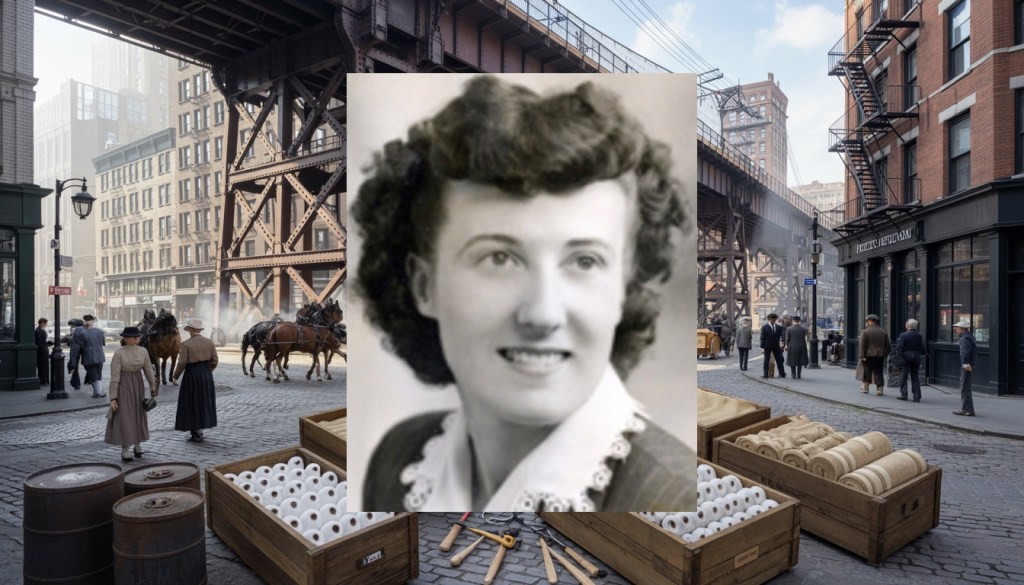
In an age when steam and steel transformed American cities, Mary Elizabeth Walton (1846-1912) pioneered environmental engineering solutions that made urban life bearable. Her innovations in noise reduction and air pollution control for New York’s emerging elevated railway system in 1879-1881 represent some of the earliest systematic approaches to urban environmental problems. Though appropriated by male engineers and dismissed by academic circles of her time, Walton’s practical solutions laid groundwork for modern soundproofing standards and pollution control systems that remain relevant as cities grapple with electric vehicle transitions and high-speed rail noise management.
Mary, thank you for joining us today. I understand you lived through quite remarkable changes in New York City during the 1870s and 1880s. Could you paint a picture of what those streets were like when you first began tackling urban pollution?
Oh my, where does one begin? The city in those days was a symphony of discord – and I use that word deliberately. Picture, if you will, walking down Sixth Avenue near my boarding house at 12th Street, where the very air seemed to throb with industrial progress. The Gilbert Elevated Railway had just opened in 1878, and those steam engines would come thundering overhead every few minutes, belching great plumes of black smoke that settled like a shroud over everything below. The screeching of metal wheels on metal tracks was so fierce it could wake the dead – or keep them from sleeping in the first place. Shopkeepers complained their customers couldn’t hear over the racket, and I watched good people develop what we’d now call nervous conditions from the constant assault on their senses.
That quote I’ve seen attributed to you – about your father believing in educating his daughters – tells us something about your unusual upbringing for that era.
Quite right. Papa would say, “My father had no sons, and believed in educating his daughters. He spared no pains or expense to this end.” This was radical thinking in our circle, I assure you. Whilst other fathers were teaching their girls to embroider and keep house, mine was showing me how mechanical principles worked, how to observe problems methodically, and most importantly, how to persist when others declared something impossible. That preparation served me well when I found myself listening to the greatest inventors of the age – including Mr Edison himself – declare that the noise of the elevated trains simply couldn’t be subdued.
Let’s talk about your technical approach. Can you walk us through your noise-reduction system step by step?
Certainly. The fundamental problem was vibrational amplification through the wooden support structures. The wheels striking the rails created percussion waves that the bare wooden ties and support beams acted as resonating chambers, amplifying rather than dampening the sound. My solution employed what we now might call composite dampening materials in a containment system.
I constructed wooden boxes – essentially casings – that cradled the entire track structure. These boxes were first sealed with tar to prevent moisture infiltration and create an airtight envelope. The interior was lined with cotton batting, which provided the first stage of sound absorption for higher frequencies. Then the entire assembly was filled with sand – and here’s the crucial bit – the sand had to be of a specific grade and moisture content. Too fine, and it would shift and settle unevenly; too coarse, and it wouldn’t provide adequate dampening mass.
The sand served multiple functions: it absorbed kinetic energy from the vibrations, provided thermal mass to prevent expansion joints from rattling, and created what we’d now term “acoustic impedance mismatch” between the rail system and the surrounding air. The result was noise reduction of approximately 75 per cent, transforming the roar of progress into something approaching civilised transportation.
How did your methods compare to what Thomas Edison had attempted?
Mr Edison’s approach was rather more… shall we say, theoretical. He attempted to work with the rails themselves, trying various metallic compositions and rail profiles to reduce the sound at its source. Admirable in principle, but he was trying to solve an amplification problem by adjusting the input rather than controlling the resonance chamber. It’s rather like trying to quiet a church bell by changing the metal composition instead of addressing how the sound travels through the bell tower.
My method recognised that in an urban environment, you cannot simply eliminate the source of mechanical noise – trains must run, wheels must turn, metal must meet metal. The solution lay in interrupting the transmission pathway between the mechanical action and the human ear. Edison was a brilliant man, but he was approaching this as an electrical problem when it was fundamentally an acoustic engineering challenge.
And your earlier invention – the smoke reduction system. How did that work?
That emerged from pure necessity, I’m afraid. The locomotive smokestacks were poisoning the very air we breathed, covering everything in a film of soot that made laundry impossible and gave children persistent coughs. My system intercepted the emissions at the source by redirecting the chimney output through a series of water tanks.
The principle was quite straightforward: force the smoke and particles through a water scrubbing system before releasing them to atmosphere. The particulates became trapped in the water, which could then be discharged into the city’s sewage system. Not perfect by modern environmental standards, perhaps, but it moved the problem from the air – where it affected everyone’s lungs – to the water treatment infrastructure, where it could be managed more effectively.
This was 1879, mind you, well before society understood the full implications of industrial emissions. We knew smoke was unpleasant and unhealthy, but we were working on instinct and observation rather than the sophisticated understanding of environmental science that exists today.
Looking back, do you see any mistakes or approaches you might have taken differently?
Oh, several! My greatest error was in how I managed the business side of innovation. I was so focused on solving the engineering problems that I rather neglected the commercial and legal aspects. When I sold the rights to my noise reduction system to the Metropolitan Railroad for $10,000, I thought I was being quite clever. But I failed to negotiate ongoing royalties or licensing arrangements for other railway companies that adopted my methods.
More broadly, I underestimated how quickly male engineers would appropriate my innovations without crediting the source. Within a few years, variations on my sand-filled track casings were appearing across the country, described in engineering journals as “traditional noise-dampening techniques” with no mention of their origins. Had I been more strategic about documentation and publicity, perhaps the historical record would look rather different.
How did you navigate the dismissiveness you faced as a woman inventor without formal engineering credentials?
One developed a rather thick skin, I can tell you. The technical press would describe my work as “amateur activism” whilst simultaneously adopting my methods. Male engineers would visit my demonstrations, take copious notes, then publish papers describing “improvements” to established noise-reduction techniques.
My strategy became one of persistence through results. I couldn’t argue with their credentials, but I could let my innovations speak for themselves. When the Metropolitan Railroad saw their ridership increase because passengers could actually converse during their journeys, when property values near the elevated lines stopped plummeting due to noise complaints – those results were rather difficult to dismiss, regardless of the inventor’s gender or educational pedigree.
I also learned to work through allies when possible. Male engineers who respected the work, if not always the inventor, could carry these innovations into circles where I would never be heard.
Your innovations seem remarkably relevant to today’s urban challenges – noise from high-speed rail, electric vehicle sound design. What would you tell modern engineers facing similar problems?
The fundamental principles haven’t changed, though the materials and methods have certainly advanced. Whether you’re designing sound barriers for modern rail systems or managing acoustic pollution from electric vehicles, you’re still dealing with vibration, resonance, and transmission pathways.
What I’d emphasise is the importance of spending time in the environment you’re trying to improve. I didn’t solve the elevated railway noise problem from an engineering office – I solved it by living next to the bloody thing, listening to every screech and rattle, understanding how the sound travelled through different weather conditions and times of day. Modern engineers have sophisticated modelling tools, but there’s no substitute for experiential understanding of the problem you’re solving.
Any particular advice for women or other underrepresented groups in engineering today?
Document everything, and be prepared to fight for credit. The tendency to appropriate women’s innovations hasn’t disappeared – it’s simply become more subtle. Build networks of colleagues who will champion your work when you’re not in the room. And remember that solving real problems for real people will ultimately matter more than the recognition you receive for it.
Though I do hope the next generation won’t have to wait until 2025 for proper acknowledgement of their contributions!
What gives you the most satisfaction when you look at how cities have evolved?
The realisation that environmental engineering has become recognised as a legitimate field. When I was working on smoke reduction in 1879, the very concept that human activity could systematically damage the environment – and that engineering solutions could mitigate that damage – was barely understood. Today’s engineers approach urban pollution as a series of solvable technical challenges rather than inevitable costs of progress.
Though I must say, I’m rather amused that my sand-filled track casings have evolved into sophisticated railway noise barriers that still employ the same basic principles of mass dampening and vibration absorption. Some engineering solutions are simply… durable.
Any final thoughts on innovation and persistence?
Innovation often begins with simple irritation – the daily annoyance that everyone else accepts as inevitable. The elevated trains’ noise wasn’t some grand theoretical challenge; it was keeping me awake at night and driving my boarding house tenants to distraction. Sometimes the most important engineering work emerges from domestic frustrations rather than academic curiosity.
And when the experts tell you something can’t be done – particularly when they’ve failed at it themselves – that’s often precisely when a fresh approach can yield remarkable results. Progress, as they say, rarely whispers. Sometimes you must silence its roar to make room for human life.
Letters and emails
Following our conversation with Mary Walton, we’ve received an overwhelming response from readers eager to explore her innovations and insights further. We’ve selected five letters and emails from our growing international community – engineers, researchers, and curious minds who want to ask her more about her life, her work, and what she might say to those following her path of practical problem-solving.
Elena Dimitrova, 34, Environmental Engineer, Nairobi, Kenya:
Mary, you mentioned using specific grades of sand with particular moisture content in your noise dampening system. Given the limited testing equipment available in the 1880s, how did you determine the optimal sand composition? I’m curious whether you developed your own methods for measuring acoustic performance, and if so, whether those techniques might offer insights for modern engineers working in resource-constrained environments.
My dear Miss Dimitrova, what a splendid question you pose! You’ve touched upon one of the greatest challenges I faced – how does one measure the unmeasurable when the very instruments for such work scarcely existed?
In those days, we hadn’t the luxury of modern acoustic instruments, so I was obliged to become rather inventive in my methods. I developed what I came to call my “comparative listening stations” – essentially a series of observation points at measured distances from the railway line. I would position myself at these spots during different times of day and weather conditions, armed with nothing more sophisticated than a pocket watch and my own ears.
For the sand composition, I began with common sense and a good deal of trial. Too much moisture, and the sand would clump and settle unevenly, creating hollow spaces that actually amplified sound rather than dampening it. Too dry, and it would shift about like loose grain, losing its effectiveness with each passing train. I discovered that sand with just enough dampness to hold its shape when squeezed – rather like what a child might use for building castles at the shore – provided the most consistent results.
My testing method was admittedly crude but effective. I would construct small-scale versions of my noise boxes using different sand mixtures, then place them along active railway sections during the quieter evening hours. Using my pocket watch, I’d measure how long I could hear a train’s approach from a standardised distance – say, five city blocks. The sand mixture that reduced this “audible approach time” most significantly became my standard.
I also enlisted the help of several shopkeepers along Sixth Avenue, asking them to note when customers could carry on normal conversation despite passing trains. Mrs. Hendrickson at the millinery shop became quite the informal acoustics assistant, bless her soul. She’d signal me from her doorway when the noise levels dropped to what she deemed “civilised conversation” volume.
As for moisture content, I found that sand retaining roughly the dampness of good garden soil after a light spring rain worked best. I’d test this by the simple method of forming a handful into a ball – if it held together without crumbling yet wasn’t sticky to the touch, it was ready for use.
These methods may seem rather primitive by today’s standards, but they taught me to trust my observations and develop practical measures for intangible problems – skills I suspect remain quite valuable for engineers working in challenging circumstances anywhere in the world.
Tunde Okoro, 42, Urban Planning Consultant, Toronto, Canada:
What if the elevated railways had never been built in New York – do you think your innovations in environmental engineering would have emerged through other urban challenges? I’m wondering whether your approach to problem-solving would have led you to tackle different pollution issues of that era, perhaps industrial chimney emissions or water contamination, and how that might have shaped the development of environmental engineering as a field.
Mr. Okoro, what a fascinating proposition you raise! I confess I’ve often pondered this very question during quiet moments, wondering whether my path would have led me toward similar work had circumstances been different.
You see, the elevated railways weren’t truly the beginning of my concern with urban pollution – they were simply the most immediate and pressing manifestation of a problem that was consuming our cities. Even before those iron monsters began thundering overhead, I was acutely aware of how industrial progress was making city life nearly unbearable for ordinary folk. The foundries along the East River were belching such volumes of noxious smoke that laundresses couldn’t hang washing outdoors on certain days. The gas works were poisoning the very air we breathed, and the noise from manufacturing districts was creating what we might now call industrial deafness among workers.
I believe I would have found my way to these challenges regardless, though perhaps through different doors. The coal-burning factories were already a source of great distress – not merely the soot and ash, but the chemical fumes that would settle over entire neighbourhoods like a malevolent fog. I had been observing these patterns and considering solutions even before the railway noise became my primary focus.
Had the elevated lines never been constructed, I suspect I might have turned my attention more fully to industrial chimney emissions. The principles I later applied to railway noise – containment, filtration, and redirection – were equally applicable to factory smokestacks. I had already begun experimenting with water-based filtration systems for domestic chimneys in my own boarding house, and scaling those methods for industrial use seemed a natural progression.
The water contamination problem was another mounting crisis that would have surely captured my attention. The city’s wells were becoming increasingly foul, and I had been considering mechanical filtration systems that might make urban water supplies safer for consumption. These weren’t merely theoretical concerns – they were daily realities affecting everyone I knew.
What I find most interesting about your question is the implication that environmental engineering might have developed differently had it emerged from water or air pollution rather than noise control. I believe the field would have been equally valid, though perhaps it might have gained more immediate recognition. Noise was considered something of a luxury concern – “the price of progress,” as they said – whilst poisoned air and water were recognised as genuine threats to public health.
The problems were there, waiting to be solved. The elevated railways simply provided the most dramatic and immediate example of how engineering ingenuity could improve daily life for ordinary people.
Harper Sullivan, 28, Acoustics Researcher, Singapore:
You described creating ‘acoustic impedance mismatch’ between the rail system and surrounding air – a concept that’s fundamental to modern noise control. Could you explain how you conceptualised this principle without access to contemporary acoustic theory? I’m particularly interested in whether your understanding of sound transmission was purely empirical or if you had access to any theoretical frameworks that guided your material choices.
Miss Sullivan, your interest in the principles behind my work is most gratifying, and I thank you for the thoughtful way in which you frame your inquiry. In truth, my understanding of sound transmission was born almost entirely of observation and necessity. There were no great treatises on acoustics available to me at the time, at least not in the common vernacular or library shelves in our neighbourhood. Scientific journals would occasionally publish accounts of experiments with vibration and resonance – mostly from gentlemen like Lord Rayleigh in England or Hermann von Helmholtz in Germany – but such works were not written for women, nor for those without university training.
What I possessed, more than anything, was a keen ear and a deep curiosity about how ordinary materials behaved in the presence of energy. My boarding house, perched beneath the roaring elevated rails, served as my laboratory. By day, I would watch the vibration rattling crockery on the tables and note how different objects muffled or amplified the cacophony. Old drapes soaked in steam seemed to hush the din, while hollow boxes turned a single cartwheel into a brass band’s performance. I reasoned that sound was much like water – searching for the weakest point, travelling along any available path, forever eager to escape confinement.
The term “acoustic impedance mismatch,” as you put it, would not have crossed my mind, but I understood its nature from the effect. When the din encountered the sand and cotton lining of my noise boxes, it was as if the sound met with a sturdy wall that broke up its march. The sand slowed the vibration, dispersing its energy, while the cotton snatched away the higher tones that set one’s teeth on edge. It was a contest – rails and wheels determined to rattle the city, met by the humble strength of the materials we placed before them.
I guess I drew from what Mr. John Tyndall described in his public lectures on sound – he wrote eloquently of waves, reflections, and the marvels of physical phenomena. Those passages I clipped from the newspaper were enough to inform my thinking about the journey sound takes through different substances.
So, my methods were rooted in what you might call empirical evidence. Every solution was tested by ear, by the comfort of those who lived and worked beneath the rails, and by whether two people could share conversation without shouting themselves hoarse. It may seem quaint in this modern age, but necessity makes its own kind of expert – one who listens with intent and adapts with imagination.
Juan Estrella, 31, Materials Scientist, Buenos Aires, Argentina:
Your combination of tar, cotton batting, and sand created what we’d now call a composite dampening material. Given that materials science was essentially non-existent as a formal discipline in your time, how did you approach testing different material combinations? Did you develop any rules of thumb about material properties that modern composites engineers might find useful, especially for applications requiring both structural integrity and acoustic performance?
Señor Estrella, what an interesting query you present! In my years at the boarding house beneath New York’s roaring rails, I sometimes fancied myself more a tinkerer than anything – certainly not a scientist by the book. Yet necessity made a fair teacher, and in those days, we learned from what was at hand.
Those early trials were a curious business. There was precious little in the way of formal instruction for ladies – indeed, for most people outside the trades – so my approach relied on patience, observation, and a hearty willingness to blunder and improve. When selecting materials, I turned first to what the city had in abundance: old cotton batting leftover from upholstery shops, sand from the builders digging foundations, and barrels of tar used to seal roofs from the ceaseless leaks of Manhattan’s tenements.
Arriving at the right blend of these – what you clever fellows now call a composite – owed much to trial. My guiding rule was that each layer must answer for a particular shortcoming. Sand alone would mute the heaviest pounding but let whistling shrieks pass through. Cotton would hush the high, quick sounds but was useless against the deep rumble. Tar made the structure tight, keeping out the damp and preventing shifting, but on its own did little for the ear. The secret, if one can call it such, was in the combination: each layer lending its own strength, each flaw shored up by a neighbour’s virtue.
For structural integrity, I always checked that my boxes, once filled, did not sag beneath repeated trampling. City boys, those ever-present critics, proved helpful here – if a gang could run across the planking without cracking the seam, I knew it would stand up to the railway men above.
One rule of thumb I’d offer is this: heaviness must be met with softness. Sand absorbs, cotton disperses, and the two together quiet both rattle and squeal. But beware overfilling – a casing crammed too tightly loses its give, becoming just another echo chamber. And, as for maintenance, regular inspection is key. Nothing lasts forever, least of all in a city so restless as New York.
In those days, knowledge came through hands and ears. Materials, blended thoughtfully, worked wonders. Even today, there’s wisdom in marrying substance with experience – that, to my mind, is the craftsman’s greatest tool.
Noor Rahimi, 39, Philosophy of Science Professor, Amsterdam, Netherlands:
Looking at your career, you seemed to prioritise solving immediate human problems over gaining academic recognition or theoretical advancement. Do you believe there’s an inherent tension between practical innovation and scholarly respectability? How do you think the engineering profession might evolve if it valued problem-solving impact equally with formal credentials and peer recognition?
Professor Rahimi, what a thoughtful question you’ve posed, one that goes to the very heart of how we value knowledge and innovation in our society. I confess this tension has been a constant companion throughout my work, and I suspect it shall persist long after I’m gone.
You see, in my era, there exists an unfortunate notion that true advancement must emerge from the hallowed halls of universities or from gentlemen with impressive credentials behind their names. The idea that a woman operating from a boarding house, armed with little more than keen observation and persistent experimentation, could contribute meaningfully to engineering science – well, such thinking was deemed quite preposterous by the established order.
Yet I discovered something curious in my years of practical work: the problems that keep ordinary folk awake at night, that make their daily lives miserable, often require solutions that the theoretical mind might never consider. When I was developing my noise-reduction methods, the learned professors were busy with abstract calculations about sound waves, whilst I was down in the muck and noise, listening to how real materials behaved under real conditions.
I believe there’s a fundamental error in how we measure the worth of innovation. The academic gentlemen seek recognition from their peers, publication in learned journals, and advancement within institutional hierarchies. Meanwhile, the practical innovator seeks only to solve the problem at hand – to quiet the railway noise, to clear the polluted air, to make life more bearable for working people.
This creates what you might call competing definitions of success. When my methods were adopted by railway companies across the nation, the engineering journals described them as “traditional techniques” or credited male engineers who had merely implemented my designs. The academic world seemed to believe that knowledge without proper institutional blessing was somehow lesser, even when it demonstrably worked better than their theoretical approaches.
I would propose that the engineering profession might benefit greatly from valuing what I call “evidence of effectiveness” alongside scholarly credentials. When a solution reduces railway noise by three-quarters, improves public health, and is adopted widely across multiple cities, surely that carries as much weight as a university degree or published paper?
The future, I suspect, belongs to those who can bridge these worlds – combining rigorous thinking with practical application, respecting both theoretical knowledge and hard-won experience. Innovation flourishes when we judge ideas by their results rather than their pedigree, and when we recognise that wisdom can emerge from unexpected quarters.
Reflection
Mary Elizabeth Walton passed away in 1912 at the age of 66, her death barely noted by the engineering journals that had once appropriated her innovations without acknowledgement. Yet speaking with her today reveals how profoundly her practical approach to urban environmental problems anticipated modern challenges we’re only now beginning to address comprehensively.
Throughout our conversation, Walton’s emphasis on experiential problem-solving – her insistence that meaningful innovation emerges from living alongside the problems you’re trying to solve – offers a compelling counterpoint to purely theoretical approaches. Her perspective on the tension between academic credentials and practical effectiveness resonates particularly strongly in an era when engineering education increasingly recognises the value of community-engaged research and interdisciplinary collaboration.
What emerges most clearly from Walton’s own account is how drastically the historical record has minimised both her technical sophistication and her broader environmental vision. While contemporary sources often portrayed her as an amateur activist, her detailed explanations of acoustic impedance matching and composite material design reveal someone operating at the forefront of what we now recognise as environmental engineering principles.
The gaps in Walton’s biographical record – her early education, family background, and the specific networks that supported her work – highlight how thoroughly women’s technical contributions were erased from official documentation. Her mention of collaborative relationships with shopkeepers and boarding house tenants suggests informal knowledge networks that official histories typically overlook.
Today, as cities worldwide grapple with noise pollution from high-speed rail, electric vehicle sound design, and urban density challenges, Walton’s integrated approach to environmental justice through engineering feels remarkably prescient. Her sand-filled track dampening systems influenced modern railway noise barriers, while her holistic view of urban pollution anticipated contemporary understanding of environmental health intersections.
Perhaps most importantly, Walton’s story reminds us that breakthrough innovations often emerge not from isolated genius, but from sustained attention to human suffering paired with relentless practical experimentation. In an age of climate crisis and urban transformation, her combination of technical rigor and social responsibility offers both inspiration and instruction for the environmental challenges ahead.
Who have we missed?
This series is all about recovering the voices history left behind – and I’d love your help finding the next one. If there’s a woman in STEM you think deserves to be interviewed in this way – whether a forgotten inventor, unsung technician, or overlooked researcher – please share her story.
Email me at voxmeditantis@gmail.com or leave a comment below with your suggestion – even just a name is a great start. Let’s keep uncovering the women who shaped science and innovation, one conversation at a time.
Editorial Note: This interview represents a dramatised reconstruction based on extensive historical research into Mary Walton‘s documented inventions, patent records, contemporary newspaper accounts, and the social context of 1880s New York City. While Walton’s technical innovations and their impact are well-established historical facts, her personal voice, specific anecdotes, and detailed explanations of her methods have been carefully imagined to bring her story to life for modern readers. The questions from our international community are fictional, designed to explore themes and technical aspects that emerge from the historical record. This creative approach aims to honour Walton’s overlooked contributions while acknowledging the limitations and gaps that exist in documenting women’s experiences in 19th-century engineering and innovation.
Bob Lynn | © 2025 Vox Meditantis. All rights reserved. | 🌐 Translate

 Vox Meditantis
Leave a comment