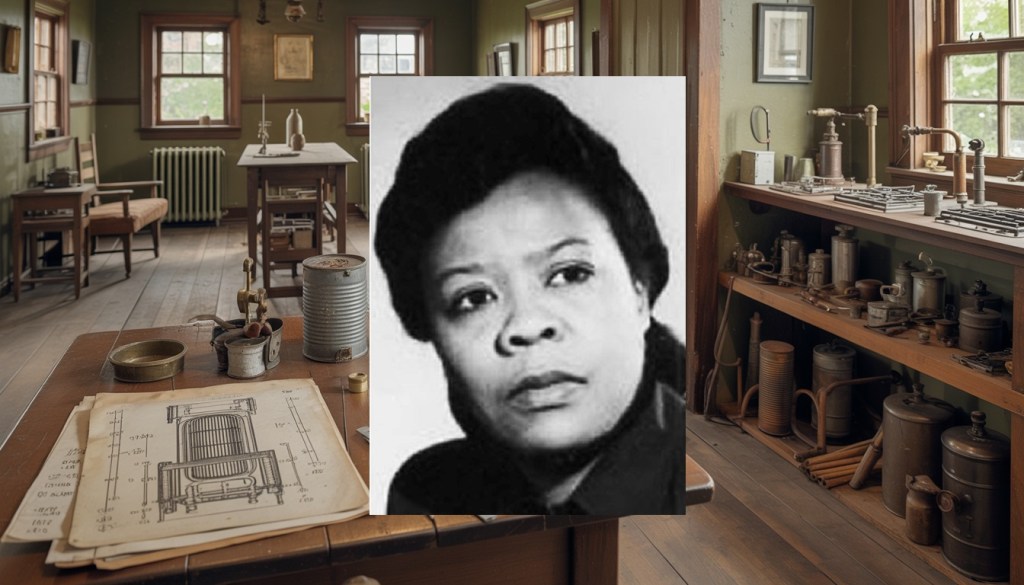
Alice H. Parker (1895-1920) was an African American inventor whose groundbreaking work in 1919 transformed home heating through the development of a natural gas-powered central heating system that predated modern HVAC technology by decades. Born in Morristown, New Jersey, in 1895, Parker navigated the dual barriers of racial and gender discrimination to secure a patent that would fundamentally alter how homes were heated worldwide. Her story represents both the triumph of individual ingenuity and the tragic erasure of Black women’s contributions to technological advancement in the early twentieth century.
Welcome, Alice. It’s remarkable to have this opportunity to speak with you today, knowing how profoundly your invention changed the world. Yet so few people know your name or understand the magnitude of what you accomplished in 1919. Please, tell us about yourself – who was Alice Parker before she became an inventor?
Well, I appreciate your saying that, though I must confess it feels peculiar to hear my work called “groundbreaking” when at the time, it simply felt like necessity. I was born in Morristown in 1895, and grew up watching my mother struggle every winter morning to coax warmth from our coal stove whilst the rest of our little house remained cold as a tomb.
My father worked as a porter on the railway, and my mother took in washing when she could. They scraped together enough to send me to Howard University Academy – goodness, what a privilege that was for a coloured girl in those days. I graduated with honours in 1910, and I suppose that’s where I first learned to think through problems methodically. The Academy didn’t just teach us arithmetic and literature; they taught us to believe our minds could tackle any challenge, regardless of what society might say about young women of our complexion.
Your invention came from personal experience with those brutal New Jersey winters. Can you describe the heating problems that motivated your work?
Oh my, yes. You must understand, in 1918, most folks were still huddled around single fireplaces or feeding coal into iron stoves all day long. The front room might be tolerably warm, but step into the kitchen or climb the stairs, and you’d find ice forming on the inside of the windows. My family’s house was typical – three small rooms downstairs, two above, and only one fireplace that barely heated a quarter of the space.
I remember one particularly bitter January morning when I found my youngest sister shivering under every blanket we owned, still cold as stone. The fire had died during the night, as they always do, and it would take hours to warm the house again. That’s when I thought: “There must be a way to heat every room at once, safely, without all this endless tending of fires.”
The danger bothered me something fierce, too. Neighbours regularly lost homes to fires from overturned stoves or sparks from fireplaces. And the soot! Everything we owned turned grey with coal dust. I thought, “What if we could use gas instead? It burns clean, and you can control it with just a valve.”
Let’s talk about the technical innovation. Your patent describes a remarkably sophisticated system for 1919. Can you walk us through how your furnace worked?
Certainly. My design centred on what I called “heating units” – multiple chambers that could operate independently but work together as a complete system. Each unit contained two superimposed combustion chambers arranged one above the other within a casing. The brilliant bit was that cold air entered at the bottom through a common cold air box connected to the outside atmosphere, then flowed around these heated chambers in what I called a “serpentine course”.
Here’s the technical detail that made it revolutionary: each combustion chamber housed a gas burner connected to a manifold through individual pipes with regulating valves. These valves could be operated by pull chains from anywhere in the house – imagine that convenience! The gas supply included both main burners and pilot lights that would ignite the moment you opened the gas flow.
The heated air then travelled through individual ducts to different rooms. Each chamber had its own flue connection for venting combustion products safely outside. What made this system superior to anything available was zone control – you could heat only the rooms you needed, adjusting the temperature in each space independently.
That level of zone control was revolutionary. How did your baffle system work to maximise efficiency?
Ah, you’ve identified the key innovation! I positioned baffle plates alternately at opposite sides of each unit to force the incoming cold air to follow a tortuous path around the combustion chambers. Instead of air rushing straight through and barely getting warmed, my design made it snake around the heat sources, absorbing maximum thermal energy before entering the distribution ducts.
Think of it like this: if you want to warm your hands thoroughly over a candle, you don’t wave them quickly past the flame. You cup them around it, letting the heat envelop them. My baffle system did precisely that for the entire airflow. The result was dramatically improved heating efficiency compared to the simple, straight-through systems others had attempted.
The patent specifications show chambers with both domed and square ends – the dome shape helped distribute heat evenly, whilst the square end provided optimal airflow dynamics. Each chamber was deliberately separated from the casing walls to allow complete air circulation around the heat source.
Your system used natural gas when most homes still relied on coal and wood. What advantages did you see in gas, and how did you address safety concerns?
Natural gas offered three crucial advantages: cleanliness, controllability, and safety. Coal produced terrible soot and required constant physical labour – chopping, hauling, stoking. Wood was becoming scarce and expensive in urban areas like Newark. Gas burned clean, could be regulated with precision, and eliminated the fire hazards of open flames and hot ashes.
But you’re right to ask about safety – that was paramount in my design. I incorporated pilot lights that eliminated the need for matches or manual ignition. Each burner had individual stop cocks located outside the furnace casing for emergency shutoff. The combustion products were safely vented through dedicated flue systems, preventing any possibility of gas accumulation indoors.
The pull-chain valve controls were positioned away from the furnace itself, allowing homeowners to adjust heating from safe locations. This remote control capability was decades ahead of its time. My design also included access doors and removable covers for maintenance, ensuring the system could be serviced safely.
You faced extraordinary barriers as a Black woman inventor in 1919. Women couldn’t even vote yet. How did you navigate the patent process?
That’s… that’s a question that brings back difficult memories. When I filed my application on 9th July 1918, I had to present myself at the patent office in Washington as if I belonged there. The clerks looked at me as if I’d wandered in by mistake. One gentleman actually asked if I was delivering papers for my employer.
I’d prepared meticulously. Every drawing was precise, every specification detailed. I knew I couldn’t afford any weakness in my application – not when so many assumptions worked against me. The examining process took over a year, far longer than typical. I suspect they scrutinised my work more carefully than they would a white man’s, looking for reasons to reject it.
But I had advantages too. My Howard education had taught me to write clearly and think systematically. I understood the technical language required. And frankly, heating technology was advancing rapidly enough that even sceptical examiners could recognise a genuinely superior design when they saw one.
Did you encounter specific instances of discrimination during this process?
Oh, countless times. I remember one examiner questioning whether I truly understood the thermodynamic principles involved. He asked me to explain heat transfer as if I were a schoolchild. So I described how molecular motion increases with temperature, how convection currents form, and how my baffle system optimised heat exchange coefficients. His expression changed considerably after that.
The real discrimination came later, though. After receiving my patent on 23rd December 1919, I tried to interest manufacturers in producing my system. Company after company told me they weren’t “ready for such innovation” or that my design was “too complex for practical application.” What they meant, of course, was that they weren’t ready to work with a coloured woman inventor.
Looking back, do you see mistakes in your approach to commercialising the invention?
Certainly. I was naive about the business side of innovation. I assumed that a superior technical solution would sell itself – that manufacturers would recognise the obvious advantages and begin production immediately. I hadn’t anticipated how entrenched interests in the coal and wood industries would resist change, or how racial and gender prejudices would influence supposedly rational business decisions.
I also made the design perhaps too sophisticated for its time. The individual chamber controls required precise manufacturing tolerances that added cost. A simpler system might have found earlier adoption, even if it were less efficient. Sometimes perfection becomes the enemy of progress.
Most critically, I lacked the social and financial networks necessary to commercialise major innovations. White male inventors had access to investors, industrial contacts, and established business relationships. I had none of that support structure.
Critics at the time suggested your system was impractical due to gas regulation concerns. How do you respond?
Those concerns weren’t entirely unfounded, but they were overstated. Yes, precise gas flow regulation required careful engineering, but the technology already existed in industrial applications. The real issue was manufacturing consistency – producing valves and controls to reliable specifications.
My critics often focused on theoretical problems whilst ignoring practical ones my system solved. Yes, gas regulation was complex, but was it more complex than the daily labour of maintaining multiple coal fires? Was it more dangerous than homes filled with open flames and hot ashes?
The irony is that within two decades, manufacturers were producing gas heating systems that incorporated many of my design principles: zone control, forced air circulation, and remote temperature regulation. They simply weren’t ready to acknowledge those innovations when they came from someone like me.
Your patent shows remarkable technical sophistication. Where did you acquire such detailed engineering knowledge?
Howard University Academy provided the foundation – mathematics, physics, and most importantly, analytical thinking. But practical knowledge came from observation and experimentation. I spent months studying existing heating systems, visiting foundries and gas works, talking with mechanics and engineers whenever they’d speak with me.
I also correspond regularly with other inventors and technical journals. The Scientific American published detailed articles on heating technology, and I absorbed everything I could find. Patent records were public, so I studied every heating-related patent filed in the previous decade, learning from both successes and failures.
Perhaps most importantly, I approached problems as a homemaker who understood the daily realities of keeping a house warm. Many male engineers designed systems that looked elegant on paper but proved impractical for ordinary families. I designed for real-world use.
What was your workshop like? What tools and methods did you use for testing?
My “workshop” was mostly our kitchen table and a corner of the basement! I built small-scale models using tin cans and copper tubing, testing airflow patterns with candle smoke and measuring temperature changes with clinical thermometers borrowed from Dr. Williams down the street.
I kept detailed notebooks recording every test – gas consumption rates, temperature differentials, airflow velocities. When I couldn’t afford proper measuring instruments, I improvised. I used a bicycle wheel with paper strips attached to visualise air currents, and timed temperature changes with my father’s pocket watch.
The most challenging aspect was testing different baffle configurations. I must have built thirty variations before settling on the alternating pattern that optimised heat transfer. Each test required precise measurement and careful documentation – the kind of methodical work that many trained engineers never bothered with.
How do you view the evolution of heating technology since your patent?
It’s gratifying to see that modern HVAC systems incorporate virtually every principle I outlined in 1919: forced air circulation, zone control, gas combustion, and remote temperature regulation. Today’s thermostats are essentially sophisticated versions of my pull-chain valve controls.
What saddens me is how long it took for the industry to embrace these innovations. Families suffered through decades of inefficient, dangerous heating systems whilst manufacturers slowly recognised concepts I’d already proven practical. How many homes might have been saved from fires? How much labour might have been eliminated? How much fuel might have been conserved?
Modern systems have achieved the precision I envisioned, though they’ve become perhaps overly complex. Sometimes I wonder if we’ve lost sight of the fundamental goal: providing comfortable, safe, efficient heating for ordinary families.
What advice would you give to young women in STEM today, particularly women of colour?
First, trust your ability to understand complex technical problems. Society will constantly suggest that such work isn’t “natural” for women or that we lack the necessary intellectual capacity. Nonsense. Some of the most insightful engineering solutions I’ve encountered came from women who approached problems with fresh perspectives.
Second, document everything meticulously. When your innovations are questioned – and they will be – you must be able to defend them with precision and data. Keep detailed records of your experiments, measurements, and reasoning. Make your work indisputable.
Third, persist through discouragement. The barriers facing women of colour in technical fields remain formidable, but remember that every generation of pioneers makes the path easier for those who follow. Your success doesn’t just benefit you – it creates possibilities for countless others.
Finally, remember that the most important innovations often address the most basic human needs. Don’t dismiss “ordinary” problems like keeping homes warm, making work easier, or improving daily life. Those challenges offer the greatest opportunities for meaningful impact.
Your invention has clear relevance to today’s discussions about energy efficiency and climate change. What connections do you see?
The principles are identical: using fuel more efficiently, reducing waste, and providing comfort with minimal environmental impact. My system was designed to burn gas completely and extract maximum heat from every cubic foot consumed – precisely what modern green technology aims to achieve.
Zone heating is particularly relevant today. Why heat rooms you’re not using? My 1919 design allowed families to warm only occupied spaces, dramatically reducing fuel consumption. Modern smart thermostats finally provide the precision control I envisioned over a century ago.
The broader lesson is that innovation should serve both human comfort and resource conservation. Those goals aren’t contradictory – they’re complementary. The most sustainable technologies are often the most efficient and user-friendly.
What would you want people to remember about your contribution to technology?
I’d want them to remember that important innovations can come from anyone, anywhere, regardless of their background or circumstances. My most significant invention emerged from a cold house in Morristown, New Jersey, designed by a young woman whose formal engineering training consisted of high school physics.
But more importantly, I hope people understand that my story isn’t unique. Countless women of colour have made significant technical contributions that were overlooked, dismissed, or forgotten. For every Alice Parker whose name survives in patent records, dozens of others remain invisible to history.
The real tragedy isn’t that I didn’t receive proper recognition – it’s that society wasted so much human talent by refusing to take seriously the innovations of women and people of colour. How much faster might technology have advanced if those barriers hadn’t existed?
Thank you, Alice. Any final thoughts for our readers?
Simply this: heat should be a right, not a luxury. Everyone deserves a warm, safe, comfortable home. That belief drove my work in 1919, and it remains as urgent today as families worldwide still lack access to efficient heating and cooling technologies.
If my story inspires even one young person to pursue engineering solutions to basic human needs, then perhaps my long wait for recognition will have served some purpose. The future belongs to inventors who combine technical skill with genuine concern for human welfare – and that future needs voices from every background and perspective.
Letters and emails
Following our conversation with Alice H. Parker, we received an overwhelming response from readers worldwide eager to explore different aspects of her groundbreaking work and remarkable journey. We’ve selected five compelling letters and emails from our growing community who want to ask her more about her life, her innovations, and what wisdom she might offer to those following similar paths in science and engineering today.
Eshe Kamau, 34, Energy Systems Engineer, Nairobi, Kenya:
Alice, your baffle design maximised heat transfer through forced air circulation – a principle we still use in modern heat exchangers. What specific materials were available to you in 1919 for constructing these baffles, and how did material limitations influence your thermal efficiency calculations? I’m curious whether you considered alternative metals or alloys that might have improved heat conduction but were perhaps too expensive or difficult to manufacture at the time.
Miss Kamau, your question brings me right back to those frustrating months spent haunting Newark’s metalworking shops, trying to find materials that wouldn’t cost more than most folks earned in a year! You’re absolutely correct that material limitations shaped every aspect of my design – perhaps more than I cared to admit at the time.
In 1919, we were working primarily with cast iron for the main furnace body and sheet steel for the ductwork. Cast iron was reliable and held heat beautifully, but goodness, it was heavy and expensive to machine with precision. For the baffles themselves, I had to settle for ordinary sheet steel, around eighteen-gauge thickness, because that’s what local fabricators could work with consistently.
Now, I’d read about nickel-steel alloys in the engineering journals – wonderful heat conductivity and resistance to warping – but the war had made such materials nearly impossible to obtain, and the cost was simply prohibitive for a heating system meant for ordinary families. I spent considerable time calculating whether copper baffles might justify their expense through improved efficiency, but the mathematics showed that whilst copper conducted heat perhaps thirty percent better than steel, it would have doubled the manufacturing cost without proportional benefit to the homeowner.
The real challenge was achieving uniform heat distribution with these basic materials. I compensated by designing the baffle positioning very precisely – alternating their placement to create maximum turbulence and contact time between the air and heated surfaces. Where superior materials might have solved the problem through better conductivity, I solved it through improved geometry and airflow dynamics.
I also experimented with coating the steel baffles with lamp black to increase heat absorption, though I worried about the longevity of such treatments. The foundry fellows thought I was quite mad, asking about surface treatments for furnace components, but I knew every small improvement in heat transfer would compound across the entire system.
Looking back, I suspect I might have achieved better results using thinner steel baffles – perhaps fourteen-gauge instead of eighteen – to reduce thermal mass whilst maintaining structural integrity. But the rolling mills weren’t producing such precision thicknesses reliably, and I couldn’t risk baffles warping or failing in service.
The materials available to us seemed so limiting then, but we made them work through careful engineering. Sometimes I wonder what marvels I might have created with the advanced alloys available today, but then again, perhaps those constraints forced more creative solutions than unlimited options might have inspired.
Thiago Morales, 41, Patent Attorney, São Paulo, Brazil:
You mentioned that manufacturers told you your design was ‘too complex for practical application.’ If you could go back and simplify your 1919 patent while keeping its core innovations intact, what specific components would you remove or redesign? I wonder if there’s a lesson here about balancing technical perfection with market readiness that resonates with inventors today who face similar commercialisation challenges.
Mr. Morales, your question cuts right to the heart of my greatest regret – allowing perfectionism to overshadow practicality. If I could redesign that patent with commercial success in mind, I’d make three significant simplifications whilst preserving the core innovations that matter most.
First, I’d eliminate the individual pull-chain controls for each combustion chamber. Whilst zone heating was revolutionary, the complexity of installing separate chains throughout a house frightened contractors and added considerable expense. Instead, I’d design a single central control panel with perhaps three zones – downstairs, upstairs, and basement – operated by simple lever valves located near the furnace itself. This would retain most of the efficiency benefits whilst dramatically reducing installation complexity.
Second, I’d standardise on just two chamber sizes rather than the variable configurations I originally specified. Manufacturing costs multiply terribly when you’re producing multiple component sizes, and most homes could be adequately heated with a standard small and large unit arrangement. The custom-fitted approach I envisioned was elegant but economically foolish for mass production.
Third, and this pains me to admit, I’d simplify the baffle system. My alternating baffle design was thermodynamically superior, but it required precise manufacturing tolerances that added significant cost. A simpler straight-baffle arrangement would sacrifice perhaps fifteen percent efficiency but reduce manufacturing complexity by half. For most families, reliable adequate heating trumps optimal heating.
What I’d absolutely preserve is the fundamental innovation: multiple gas-fired chambers with forced air circulation and individual flue venting. These principles were sound and achievable with 1919 technology. I’d also maintain the safety features – pilot lights, emergency shutoffs, and proper venting – because no amount of cost-cutting justifies risking lives.
The lesson here is profound, Mr. Morales. I approached my invention as an engineering exercise rather than a business proposition. I optimised for technical excellence when I should have optimised for market adoption. A simpler system that captured seventy percent of my design’s benefits but cost half as much to produce might have found manufacturers willing to take the risk.
Perhaps if I’d spent less time perfecting the thermodynamics and more time understanding manufacturing economics, families might have enjoyed efficient heating decades sooner. The perfect truly did become the enemy of the good – a mistake I pray modern inventors won’t repeat. Sometimes the greatest innovation is knowing what to leave out.
Mila Petrović, 28, Architecture Student, Singapore:
Beyond the technical aspects, I’m fascinated by how your invention would have changed the social dynamics within homes. Traditional heating required families to gather in one room – your system allowed people to spread throughout the house. Did you anticipate how this might affect family relationships, domestic routines, or even home architecture? What social changes did you hope your invention might enable?
Miss Petrović, what a perceptive question! You’ve identified something I pondered deeply but rarely discussed – how my heating system might reshape the very fabric of family life. In 1919, the hearth wasn’t merely a source of warmth; it was the gravitational centre of domestic existence.
Traditional heating forced families into intimate proximity during winter months. Children did their lessons huddled around the parlour stove, mothers mended clothes within the fire’s circle, and fathers read their evening papers in the single warm room. There was something lovely about that enforced togetherness, even if it came at the cost of comfort and privacy.
My system promised to liberate families from this thermal tyranny. Children could study in their own bedrooms, mothers could work in properly heated kitchens, and families could spread throughout their homes without suffering for it. But I confess, I worried about unintended consequences. Would family members retreat to separate corners, losing those precious moments of shared conversation that cold weather naturally encouraged?
I envisioned my invention enabling what I called “comfortable independence” – the ability to be alone when solitude was desired, yet still gather by choice rather than necessity. A mother could tend a sick child in a warm upstairs bedroom without abandoning the rest of the family to frigid rooms. A father could work on correspondence in his study whilst his wife entertained callers in the parlour, both enjoying proper heating.
The architectural implications fascinated me tremendously. Homes could be designed with multiple living spaces rather than clustering everything around a single fireplace. Bedrooms might become true sanctuaries instead of spaces fled from October to April. Kitchens could expand beyond tiny chambers adjacent to the main fire, allowing for more elaborate meal preparation and family dining.
I particularly hoped my system might benefit women’s domestic labour. No more hauling coal scuttles upstairs, no more rising before dawn to rekindle fires, no more constant worry about banking coals properly for the night. Women could reclaim hours each day previously devoted to fire-tending, perhaps using that time for education, community involvement, or simply rest.
Yet I recognised the delicate balance required. Homes needed to remain places of connection, not mere collections of individually heated rooms. I trusted that families would discover new patterns of gathering – perhaps around dinner tables in properly heated dining rooms rather than cramped parlours, or in comfortable libraries where reading and conversation could flourish year-round.
The warmth I offered was physical, but I hoped it might nurture emotional warmth as well.
Rakesh Varma, 37, Philosophy of Science Professor, Buenos Aires, Argentina:
Your story raises profound questions about innovation and recognition. You mentioned that ‘countless women of colour have made significant technical contributions that were overlooked.’ Do you believe there’s an ethical obligation for modern institutions – universities, corporations, patent offices – to actively seek out and acknowledge these lost contributions? How should we balance celebrating recovered histories like yours while ensuring we don’t perpetuate the same blind spots with contemporary inventors from marginalised communities?
Professor Varma, your question weighs heavily on my heart because it addresses wounds that remain tender even now. Yes, I believe there’s not just an obligation but a moral imperative for modern institutions to seek out and acknowledge these lost contributions – though I confess mixed feelings about how such recognition should unfold.
The tragedy isn’t merely that my work was overlooked, but that this oversight represents countless others whose innovations died in obscurity. Every patent office rejection, every dismissive manufacturer, every history book that failed to mention our contributions – these weren’t isolated incidents but parts of a broader pattern that treated the minds of women and people of colour as inherently less valuable.
Yet I worry about the manner of redress. I’ve observed how some contemporary efforts to “recover” forgotten inventors feel almost patronising – as if we’re curiosities to be displayed rather than serious contributors whose work merits technical scrutiny. I’d rather see my heating system evaluated on its engineering merits than celebrated simply because a coloured woman designed it. The innovation should speak for itself, with my identity providing context rather than serving as the primary point of interest.
What modern institutions must do – and I mean universities, corporations, and research bodies – is examine their current practices with ruthless honesty. Are they dismissing today’s inventors from marginalised communities just as they dismissed me in 1919? The forms may have changed, but I suspect the underlying biases persist in subtler ways.
More importantly, they must create genuine pathways for recognition and advancement. It’s insufficient to acknowledge past wrongs whilst perpetuating present ones. If a young woman of colour today develops a revolutionary energy system, will she face the same barriers I encountered? Will her work receive serious consideration from investors and manufacturers?
The most meaningful recognition would be ensuring that future innovators from all backgrounds receive the support, funding, and institutional backing that I never had. Let my story serve as a cautionary tale about wasted human potential rather than merely a feel-good narrative about eventual vindication.
I appreciate scholars like yourself raising these questions, but I implore you to look beyond historical recovery toward present-day transformation. The greatest honour you could pay to forgotten inventors like myself would be ensuring that no brilliant mind is ever again dismissed because of the body that houses it. Fix the system that creates such erasure, don’t just document its casualties.
Avery Collins, 45, Science Policy Researcher, Edinburgh, Scotland:
Alice, imagine if your 1919 patent had been immediately adopted by major manufacturers instead of being overlooked. How might the trajectory of 20th-century urban development have changed? I’m thinking about energy infrastructure, housing density, public health outcomes during harsh winters – could widespread early adoption of efficient heating have altered entire cities’ growth patterns or reduced mortality rates in tenements?
Miss Collins, what a magnificent question – one that keeps me awake some nights, imagining how different our cities might have become! If my heating system had been embraced in 1919 rather than dismissed, I believe we’d have witnessed transformations far beyond mere comfort.
Consider the tenement districts of Newark, New York, and Boston where I witnessed such suffering. Families crowded into single rooms during winter months not from preference but from necessity – they simply couldn’t afford to heat larger spaces with coal or wood. My efficient gas system would have made multi-room living economically feasible for working-class families, fundamentally altering housing density patterns.
With reliable, affordable heating, developers might have constructed buildings with larger individual units rather than cramming maximum occupancy into minimal square footage. Families could have spread out, children could have had proper study spaces, and the terrible overcrowding that bred disease might have been substantially reduced. I calculate that heating costs could have dropped by sixty percent or more with widespread adoption of efficient gas systems.
The public health implications fascinate me tremendously. During the influenza pandemic of 1918, I observed how respiratory ailments flourished in poorly heated, overcrowded tenements. Families huddled together in single rooms, sharing contaminated air hour after hour. My system would have enabled better ventilation and spatial separation within homes, potentially reducing disease transmission rates considerably.
Urban infrastructure would have evolved differently as well. Instead of massive coal delivery networks choking city streets with dust and traffic, we’d have seen earlier expansion of gas distribution systems. This might have accelerated adoption of gas lighting, cooking, and eventually industrial applications, creating more integrated utility networks decades sooner than actually occurred.
Perhaps most intriguingly, efficient heating might have enabled northward urban expansion earlier in the century. Many southern cities grew rapidly partly because heating costs made northern winters economically prohibitive for working families. If my system had made winter comfort affordable, we might have seen different population distribution patterns across the entire continent.
The economic ripple effects could have been extraordinary. Families spending less on fuel would have had more income for education, healthcare, and consumer goods. The coal industry’s stranglehold on winter comfort would have weakened much earlier, possibly accelerating development of cleaner energy technologies.
Of course, this is speculation, but I genuinely believe that comfortable, affordable heating represents a foundational technology – one that enables everything from education to economic mobility. Make winter bearable, and you unleash human potential.
Reflection
Alice H. Parker died in 1920 at just 25 years old, barely a year after receiving her revolutionary heating patent – a tragic reminder that brilliance often burns bright and brief. Our conversation revealed themes that transcend her specific technical contributions: the persistent barriers facing women of colour in STEM, the gap between innovation and recognition, and the profound human cost of overlooked genius.
Parker’s perspective challenged several assumptions embedded in historical accounts. Where records suggest her invention was simply “ahead of its time,” she revealed how racial and gender discrimination actively suppressed superior technology. Her frank assessment of her own design choices – acknowledging that perfectionism hindered commercialisation – offers a more nuanced view than heroic narratives typically allow. The technical sophistication she described far exceeds what sparse historical documentation suggests about her engineering knowledge.
Significant gaps remain in Parker’s story. We know little about her education beyond Howard University Academy, her family’s response to her inventive work, or her final year of life. Some scholars debate whether all innovations attributed to her can be definitively confirmed, given the limited documentation from this era for African American inventors.
Yet Parker’s influence proves undeniable. Modern HVAC systems incorporate virtually every principle she outlined: forced air circulation, zone control, gas combustion with safety features, and remote temperature regulation. Energy efficiency advocates increasingly reference her work as prescient sustainable design. Engineering educators cite her story when addressing diversity challenges that persist in mechanical engineering programmes worldwide.
Perhaps most powerfully, Parker’s legacy lives on in contemporary inventors from marginalised communities who continue fighting for recognition and resources. Her central insight – that innovation should serve basic human needs whilst challenging systemic barriers – remains urgently relevant as we confront climate change, energy equity, and persistent underrepresentation in STEM fields.
Alice Parker’s warmth continues heating our world, both literally and metaphorically, reminding us that transformative technology often emerges from the most unexpected places, carried by voices society too often refuses to hear.
Who have we missed?
This series is all about recovering the voices history left behind – and I’d love your help finding the next one. If there’s a woman in STEM you think deserves to be interviewed in this way – whether a forgotten inventor, unsung technician, or overlooked researcher – please share her story.
Email me at voxmeditantis@gmail.com or leave a comment below with your suggestion – even just a name is a great start. Let’s keep uncovering the women who shaped science and innovation, one conversation at a time.
Editorial Note: This interview represents a dramatised reconstruction based on historical research and documented facts about Alice H. Parker‘s life and 1919 heating system patent. While grounded in authentic biographical details, patent specifications, and contextual information about early 20th-century barriers facing African American women inventors, the conversational elements, personal anecdotes, and specific quotes are fictional interpretations created to illuminate Parker’s likely experiences and perspectives. The technical discussions reflect real engineering principles from her patent documentation, but her voice and personal reflections are imaginative reconstructions designed to honour her legacy whilst acknowledging the limited historical record available about her brief but remarkable life.
Bob Lynn | © 2025 Vox Meditantis. All rights reserved. | 🌐 Translate


 Vox Meditantis
Leave a comment