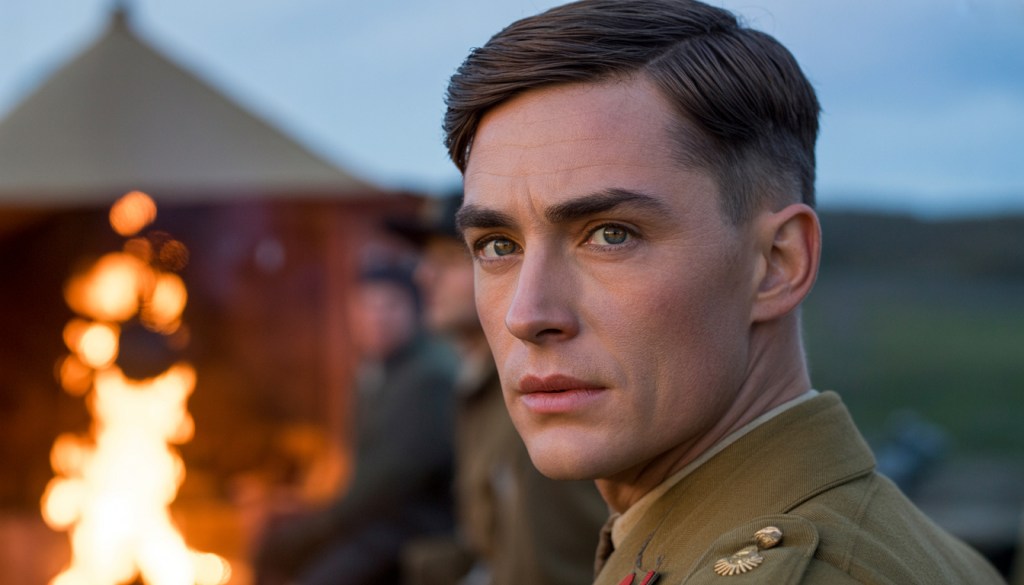
8th October 1904
I write this by the light of our campfire, at the junction where the Peshawar road meets the old caravan route – a place where armies have stood since time immemorial, and where tonight I find myself contemplating matters that exceed the mere disposition of troops.
News has reached us from Manchuria of the great battle at the Sha-ho River, where Russian and Japanese forces have been locked in terrible embrace these past days. The dispatches speak of such slaughter as to make one’s blood run cold, yet also of such steadfast courage as must surely be numbered amongst the noblest exhibitions of martial virtue. To read of men holding their ground under withering fire, of regiments advancing into the very jaws of death with colours flying – it strikes the soul with awe. One cannot help but wonder at the steel that binds such fellows together, that they should face annihilation rather than forsake their brothers-in-arms.
Here, beneath stars that have witnessed the march of Alexander’s phalanxes and the passage of Moghul emperors, I am moved to consider what it means to belong to such a brotherhood. We are but a small detachment, charged with maintaining the King’s peace along this frontier, yet I perceive in my companions the same sacred flame that must burn in the hearts of those brave souls at Sha-ho. It is not mere obedience to orders that keeps a man at his post when danger threatens; it is something altogether finer and more mysterious.
The fire before me crackles and sends sparks heavenward, and I am reminded of the forge. A blade that has not been tempered in flame is worthless; it will bend or shatter at the first trial. So too with men. I have come to understand that it is shared hardship – the burning crucible of service – that transforms a collection of individuals into something greater than themselves. When Sergeant MacLeod fell ill with the fever last month, every man in the company took turns at his bedside. When young Hargreaves lost his way during patrol and was feared captured by raiders, we searched through the night, each of us driven by a conviction that to abandon one was to betray all.
This is the alchemy of which the poets speak, though they dress it in finer words than a simple soldier can command. We are bound not merely by King and country, though these are sacred charges, but by something that partakes of the divine. The Almighty, in His wisdom, has ordained that man should not stand alone, but should find his truest self in service to his fellows.
I am put in mind of the severest obligation I have undertaken in all my years of service. It was not a matter of tactics or strategy, but of the soul. Three years past, when I received my commission, I made a solemn vow – not only the oath required by regulations, but a private covenant with the Heavenly Father. I swore that I should never, by cowardice or neglect, be the cause of harm to those placed under my charge. I pledged that I would rather lay down my own life than see a single man lost through my failure of nerve or judgement.
It is a fearsome thing to set such terms for oneself, and there have been nights when the weight of it has pressed upon me like a stone. How does one prepare to keep such a promise? How does one steel oneself against the moment when all shall be tested? I have sought the answer in prayer and in study of the great commanders, but increasingly I perceive that the preparation lies not in solitary striving but in the daily fires of fellowship. Each shared meal, each jest around the evening fire, each instance of mutual aid – these are the faggots that build the pyre upon which one’s lesser self is consumed, leaving only what is pure and serviceable.
The flames dance and shift, casting shadows that seem almost to take corporeal form – phantoms of all who have stood at such crossroads before us. I stand now at my own crossing, between the man I was and the man I must become. The road behind is marked by comfort and self-regard; the road ahead demands sacrifice and surrender of one’s private will to the greater good.
Word has come that we may be ordered north, to reinforce positions along the Afghan border. There is talk of unrest, of movements in the mountain passes. If the call comes, we shall answer, not as solitary warriors but as a body united. The thought fills me with a species of dread, certainly, but also with a strange exaltation. To be permitted to serve amongst such men, to take one’s place in a line that stretches back through the centuries – surely this is to touch something eternal.
The fire burns low now, and I must to my rest. Yet before I close this journal, I am compelled to record one final thought. In observing the embers – how each coal, in isolation, quickly grows cold and dark, whilst those that remain together maintain their heat and light – I see the very image of human community. We are nothing alone. We are everything together. And if this be the lesson that the Lord has appointed me to learn in this remote outpost, then I accept it with gratitude and with trembling.
The flame of faith, the fire of fellowship, the burning conviction that our cause is righteous – these are the forces that shall carry us forward, whether to glory or to the grave. And in either event, we shall not go alone.
Ad astra per aspera. Through hardship, to the stars – or perhaps more truly, through the fire of shared trial, to the brotherhood that redeems us all.
Set in the Edwardian era, the entry references the 1904 Russo‑Japanese War’s autumn fighting around the Sha‑ho River, where Japan’s offensives pressured Russian forces in Manchuria and signalled a shift in Asian power dynamics. It also evokes Britain’s imperial frontier policing after the Second Boer War (1899-1902), when the British Army maintained garrisons across India’s North‑West Frontier to secure routes and suppress local unrest. The Russo‑Japanese War culminated in Japan’s victory and the Treaty of Portsmouth (1905), reshaping regional influence and inspiring global military reforms. For Britain, lessons from South Africa and frontier service informed Edwardian army modernisation, including staff training, intelligence, logistics, and small‑unit tactics.
Bob Lynn | © 2025 Vox Meditantis. All rights reserved. | 🌐 Translate

 Vox Meditantis
Leave a comment