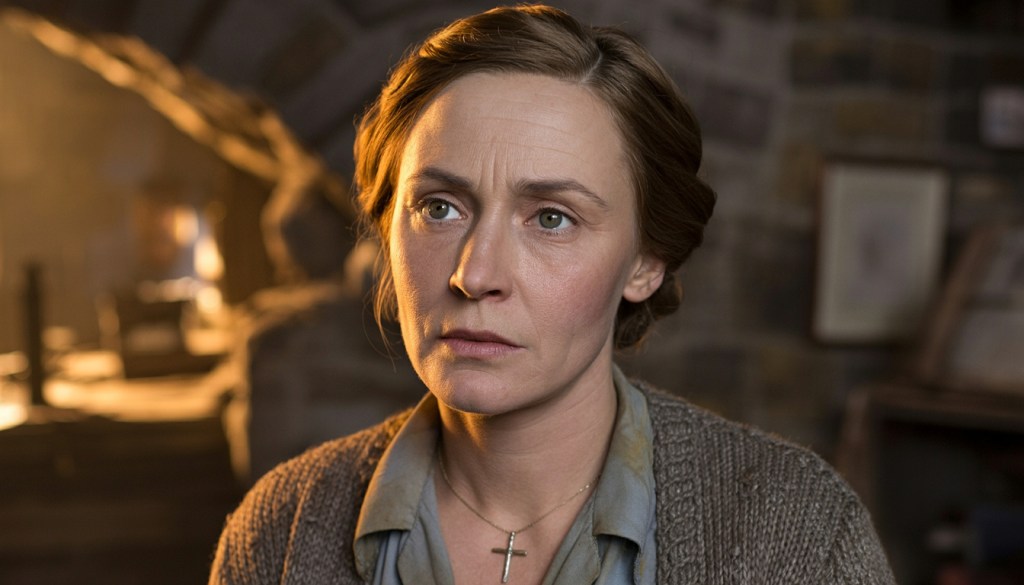
7th October 1946
The crypt is cold tonight, colder than it ought to be for October, but then everything feels colder without proper coal. I’ve come down here after Evensong, told Mrs Parsons I’d give the brass another polish before Sunday, but truth be told I wanted the quiet. The shadows stretch long from my candle, reaching into corners where the damp has darkened the stone, and there’s an echo down here that makes you feel you’re conversing with something older than yourself.
The vicar spoke this morning of judgement and mercy, and I cannot get his words from my mind. They’ve hanged those men at Nuremberg – I read it in last week’s paper, what they did, what they ordered done. Ten of them, dropped through the trap on the 16th. I ought to feel that justice has been served, and perhaps it has, but sitting here among the memorial tablets to the parish dead, I find myself turning it over and over like a worn coin. “Vengeance is mine, saith the Lord.” We prayed for the victims, for those camps we can scarce bring ourselves to name, and I wonder how a body begins to fathom such wickedness. The vicar says we must trust in God’s mercy whilst acknowledging the reality of sin, but my mind cannot hold both truths at once without feeling torn in two.
I’ve been thinking on beauty this evening, on what lifts the spirit when the world feels heavy as wet wool. There’s a painting of the Annunciation in the Lady Chapel – nothing fine, just a Victorian copy of something grander – but the way the light falls on Our Lady’s face, the blue of her mantle even beneath years of candle smoke, it steadies me somehow. Makes me think of Mr Moore’s drawings I saw reproduced in the Illustrated London News during the war, all those souls sheltering in the Underground, huddled forms in the dark. He saw the dignity in it, the strange beauty of people enduring. That’s artistry to my mind – not making pretty pictures of pleasant things, but showing forth the truth of how we bear up under the weight of living.
And there’s Mrs Talbot, who does the altar cloths. Her hands are twisted something cruel with the rheumatism, but she embroiders like an angel. Last Easter she did lilies so real you’d swear you could smell them. She says it’s her offering, her prayer in thread and needle. I think she’s got the right of it. There’s artistry in any work done with care and love. The women who made the Bayeux Tapestry – that’s history told in needlework, isn’t it? The hands that carved the rood screen upstairs, the man who laid these crypt stones so true they’ve not shifted in three hundred years. We’re surrounded by the labour of the faithful, and that’s a kind of beauty that endures.
The wireless had a programme last week on church music, and they played “When I Survey the Wondrous Cross.” Isaac Watts wrote that hymn, and every time I sing it I think how he found words for what my heart feels but cannot say. Love so amazing, so divine, demands my soul, my life, my all. That’s what I mean by beauty – something that reaches past the everyday and touches the eternal. The choir here isn’t much – Mrs Hill hasn’t got the voice she once had, and young George Clark is tone-deaf as a post – but when we sing together in this old church, there’s something in it that lifts me.
I can hear the echo of my own movements down here, my shoes on the flagstones, the scrape of the brass polish tin. It puts me in mind of absence, of all the folk who should be here and aren’t. My brother Tom, rest him, who ought to be upstairs polishing the altar rail instead of lying in Normandy earth. The sound bounces back at me, and I think that’s what memory is – an echo of what was, growing fainter but never quite silent. The shadows move when I move, keeping pace, and I fancy sometimes they’re the shapes of those gone before, the centuries of faithful who’ve knelt in this place.
The coal shortage is biting hard now. We’re rationed to nothing, and the scullery at the vicarage where I work mornings is bitter in the early hours. Mrs Parsons says it’ll be a harsh winter if this keeps on. The government promises more, but promises don’t heat the copper or warm the water for scrubbing. We manage, as we always have. Make do and mend, wasn’t that what we learned? It’s become a habit of the soul now, not just the wardrobe.
I find myself wondering what the Lord requires of us now, in this strange peace. The war demanded everything – our sons, our sleep, our certainty about the world. Now we’re meant to rebuild, to carry on, but some days I feel we’re all still underground, sheltering, waiting for the all-clear that never quite comes. The verger says the cracks in the church wall from the bombing three years ago are spreading. We patched them then, but the building hasn’t settled right. Neither have we, I suppose.
When I finish here I’ll snuff the candle and climb back up to the world, to the cold street and the long walk home in the blackout that isn’t quite a blackout anymore but habits die hard. I’ll make my tea on the gas ring if there’s a shilling for the meter, eat my bit of bread and marge, and try to sleep despite the cold. But I’ll carry with me the thought that even in this cellar, in the damp and the dark and the echoes of the dead, there’s something worth preserving. The brass will shine come Sunday. The altar cloths will be clean. The small beauties will endure, and perhaps that’s its own form of faith – that the work of our hands matters, that there’s holiness in the ordinary, that even shadows need light to exist at all.
The Lord sees into all the dark places, that’s what Scripture promises. He knows the number of hairs on our heads and the depths of our hearts. If He can find us here, in the cellars and the ruins and the cold rooms of this broken world, then perhaps we’re not as lost as we feel.
Post-war Britain in 1946 faced the moral reckoning of the Second World War and the practical hardships of recovery, as the Nuremberg Trials exposed the extent of Nazi crimes while the United Kingdom endured rationing, housing shortages, and a mounting coal crisis under a Labour government committed to reconstruction. The trials, culminating in late 1946 sentences, established legal precedents for crimes against humanity and war crimes, shaping international law and post-war justice efforts. At home, demobilisation, “make do and mend,” and continued austerity defined daily life, leading into the severe winter of 1946-47, nationalisation of key industries, and the founding of the NHS in 1948.
Bob Lynn | © 2025 Vox Meditantis. All rights reserved. | 🌐 Translate

 Vox Meditantis
Leave a comment