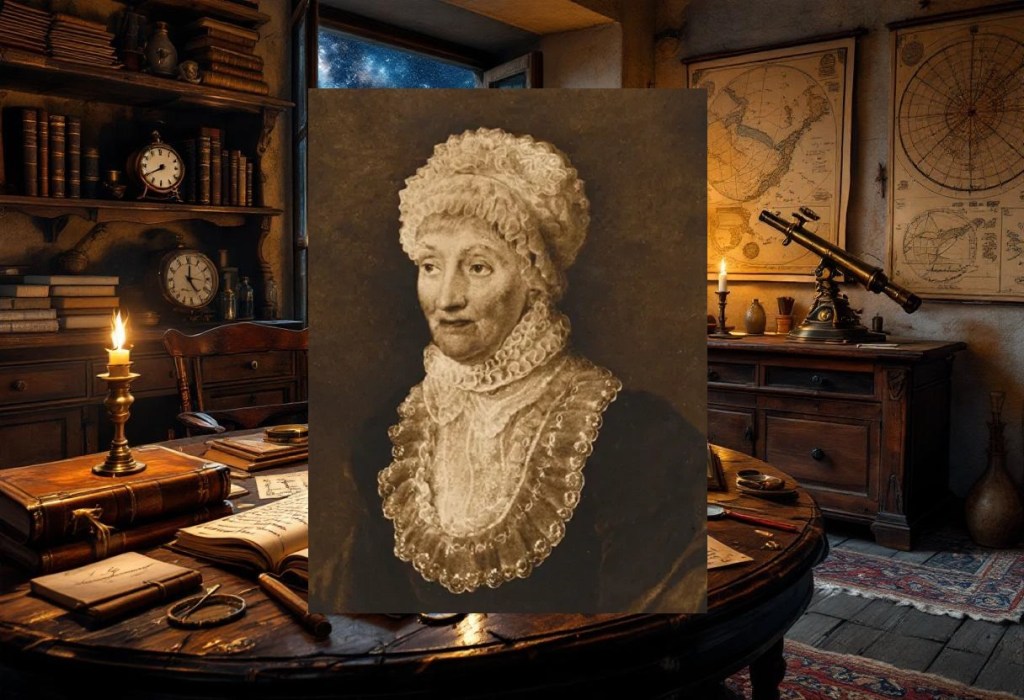
Caroline Lucretia Herschel (1750-1848) carved her name amongst the stars not by accident, but through tireless nights spent with her eyes trained skyward, methodically scanning the heavens for objects others had overlooked. Working alongside her brother William yet pursuing discoveries entirely her own, she became the first woman to receive payment for scientific work in Britain and the first to discover a comet with her own eyes. Her detailed observations and catalogues remain foundational to modern astronomy, proving that quiet dedication and precision can illuminate paths previously hidden in darkness.
Caroline, thank you for joining us from across the centuries. Your journey to becoming the first professional female astronomer was quite remarkable. I’d like to begin with your early years in Hannover – what was your upbringing like, and how did a girl destined for domestic service end up with her eyes on the stars?
Why, the pleasure is mine entirely, though I confess this manner of speaking across time feels rather peculiar to an old creature like myself! My early years were indeed marked by what one might charitably call limited prospects. Mother was most insistent that my place was in the household – sewing, cooking, keeping house for whichever brother might require it. I was quite stunted in growth after the typhus fever as a child, you see, which Mother took as Providence’s sign that I should remain in service rather than seek a husband.
But William – dear Wilhelm, as we called him then – had different ideas altogether. When he wrote from Bath in 1772 requesting I join him in England, it felt rather like a miracle. I was twenty-two and had never ventured beyond our neighbourhood. Mother was quite beside herself, but William prevailed. He promised to train me as a singer, you understand. Music was to be my liberation, not the stars. How little we knew then what lay ahead!
The transition from music to astronomy seems to have happened gradually. Can you describe that shift and what drew you to the precision work that astronomy demanded?
Oh, it was William’s growing madness for the heavens that pulled us both in! By 1775, he had quite abandoned any sensible approach to music-making. Our beautiful drawing rooms became workshops filled with grinding tools, metal shavings, and the most dreadful mess you can imagine. I grieved for our lovely parlours, I must tell you.
But there was something rather extraordinary happening. William would spend entire nights polishing mirrors – sixteen hours at a stretch, mind you – and I found myself feeding him by hand so he needn’t stop his work. The dedication was infectious, I suppose. When he began his sky surveys, he required someone to record his observations, and who else was so conveniently placed as his sister?
The precision work suited me surprisingly well. I had always possessed a careful hand with numbers – Mother’s domestic training had taught me to account for every penny and measurement. Astronomy simply demanded the same careful attention, but applied to celestial objects rather than household inventories. I discovered I rather enjoyed the mathematical calculations required for determining star positions and tracking celestial motions.
Let’s focus on your technical expertise. Can you walk us through the process of how you discovered your comets? What were the specific tools and methods you used?
Ah, now you’ve asked me to reveal my particular methods! William had constructed for me in 1783 a most excellent comet-sweeper – a small Newtonian reflector of 4.2 inches aperture with about six feet focal length. It was designed expressly for my use, with a comfortable mounting that allowed me to sweep the sky efficiently.
My technique was rather methodical. I would begin each clear night by examining those regions of sky where comets were most likely to appear – generally the areas near the horizon just after sunset or before dawn, where the sun’s glare wouldn’t overwhelm faint objects. I developed a pattern of slowly sweeping vertically, then moving slightly and repeating, rather like mowing a field in strips.
The crucial skill was distinguishing a genuine comet from the many nebulous objects that might confuse the observer. A true comet shows motion against the background stars over the course of several nights, and often displays that characteristic fuzzy appearance with perhaps a slight tail. I would mark the position of any suspicious object most precisely, then return to it the following night to confirm movement.
My first comet – discovered on 1st August 1786 – appeared as a small, hazy star that seemed somehow out of place. I noted its position most carefully and observed it for three consecutive nights before confirming its motion. The excitement was quite overwhelming, though I was careful to verify my observations before announcing anything to the astronomical community.
Your work with cataloguing stars was equally groundbreaking. Tell us about your revision of Flamsteed’s catalogue – what problems were you solving, and how did your approach differ from existing methods?
Ah, dear John Flamsteed’s Historia Coelestis! A monumental work, to be certain, but organised in a manner that quite frustrated practical observers. Flamsteed had arranged his catalogue by constellation, which was traditional but terribly inconvenient for those of us actually searching the skies.
You see, when William and I were conducting our systematic sweeps, we needed to know what stars belonged in a particular region of sky, not which constellation they represented. I recognised that the catalogue would be far more useful if reorganised by what we called “north polar distance” – essentially, bands of declination that corresponded to how we actually moved our telescopes across the heavens.
The work was extraordinarily tedious – I spent countless hours recalculating positions for nearly three thousand stars, correcting errors I discovered in the original observations, and adding 561 stars that Flamsteed had observed but somehow omitted from his published catalogue. Each star required careful verification and mathematical conversion to the new system.
What made the work particularly valuable was my attention to omissions and errors. I discovered that many stars Flamsteed had actually observed were missing from the British Catalogue entirely. These weren’t obscure objects – some were quite readily visible! My supplement helped ensure that future astronomers wouldn’t overlook these celestial treasures.
The resulting catalogue was published in 1798 and remained in use for decades. I’m particularly proud that it served as foundation work for what became the New General Catalogue, which I understand astronomers still employ today.
You mentioned working “in your brother’s shadow,” yet you achieved remarkable independence. How did you navigate the challenges of being a woman in 18th-century science?
The shadow business is rather complex, isn’t it? On one hand, William’s reputation certainly opened doors that would have remained firmly bolted to a woman approaching alone. His discovery of Uranus made us both figures of considerable interest, and King George’s patronage provided security neither of us could have imagined.
Yet there were persistent frustrations. When I compiled William’s observations into that magnificent catalogue of nebulae, it was published under his name alone – I was credited merely as his “assistant,” though I had performed all the mathematical work and verification. The distinction between observer and computer was quite rigid, you understand. Recognition went to whoever actually peered through the telescope, regardless of who performed the calculations or prepared the final papers.
The royal salary was both blessing and burden. Fifty pounds annually made me the first woman paid for scientific work in Britain – quite revolutionary! But it was explicitly for my role as William’s assistant, which rather emphasised my subordinate position even as it elevated my status.
I found my truest independence in those solitary nights with my comet-sweeper. When I was alone under the stars, pursuing objects that might never have been seen by human eyes, there was no question of secondary status. The comets didn’t care whether their discoverer was male or female – they simply needed someone patient and skilled enough to detect their presence.
Let me ask you about a moment of self-reflection. Looking back, was there a discovery or decision you’d approach differently now?
Oh, you wish me to confess my failures, do you? Very well. I must acknowledge that I sometimes allowed my devotion to William to override my own scientific judgement.
There was a particular incident regarding double star measurements where I accepted William’s observations without sufficient verification of my own. I had actually detected discrepancies in his measurements, but I reasoned that his superior instruments and experience made my concerns invalid. Later observations proved my initial suspicions correct – we had indeed made an error that was subsequently corrected by other astronomers.
I also regret not pursuing certain theoretical questions more vigorously. I was quite capable of mathematical analysis beyond simple calculations, yet I often deferred to William’s theoretical interpretations rather than developing my own. There were patterns I noticed in the distribution of nebulae that might have led to interesting conclusions, but I treated them as mere observational notes rather than subjects worthy of deeper investigation.
Perhaps most significantly, I sometimes presented my work too modestly. When describing my comet discoveries in correspondence, I often emphasised the preliminary nature of my observations rather than the skill and dedication required to make them. This self-deprecation, while considered proper for a lady, may have diminished appreciation for the genuine scientific achievement involved.
Contemporary critics sometimes argued that family collaborations in astronomy gave undue credit to the male head of household. How would you respond to that view of your partnership with William?
Those critics raise a legitimate concern, though I’d argue they misunderstand the nature of our collaboration. Yes, family teams were often credited exclusively to the male member – this was the prevailing custom and quite unfair to the women involved.
However, our partnership was rather more complex than mere assistance. While I certainly spent countless hours recording William’s observations, I also made independent discoveries that were recognised under my own name. My eight comets, my revision of Flamsteed’s catalogue, my identification of new nebulae – these were acknowledged as my work, not William’s.
The difficulty lies in determining where collaboration ends and individual achievement begins. When I calculated the positions of William’s discovered nebulae, was I merely performing mechanical computation, or was I contributing scientific judgement about the reliability and significance of the observations? I would argue the latter – I frequently questioned measurements, suggested additional observations, and identified patterns that influenced our subsequent work.
The critics are absolutely correct that the astronomical community systematically undervalued women’s contributions. But I would not characterise my relationship with William as exploitation. He genuinely supported my independent work, provided me with instruments, and ensured I received credit for my discoveries. Many husbands of that era would have been far less generous.
The real injustice was the broader system that made such partnerships necessary for women to participate in science at all. I would much prefer that talented women could pursue astronomy directly, rather than requiring the protection and sponsorship of male relatives.
Your catalogues are still being used today in exoplanet research, and your legacy inspires women astronomers working with instruments like the James Webb Space Telescope. What do you make of these modern developments?
Exoplanets! You speak of worlds orbiting other stars? When William and I were working, such objects were purely theoretical – we could barely imagine how one might detect them. The notion that my humble catalogues contribute to their study is quite extraordinary.
I understand these modern astronomers use my organised star positions as reference points for their incredibly sensitive instruments. How perfectly appropriate! That’s precisely what William and I were attempting – creating reliable maps of the heavens that future observers could employ for ever more sophisticated investigations.
As for inspiring women in astronomy, I’m both pleased and somewhat rueful. Pleased, naturally, because I always believed women possessed the careful observation skills and mathematical abilities that astronomy requires. But rueful because it suggests the barriers I encountered have not entirely disappeared after more than two centuries.
When you mention this “James Webb” telescope – I assume it’s named for another astronomer? – I’m astounded by what you describe. A telescope in space itself, capable of detecting the faintest emissions from the most distant objects! William would have been beside himself with excitement. We struggled so terribly with atmospheric interference and the limitations of even our largest mirrors.
The idea that women now lead such magnificent projects seems almost impossible to an old German hausfrau like myself. Yet perhaps it’s the natural progression of what we began – demonstrating that patient, precise observation knows no gender. If my small contributions helped establish that principle, then the countless cold nights spent at my comet-sweeper were worthwhile indeed.
Caroline, before we conclude, what advice would you offer to young women – or indeed anyone – pursuing careers in science today?
Oh, my dear young persons, how I should love to speak with each of you directly! First, I must tell you that persistence matters far more than brilliance. I was never the most gifted mathematician or the keenest-eyed observer, but I was uncommonly stubborn. Night after night, year after year, I continued my work regardless of cold, fatigue, or discouragement.
Do not wait for perfect conditions or ideal opportunities. I began my astronomical work with a small spyglass and progressed to more sophisticated instruments only gradually. Use whatever tools you have access to, and use them thoroughly. Excellence with simple equipment often proves more valuable than mediocrity with expensive apparatus.
Keep meticulous records of everything. I cannot emphasise this sufficiently! Those endless columns of numbers and careful observational notes that seemed so tedious at the time proved essential for later discoveries. Your future self – and perhaps other scientists – will thank you for your thoroughness.
Most importantly, do not allow others to define the scope of your contributions. I spent too many years accepting the role of “assistant” when I was, in fact, conducting independent research. If you make a discovery, claim it. If you develop an insight, pursue it. The scientific community may be slow to recognise your work, but history has a way of correcting such oversights.
Finally, remember that science is not merely about grand discoveries – though those are lovely when they occur. The careful, methodical work of cataloguing, verifying, and organising knowledge is equally essential. Every field star I measured, every comet position I calculated, contributed to the larger project of understanding our universe.
Be patient with yourselves, but impatient with limitations others would place upon you. The stars have waited billions of years to be discovered – they can wait a bit longer while you prepare yourselves properly to find them.
And do remember to enjoy the simple wonder of it all. On clear nights, when I was alone with my telescope and the vast cosmos spread above me, I felt more alive and purposeful than at any other time. That sense of connection to something infinitely larger than ourselves – that is the true reward of astronomical work, whatever recognition may or may not follow.
Caroline, it has been an absolute honour speaking with you. Your contributions to astronomy continue to illuminate our understanding of the universe, just as your pioneering role continues to inspire scientists around the world.
The honour has been entirely mine! Though I must say, this conversation has made me feel rather like one of my own comets – a small, somewhat irregular object that somehow managed to capture attention whilst pursuing its determined path through the heavens. If my story encourages even one young person to lift their eyes to the stars and wonder what marvels await discovery, then I shall consider my life’s work most thoroughly accomplished.
Letters and emails
The conversation with Caroline Herschel has sparked tremendous interest from readers around the world, and we’ve been inundated with thoughtful questions from astronomers, historians, and curious minds eager to learn more. We’ve selected five letters and emails from our growing community who want to explore deeper aspects of her life, her groundbreaking work, and what wisdom she might offer to those following similar paths of discovery.
Megan Foster (28, Astrophysics PhD student, Cape Town, South Africa):
Caroline, I’m fascinated by your decision to reorganise Flamsteed’s catalogue by declination bands rather than constellation groupings. As someone who spends countless nights with modern telescopes, I can see the practical brilliance of this approach. But I’m curious about the computational challenges – without calculators or computers, how did you maintain accuracy across thousands of coordinate conversions? Did you develop any shortcuts or verification methods that might surprise us today?
My dear Miss Foster, how delighted I am to correspond with a fellow observer from such distant shores! Your question regarding the coordinate conversions brings back vivid memories of those long winter evenings spent hunched over calculations by candlelight, my fingers quite numb with cold but my mind thoroughly engaged with the mathematical puzzles at hand.
You are quite correct that the computational challenges were formidable indeed. Without the benefit of mechanical aids, I relied upon what we called “proportional logarithms” – tables that Mr. Henry Sherwin had compiled, which proved invaluable for trigonometric calculations. I also employed Nevil Maskelyne’s excellent nautical almanacs, which provided the precise data needed for coordinate transformations.
My particular method involved what I termed “verification by triangulation.” Rather than simply converting each star’s position once, I would approach the same calculation from different mathematical pathways – sometimes using the direct trigonometric relationships, other times employing what we called the “method of differences” where I would calculate the angular separations between known reference stars. If my results agreed within acceptable margins – typically no more than a few arc-seconds – I considered the position reliable.
I also developed what might amuse you as a decidedly practical shortcut. I created my own abbreviated tables for the most commonly occurring calculations, writing them upon small cards that I could reference quickly during observing sessions. These contained pre-calculated values for the most frequent coordinate transformations between Flamsteed’s system and my declination bands. It saved considerable time and reduced the likelihood of arithmetic errors in the field.
Perhaps most importantly, I learned to work in small, manageable sections. Rather than attempting to convert the entire catalogue at once – which would have been quite overwhelming – I focused upon completing perhaps fifty to one hundred stars each week, checking each calculation twice before moving forward. This methodical approach, though slower, ensured accuracy and prevented the sort of compounding errors that might render an entire section unreliable.
I must confess that William occasionally questioned my insistence upon such thorough verification, suggesting it was unnecessarily time-consuming. But I had observed too many instances where small computational errors had led to significant confusion in later observations. Better to proceed carefully than to rush and create difficulties for future astronomers who might depend upon the catalogue’s accuracy.
The work was indeed laborious, Miss Foster, but I found great satisfaction in knowing that each carefully verified position might someday guide another observer to new discoveries amongst the stars.
Lukas Hoffmann (34, Science museum curator, Toronto, Canada):
What strikes me most about your story is how you transformed from someone expected to remain in domestic service into a person making discoveries that outlasted empires. I wonder – do you think there’s something particular about astronomy that made it more accessible to women than other sciences of your time? Or was it purely circumstance that the stars became your pathway to intellectual freedom?
Mr. Hoffmann, your question quite takes me back to contemplating the peculiar circumstances that led to my involvement in natural philosophy. I must say, I believe there were indeed particular qualities about astronomical observation that made it somewhat more accessible to women than other branches of natural science, though perhaps not for the reasons one might initially suppose.
Firstly, astronomy required no special admission to universities or learned societies – the heavens were equally visible from any garden or rooftop, provided one possessed the necessary instruments and dedication. Unlike anatomy, which demanded access to medical schools, or chemistry, which required expensive laboratories and potentially dangerous substances, astronomy could be pursued from one’s own residence. This domestic aspect made it far less threatening to those who believed women ought to remain within familiar surroundings.
Furthermore, the nature of astronomical work suited qualities that society already attributed to women – patience, careful attention to minute details, and the ability to perform repetitive tasks with consistent accuracy. When I spent hours recording William’s observations or calculating star positions, I was employing skills not dissimilar to those required for fine needlework or household accounting. The mathematical computations, while complex, followed established procedures that could be learned through diligent practice rather than formal theoretical training.
There was also the matter of timing. Most serious astronomical observation occurred during nighttime hours when households were quiet and domestic duties temporarily suspended. A woman could pursue such work without interfering with expected daytime responsibilities or drawing excessive attention from neighbours who might disapprove of more public scientific activities.
Yet I must emphasise that circumstance played an equally crucial role in my particular case. Had William not required an assistant for his increasingly ambitious projects, I might never have discovered my aptitude for celestial observation. His willingness to provide me with instruments, encourage my independent discoveries, and ensure I received proper credit was quite extraordinary – many brothers would not have been so generous with recognition.
I also benefited enormously from King George’s interest in astronomical matters. His patronage lent respectability to our work and made my position as a paid observer far more acceptable to society than it might otherwise have been. The King’s enthusiasm for natural philosophy created an environment where even a woman’s contributions could be acknowledged, provided they demonstrated genuine merit.
So while astronomy may have offered certain practical advantages for women’s participation, I suspect my success owed as much to fortunate timing and supportive circumstances as to any inherent accessibility of the field itself.
Aisha Rahman (42, Data scientist and amateur astronomer, Kuala Lumpur, Malaysia):
Caroline, you mentioned developing a methodical sweeping pattern for comet hunting – essentially creating an early form of what we’d now call a search algorithm. Given that you discovered eight comets using these techniques, I’m wondering: if you could observe with modern equipment like CCD cameras and computer-guided mounts, what celestial phenomena would most excite you to investigate? Would you still prefer the personal intimacy of visual observation, or embrace the precision of digital detection?
Dear Miss Rahman, what a fascinating notion you present – these “CCD cameras” and “computer-guided mounts” sound rather like magical apparatus from some fantastical tale! Though I confess I cannot fully comprehend such marvellous instruments, your question regarding the choice between personal observation and mechanical precision goes to the very heart of astronomical practice.
You describe my comet-hunting methods as a “search algorithm,” which amuses me greatly – though I suppose there was indeed a logical pattern to my approach. I developed this technique through necessity, you understand. With limited time and modest instruments, one simply cannot afford to waste clear nights wandering aimlessly about the heavens. The methodical sweeping emerged from practical considerations: beginning where comets were most likely to appear, maintaining careful records of previously examined regions, and returning to suspicious objects for confirmation.
Yet I must tell you, Miss Rahman, that the personal intimacy of visual observation provided rewards beyond mere detection. When I glimpsed that first comet through my little sweeper in 1786, there was a moment of profound connection – a sense that I was perhaps the first human being to witness this particular celestial visitor. No mechanical contrivance, however precise, could replicate that immediate thrill of discovery.
However, I would embrace your digital detection methods with considerable enthusiasm! The precision you describe would eliminate many of the uncertainties that plagued our observations. We frequently struggled with atmospheric disturbances, instrument limitations, and the simple fatigue that comes from hours of concentrated visual work. If these modern apparatus could extend our reach to fainter objects and provide more accurate positions, imagine what discoveries might await!
What would most excite me to investigate? Beyond comets, I was always intrigued by the peculiar behaviour of certain variable stars – objects that seemed to brighten and dim in regular patterns. We had so few reliable observations of these phenomena that their true nature remained quite mysterious. With your enhanced instruments, one might track these variations with extraordinary precision and perhaps uncover the physical causes behind such behaviour.
I would also wish to examine those nebulous objects more thoroughly. Many appeared in our telescopes as mere fuzzy patches, but I suspected they might reveal remarkable structure under closer scrutiny. The possibility of resolving individual stars within distant clusters, or detecting the spiral patterns that some natural philosophers theorised, would be absolutely compelling.
Though I would certainly treasure the precision of modern methods, I hope astronomers never entirely abandon the simple pleasure of standing beneath the stars and witnessing the cosmos with their own eyes.
Pedro Gutiérrez (29, Physics teacher and science communicator, Santiago, Chile):
Caroline, imagine an alternative history where you’d been born into a family that encouraged women’s education from the start, and where you’d had access to university training in mathematics and natural philosophy. Do you think formal scientific education would have enhanced your discoveries, or might it have constrained your innovative approaches – like that brilliant reorganisation of star catalogues – that came from thinking outside established academic traditions?
Mr. Gutiérrez, what a provocative notion you present! To imagine oneself born into circumstances entirely different from what Providence ordained is both fascinating and somewhat unsettling, I must confess.
Had I possessed access to university training in natural philosophy and mathematics from my youth, I believe certain aspects of my work would indeed have proceeded more efficiently. The mathematical foundations underlying celestial mechanics, for instance – I learned these piecemeal, as necessity demanded, rather than through the orderly progression a proper education might have provided. Understanding the theoretical principles behind orbital calculations or the physical causes of cometary behaviour would have enriched my observations considerably.
A formal education might also have granted me greater confidence in challenging established authorities. When I discovered those 561 omitted stars in Flamsteed’s catalogue, I hesitated considerably before announcing such findings, fearing I had somehow erred. A university-trained natural philosopher would likely have possessed the assurance to trust their calculations and present corrections more boldly.
Yet I must acknowledge that my unconventional path may have provided certain advantages that formal training might have discouraged. My reorganisation of the star catalogue by declination bands, which you so kindly praise, emerged precisely because I approached the problem as a practical observer rather than a theoretical astronomer. University instruction might have emphasised traditional methods and discouraged such departures from established practice.
Furthermore, my domestic training proved unexpectedly valuable. The careful record-keeping required for household management translated beautifully to astronomical observation. The patience needed for fine needlework served me well during those lengthy nights of star-sweeping. Even my experience managing musical performances with William taught me to coordinate complex activities requiring precise timing – skills that proved essential when conducting simultaneous observations.
I suspect that formal education, particularly for women of that era, might have channelled my interests toward more “appropriate” subjects – perhaps natural history or botanical illustration rather than mathematical astronomy. The very constraints I faced may have opened pathways that conventional education would have closed.
There is also the matter of fresh perspective. Coming to astronomy without preconceived notions about proper methods or established hierarchies, I felt free to question existing approaches and develop solutions that served my particular needs. A university training might have instilled greater respect for traditional authorities and less willingness to propose innovations.
I believe the ideal would combine both approaches – solid theoretical grounding paired with the freedom to think beyond conventional boundaries. Perhaps future generations of women will enjoy such advantages, approaching the heavens with both rigorous preparation and unfettered curiosity.
Thandeka Ndlovu (31, History of science lecturer, Cambridge, England):
Your relationship with William seems to have evolved from dependence to interdependence over the decades. I’m curious about those moments when you had to assert your scientific authority – perhaps disagreeing with William’s interpretations or defending your own observations to other astronomers. How did you develop the confidence to trust your own scientific judgement over that of more established male colleagues?
Miss Ndlovu, your question stirs old recollections, both pleasant and painful, for asserting one’s judgement as a woman in my era was rarely without consequence. In my earliest years assisting William, it seemed only natural to defer to his wisdom; he, after all, had devoted himself to the study of mathematics, optics, and celestial phenomena long before I knew anything of such matters. Yet, as my own knowledge and experience grew, I found occasions when my observations or calculations ran contrary to those of my esteemed brother or his learned peers.
One must understand, the Royal Society and its associated men of science did not expect a woman to question, let alone challenge, their assertions. Still, the sky itself offered no favours – its evidence lay unchanging for all to see, should one take proper care in observation. More than once, while preparing fair copies of William’s catalogues or recalculating the positions of nebulae, I noticed errors – be they simple transpositions, a misapplied correction for atmospheric refraction, or confusion between similar objects.
In such moments, I learned to approach correction with a measure of tact. Rather than declare the fault outright, I would pose my findings as humble queries: “Might there have been a confusion here, brother, between these two? For my calculation gives a slightly different declination.” William, to his credit, did not always take umbrage – even if his first response was a frown or sharp word, he often returned later, having considered the evidence afresh.
With time, as my comet discoveries and my work on Flamsteed’s catalogue were acknowledged, I grew more assured in defending my own results. When, upon presenting my first independent comet observation, I was met with hesitant acceptance by other astronomers, I learned it was not enough merely to be correct. One must lay forth the data plainly, show one’s careful record-keeping, and, above all, persist. It was, in fact, the unyielding truth of numbers and repeated observation that lent me courage; the heavens are indifferent to the pride of men.
I must also credit a few thoughtful gentlemen, such as Dr. Maskelyne, who responded to my correspondence with respectful engagement rather than dismissal. Their willingness to examine my work on its merits rather than its provenance bolstered my resolve considerably.
In all, it was not a sudden transformation, but a gradual assent toward conviction, built upon countless nights of solitary observing and ceaseless checking of figures, until I could balance humility before the sky with a proper trust in what my own eyes and mind revealed.
Reflection
Caroline Herschel died on 9th January 1848 in Hannover, at the remarkable age of 97, having witnessed nearly a century of astronomical discovery. Her voice in this conversation reveals themes that resonate powerfully with contemporary struggles in STEM: the quiet perseverance required to overcome institutional barriers, the ingenuity born from working with limited resources, and the complex dynamics of collaboration when recognition flows unevenly.
What emerges most vividly is her pragmatic approach to obstacles that might have defeated others. Rather than lamenting her lack of formal education, she transformed domestic skills into scientific assets. Her reorganisation of Flamsteed’s catalogue – dismissed by some historians as mere clerical work – here appears as genuine innovation born from an observer’s practical needs. This perspective challenges traditional narratives that position her solely as William’s assistant, revealing instead a methodical thinker whose contributions extended far beyond dutiful record-keeping.
The historical record remains frustratingly incomplete regarding Caroline’s inner life and scientific reasoning. Many of her personal papers were destroyed, and contemporary accounts often filtered her achievements through the lens of familial collaboration. Her voice here necessarily bridges these gaps, offering plausible insights into her technical methods and emotional responses to the barriers she faced.
Caroline’s legacy found new life in the 20th century when feminist historians began reassessing women’s scientific contributions. Her star catalogues proved foundational to modern databases used in exoplanet research, whilst her comet discoveries established methodological approaches still employed today. The Royal Astronomical Society’s Caroline Herschel Medal, awarded annually since 2014, honours women making exceptional contributions to astronomy – a fitting tribute to someone who carved space for future generations.
Perhaps most inspiring is her insistence that wonder and precision need not be mutually exclusive. In an era when astronomical research increasingly relies on remote sensing and automated systems, Caroline’s reminder about the “simple pleasure of standing beneath the stars” feels both nostalgic and essential. Her story suggests that the most profound discoveries emerge not just from technological advancement, but from the patient curiosity of individuals willing to spend countless nights mapping the unknown.
Who have we missed?
This series is all about recovering the voices history left behind – and I’d love your help finding the next one. If there’s a woman in STEM you think deserves to be interviewed in this way – whether a forgotten inventor, unsung technician, or overlooked researcher – please share her story.
Email me at voxmeditantis@gmail.com or leave a comment below with your suggestion – even just a name is a great start. Let’s keep uncovering the women who shaped science and innovation, one conversation at a time.
Editorial Note: This interview represents a dramatised reconstruction based on extensive historical research into Caroline Herschel‘s life, work, and correspondence. While grounded in documented facts about her astronomical discoveries, methodologies, and personal circumstances, the conversational format and specific responses are imaginative interpretations designed to bring her story to contemporary audiences. Caroline’s actual voice, opinions, and personal reflections on her work remain largely unknown due to limited surviving personal records. This creative approach aims to honour her scientific legacy whilst acknowledging the gaps in our historical knowledge. Readers interested in her documented achievements should consult primary sources and established biographical works.
Bob Lynn | © 2025 Vox Meditantis. All rights reserved. | 🌐 Translate


 Vox Meditantis
Leave a comment