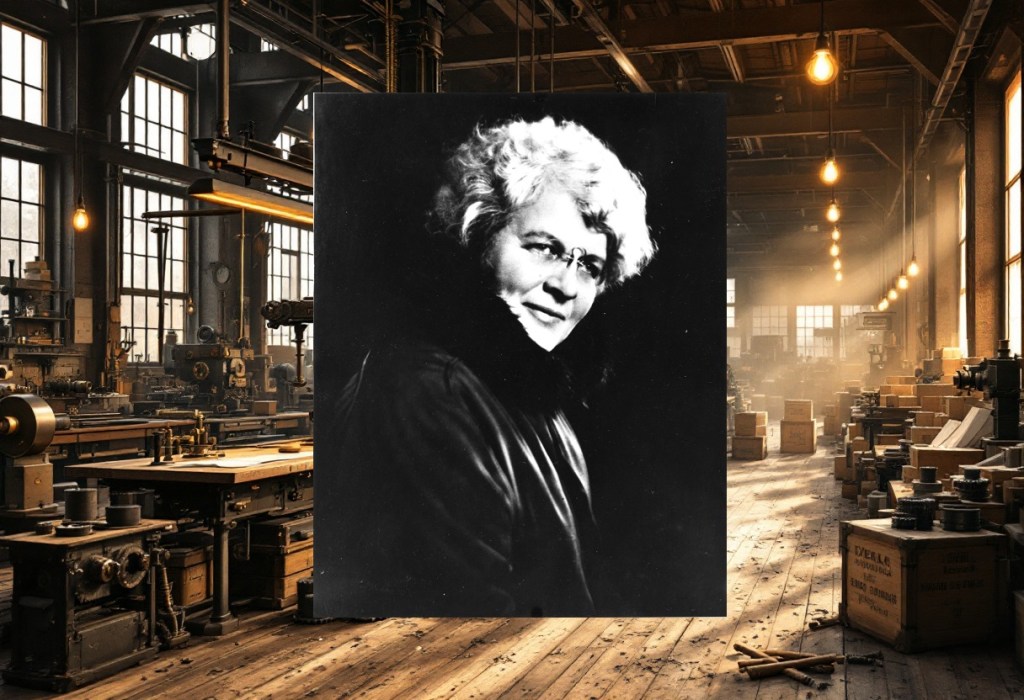
Catherine Anselm “Kate” Gleason (1865-1933) engineered her way through the rigid constraints of late Victorian society to become America’s first recognised female mechanical engineer. Born in 1865 into a Rochester machine shop family, she transformed her father’s modest gear-cutting business into an international manufacturing empire whilst revolutionising mass production techniques that would shape industries from automobiles to aviation. Her most significant achievement – the development of automated bevel gear manufacturing machinery in the 1890s – enabled the mass production of gears essential for transmitting power at right angles, fundamentally changing how mechanical devices from automobiles to factory equipment could be built and scaled.
In the comfortable sitting room of her Rochester estate, surrounded by engineering drawings and mementos from a life spent amongst gears and gadgetry, Kate Gleason appears as vibrant and assured as the day she first stepped into her father’s machine shop at age eleven. Her keen eyes reflect decades of problem-solving, her weathered hands evidence of countless hours working alongside craftsmen and engineers. There’s an unmistakable warmth about her – the confidence of someone who has spent a lifetime turning impossible into inevitable.
Ms Gleason, thank you for joining us today. I’d like to begin by asking about your earliest memories of the machine shop. What drew an eleven-year-old girl to the world of mechanical engineering?
Well now, you make it sound rather more romantic than it was at the time! When my dear brother Thomas passed from typhoid, somebody had to mind the books, and Father couldn’t afford to hire another clerk. I wasn’t drawn to it so much as pressed into service – though I’ll admit, once I got a proper look at those machines humming away, creating something useful from raw iron, I was quite captivated.
The truth is, I’d been sneaking into the shop since I could toddle about. Mother would send me to fetch Father for supper, and I’d find myself lingering, watching the men work the lathes and planers. There was something marvellous about the precision of it all – the way a rough casting could be transformed into something beautiful and functional. By the time I formally joined the business, I’d already absorbed quite a bit just through observation.
You entered Cornell’s Mechanical Arts programme in 1884, becoming the first woman in their engineering programme. What was that experience like?
Oh my, what a to-do that caused! The professors weren’t quite sure what to make of me – whether I ought to be treated like spun glass or expected to keep up with the fellows. I chose the latter approach, naturally. The coursework itself wasn’t the challenge; I’d been reading engineering texts since I was fourteen. It was the social aspects that proved… interesting.
Some of the young men were perfectly decent – curious about my background, willing to work together on projects. Others behaved as though I were some exotic specimen that had wandered into their domain by mistake. I found the best approach was to let my work speak for itself. When you can calculate bearing loads and understand metallurgy as well as anyone in the room, objections tend to fade rather quickly.
Unfortunately, I had to leave before completing my degree. Father’s replacement for me at the Works had proved rather expensive and quite incompetent. The financial situation demanded my return, and duty to family came first. I’ve never regretted that decision, though I sometimes wonder what might have been different had I stayed.
Let’s talk about your father’s bevel gear planer, invented in 1874. Can you explain to our technically minded readers how this machine revolutionised manufacturing?
Ah, now you’re speaking my language! Father’s machine was quite brilliant in its simplicity. You see, before his invention, cutting bevel gears was largely a hand operation – extremely time-consuming and requiring considerable skill from the machinist. The quality was inconsistent, and production volumes were limited.
Father’s bevel gear planer combined a planing mechanism with an integral indexing head specifically designed for gear teeth. The key innovation was the automatic indexing system – the machine could cut one tooth, automatically rotate the gear blank to the precise next position, and cut again. This eliminated the human error factor and dramatically increased both speed and consistency.
But here’s what made it truly revolutionary: the templates. By using interchangeable templates, a single machine could produce gears of different sizes and tooth configurations. This flexibility meant manufacturers could produce various gear ratios without investing in entirely separate machinery for each specification.
And how did you improve upon this design for mass production?
Well, I must correct a common misconception first. I didn’t invent the bevel gear planer – that was entirely Father’s achievement, and I won’t take credit where none is due. What I did was recognise its potential and develop the manufacturing and sales systems to exploit that potential properly.
My contribution was understanding how this machine could transform entire industries, particularly the emerging automobile sector. When I began selling these machines in the 1890s, I saw that manufacturers needed not just the equipment, but complete production systems. I worked closely with our customers to optimise their workflows, suggesting modifications to their factory layouts, training programmes for operators, and maintenance schedules.
For instance, when dealing with the automobile manufacturers, I observed their assembly methods and proposed ways to integrate our gear-cutting operations more efficiently into their production lines. This wasn’t just about selling machines – it was about selling productivity solutions.
Can you walk us through the technical specifications of a typical installation?
Certainly. A standard Gleason bevel gear planer of the type I was selling in the 1890s could handle gear blanks up to about fourteen inches in diameter. The machine operated on a reciprocating planing action – the cutter head would travel across the gear tooth surface at roughly sixty strokes per minute, removing material in controlled passes.
The indexing mechanism was quite precise – it could divide a gear blank into anywhere from eight to sixty teeth, depending on the template configuration. Tolerance was typically maintained within two thousandths of an inch, which was remarkable precision for the era. One complete gear could be roughed out in approximately forty minutes, compared to the four to six hours required for hand cutting.
Power requirements were modest – about five horsepower for most operations. The machines were built to run continuously, with proper maintenance schedules allowing for operation sixteen hours daily. We provided detailed specifications for foundation requirements, as proper mounting was essential for maintaining accuracy.
What advantages did your machines offer over competing methods?
The comparison wasn’t even close, really. Hand-cut gears varied considerably in quality depending on the skill of the individual craftsman. Our machine-cut gears were uniform – every tooth profile identical within our tolerance specifications. This consistency was crucial for the automotive industry, where gears from different production runs needed to be interchangeable.
Cost was equally dramatic. A skilled gear cutter might produce two or three gears per day. Our machines could complete eight to ten gears daily with a less skilled operator. When you consider the labour costs and the improved quality, the return on investment was typically recovered within eighteen months.
Speed wasn’t everything, though. The real advantage was reliability. When an automobile manufacturer could depend on receiving precisely uniform gears in predictable quantities, they could plan their entire production schedules accordingly. This predictability was what enabled the mass production techniques that transformed manufacturing.
Tell us about your European sales expeditions. That must have been quite unusual for a woman in the 1890s.
Unusual? My dear fellow, it was practically scandalous! A young unmarried woman, travelling alone to foreign countries, discussing machinery with men in industrial settings – it simply wasn’t done. Mother was convinced I’d either be kidnapped by brigands or die of some foreign malady.
But you see, I had advantages that the typical travelling salesman didn’t possess. Precisely because I was so unusual, potential customers remembered me. I couldn’t take them to the usual… establishments… where business was often conducted, so I had to develop different approaches. I found that a well-prepared technical presentation, delivered over a proper dinner, was far more effective than the traditional methods.
I also discovered that European engineers were often more interested in the technical details than their American counterparts. They wanted to understand exactly how the machines worked, what maintenance was required, how they could be adapted for their specific needs. This suited me perfectly – I knew our machines inside and out.
The success of those trips established Gleason Works as one of the first American manufacturers with a substantial European presence. By 1900, nearly thirty per cent of our sales were overseas, largely due to relationships I’d established during those early expeditions.
What undocumented techniques or modifications did you develop that aren’t in the official records?
Oh, there were several little tricks that made all the difference. For instance, the official specifications called for particular cutting speeds, but I learned that by varying the speed slightly based on the hardness of the material being cut, you could extend tool life considerably whilst improving surface finish.
I also developed a technique for pre-heating gear blanks in winter months. The official procedures didn’t account for temperature variations, but I noticed that cold blanks from unheated storage areas would sometimes crack during cutting. A few minutes near the forge before mounting eliminated this problem entirely.
Then there was the matter of operator training. The instruction manuals were quite technical, but I found that teaching operators to listen to the machine was more valuable than any written procedure. An experienced operator could tell from the sound of the cutting whether the tool was dull, the feed rate was wrong, or the material was causing problems. I spent considerable time developing training programmes that emphasised this intuitive understanding alongside the technical knowledge.
Looking back, what mistakes or misjudgements can you acknowledge?
Oh, several, I’m afraid. Perhaps my greatest error was underestimating the resistance I’d face from my own family regarding business decisions. I assumed that my proven success in sales and my technical knowledge would naturally lead to greater influence in company direction. When my brothers increasingly excluded me from strategic decisions in the 1910s, I should have addressed the situation more diplomatically rather than letting resentment build.
I also made some poor judgements about market timing. I was quite enthusiastic about spiral bevel gears in the early 1900s, believing they would quickly replace straight bevel gears. I pushed for significant investment in developing spiral gear cutting machinery before the market was truly ready. While the technology eventually proved successful, we were perhaps five years ahead of demand, which created financial strain.
Additionally, I sometimes became too involved in customers’ production problems. My desire to ensure successful implementation of our machines occasionally led me to provide consulting services that would have been better charged for separately. I treated customer success as validation of our products, when I should have recognised it as a valuable service in its own right.
What contemporary criticisms did you face, and how do you respond to them now?
The most persistent criticism was that my involvement in sales was merely a novelty act – that customers were buying from Gleason Works despite my presence, not because of it. Some competitors suggested that I was trading on curiosity rather than competence.
I’ll admit this stung because there was a grain of truth to it initially. My gender certainly made me memorable, and that did open doors that might otherwise have remained closed. However, I believe my technical knowledge and genuine commitment to customer success quickly proved that I was offering substance, not just spectacle.
Another criticism was that I was too aggressive in pursuing new markets, particularly overseas. Conservative voices within our industry argued that American manufacturers should focus on domestic customers rather than competing internationally. They viewed my European activities as risky and potentially disloyal to American industry.
Looking back, I think both criticisms missed the point. Whether my gender helped open doors is irrelevant – what mattered was what I did once those doors were opened. And as for international expansion, Gleason Works’ global presence today suggests that the critics were the ones lacking vision, not I.
How do you view the evolution of your field, and what surprises you about modern manufacturing?
What amazes me is how the fundamental principles remain unchanged whilst the execution has become almost unimaginably sophisticated. We’re still cutting gear teeth, still concerned with accuracy and surface finish, still dealing with the relationship between cutting speed and tool life. But the precision achievable today, the speeds, the automation – it’s quite remarkable.
The computer-controlled machinery particularly fascinates me. In my day, an operator’s skill and experience were essential for producing quality gears. Today’s machines can maintain tolerances that we could barely measure, let alone achieve consistently. Yet I notice that the most successful modern manufacturers still value operators who understand the process intuitively, just as I advocated.
What disappoints me somewhat is how specialised everything has become. In my era, an engineer was expected to understand materials, production processes, cost accounting, and customer needs. Today’s engineers seem to know vastly more about narrower subjects. I wonder if this specialisation sometimes prevents the kind of holistic thinking that leads to breakthrough innovations.
What advice would you give to women entering engineering today?
Firstly, don’t allow anyone to convince you that being female requires you to approach engineering differently than your male colleagues. The mathematics don’t care about your gender, and neither do the physical principles you’re applying. Competence is competence.
However, I would advise taking advantage of the unique perspectives your experiences might provide. I found that my exclusion from certain social aspects of business forced me to develop more direct, substantive approaches to client relationships. What initially seemed like a disadvantage became a strength.
Most importantly, don’t be content merely to join existing systems – look for opportunities to improve them. My greatest contributions weren’t in designing new machines, but in recognising how existing technologies could be applied more effectively. There’s always room for someone who can see familiar problems from fresh angles.
And finally, develop thick skin early. You’ll face criticism, some of it valid, much of it not. Learn to distinguish between feedback that will make you better at your work and commentary that’s merely reflecting the speaker’s biases.
Any final thoughts on your legacy and the gear technology that continues to drive modern industry?
It’s rather satisfying to know that every automobile on the road still depends on principles we were developing more than a century ago. The gears may be cut with computer precision now, but they’re still transmitting power at right angles just as Father’s original bevel gears did.
If I have any legacy, I hope it’s the demonstration that technical excellence and business acumen need not be separate skills. Too many engineers dismiss the commercial aspects of their work, whilst too many business people fail to understand the technical constraints and possibilities. The most successful enterprises require both perspectives.
And perhaps most importantly, I hope I’ve shown that persistence and competence will eventually overcome prejudice. The barriers I faced were real, but they weren’t insurmountable. Progress comes from people who refuse to accept “impossible” as a permanent condition.
The gears keep turning, as they always have. I’m rather proud to have played a part in keeping them well-oiled and precisely cut.
Letters and emails
Following our conversation with Kate Gleason, we’ve received a remarkable response from our growing community of readers eager to explore her experiences further. We’ve selected five letters and emails from engineers, historians, and innovators across the globe who want to ask her more about her life, her work, and what she might say to those following similar paths today.
Achieng Otieno, 34, Industrial Engineer, Nairobi, Kenya
Ms Gleason, you mentioned that your gear-cutting machines could maintain tolerances within two thousandths of an inch – remarkable precision for the 1890s. I’m curious about the metallurgy challenges you faced. How did variations in steel quality from different suppliers affect your manufacturing processes, and what techniques did you develop to ensure consistent results despite these material inconsistencies?
My dear Miss Otieno, you’ve raised one of the most vexing problems we faced in those early days – and indeed, it nearly drove me to distraction on more than one occasion! The steel quality in the 1890s was frightfully inconsistent, even from supposedly reputable suppliers. Carnegie’s mills in Pittsburgh were generally reliable, but even they had their off days, and smaller foundries… well, that was rather like gambling with the company’s reputation.
I learned early on that you simply couldn’t trust a supplier’s word about their steel composition. We developed what I called our “shop floor testing” methods – nothing so fancy as what you might have today, but quite effective for our purposes. Before cutting any gear, we’d take sample pieces from each delivery and test them on our machines at reduced speeds. The sound of the cutting tool told us volumes about the steel’s hardness and consistency. A smooth, steady hum meant good, uniform steel. Chattering or irregular sounds indicated problems – either inconsistent hardness or inclusions that would ruin the gear teeth.
We also instituted what Father initially thought was wasteful: keeping detailed records of every steel delivery, noting the supplier, the heat number when available, and how the material performed during cutting. After about two years of this record-keeping, patterns emerged quite clearly. Certain suppliers were consistently problematic, whilst others proved dependable. We gradually narrowed our supplier list to perhaps four foundries whose steel we could trust.
For the problematic batches – because waste was simply unacceptable in our business – I developed a sorting system. We’d segregate questionable steel for less critical applications: prototype gears, replacement parts for older machines, or practice pieces for training new operators. The premium steel was reserved for our most demanding customers, particularly those automobile manufacturers who required absolute precision.
I also learned to negotiate differently with suppliers. Rather than simply ordering “steel suitable for gear cutting,” I began specifying exact Brinell hardness ranges and requiring certification. This was unusual at the time – most manufacturers simply accepted what they received – but our reputation for quality depended upon it.
The most important lesson, though, was building relationships with the foundry foremen themselves. These fellows knew their business intimately, and a personal conversation over a proper meal often yielded better steel than any written specification. They’d warn me when a particular heat wasn’t quite right, or set aside their best material for our orders. Trust and mutual respect, I found, were worth more than any contract clause.
David O’Connor, 42, Manufacturing Historian, Dublin, Ireland
What if your father had been blessed with several sons instead of losing Thomas to typhoid? Do you think the Gleason Works would have achieved the same international success, or was there something uniquely valuable about your outsider’s perspective that enabled innovations the established male-dominated industry might have missed?
Mr O’Connor, what a fascinating question to ponder! I’ve often wondered the same thing myself, particularly during those difficult years when my brothers seemed determined to remind me that I was, after all, merely filling in where a proper son ought to have been.
If dear Thomas had lived, and perhaps if Father had more sons, I suspect the Gleason Works might have remained a perfectly respectable local concern – profitable enough, serving the Rochester area and perhaps extending into western New York. The business would likely have followed the conventional path: gradual expansion, steady customers, reasonable profits. Nothing wrong with that approach, mind you, but hardly the stuff of international commerce.
You see, having sons would have given Father exactly what he expected from his business – competent successors who understood machinery and could maintain the family enterprise. But I rather think my peculiar position as an outsider forced both Father and myself to view opportunities differently. When you’re not quite fitting into the established patterns, you begin looking for alternative paths.
My European expeditions, for instance, would never have occurred to my brothers. Proper young men from good Rochester families didn’t gallivant about Europe selling machinery – they stayed home, married suitable wives, and built solid local reputations. But being unmarried and rather unconventional already, I had fewer social constraints. What was one more breach of propriety when I’d already scandalised half the city by working in the shop?
More importantly, I think my exclusion from the usual business networks – the gentlemen’s clubs, the informal arrangements made over cigars and whiskey – forced me to develop more direct approaches to customer relationships. I couldn’t rely on old-boy connections or assume that customers would purchase from us simply because their fathers had done so. Every sale had to be won on merit, every relationship built through demonstrated competence.
This outsider’s perspective also made me more attentive to our customers’ actual needs rather than what we assumed they needed. When automobile manufacturers began appearing, established gear-cutting companies dismissed them as a passing fad. But I saw genuine technical requirements that our machines could address brilliantly – if we modified our approach slightly.
So whilst I’ve no doubt that sons would have made Father’s later years more comfortable and conventional, I suspect the Gleason name would be known primarily in Rochester rather than recognised internationally. Sometimes being the unexpected answer to a problem creates possibilities that the expected solutions never could have achieved.
Sunita Joshi, 28, Robotics Engineer, Mumbai, India
You spoke about teaching operators to ‘listen to the machine’ and developing intuitive understanding alongside technical knowledge. In our age of automated manufacturing and AI-driven quality control, do you believe there’s still value in this human sensory approach to machinery? How would you adapt your operator training philosophy to work alongside modern sensors and predictive maintenance systems?
Miss Joshi, your question brings me considerable delight because it suggests that even with all your marvellous modern contraptions, you still recognise the value of human intuition! I’m quite pleased to hear that, because I’ve always believed that machines, no matter how sophisticated, are fundamentally tools in service of human intelligence – not replacements for it.
You see, in my day, we didn’t have gauges that could measure every conceivable aspect of a machine’s operation. What we had were our senses, finely tuned through years of experience. An experienced operator could detect a dull cutting tool by the subtle change in vibration through the machine frame, or recognise that the steel was running too hard by the particular pitch of the cutting sound. These weren’t wild guesses – they were learned responses based on hundreds of hours of careful observation.
I suspect your modern sensors can measure far more precisely than human senses ever could, but I wonder if they can interpret context as effectively as a skilled human mind. For instance, our operators learned to distinguish between the sound of normal cutting through a hard spot in the steel versus the sound of a tool beginning to fail. Both might register similarly on vibration measurements, but the experienced ear could tell the difference and respond appropriately.
My approach to training would adapt rather beautifully to your modern equipment, I think. Instead of replacing human judgement with automated systems, I’d use your sensors to enhance and validate human intuition. Imagine training operators to recognise patterns in your sensor data the same way we trained them to recognise auditory and tactile patterns. Your predictive maintenance systems could alert operators to potential problems, but I’d still want those operators capable of independent assessment.
The real value, though, lies in what happens when your automated systems encounter something unexpected. Machines excel at recognising known patterns, but human intuition often spots anomalies that fall outside programmed parameters. A skilled operator might notice that something sounds different today, even if all your measurements fall within acceptable ranges.
I’d create training programmes that combined your technical data with traditional sensory skills. Let your sensors provide the precise measurements, but teach operators to correlate those measurements with what they observe directly. This creates redundancy in your quality control whilst developing operators who can troubleshoot problems that your automated systems might miss.
The marriage of human intuition with mechanical precision has always been the foundation of excellent manufacturing. Your modern tools simply give us more sophisticated ways to achieve that partnership.
Marcos Villalba, 31, Mechanical Design Engineer, São Paulo, Brazil
You mentioned being five years ahead of the market with spiral bevel gears, which created financial strain. Looking back at your career, how do you think about the relationship between innovation timing and market readiness? What advice would you give to modern engineers who believe they’ve developed breakthrough technologies but face similar market timing challenges?
Mr Villalba, you’ve identified one of the most painful lessons of my career – and one that nearly cost us the business! That spiral bevel gear debacle taught me more about innovation timing than any textbook ever could have managed.
The technical merits were absolutely sound – spiral bevel gears offered smoother operation, greater strength, and reduced noise compared to straight bevel gears. Our engineering was impeccable, the manufacturing processes worked beautifully, and the finished products performed exactly as predicted. But none of that mattered a whit when our customers weren’t ready to pay for those advantages.
You see, in the early 1900s, most manufacturers were still focused on basic functionality rather than refinement. Automobile makers needed gears that worked reliably at reasonable cost – the smoother operation of spiral gears wasn’t worth the additional expense when their customers were more concerned with whether the motor would start on cold mornings than with reducing gear noise.
I learned that market readiness involves far more than technical capability. It requires customers who understand the value proposition, manufacturing economies that make the innovation affordable, and often, supporting technologies that make the advantages apparent. Spiral bevel gears became successful when automobile engines became powerful enough that gear noise became objectionable, and when manufacturing volumes made the additional complexity economically viable.
My advice to you and other modern engineers facing similar challenges would be this: develop your breakthrough technology, but don’t stake everything on immediate market acceptance. Find ways to demonstrate value in smaller, less critical applications first. We should have introduced spiral gears in specialty applications – perhaps high-end machinery where the performance advantages justified the cost – rather than trying to replace straight bevel gears across our entire product line.
Also, pay attention to adjacent developments that might create demand for your innovation. The growth of electric lighting made factory night shifts practical, which increased demand for quieter machinery. Had I recognised this connection earlier, I might have positioned spiral gears as solutions for manufacturers operating around residential areas.
Most importantly, maintain your financial reserves for the long term. Innovation rarely follows the timeline you expect. We survived that period only because Father had insisted on conservative financial management in our earlier years. Many brilliant inventions have failed simply because their creators ran out of money before the market caught up.
Patent your work, demonstrate its value where possible, but don’t mortgage your future on the assumption that the world will immediately recognise genius. Sometimes the world needs time to grow into your ideas.
Brooke Henderson, 39, Business Strategy Consultant, Toronto, Canada
I’m impressed by how you balanced technical excellence with business acumen – something many engineers still struggle with today. When you were making those crucial decisions about international expansion and product development, how did you manage the tension between your engineering perfectionism and the commercial pressures to deliver products quickly and profitably?
Miss Henderson, you’ve put your finger on what I consider the greatest challenge of my professional life – and one that I suspect plagues engineers to this day! The tension between perfectionism and commercial reality was a constant companion, rather like having two voices arguing in one’s head at every decision point.
My engineering mind wanted every gear cut to absolute precision, every machine tested beyond any reasonable requirement, every customer installation supervised until it achieved theoretical perfection. But the business side understood that customers needed solutions delivered on schedule and within budget, not engineering marvels that bankrupted them whilst we pursued the last increment of improvement.
I learned to manage this tension through what I called “staged perfectionism.” When developing new machinery, I’d establish three levels of specification: minimum acceptable performance that met customer needs, optimal performance that satisfied my engineering standards, and theoretical maximum performance that represented the absolute best we could achieve. This framework helped me make rational decisions about where to invest time and resources.
For customer relationships, I developed the practice of delivering working solutions quickly, then offering enhancement services separately. Rather than insisting that every installation achieve perfection before shipment, we’d get machines operational within the customer’s requirements, then propose additional optimisation as a follow-up project. This approach satisfied the commercial pressures whilst still allowing for engineering refinement.
The key insight came from observing that customers rarely wanted perfection – they wanted reliable solutions to specific problems. A gear-cutting machine that produced gears meeting their assembly requirements on schedule was infinitely more valuable than a theoretically superior machine delivered three months late.
I also learned to channel my perfectionist tendencies into areas that directly supported commercial success. Obsessive attention to operator training manuals, for instance, reduced customer support costs and improved satisfaction. Meticulous documentation of machine specifications helped our sales efforts. Perfect record-keeping of performance data strengthened our reputation for reliability.
The most difficult lesson was accepting that commercial success often enabled better engineering, not the reverse. Profitable operations provided resources for research and development, whilst pursuing engineering perfection at the expense of profitability ultimately limited our ability to innovate.
My advice would be to embrace both aspects of your nature, but sequence them appropriately. Use commercial success to fund your pursuit of engineering excellence, rather than assuming that engineering excellence will automatically generate commercial success. The market rewards solutions to real problems, delivered reliably and affordably. Perfect those fundamentals first, then pursue your higher aspirations.
Reflection
Kate Gleason passed away in Rochester on 9th January 1933 at the age of 67, leaving behind a legacy that extends far beyond the gears that made her fortune. Her voice in this conversation reveals dimensions often absent from historical accounts – the pragmatic problem-solver who learned metallurgy through necessity, the astute businesswoman who understood that innovation without market timing was merely expensive experimentation, and the teacher who recognised that human intuition remained essential even as machines grew more sophisticated.
What emerges most powerfully is Gleason’s unflinching honesty about her mistakes and limitations. Official histories tend to celebrate her as a pioneer who overcame obstacles through sheer determination, but her own reflections reveal someone more nuanced – acknowledging that her gender initially opened doors through curiosity before competence secured her reputation, and admitting that family dynamics and market misjudgements created genuine setbacks alongside her triumphs.
The gaps in the historical record are telling. Her detailed knowledge of metallurgical challenges, operator training techniques, and international business relationships suggest contributions that were likely never formally documented, lost perhaps because women’s technical insights were often considered supplementary rather than foundational. Her emphasis on listening to machinery and developing intuitive understanding represents a philosophy that challenges the stereotype of early engineering as purely mechanical.
Today’s mechanical engineers face remarkably similar tensions – balancing technical perfection with commercial viability, integrating human judgement with automated systems, and timing innovation with market readiness. Gleason’s insights about “staged perfectionism” and the importance of understanding customer needs over engineering ideals resonate particularly strongly in an era of rapid technological advancement.
Her influence persists not only through the Gleason Corporation’s continued leadership in gear technology, but through the Kate Gleason College of Engineering at Rochester Institute of Technology and the ASME’s Kate Gleason Award. Perhaps most significantly, her approach to combining technical excellence with business acumen has become the standard expectation for modern engineers – a integration she pioneered when such versatility was considered unusual.
Gleason’s story ultimately reminds us that progress in engineering, as in life, comes not from isolated moments of brilliance, but from the patient accumulation of practical solutions, market understanding, and human insight. Her gears may have turned the wheels of industry, but her greatest contribution may be demonstrating that lasting innovation requires both technical mastery and empathetic connection to the people who will use your work.
Who have we missed?
This series is all about recovering the voices history left behind – and I’d love your help finding the next one. If there’s a woman in STEM you think deserves to be interviewed in this way – whether a forgotten inventor, unsung technician, or overlooked researcher – please share her story.
Email me at voxmeditantis@gmail.com or leave a comment below with your suggestion – even just a name is a great start. Let’s keep uncovering the women who shaped science and innovation, one conversation at a time.
Editorial Note: This interview represents a dramatised reconstruction based on extensive historical research into Kate Gleason‘s life, work, and era. While grounded in documented facts about her engineering achievements, business practices, and personal circumstances, the conversational format and specific responses are interpretative, drawing from historical sources, technical records, and contemporary accounts to present her likely perspectives and voice. Readers should understand this as an informed historical interpretation rather than a literal transcript. All technical details about gear manufacturing, business operations, and historical context have been verified against available records, but Kate Gleason’s personal reflections and specific anecdotes represent plausible reconstructions based on the historical evidence of her character, achievements, and the challenges she faced as a pioneering woman engineer in the late 19th and early 20th centuries.
Bob Lynn | © 2025 Vox Meditantis. All rights reserved. | 🌐 Translate

 Vox Meditantis
Leave a comment