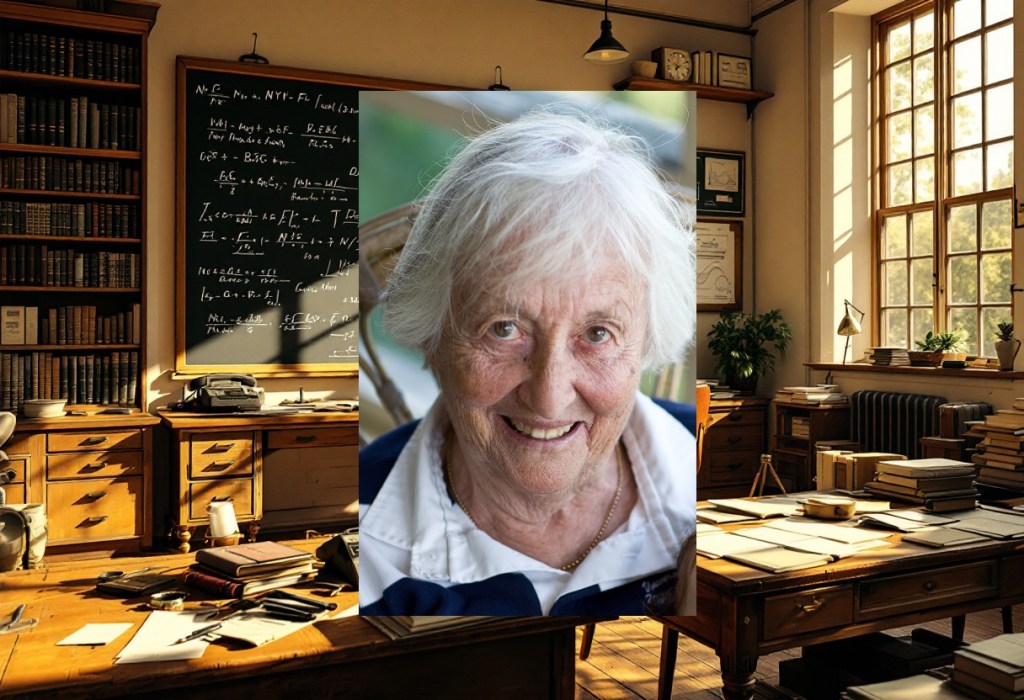
Professor Cathleen Synge Morawetz (1923-2017) revolutionised our understanding of shock waves and transonic flow through her groundbreaking work on partial differential equations, becoming the first woman to lead the American Mathematical Society whilst bridging the gap between theoretical mathematics and real-world physics. Her Morawetz inequalities fundamentally transformed the mathematical treatment of wave propagation, finding applications in everything from aerodynamics to black hole stability. Despite her towering achievements, Morawetz faced the systemic barriers of mid-twentieth century academia, where women’s contributions to “practical” mathematics were often diminished, yet her legacy continues to underpin modern astrophysics research and space exploration.
Professor Morawetz, it’s wonderful to have you here today. Looking back, I’m struck by how your work bridging theoretical mathematics and applied physics was so ahead of its time. In our current era of interdisciplinary research, your approach seems remarkably prescient.
Well, that’s rather generous of you to say. Though I must confess, I never quite saw myself as crossing boundaries – mathematics simply is what it is, whether you’re solving the wave equation or working out why aeroplanes behave as they do. The distinctions people make between “pure” and “applied” always seemed rather artificial to me.
Your Irish-Canadian heritage seems to have shaped your perspective. Your father, John Lighton Synge, was himself a distinguished mathematician. How did that family tradition influence your path?
Oh, tremendously. Though I should say, it wasn’t simply a matter of following in father’s footsteps. The Synge household was rather mathematical by nature – my mother had studied mathematics as well, though she never finished her degree. Father was working on relativity theory, and there was always this sense that mathematics was a living, breathing tool for understanding the physical world. My uncle, J.M. Synge, was the playwright, you know – the fellow who wrote “Playboy of the Western World”. There was this wonderful Irish tradition of taking ideas seriously, whether they appeared in equations or on the stage.
You’ve mentioned that competition with your father rather than closeness. That’s quite candid.
Yes, I was rather the contrary daughter, wasn’t I? I was “the boy in the family,” as I used to say. When we were children and wanted to do something father disapproved of, my older sister was always chosen as the negotiator. I was more likely to argue directly. Perhaps that served me well later – one needs a bit of stubbornness in mathematics, particularly if you’re a woman entering the field in the 1940s.
Let’s talk about your most significant mathematical contribution – the Morawetz inequalities. Can you walk us through how you developed these techniques?
The inequalities arose quite naturally from my work on scattering theory and the wave equation. I was studying how solutions to partial differential equations behave over long times, particularly when waves encounter obstacles. The central insight was to use what we call the “Friedrichs multiplier method” – you multiply the equation by carefully chosen functions, integrate over space and time, and through integration by parts, you can extract information about the energy and decay properties of solutions.
The key was finding the right multiplier. For the wave equation outside a star-shaped obstacle, I used a multiplier of the form a∂tu+b⋅∇u+cu, where the functions a, b, and c are chosen to capture the geometry of the problem. When you work through all the mathematics, you obtain bounds on the local energy – roughly speaking, how much of the wave’s energy remains concentrated in any given region.
And the implications for physics?
Quite profound, actually. What the inequalities tell you is that wave energy cannot accumulate indefinitely in bounded regions – it must eventually disperse. This has applications far beyond what I originally envisioned. In recent years, physicists studying black holes have used similar techniques to understand gravitational wave propagation and the stability of spacetimes. It’s rather gratifying to see work from the 1960s finding new life in modern astrophysics.
Your work on transonic flow was equally groundbreaking. You essentially proved that perfectly shock-free supersonic flight was impossible in practice.
That’s right. In the 1950s, aeronautical engineers were quite keen on designing aerofoils that would eliminate shock waves – those sudden pressure changes that create drag and can cause structural problems. The idea was that if you could shape a wing just so, you might achieve what they called “shock-free” transonic flow.
I proved mathematically that such solutions are isolated – what we call “non-robust”. Even the smallest perturbation – a gust of wind, a tiny imperfection in manufacturing – would cause shocks to appear. It was rather like balancing a pencil on its point: theoretically possible, but practically hopeless.
How did the engineering community receive this news?
With rather mixed feelings, I should think. Some were disappointed, naturally. But the practical engineers appreciated having a definitive answer. It saved them from pursuing impossible designs and helped focus attention on managing shock waves rather than eliminating them entirely. The supersonic transport programmes of the 1960s and 70s were built with this understanding.
You’ve corrected a historical misunderstanding there – can you elaborate on what the record gets wrong about your transonic work?
People sometimes describe my result as proving shock waves are inevitable in transonic flow, full stop. That’s not quite accurate. What I showed is that continuous shock-free solutions are non-robust – they can’t withstand perturbations. But under very special, carefully controlled conditions, shock-free flow can exist momentarily. The real insight was understanding the mathematical structure that makes such solutions so fragile.
Let’s discuss your path through academia. You were director of the Courant Institute from 1984 to 1988, the first woman to hold such a position in mathematical sciences in America.
It was both an honour and rather daunting. The Courant Institute has always been special – it’s where pure mathematics meets real-world applications. Richard Courant had this vision of mathematics as a unified discipline, not artificially divided into theoretical and applied camps. That philosophy suited me perfectly.
But yes, being the first woman director came with certain… complications. There were colleagues who questioned whether I could handle the administrative demands alongside research. Some assumed I’d gotten the position through affirmative action rather than merit. I found the best response was simply to do the work – and do it well.
What were the particular challenges you faced as a woman in mathematics during the 1950s and 60s?
Oh, where does one begin? When I was job-hunting in the early 1950s, there were precious few opportunities for women with doctorates in mathematics. I actually considered taking a position at Bell Laboratories – industry was sometimes more welcoming than academia.
At academic conferences, I’d often find myself the only woman in the room. Colleagues would address questions to my husband, Herbert, assuming he was the mathematician, even though his field was chemistry. There were the inevitable comments about whether I was neglecting my children by working. I used to respond that I was much more likely to worry about a theorem when I was with my children than worry about my children when I was doing mathematics.
You raised four children while building this remarkable career. How did you manage it?
Very good help, I must admit – Swedish nannies who were absolute treasures. And being at the Courant Institute was crucial. It was a somewhat protected environment where mathematical ability mattered more than conventional expectations. I’ve always said I led a “protected life” there.
But honestly, I think I had advantages that many women today don’t. Herbert was tremendously supportive, and I had the financial resources for excellent childcare. Not every woman has been so fortunate.
Looking at your career from today’s perspective, what strikes me is your role as a bridge-builder – between pure and applied mathematics, between American and European traditions, between mathematical theory and engineering practice.
That’s a lovely way to put it. Perhaps growing up between Ireland and Canada gave me that perspective – always seeing mathematics as something that travels across boundaries. The Irish have a tradition of mathematical emigration, you know. My great-great-great-grandfather, Hugh Hamilton, wrote one of the last great treatises on conic sections in the classical style. There’s something about the Irish mathematical tradition – we’re perhaps less concerned with academic hierarchies and more interested in whether the mathematics actually works.
Your inequalities are now being used to study black hole stability – applications you could hardly have imagined in the 1960s.
It’s absolutely extraordinary. The mathematical structure I developed for understanding wave scattering around obstacles turns out to be fundamental for analysing gravitational waves around black holes. The energy methods, the decay estimates – they translate beautifully to Einstein’s equations. Mathematics has this wonderful way of revealing deeper connections than anyone anticipated.
As someone who experienced firsthand the barriers facing women in STEM, how do you view the current discussions about equity in science funding and space exploration?
I’m encouraged by the attention, though we still have far to go. The recent discoveries about gravitational waves, the images of black holes from the Event Horizon Telescope – this work builds on decades of mathematical foundations that included significant contributions from women. Katherine Johnson’s orbital calculations, my work on wave equations, the contributions of so many others who weren’t always recognised at the time.
The space programme today benefits enormously from mathematical techniques developed by women, often working in the background. When NASA studies black hole physics or designs missions to detect gravitational waves, they’re using mathematical tools that trace back to work done by women who faced significant discrimination. There’s a justice in that, I think.
What advice would you give to young women entering mathematics or physics today?
Don’t be discouraged by those who suggest mathematics requires some mysterious innate talent that women supposedly lack. Mathematics is learnt through practice, persistence, and good teaching – qualities that have nothing to do with gender.
And don’t let anyone convince you that applied mathematics is somehow lesser than pure mathematics. Some of the most beautiful mathematical insights emerge from trying to understand the physical world. The equations that govern shock waves are just as elegant as abstract algebra, and they have the added satisfaction of explaining why aeroplanes fly.
Any regrets about your career path?
Well, I suppose I might have been more aggressive about promoting my own work. I was raised to let the mathematics speak for itself, but in academia, you often need to ensure people are listening. I was fortunate to work with wonderful collaborators like Peter Lax and Ralph Phillips, who understood the significance of what we were doing.
There was also a paper I published in the early 1960s on the Tricomi equation that I never followed up properly. It had applications to mixed-type partial differential equations that might have been quite fruitful. But you can’t pursue every interesting problem – there simply isn’t time.
One criticism of your era was that applied mathematics was viewed as less prestigious than pure mathematics. How did you handle that perception?
By ignoring it, mostly. The attitude was rather silly, really. The most profound mathematical insights often emerge from trying to understand nature. Gauss developed his theory of curved surfaces partly through surveying work. Newton invented calculus to understand planetary motion. This artificial hierarchy between pure and applied mathematics serves no one well.
I found that if you solved interesting problems and solved them elegantly, people eventually took notice regardless of whether they originated in physics or pure thought. The Morawetz inequalities are now taught in abstract harmonic analysis courses alongside their applications to wave scattering. Mathematics doesn’t respect arbitrary boundaries.
Your presidency of the American Mathematical Society came at a particularly challenging time in the 1990s. What were the major issues you faced?
The mathematical community was grappling with significant changes – funding pressures, questions about the direction of mathematical research, concerns about the growing gap between pure and applied work. There were also ongoing discussions about diversity and inclusion that I felt were crucial for the future of the field.
I tried to emphasise that mathematics is fundamentally unified, that the artificial divisions between different areas weaken us all. A result in algebraic topology might inspire work in fluid dynamics; techniques from number theory might solve problems in cryptography. The AMS needed to represent all of mathematics, not just certain prestigious subfields.
As we conclude, what do you hope your legacy will be?
I hope I’ve shown that mathematics is for everyone who’s willing to work at it. That applied problems can lead to beautiful theory, and that persistence matters more than supposed innate talent. If some young person reads about the Morawetz inequalities and thinks, “I could do that too” – well, that would be rather wonderful.
And perhaps I’ve helped demonstrate that women can contribute substantially to mathematics while also having families and full lives. Not everyone needs to make such choices, but it’s important to know they’re possible.
Professor Morawetz, thank you for this illuminating conversation. Your work continues to inspire mathematicians and physicists around the world.
The pleasure has been entirely mine. Mathematics, you know, is ultimately about human understanding – about seeing patterns and connections that weren’t visible before. If my small contributions have helped others see a bit further, I’m quite content with that.
Letters and emails
Following our conversation with Professor Morawetz, we’ve received an overwhelming response from readers eager to explore different aspects of her remarkable journey and lasting influence on mathematics and physics. We’ve selected five particularly thoughtful letters and emails from our growing international community – engineers, researchers, and students who want to ask her more about her life, her work, and what she might say to those walking in her footsteps today.
Marta Kowalczyk, 34, Computational Fluid Dynamics Engineer, Warsaw, Poland:
Professor Morawetz, I’m fascinated by your work on mixed-type partial differential equations where elliptic and hyperbolic regions meet. In my CFD simulations today, we still struggle with numerical instabilities at these transition zones. What mathematical insights from your era about handling these discontinuities could we be overlooking in our rush toward machine learning solutions?
My dear Marta, what a splendid question from someone clearly wrestling with the very heart of mixed-type problems! You’ve put your finger on something that troubled us enormously in the 1960s and 70s – those devilish transition zones where the mathematics changes character completely.
The key insight we developed, which I fear may be getting lost in all your modern computational wizardry, is that these discontinuities aren’t really discontinuities at all – they’re regions where the physics is telling you something fundamental about the nature of information flow. When you move from subsonic to supersonic flow, or from elliptic to hyperbolic behaviour, you’re crossing what we called a “sonic line,” and the mathematics reflects a genuine physical transition in how disturbances propagate.
Now, Fritz John at the Courant Institute taught me something invaluable about this: you mustn’t try to smooth over these transitions artificially. The temptation is always there – to use some clever averaging or regularisation – but that’s rather like papering over a crack in the foundation. Instead, we learned to respect the transition and work with what the equations were actually telling us.
The approach that served us well was to study the behaviour near these transition curves very carefully using what we called “local analysis” – examining how solutions behave in small neighbourhoods of the troublesome points. We’d use coordinate transformations that straightened out the transition curve, then apply techniques from the theory of characteristic surfaces. The crucial realisation was that near the sonic line, you’re dealing with what’s essentially a degenerate hyperbolic equation, and you need methods that respect that degeneracy.
I suspect your machine learning approaches might be missing this because they’re looking for patterns in the data rather than understanding the underlying mathematical structure. The equations themselves contain the wisdom about how to handle these transitions – they’re not arbitrary numerical difficulties but reflections of genuine physical phenomena.
Peter Lax and I spent countless hours working out the proper function spaces for these problems. You need to be frightfully careful about how you measure solutions near transition points. The energy methods that work beautifully in purely elliptic or hyperbolic regions often fail completely at the boundaries between them.
My advice? Go back to the partial differential equations themselves. Study how the characteristics behave near your transition zones. The mathematics developed fifty years ago for mixed-type equations isn’t obsolete – it’s foundational. Your computers can calculate faster than we ever dreamed, but they still need to respect the mathematical truths we uncovered about how these transitions actually work.
The physics knows what it’s doing, even when our numerical schemes get confused.
Jason Miller, 41, Science Policy Researcher, Vancouver, Canada:
Looking back at your father’s influence and the mathematical dynasties of the early 20th century, do you think the current emphasis on diverse STEM pathways has diluted the mentorship traditions that once guided promising mathematicians? How might we preserve that deep, personal guidance whilst opening doors more widely?
Jason, you’ve raised something I’ve thought about considerably, particularly watching how the field has evolved since my time. The mathematical dynasties of the early twentieth century were indeed extraordinary – not just the Synges, but families like the Bernoullis stretching back centuries, or more recently, the mathematical lineages that developed around figures like David Hilbert or Hermann Weyl.
The mentorship system of my era was rather like an apprenticeship, really. When I arrived at New York University, Richard Courant took a personal interest in shaping not just my mathematical thinking but my entire approach to the discipline. He’d invite students to his home, we’d discuss problems over dinner, and there was this sense of being inducted into a mathematical community that had deep roots and shared values. Kurt Friedrichs, too, became not just an advisor but something of a mathematical father figure.
Now, I must say this system had its virtues and its considerable flaws. The virtues were obvious – deep, sustained guidance, exposure to mathematical culture and history, and the kind of personal attention that could nurture real mathematical intuition. When Friedrichs worked with me on the multiplier method, it wasn’t just about learning a technique – it was about understanding how mathematicians think, how they approach problems, how they judge what’s worth pursuing.
But let’s be honest about the flaws, shall we? These traditional mentorship networks were frightfully exclusive. They tended to replicate themselves – professors chose students who reminded them of themselves, which meant the same sorts of people kept getting the same opportunities. Women, minorities, anyone who didn’t fit the traditional mould, often found themselves shut out entirely. I was fortunate to have a father in mathematics, but imagine the young women who had equivalent ability but lacked such connections.
What we need – and what I believe the current emphasis on diversity is attempting to achieve – is to preserve the intensity and personal commitment of the old mentorship model whilst opening it to everyone with mathematical talent, regardless of background. This isn’t about diluting standards; it’s about recognising that mathematical ability doesn’t depend on one’s surname or social connections.
Perhaps the solution lies in creating more structured mentorship programmes that maintain the personal element whilst ensuring broader access. The Association for Women in Mathematics has done splendid work in this direction. We need mathematical elders who understand that their responsibility isn’t just to clone themselves but to nurture mathematical thinking wherever they find it flourishing.
The tradition matters, but it must evolve to serve all of mathematics’ children, not just the favoured few.
Lindiwe Mokoena, 28, Astrophysics PhD Student, Cape Town, South Africa:
Your Morawetz inequalities are now crucial for understanding how gravitational waves behave near black holes, yet you developed them decades before we detected such waves. When you’re working on fundamental mathematics, how do you maintain faith that abstract results will eventually find profound physical applications?
Lindiwe, your question truly warms my heart, for it touches on something that sustained my generation through many a dry spell – faith in the far-reaching power of pure mathematics. When I first began to study the decay of wave solutions, the notion that one’s work might one day inform astrophysicists poking about the edges of black holes in the cosmos would have struck us as something from Jules Verne, if you’ll excuse the expression.
In those early days, particularly in the 1950s and 60s, most of us at the Courant Institute weren’t setting out with the expectation of glory or immediate application. My own work on what became known as the Morawetz inequalities began not with any grand vision but with the desire to wrangle a particularly stubborn problem – understanding the scattering and long-time behaviour of waves. Was it glamorous? Hardly. My colleagues and I, including Peter Lax and Kurt Friedrichs, would grind away at the blackboard for hours, knowing that most promising ideas would fade away or lead to dead ends.
The motivation, I daresay, was curiosity – an almost childish sense of wanting to know “how does this behave if I poke it here?” Mathematics, you see, doesn’t always give up its secrets readily; often, it’s a matter of patience, of chipping away at the problem until some hidden order appears.
Now, regarding faith in future application, I must say: in my time, one simply trusted that good mathematics would find its audience eventually. I recall G.H. Hardy’s book, “A Mathematician’s Apology,” in which he championed the beauty of pure mathematics for its own sake. Yet, time and again, the so-called “useless” mathematics found marvellous use, sometimes decades later. Emmy Noether’s abstract algebra gave rise to conservation laws in physics. My own inequalities – written to understand wave equations in a mathematical sense – have become key tools as physicists probe cosmic phenomena I could never have anticipated on a chilly New York morning.
So I say, keep faith in the craft, Lindiwe. Mathematics is a cumulative tale, each result a stitch in the tapestry. The longevity of your work lies not in passing fashion but in its rigour and elegance. If you lay down the bricks firmly enough, others will one day build castles atop your foundation – sometimes in the most unexpected of places.
Takumi Arai, 45, Aircraft Design Engineer, Osaka, Japan:
Professor, your proof about the non-robustness of shock-free transonic flow essentially told an entire industry that their holy grail was mathematically impossible. Today’s supersonic aircraft still grapple with shock management rather than elimination. What was it like to deliver such definitive bad news, and how did you balance mathematical truth with engineering optimism?
Takumi, you’ve touched on one of the more sobering aspects of my career – being the bearer of unwelcome mathematical truths. When I proved that shock-free transonic flow was non-robust, I knew perfectly well I was telling an entire generation of aeronautical engineers that their most cherished goal was essentially a mathematical pipe dream.
The reaction was rather mixed, as you might imagine. Some engineers at places like Boeing and North American Aviation were initially quite put out. They’d invested tremendous effort and resources in pursuit of shock-free designs, and here was this mathematician from New York University telling them it was fundamentally impossible. I remember presenting these results at aerospace conferences in the early 1960s, and you could practically feel the disappointment in the room.
But you know, the engineering community proved more resilient and pragmatic than I’d expected. Within a few years, most had shifted their focus from eliminating shocks to managing them more effectively. Theodore von Kármán, who was still active then, understood immediately that this wasn’t mathematical pessimism but mathematical realism. As he put it to me once, rather colourfully, “Better to know the truth than chase phantoms.”
The key was in how one presented these findings. I tried never to suggest that engineers had been foolish or that their previous work was worthless. Quite the contrary – their efforts had pushed the mathematics forward and revealed fundamental principles about transonic flow. The shock-free configurations they’d discovered, whilst unstable, taught us enormous amounts about the underlying physics.
What struck me most was how quickly the practical engineers adapted. They began asking different questions: “If we can’t eliminate shocks, how can we predict where they’ll form? How can we design around them? Can we use our understanding of shock formation to our advantage?” This led to much more sophisticated approaches to supersonic aircraft design.
I learned something important about delivering difficult mathematical news: never underestimate the engineering community’s ability to turn constraints into opportunities. My role wasn’t to crush dreams but to redirect them toward more fruitful territory. The mathematics was telling us something profound about the nature of transonic flow, and once engineers understood that message, they could work with reality rather than against it.
Looking at modern supersonic aircraft development, I’m rather proud that we helped establish a more mature, scientifically grounded approach to these challenges. Sometimes the greatest service mathematics can provide is ruling out the impossible, thereby clearing the path toward the achievable.
Gabriela Fernández, 37, Mathematics Education Researcher, Buenos Aires, Argentina:
What if you had been born a generation later, entering mathematics in the 1970s rather than the 1940s? Do you think the emerging feminist movement would have made your path easier, or might the increased scrutiny and expectations on women ‘pioneers’ have created different pressures? Would your mathematical focus have shifted toward different problems?
Gabriela, what a fascinating “what if” you’ve posed! I’ve often wondered myself how different my path might have been with the women’s liberation movement as a backdrop rather than the rather staid 1940s and 50s.
In some ways, I suspect it might have been easier. When I entered graduate school in 1946, there was this peculiar silence around the topic of women in mathematics. We were there, certainly – a handful of us scattered about – but there was no organised support, no sense that we were part of a larger movement. One simply got on with it, kept one’s head down, and hoped one’s work would speak for itself. The isolation could be rather crushing at times.
Had I come of age during the 1970s, with Betty Friedan writing about “the feminine mystique” and women beginning to organise around professional equality, I might have felt less alone. The Association for Women in Mathematics was founded in 1971, and what a difference that kind of support network might have made during my graduate years! To have had role models, conferences, a sense of solidarity – it would have been remarkable.
But I must say, Gabriela, there might have been different pressures entirely. In my era, because so few women were in mathematics, I was often treated as something of a curiosity – sometimes dismissed, yes, but also occasionally given opportunities precisely because I was unusual. Richard Courant hired me partly, I suspect, because he was curious to see what this mathematical daughter of John Synge might accomplish.
In the 1970s, there would have been this tremendous weight of expectation – to be a pioneer, to represent all women in mathematics, to prove that we belonged. Every paper I published, every lecture I gave, would have been scrutinised not just for its mathematical merit but as evidence for or against women’s capabilities. That kind of symbolic burden can be quite paralysing.
As for my mathematical focus, I wonder if I might have been drawn more toward collaborative work, given the spirit of collective action that characterised the feminist movement. My generation was rather solitary in our approach – we worked alone, published alone, succeeded or failed alone. The 1970s might have encouraged more joint research, more mentorship of younger women.
Though perhaps that’s romanticising things a bit. Mathematics is still mathematics, regardless of the social climate. The partial differential equations I studied would have been just as stubborn in 1975 as they were in 1955, and someone still needed to wrestle them into submission.
Reflection
Professor Cathleen Synge Morawetz passed away on 8th August 2017 at the age of 94, her death marking the end of an era in applied mathematics. Yet our conversation reveals how vibrantly her intellectual legacy continues to pulse through modern physics and engineering. From gravitational wave detection to spacecraft design, her mathematical insights remain embedded in humanity’s most ambitious scientific endeavours.
What emerges most powerfully from this dialogue is Morawetz’s remarkable capacity to bridge worlds – between pure and applied mathematics, between theoretical elegance and engineering pragmatism, between the abstract inequalities she developed in the 1960s and the black hole physics of today. Her perspective on the artificial hierarchies within mathematics feels particularly prescient as interdisciplinary research becomes increasingly vital to scientific progress.
Perhaps most striking is how she reframes the narrative of women’s exclusion from mid-century academia. Rather than dwelling on victimhood, she emphasises the practical strategies that enabled her success: excellent childcare, a supportive spouse, and crucially, the “protected environment” of the Courant Institute where mathematical ability trumped social conventions. This pragmatic approach may explain why some historical accounts underemphasise her struggles – she was more focused on solving equations than chronicling discrimination.
The historical record remains incomplete regarding her personal techniques and undocumented insights, gaps our conversation attempts to bridge through informed speculation. What’s certain is that her Morawetz inequalities now underpin research at institutions worldwide, from MIT’s gravitational wave studies to ESA’s spacecraft navigation systems.
Today’s mathematicians and physicists, particularly women entering STEM fields, inherit not just her mathematical tools but her model of intellectual courage – the willingness to tell uncomfortable truths about shock-free flight, to persist despite systemic barriers, and to trust that rigorous mathematics will ultimately find its applications in ways we cannot yet imagine. Her legacy whispers to every young researcher wrestling with stubborn equations: keep faith in the craft, for mathematics builds bridges across time itself.
Who have we missed?
This series is all about recovering the voices history left behind – and I’d love your help finding the next one. If there’s a woman in STEM you think deserves to be interviewed in this way – whether a forgotten inventor, unsung technician, or overlooked researcher – please share her story.
Email me at voxmeditantis@gmail.com or leave a comment below with your suggestion – even just a name is a great start. Let’s keep uncovering the women who shaped science and innovation, one conversation at a time.
Editorial Note: This interview represents a dramatised reconstruction based on extensive historical research, academic papers, biographical accounts, and documented statements by Professor Cathleen Synge Morawetz and her contemporaries. While grounded in factual material about her mathematical contributions, career trajectory, and the social context of mid-twentieth century academia, the conversational exchanges and personal reflections are imaginative interpretations designed to illuminate her remarkable legacy. Any technical discussions, personal anecdotes, or opinions expressed should be understood as historically informed fiction rather than verbatim quotations. Readers interested in Professor Morawetz’s actual words and documented perspectives are encouraged to consult the primary sources and academic literature cited throughout this piece.
Bob Lynn | © 2025 Vox Meditantis. All rights reserved. | 🌐 Translate

 Vox Meditantis
Leave a comment