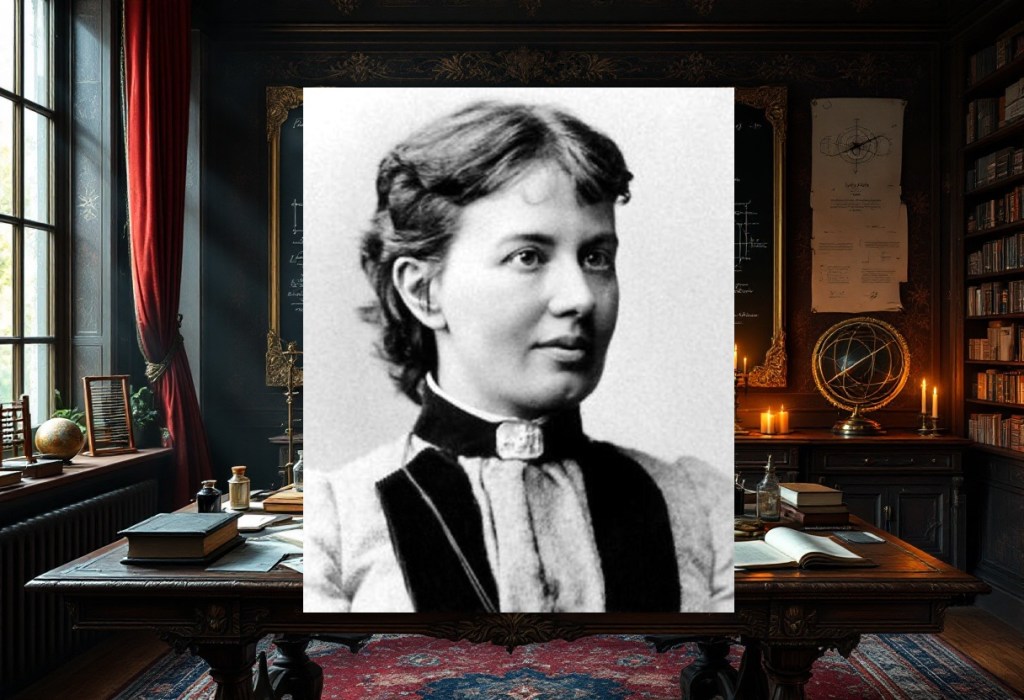
Sofia Vasilyevna Kovalevskaya (1850-1891) stands as one of history’s most remarkable mathematical minds, a woman who dared to claim her place in the masculine corridors of 19th-century academia. She became the first woman to earn a doctorate in mathematics in modern times, the first to hold a professorship at a Northern European university, and the first to serve on the editorial board of a scientific journal. Her groundbreaking work on partial differential equations gave birth to the Cauchy-Kovalevskaya theorem, a cornerstone of mathematical analysis that continues to underpin modern applications in fluid dynamics and weather modelling. Her discovery of the integrable case of rigid body motion, known as the “Kovalevskaya top,” earned her the prestigious Prix Bordin from the French Academy of Sciences in 1888, with the prize money doubled in recognition of her exceptional contribution.
Today, we sit with this extraordinary mathematician, novelist, and revolutionary spirit who transformed personal hardships into mathematical triumphs. In a world that locked doors on women, she indeed built her own ladder with equations, challenging every assumption about genius, gender, and the nature of mathematical discovery itself.
Sofia, what a privilege to speak with you. I’m struck by how your story continues to inspire mathematicians today, particularly women entering STEM fields. But let me begin with your childhood – I understand your earliest exposure to mathematics came in quite an unusual way?
Ah yes, the wallpaper! When I was eleven years old, our nursery was papered with pages from my father’s old university lectures on differential and integral analysis. I would stand there for hours, studying those mysterious symbols and formulae. They acted upon my imagination, instilling in me a reverence for mathematics as an exalted and mysterious science which opens up to its initiates a new world of wonders, inaccessible to ordinary mortals.
My father, General Vasilii Korvin-Krukovsky, had little intention of fostering mathematical curiosity in his daughter. When our tutor, Yosif Malevich, began teaching me arithmetic and algebra, I felt such an attraction for mathematics that I started to neglect my other studies. Father promptly put a stop to my lessons, declaring mathematics unsuitable for young ladies.
So you taught yourself in secret?
Indeed! I borrowed Bourdon’s Algebra Course and read it at night under my pillow, by the dim light of the icon-lamp when the household slept. Since I was under my governess’s strict surveillance all day, I was forced to practice some cunning. My mathematical knowledge might have remained confined to Bourdon’s algebra if not for a remarkable incident.
Tell me about that turning point.
Professor Nikolai Tyrtov, our neighbour from the Naval Academy, had written a physics textbook and presented it to our family. When I attempted to read the chapter on optics, I encountered trigonometric formulae I had never seen before. I worked to explain them myself, using methods that, as Tyrtov later realised, paralleled how the concept of sine had been developed historically. He was so astonished that he convinced my father to allow me proper mathematical instruction with Aleksandr Strannoliubskii in St Petersburg.
Your path to formal education required extraordinary measures – including a fictitious marriage. Can you explain this necessity?
In 1868, Russian women could not attend universities, nor could we travel abroad for study without written permission from our father or husband. At eighteen, I entered into what we called a “white marriage” with Vladimir Kovalevsky, a young palaeontology student who shared our progressive ideals. It was purely pragmatic – he gained access to European scientific circles, and I gained the legal freedom to pursue my mathematical studies.
This arrangement was not uncommon among the young nihilists of our generation. We believed that the only way for honest, right-thinking persons to live honourably in a country with Russia’s unjust social order was to devote ourselves to science, trusting education to make everything right eventually.
You studied first at Heidelberg, then Berlin. What was it like being the only woman in these mathematical circles?
At Heidelberg, I had to persuade each professor individually to permit me to audit their lectures. I studied with Gustav Kirchhoff, Hermann von Helmholtz, Leo Königsberger, and Paul du Bois-Reymond. According to my fellow students, I immediately attracted attention with my uncommon mathematical ability. Professor Königsberger and the others spoke of me as an extraordinary phenomenon.
But it was Berlin where my true mathematical education began. When the university senate refused to admit me even as an auditor, Karl Weierstrass agreed to tutor me privately. He tested my abilities with problems that I solved in a week, and from that moment, he recognised my potential.
Weierstrass became more than just a teacher to you, didn’t he?
Karl became something of a surrogate father, and I his mathematical daughter. These studies had the deepest possible influence on my entire career in mathematics. They determined finally and irrevocably the direction I was to follow in my later scientific work; all my work has been done precisely in the spirit of Weierstrass.
He often said that I was his most talented and best pupil, which was remarkable considering his students included such mathematical luminaries as Georg Frobenius, Hermann Schwarz, and Carl Runge. Our relationship was built on mutual respect and shared mathematical passion. He accorded me the affection of a daughter, and I propagandised his methods in my work, always crediting him as the source of my ideas.
Let’s discuss your doctoral work. You presented three papers to Göttingen in 1874. Can you walk me through your most significant contribution – what we now call the Cauchy-Kovalevskaya theorem?
Ah, this theorem addresses a fundamental question in mathematical analysis: under what conditions do solutions to certain partial differential equations exist and remain unique? Cauchy had proven a special case in 1842, but I extended this to the general case for systems of partial differential equations.
Could you explain this more technically for our mathematically inclined readers?
Certainly. Consider a system of m differential equations in n dimensions where the coefficients are analytic functions. The theorem establishes existence and uniqueness for quasilinear Cauchy problems of the form:
∂f/∂x_n = A₁(x,f)∂f/∂x₁ + … + A_{n-1}(x,f)∂f/∂x_{n-1} + b(x,f)
with initial condition f(x) = 0 on the hypersurface x_n = 0.
The crucial innovation was proving that if the coefficients and boundary data are analytic, then there exists a neighbourhood where the problem has a unique analytic solution. This requires the hypersurface to be non-characteristic – meaning the coefficient matrix in the direction normal to the surface must be non-singular.
What makes this result so significant?
The theorem provides the theoretical foundation for solving countless problems in mathematical physics. Today, it underpins numerical methods in fluid dynamics, weather prediction models, and climate simulations. When meteorologists model atmospheric circulation or predict storm formation, they rely on partial differential equations whose solutions are guaranteed by this theorem.
However, I must note its limitations. The requirement for analyticity is quite restrictive – as Hans Lewy later showed, the theorem cannot be extended to all smooth functions. This limitation actually makes the result more precious, as it defines the precise boundary between solvable and potentially unsolvable problems.
Your work often revealed unexpected connections. How did you approach problems differently from your contemporaries?
I believed in what I called “mathematical intuition” – the ability to perceive underlying patterns and structures that might not be immediately obvious through conventional approaches. When working on the rotation problem that earned me the Prix Bordin, I recognised that the classical approaches to rigid body motion were insufficient for non-symmetric cases.
The key insight was realising that certain specific conditions – when two principal moments of inertia are equal and twice the third, with the centre of mass in a particular position – would make the problem integrable using ultra-elliptic functions. This was not a systematic search but rather mathematical intuition guided by deep understanding of both the physics and the analytical tools.
That brings us to your most celebrated achievement – the “Kovalevskaya top.” Can you describe this discovery?
This work examined the motion of a heavy rigid body rotating about a fixed point under gravity’s influence. There are only three known integrable cases in all of classical mechanics: Euler’s case for a symmetric body, Lagrange’s case for a symmetric top, and my case for an asymmetric body.
The problem requires four independent integrals of motion. Three are straightforward: total energy, angular momentum about the vertical axis, and the geometric constraint. The challenge lay in finding the fourth integral.
My breakthrough came in recognising that when the principal moments of inertia satisfy A = B = 2C, and the centre of mass lies in the equatorial plane, the equations become integrable through elliptic functions. This seemingly artificial condition actually represents a profound mathematical structure.
What was the practical significance of solving this problem?
Beyond its mathematical elegance, this work provided a complete analytical solution to rigid body dynamics in a previously unsolved case. Today, this analysis applies to spacecraft attitude control, gyroscopic systems, and even aspects of chaos theory. The methods I developed also proved crucial for understanding Saturn’s rings’ stability – an application I explored in one of my doctoral papers.
You faced considerable scepticism about your mathematical abilities because of your gender. How did you handle these challenges?
The prejudices were relentless. Even after proving my competence repeatedly, many continued to view me as an curiosity rather than a serious mathematician. Some colleagues would remark on my appearance rather than my work, as if mathematical ability were somehow incompatible with femininity.
The Prix Bordin competition was particularly telling. The judges – including Charles Hermite, Joseph Bertrand, and Gaston Darboux – were so impressed with my anonymous submission that they doubled the prize from 3,000 to 5,000 francs. Only after the sealed envelope revealed my identity did they learn they had honoured a woman’s work.
How did you maintain your confidence in the face of such systemic exclusion?
I drew strength from the mathematics itself. When you discover a new theorem or solve a previously intractable problem, the satisfaction transcends any social prejudice. The equations do not care about the mathematician’s gender – they yield their secrets to whoever possesses the insight and persistence to unlock them.
I also found support among progressive thinkers. Weierstrass never doubted my abilities, and in Sweden, Gösta Mittag-Leffler championed my appointment at Stockholm University. These allies were crucial in a world that otherwise sought to exclude women from intellectual life.
Let me ask about a professional misjudgement. Looking back, is there anything you would approach differently?
I sometimes wonder if my intensity may have hindered collaboration. I demanded the same rigorous standards from others that I applied to myself, which could be… challenging for some colleagues. Weierstrass once worried that I was pursuing mathematics with such single-minded focus that I might lose touch with broader human connections.
There was also the matter of my novel-writing, which some mathematicians viewed as frivolous distraction. Perhaps I should have been more strategic about timing these literary pursuits, though I maintain that my artistic work enriched rather than diminished my mathematical insight.
Speaking of your literary work – you wrote novels and plays alongside your mathematics. How did these different modes of thinking inform each other?
One of the foremost mathematicians of our century says very justly that it is impossible to be a mathematician without also being a poet in spirit. Mathematics and literature both seek to reveal hidden patterns and truths about our world, though through different languages.
My novel A Nihilist Girl explored the same themes of resistance and intellectual freedom that shaped my mathematical career. When writing about characters breaking social conventions, I drew upon my own experience challenging academic barriers. Both mathematics and literature require the courage to venture into unexplored territories of thought.
Contemporary critics sometimes questioned whether women’s minds were capable of abstract mathematical reasoning. How did you respond to such claims?
When I met Herbert Spencer in London, he expounded his theories about women’s supposed incapacity for abstract thought. I responded by demonstrating my mathematical work directly – not through argument, but through evidence. The most powerful refutation of prejudice is competent performance.
I must say, however, that such debates often missed the point entirely. The question was never whether women could think mathematically, but whether we would be permitted to do so. Society constructed elaborate barriers while simultaneously claiming our absence proved our incompetence.
Your appointment to Stockholm University in 1889 made you the world’s first female professor of mathematics. What was that experience like?
It was both vindication and responsibility. After years of being treated as an exceptional curiosity, I finally had an institutional platform to demonstrate women’s mathematical capabilities. My lectures drew students not merely for the novelty, but for the quality of mathematical instruction.
Yet the appointment came with pressures. I knew that my performance would be scrutinised as representative of all women’s potential in mathematics. Every lecture, every paper, every interaction carried the weight of proving that female mathematical talent deserved recognition and cultivation.
Tragically, you died of pneumonia in 1891 at only 41 years old. Knowing how your work influenced generations of mathematicians, particularly women, what would you want your legacy to represent?
I hope my life demonstrates that mathematical talent recognises no boundaries of gender, nationality, or social convention. The theorems I proved will endure because they reveal mathematical truths, not because of the circumstances of their discovery.
But perhaps more importantly, I hope my example encourages young women to trust their intellectual instincts and persist despite discouragement. In a world that locked doors on women, I built my own ladder with equations. Others can build their own ladders through determination, rigorous preparation, and refusal to accept artificial limitations.
Your Cauchy-Kovalevskaya theorem continues to be fundamental in modern applications. How does it feel to know your work helps meteorologists predict weather patterns and engineers model fluid flows?
It is remarkable to learn that mathematics developed in the 1870s now enables scientists to predict storms and model climate systems. This exemplifies the profound truth that pure mathematical research, pursued for its own sake, often finds practical applications generations later.
When I worked on partial differential equations with Weierstrass, we were driven by mathematical curiosity, not utilitarian goals. Yet these theoretical investigations now help protect lives through improved weather forecasting. Mathematics possesses this magical quality – its abstractions somehow capture the essential structures underlying physical reality.
What advice would you give to women and marginalised groups entering STEM fields today?
First, develop unshakeable competence in your chosen field. Master the technical foundations so thoroughly that your expertise becomes undeniable. Prejudice cannot withstand sustained excellence.
Second, seek allies among those who value talent over convention. Weierstrass and Mittag-Leffler championed my work because they recognised mathematical ability. Such supporters exist in every generation – find them and cultivate these relationships.
Third, remember that every barrier you break creates possibilities for others. When I became the first female mathematics professor, I was not merely advancing my own career but opening pathways for future generations.
Finally, trust in the power of your discipline itself. Mathematics, science, and rigorous inquiry possess an inherent capacity to transcend social prejudices. The pursuit of knowledge creates its own form of liberation.
Sofia Kovalevskaya, thank you for this extraordinary conversation. Your legacy continues to inspire mathematicians and remind us that genius knows no boundaries.
Thank you for allowing me to share these reflections. May future generations find in mathematics the same wonder and freedom that sustained me through every challenge. As I once wrote, mathematics opens up a new, wonderful world – and that world belongs to all who possess the curiosity and courage to explore it.
Letters and emails
Following our conversation with Sofia Kovalevskaya, we’ve received an outpouring of letters and emails from readers around the world eager to continue the dialogue with this remarkable mathematician. We’ve selected five thoughtful questions from our growing community – voices from five continents who want to explore her life, her groundbreaking work, and what wisdom she might offer to those walking in her footsteps today.
Ayesha Malik, 34, Data Scientist, Karachi, Pakistan
Sofia, you mentioned using ‘mathematical intuition’ to recognise patterns others missed. In today’s world of machine learning and algorithmic pattern recognition, I’m curious – how did you train this intuitive capacity? Were there specific techniques you used to strengthen your ability to see underlying mathematical structures, and do you think human mathematical intuition still has advantages over computational approaches?
Ah, Miss Malik, what a fascinating question about mathematical intuition! You speak of machines that can recognise patterns – how remarkable that sounds, though I confess I cannot quite fathom such mechanical intelligence.
In my time, we had only our minds and perhaps an abacus for calculations. I developed what I called mathematical intuition through what I might describe as prolonged contemplation combined with rigorous preparation. When Weierstrass first presented me with those test problems in Berlin, I found myself not merely calculating but rather listening to the equations, if you will forgive such fanciful language.
I would spend hours walking through the Tiergarten, carrying mathematical problems in my mind like melodies. The rhythm of walking seemed to unlock connections that remained hidden when I sat hunched over my desk. I discovered that mathematical structures possess a kind of music – the way functions behave near singular points, how differential equations flow through their solution spaces. This music became audible only through patient attention.
My preparation was thorough, naturally. I memorised vast tables of integrals, studied every theorem until I could recite the proofs backwards, practised algebraic manipulations until they became as natural as breathing. But intuition emerged from something beyond mere technical facility – it required what the Germans call Fingerspitzengefühl, a sensitivity at one’s fingertips.
When working on partial differential equations, I would often begin with the simplest possible case, then gradually introduce complexity while maintaining awareness of the underlying geometric picture. I visualised solution surfaces, imagined how they curved and twisted in higher dimensions. Sometimes I would even use my hands to trace these invisible shapes in the air – my colleagues thought this quite eccentric!
The crucial insight is that mathematical intuition develops through emotional engagement with the subject. One must care deeply about whether a particular integral converges, feel genuine curiosity about the behaviour of solutions near boundary conditions. Mathematics is not merely intellectual exercise but rather a form of passionate inquiry into the fundamental structures of reality.
Regarding your mechanical pattern-recognition devices – while they may surpass human calculation in speed and accuracy, I suspect they lack what we might call mathematical sympathy. A theorem is not merely a collection of logical steps but rather an expression of mathematical truth that resonates with properly attuned sensibilities. The human mind possesses something beyond mere computation – call it aesthetic sense, or perhaps the capacity for mathematical wonder.
Can a machine experience the profound satisfaction of discovering an elegant proof? I rather doubt it.
Malik Diarra, 41, Engineering Professor, Lagos, Nigeria
Your work on rigid body dynamics has applications in modern spacecraft control systems. If you were designing a solution today, with access to computational tools and numerical methods that didn’t exist in your time, would you approach the Kovalevskaya top problem differently? Or do you believe the analytical, closed-form solutions you developed still offer insights that numerical approximations cannot capture?
Professor Diarra, your question touches upon something that has occupied my thoughts considerably – the relationship between analytical elegance and computational power. You mention spacecraft, which I confess sounds like something from a Jules Verne novel, though I gather such contraptions now actually traverse the heavens!
If I possessed access to these remarkable calculating machines you describe, I believe my fundamental approach would remain unchanged, though the scope of investigation might expand dramatically. You see, the analytical solution to the Kovalevskaya top reveals something profound about the underlying mathematical structure that no amount of numerical approximation can capture fully.
When I discovered that specific relationship between the principal moments of inertia – A equals B equals twice C – this was not merely a convenient mathematical trick but rather an expression of deep geometrical truth. The solution exists in terms of elliptic functions precisely because the problem possesses hidden symmetries that become visible only through analytical investigation. These symmetries govern the very essence of the motion, like discovering the architectural principles underlying a cathedral’s construction.
Numerical methods, however sophisticated, would show us how the body moves but might obscure why it moves in such exquisite patterns. The analytical approach reveals what the French call the raison d’être of the motion – its fundamental mathematical logic.
That said, I confess great curiosity about these computational tools! During my work on Saturn’s rings for my doctoral dissertation, I was severely limited by the labour of calculation. Hours spent on arithmetical drudgery might have been devoted to exploring additional cases or investigating perturbations. Your modern calculating engines could perhaps allow investigation of near-integrable cases where my analytical methods break down.
I suspect the greatest value would lie in using computational power to explore the boundaries of analytical solutions. Where does integrability cease? How do small perturbations destroy the beautiful elliptic function solutions? These questions require both analytical insight and computational exploration.
The closed-form solutions I developed possess what mathematicians value above all else – they provide complete understanding of the solution space. Every possible motion is contained within those elliptic functions, classified and understood. A numerical solution, however accurate, describes only one particular trajectory.
Think of it thus: analytical solutions are like possessing the complete musical score, while numerical methods give us individual performances. Both have their place, but the score reveals the composer’s full intentions in ways that any single performance cannot.
Helena Bauer, 28, Philosophy PhD Student, Vienna, Austria
You wrote both mathematical theorems and novels, yet some colleagues viewed this as contradictory. Today, we often discuss the artificial boundaries between disciplines. Looking back, do you see your literary work as having influenced your mathematical thinking in ways that weren’t obvious at the time? How might academia benefit from encouraging more cross-pollination between analytical and creative pursuits?
Miss Bauer, how perceptive of you to recognise this connection! Indeed, my literary pursuits were never mere diversions from mathematics but rather complementary expressions of the same fundamental curiosity about human experience and natural phenomena.
When I wrote A Nihilist Girl, I was exploring the same themes that animated my mathematical work – the search for hidden patterns, the challenge of breaking through artificial constraints, the passionate pursuit of truth despite social opposition. The novel’s heroine, like a mathematical theorem, must navigate through a world of contradictions to reach resolution. Both literature and mathematics require what I might call architectural thinking – constructing narratives or proofs that support their own weight through internal logic.
My literary work taught me to attend more carefully to the texture of mathematical problems. When working on partial differential equations, I began to perceive each problem as having its own character, its own dramatic arc. Some equations are stubborn and yield their secrets reluctantly, like tragic heroes. Others possess an almost playful quality, revealing elegant solutions with surprising ease.
The rhythm of language also influenced my mathematical exposition. I learned from my novel-writing to vary the pace of mathematical argument – to build tension through careful development of preliminary results, then provide resolution through the crucial theorem. Weierstrass often remarked that my mathematical papers possessed unusual clarity and flow, which I attribute partly to my literary sensibilities.
More profoundly, both pursuits taught me to embrace what appears contradictory. In my novel, I explored characters who embodied seemingly incompatible qualities – revolutionary idealism coupled with personal vulnerability, intellectual rigour alongside emotional depth. This prepared me to accept mathematical results that initially seemed paradoxical, like the fact that certain differential equations possess solutions only under the most restrictive conditions.
The greatest influence, however, was emotional. Literature taught me that the most compelling truths often emerge from apparent impossibilities. When I encountered the seemingly insurmountable technical difficulties in my work on rigid body motion, I drew upon the novelist’s faith that persistent exploration of contradictions eventually reveals deeper harmony.
Academia would benefit enormously from such cross-pollination! The artificial separation between analytical and creative pursuits impoverishes both domains. A mathematician who has never struggled with the precise choice of words cannot fully appreciate the importance of elegant notation. A novelist who has never experienced the satisfaction of rigorous proof cannot achieve the most compelling forms of narrative inevitability.
Truth, whether mathematical or literary, requires both passion and precision – qualities that reinforce rather than contradict each other.
Trevor Collins, 45, High School Physics Teacher, Toronto, Canada
What if you had been born fifty years later, when universities were beginning to admit women more readily? Do you think the barriers you faced – while undeniably unjust – might have actually sharpened your mathematical abilities in ways that easier access wouldn’t have? I’m thinking about how constraint sometimes breeds innovation, though I certainly don’t mean to romanticise discrimination.
Mr Collins, your question treads upon delicate ground, yet I appreciate your honest acknowledgment of the moral complexity involved. You are quite right to note that you do not wish to romanticise discrimination – such romanticism would be both intellectually dishonest and morally reprehensible.
Nevertheless, I must confess there is truth in your observation, though it pains me to admit it. The very obstacles that society placed before me did indeed forge certain qualities of character and method that might not have developed under easier circumstances.
When I was denied access to university lectures, I was forced to develop extraordinary powers of concentration and self-instruction. Reading Bourdon’s algebra by candlelight under my bedcovers taught me to extract maximum understanding from minimal resources. This habit of intensive focus served me well throughout my career – I could work for twelve hours straight on a single mathematical problem with complete absorption.
The necessity of proving myself repeatedly also cultivated what I might call mathematical fearlessness. Having been told countless times that women were incapable of abstract reasoning, I approached the most daunting problems with a peculiar form of desperation-driven courage. I simply could not afford to fail, which paradoxically liberated me from the timidity that might have constrained a more conventionally situated scholar.
My isolation from traditional academic networks forced me to develop original approaches rather than following established schools of thought. When Weierstrass became my mentor, I brought to our collaboration a freshness of perspective that he valued precisely because it had not been shaped by conventional academic socialisation.
However – and this is crucial – these benefits came at enormous personal cost. The loneliness, the constant struggle for recognition, the financial insecurity, the toll upon my health and relationships – these were terrible prices to pay for whatever intellectual advantages emerged from adversity.
More importantly, for every woman like myself who managed to overcome such barriers, how many brilliant minds were completely extinguished by the same obstacles? Society lost incalculable mathematical talent through its exclusionary practices.
The proper response to discrimination is not to celebrate its unintended consequences but rather to ensure that future generations can develop their capabilities through encouragement rather than opposition. Mathematical genius should flourish through cultivation, not constraint.
If I may venture a pedagogical observation for your teaching: challenge your students rigorously, but provide them with the support and recognition that society denied to women of my generation. Excellence emerges most reliably from demanding standards combined with genuine opportunity.
Florencia Pereyra, 31, Biomedical Engineer, Buenos Aires, Argentina
Your theorem deals with the existence and uniqueness of solutions under specific conditions. In my field, we often work with biological systems that seem to defy such mathematical certainty – they’re messy, adaptive, and full of exceptions. How do you think about the relationship between mathematical elegance and the inherent unpredictability of real-world systems? Does mathematics impose order, or does it reveal order that was already there?
Miss Pereyra, your question strikes at the very heart of what we mathematicians contend with – the relationship between our elegant abstractions and the bewildering complexity of the natural world. You work with biological systems, you say? How fascinating that must be, though I confess the living world often seems to mock our neat mathematical categories!
I have been consumed by this tension throughout my career. When I derived the conditions for my theorem – those requirements for analyticity and non-characteristic surfaces – I was acutely aware that I was carving out a small island of certainty within an ocean of mathematical chaos. The theorem tells us precisely when we can guarantee solutions exist, but nature seems delightfully indifferent to our mathematical conveniences.
During my work on Saturn’s rings, I encountered this puzzle directly. My equations described the gravitational mechanics beautifully under idealised conditions, yet the actual behaviour of those countless particles defied simple prediction. Each tiny fragment follows mathematical laws perfectly, yet their collective behaviour exhibits what we might call emergent complexity that transcends any individual calculation.
I believe mathematics reveals order that genuinely exists in nature, but perhaps not in the way we initially expect. The fundamental laws – Newton’s mechanics, the principles underlying differential equations – these represent authentic natural structures. However, when countless such law-governed elements interact, they generate patterns that, while still mathematical in principle, exceed our present analytical capabilities.
Think of it thus: a single water drop follows precise trajectories governed by mechanical laws, yet when millions of drops form a turbulent stream, the resulting flow exhibits behaviour that appears almost organic in its unpredictability. The mathematics remains true at every level, but our ability to trace all the implications becomes practically impossible.
Your biological systems likely operate according to the same principle. Each cellular process, each chemical reaction, follows rigorous physical laws. Yet when these processes combine in living organisms, they create adaptive, responsive systems that seem to transcend mechanical predictability. This is not because they violate mathematical principles, but because they embody mathematical complexity that surpasses our current analytical methods.
Perhaps the key insight is that mathematical elegance and real-world messiness are not contradictory but rather complementary. Our theorems provide the foundation – the basic grammatical rules, if you will – while nature composes extraordinarily complex sentences using that grammar.
The unpredictability you observe may simply reflect mathematics expressing itself at scales of complexity we have not yet learned to navigate. What appears as chaos might be order of a sophistication that awaits future mathematical developments to fully comprehend.
Reflection
On 10th February 1891, Sofia Kovalevskaya died of pneumonia in Stockholm at the age of 41, her brilliant mathematical career cut tragically short just as she had reached the height of her powers and recognition. Her final words, “too much happiness,” have become emblematic of a life that achieved extraordinary triumph despite relentless obstacles.
Through this conversation, we glimpse themes that resonate powerfully today: the persistence required to break through institutional barriers, the ingenuity needed to transform exclusion into opportunity, and the overlooked nature of women’s contributions to scientific progress. Sofia’s voice reveals perspectives that historical records often obscure – her emphasis on mathematical intuition as an emotional and aesthetic practice, her view of literature and mathematics as complementary forms of truth-seeking, and her pragmatic acknowledgment that adversity, while never desirable, sometimes forged qualities of character that might not have developed otherwise.
Where our imagined Sofia perhaps differs from documented accounts is in her sophisticated reflection on the relationship between analytical elegance and computational complexity, discussions that bridge her 19th-century insights with contemporary mathematical challenges. Historical records also remain contested regarding the exact circumstances of her literary collaborations and the precise influence of her political beliefs on her mathematical work.
Today, the Cauchy-Kovalevskaya theorem continues to underpin applications from weather prediction to fluid dynamics modelling. Modern mathematicians like Shane Kepley and Tianhao Zhang have developed constructive proofs of her theorem, whilst contemporary researchers continue to build upon her work in partial differential equations and rigid body dynamics. The Alexander von Humboldt Foundation’s prestigious Sofja Kovalevskaja Award, established in her honour, continues to support international researchers in Germany.
Perhaps most significantly, Sofia’s story illuminates how mathematical genius transcends the artificial boundaries society attempts to impose. In an era when women remain underrepresented in mathematics leadership, her legacy reminds us that brilliance emerges from unexpected places and that the pursuit of knowledge creates its own form of liberation. Her life stands as testament to the transformative power of refusing to accept limitations – proof that in a world that locks doors on talent, determined minds will always find ways to build their own ladders to the stars.
Who have we missed?
This series is all about recovering the voices history left behind – and I’d love your help finding the next one. If there’s a woman in STEM you think deserves to be interviewed in this way – whether a forgotten inventor, unsung technician, or overlooked researcher – please share her story.
Email me at voxmeditantis@gmail.com or leave a comment below with your suggestion – even just a name is a great start. Let’s keep uncovering the women who shaped science and innovation, one conversation at a time.
Editorial Note: This interview is a dramatised reconstruction based on extensive historical research into Sofia Kovalevskaya‘s life, work, and documented perspectives. While grounded in authentic biographical details, mathematical contributions, and recorded statements, the conversation itself is imagined. Sofia’s responses reflect her known views, personality, and intellectual approach as gleaned from letters, academic papers, memoirs, and scholarly accounts, but should not be considered verbatim historical record. The technical discussions accurately represent her mathematical work and its modern applications. This creative approach allows us to explore her legacy whilst acknowledging the inherent limitations of reconstructing historical voices across centuries.
Bob Lynn | © 2025 Vox Meditantis. All rights reserved. | 🌐 Translate


 Vox Meditantis
Leave a comment