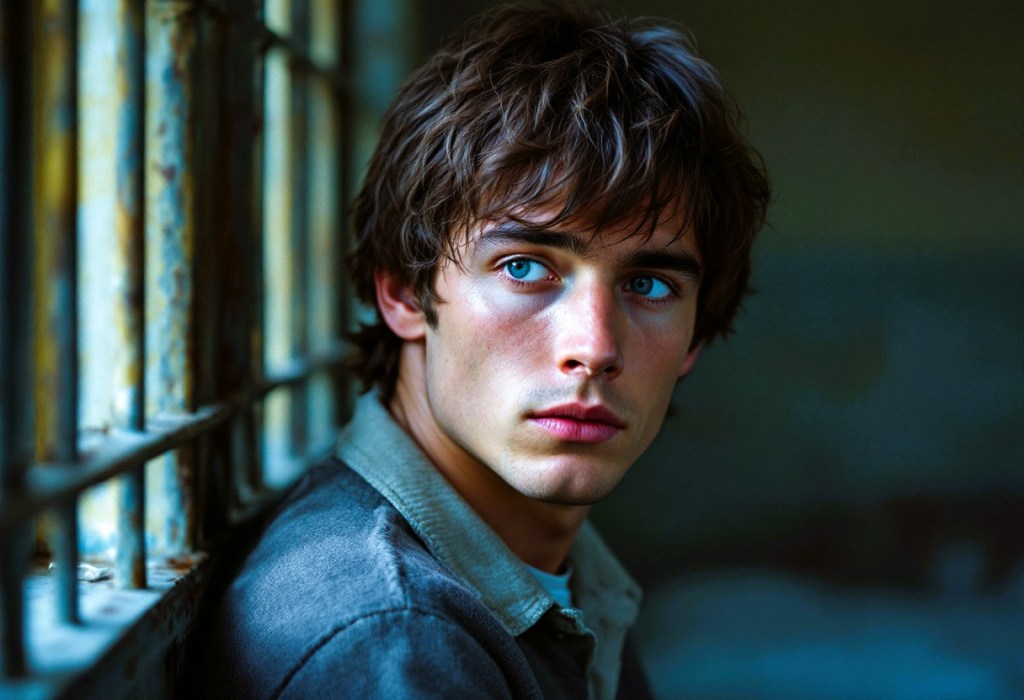
22nd September 1969
The walls here are the colour of old mustard, that sickly yellow-brown that seems to seep into a man’s soul after months of staring at it. I’ve been counting the days since Apollo 11 touched down – two months now – and still I’m trapped beneath these fluorescent lights that drain everything of its proper hue. The lads who made it to the moon, they saw the Earth as a blue marble against the black. Blue like freedom, I reckon. Blue like the ocean I’ve never crossed.
Today I watched a sparrow through the barred window, its breast the russet of autumn leaves I’ll not see fall this year. It hopped about the courtyard with such ease, such thoughtless liberty, and I felt that familiar sting of envy rise in my chest like bile. That bird doesn’t know what borders mean, what walls signify. It simply flies.
The wireless crackled with news of more protests in London, students marching against the war. Their voices carry colours too – the red of anger, the white heat of righteous fury. Here I sit in grey monotony whilst the world burns in Technicolor beyond these stones. The Beatles are recording again, they say, though some reckon it might be their last. “Come Together,” they’re calling one tune. If only I could.
I’ve been thinking of what old Father Walsh told me before I landed in this mess. “The blackest night,” he said, his Irish accent thick as treacle, “always gives way to dawn. But you’ve got to keep your eyes open for the first streak of gold on the horizon, lad, or you’ll miss it entirely.” At the time, I thought it just church talk, the sort of thing priests say when they can’t think of anything useful. But now, surrounded by these drab walls, I understand the wisdom buried in his words.
He was speaking of hope, wasn’t he? Not the weak, wishful kind that gets a man nowhere, but the sturdy sort that keeps the soul alive when everything else has turned to ash. The kind that sees colour where others see only shadows. Even here, in this place where dreams come to die, I can still imagine the deep purple of Mediterranean evenings, the golden wheat of harvest fields stretching toward distant mountains. The advice wasn’t about waiting for better times – it was about training the eye to see beauty even when caged, to find the artist’s palette even in a prisoner’s cell.
The evening light is fading now, painting the opposite wall in shades of amber and rust. Tomorrow will bring the same routine, the same walls, the same longing for distant shores. But perhaps Father Walsh was right. Perhaps the dawn isn’t just something that happens to you – perhaps it’s something you learn to see, one small streak of colour at a time.
The sparrow is gone now, vanished into the gathering dusk. But I know it will return, as surely as morning follows night. And when it does, I’ll be watching for those first golden rays to touch its wings.
Late 1960s Britain and the first Moon landing frame this entry’s mood, contrasting confinement with Apollo 11’s July 1969 success that fulfilled President Kennedy’s goal and symbolised a U.S. lead in the Space Race. Apollo 11 saw Neil Armstrong and Buzz Aldrin walk on the Moon while Michael Collins orbited above; millions watched worldwide, and the crew entered quarantine on return in July 1969. In Britain, prisons remained austere institutions amid wider social unrest and youth protest, lending realism to the diarist’s setting and tone. The landing was followed by further Apollo missions through 1972 and later debates over costs and priorities, shaping space policy and technological spinoffs.
Bob Lynn | © 2025 Vox Meditantis. All rights reserved. | 🌐 Translate

 Vox Meditantis
Leave a comment