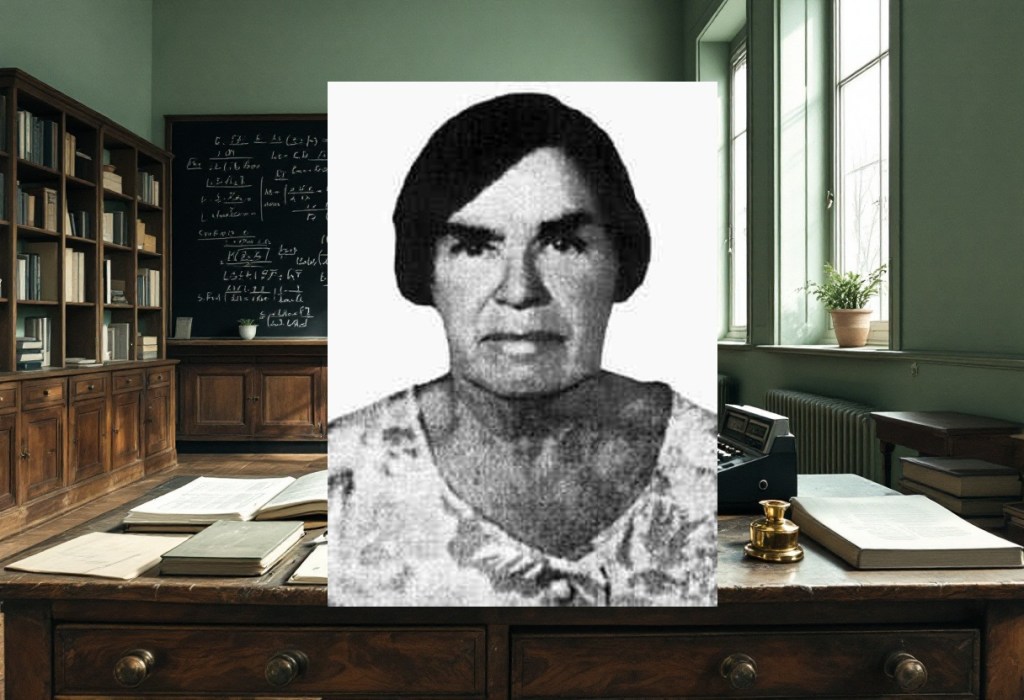
Vera Nikolaevna Faddeeva (1906-1983) blazed through the male-dominated world of Soviet mathematics at a time when computers were barely more than a gleam in engineers’ eyes. She would become one of the founders of numerical linear algebra, developing computational methods that would power the digital age decades before the advent of laptops and smartphones. Today, her algorithms quietly underpin the mathematical engines that drive artificial intelligence, computer graphics, and scientific simulation across the globe.
Vera’s story matters not merely as a historical curiosity, but as a testament to the power of methodical, foundational thinking in an era that often celebrates flashier innovations. She understood that before you could have massive computer networks, you needed reliable ways to solve the basic mathematical problems that would fuel them. Her 1950 masterwork, Computational Methods of Linear Algebra, became the definitive guide for an entire generation of computational mathematicians worldwide.
Vera Nikolaevna, welcome. It’s rather extraordinary to be speaking with you here in 2025, looking back at nearly eight decades of mathematical progress since your groundbreaking work. You began your career at a time when most calculations were done by hand with desk calculators. Could you paint us a picture of what mathematical computation looked like in 1950?
Well, you must understand, we had no choice but to be precise the first time. When every multiplication might take several minutes on a mechanical calculator, and each matrix inversion could consume days of careful work, one learned to think very carefully about every step. We couldn’t simply run the calculation again if we’d made an error – time and resources were too precious.
That discipline must have been formative for your approach to developing algorithms.
Exactly so. In my laboratory at the Steklov Institute, we weren’t just developing methods – we were crafting tools that had to work reliably for physicists calculating nuclear reactions, engineers designing structures, and mathematicians solving fundamental problems. Every algorithm had to be what you might call “bomb-proof” – forgive the expression, but it was fitting for the times. We tested everything by hand first, with small matrices, checking every arithmetic operation.
Speaking of your early years, you witnessed some of the most tumultuous periods in Soviet history. How did the political climate affect your mathematical education?
My undergraduate years at Leningrad State University were deeply troubled times. My advisor, Nikolai Maksimovich Gyunter, was a man of great courage and independent thought – exactly the qualities that made him dangerous in Stalin’s regime. Independent thinkers were being persecuted, and the Leningrad Mathematical Society was actually disbanded in 1930, the year I graduated, in an attempt to save the lives of mathematicians like Gyunter.
You see, in those days, even pure mathematics could be viewed with suspicion if it seemed too abstract or too influenced by Western ideas. One had to be very careful about which problems one chose to work on, and with whom one collaborated.
Yet you persisted in pursuing mathematical research. What drove you during those uncertain times?
The mathematics itself, of course. Numbers don’t lie, and equations don’t care about politics. But also, I had a practical streak – I could see that the problems I was working on had real applications. When I started developing computational methods for linear systems, it wasn’t abstract theory. It was the difference between Soviet engineers being able to calculate stress in a bridge or not, between our physicists being able to design better reactors or not.
Let’s talk about your most famous contribution – could you walk us through the development of your computational methods for linear algebra? What exactly were you trying to solve?
The fundamental problem was this: how do you solve a system of linear equations when you have, say, fifty or a hundred unknowns? Or how do you find the eigenvalues of a large matrix when doing it by hand would take months? These weren’t just academic questions – they were bottlenecks holding back entire fields of engineering and physics.
For our technical readers, could you explain your most important algorithmic contribution in detail?
Certainly. Let me walk you through what became known as the Faddeev-LeVerrier algorithm for computing eigenvalues, which my husband Dmitrii and I developed.
The traditional approach to finding eigenvalues requires solving the characteristic equation det(λI – A) = 0, which means you first need to compute that determinant symbolically – a nightmare for large matrices. Our method works differently.
We generate a sequence of matrices M₀, M₁, M₂, … where M₀ = 0, and for each step k, we compute:
- M_k = A·M_{k-1} + c_{n-k+1}·I
- c_{n-k} = -1/k · trace(A·M_k)
This gives us the coefficients of the characteristic polynomial directly, without symbolic computation. But here’s the clever bit – as a bonus, the final matrix M_n gives us A⁻¹ essentially for free. So we get eigenvalues, the characteristic polynomial, and the matrix inverse all in one go.
That’s remarkably efficient. How did this compare to competing methods?
Other methods typically required you to choose: either compute eigenvalues OR compute the inverse OR compute the determinant. Ours gave you everything at once, with numerical stability that was quite good for the era. The error propagation was well-controlled, which was crucial when you’re doing everything by hand and can’t afford to accumulate rounding errors.
More importantly, our method was completely deterministic – no iteration, no convergence worries. You knew exactly how many steps it would take based on the matrix size.
Your 1950 book became legendary in the field. What drove you to write such a comprehensive treatment?
Desperation, partly! There simply wasn’t a proper textbook anywhere that collected all these methods. Soviet mathematicians were developing excellent techniques, but they were scattered across different institutes and publications. Western researchers were doing brilliant work too, but we had limited access to their publications.
I wanted to create something that a mathematician or engineer could pick up and actually use – not just theory, but practical guidance. Twenty-three detailed numerical examples worked out step by step. If you were sitting at your desk calculator at two in the morning trying to invert a matrix, I wanted my book to be your reliable companion.
You mentioned limited access to Western publications. How did the Iron Curtain affect Soviet mathematics?
It was complicated. On one hand, yes, we were somewhat isolated from Western developments, which meant we sometimes spent effort rediscovering methods that were already known elsewhere. But isolation also forced us to be more self-reliant and thorough. We couldn’t just cite someone else’s result – we had to work everything out ourselves and understand it completely.
Interestingly, this led to some uniquely Soviet approaches. We were perhaps more focused on stability and reliability than our Western counterparts, because we couldn’t afford to have methods that only worked sometimes.
Looking back, is there anything you would have done differently in your early work?
I was perhaps too conservative about the potential of electronic computation. Even when the first Soviet computers like MESM began operating in the early 1950s, I still oriented my methods primarily toward hand calculation. It took me longer than it should have to fully grasp that the computational landscape was about to change fundamentally.
Also, I regret that some of my most innovative ideas weren’t published quickly enough. In the Soviet system, everything had to be approved through multiple layers, and sometimes by the time our papers appeared, similar work had already been published in the West.
What was it like being a woman in Soviet mathematics during that era?
It was certainly easier than it would have been in many Western countries at the time. The Soviet system, for all its faults, did genuinely promote women in sciences. I wasn’t the only woman mathematician at the Steklov Institute – we had Olga Ladyzhenskaya doing magnificent work on partial differential equations, and many others.
But that doesn’t mean it was simple. When I was evacuated from Leningrad during the siege and tried to continue my research from Kazan, I had three young children to care for, including our son Ludwig who would later become a brilliant physicist himself. The practical challenges of balancing research with family responsibilities were enormous.
You established and led the Laboratory of Numerical Computations. What was that like?
It was one of the greatest joys of my career. We hosted visits from mathematicians around the world – James Wilkinson from Britain, George Forsythe from America, Gene Golub, so many brilliant minds. Despite the political tensions of the Cold War, mathematics provided a common language that transcended borders.
The laboratory became a place where theoretical insights met practical computation. We weren’t just developing algorithms – we were training the next generation of computational mathematicians, teaching them to think carefully about numerical stability, error propagation, and practical implementation.
Your algorithms are now embedded in virtually every piece of software that does linear algebra. What do you make of that legacy?
It’s rather astonishing, isn’t it? Every time someone trains a neural network or renders a 3D image or runs a scientific simulation, there’s a good chance our matrix methods are working quietly in the background. We built these techniques thinking about mechanical calculators, and now they’re running on machines millions of times more powerful.
But I’m particularly pleased that the emphasis on numerical stability and careful error analysis that we championed has remained central to computational mathematics. The computers may be faster, but the fundamental challenge of maintaining accuracy through long sequences of operations remains.
What would you say to young mathematicians, particularly women, entering the field today?
First, don’t be seduced by flashy applications at the expense of solid fundamentals. The most exciting machine learning algorithms in the world are worthless if your linear algebra is unstable. Master the foundations first.
Second, remember that the best computational methods often come from understanding both the mathematics and the practical constraints of implementation. Don’t just ask “What’s the most elegant algorithm?” Ask “What’s the most reliable algorithm that will actually work when someone needs it at three in the morning?”
And to the women specifically: you belong here. Mathematics doesn’t care about your gender, only about the quality of your thinking. Be persistent, be precise, and don’t let anyone convince you that you’re not cut out for this work.
Any final thoughts as we look toward an age of quantum computing and artificial intelligence?
The more things change, the more they stay the same. You can have quantum computers and artificial intelligence, but you’ll still need to solve linear systems, compute eigenvalues, and understand how errors propagate through calculations. The tools may evolve, but the mathematical foundation remains.
I’m also confident that somewhere out there, a young mathematician is developing the next generation of computational methods that will seem as revolutionary to you as electronic computers seemed to us. Mathematics has a way of preparing us for futures we can barely imagine.
Thank you, Vera Nikolaevna. Your quiet revolution in computational mathematics has indeed prepared us for a future you could barely have imagined in 1950.
Quiet revolution – I rather like that phrase. Sometimes the most profound changes happen not with great fanfare, but with careful, methodical work that builds the foundation for everything that comes after. That’s the true power of mathematics.
Letters and emails
The conversation with Vera Faddeeva has sparked tremendous interest from our international community of readers, researchers, and students who see their own struggles and aspirations reflected in her remarkable journey through Soviet mathematics. We’ve selected five particularly thoughtful letters and emails from our growing community – spanning five continents – whose questions probe deeper into her technical innovations, her navigation of institutional barriers, and the wisdom she might offer to those walking in her footsteps today.
Madison Rivera (29, Data Scientist, Toronto, Canada):
You mentioned that the Faddeeva function named after you is still widely used in modern computational physics and spectroscopy. I work with machine learning algorithms that use complex error functions for signal processing, but honestly, I never knew their origin. Could you explain what drove you to work on complex-valued functions rather than sticking to purely real calculations? And do you think there are untapped applications of your complex error function work that today’s researchers might be missing?
Madison, your question gets to the very heart of something very dear to me! You see, when we were developing these complex-valued methods in the late 1940s, it wasn’t theoretical curiosity that drove us – it was urgent practical necessity. The physicists at our institute were struggling with plasma calculations, trying to understand how electromagnetic waves propagate through ionised gases. They needed what we now call the plasma dispersion function, but the computations were absolutely murderous by hand.
The real breakthrough came when my husband Dmitrii and I realised that many physical phenomena – absorption line shapes in spectroscopy, electromagnetic wave propagation, even neutron cross-section calculations – all involved the same underlying mathematical structure: the complex error function. What you call signal processing today, we were calling “wave analysis in complicated media”.
You must understand, in those days we thought very concretely about applications. When an astronomer wanted to analyse stellar spectra, the absorption lines weren’t simple Gaussian shapes – they were these hybrid profiles that combined thermal broadening with collision effects. That’s the Voigt profile, which is fundamentally built from our complex error function. We were essentially giving them the mathematical tools to untangle what the stars were telling us about their composition and physical conditions.
But here’s what fascinates me about your work with machine learning: you’re using these same functions for completely different purposes than we ever imagined! The mathematical essence remains the same – you’re still dealing with convolutions of different probability distributions, still needing rapid, accurate computation of complex-valued functions. The applications have expanded far beyond what we dreamed possible.
As for untapped applications, I suspect there are many. We focused on electromagnetic problems and spectroscopy because that’s what our physicists needed. But the fundamental mathematical structure – that interplay between Gaussian and Lorentzian behaviours in the complex plane – appears wherever you have competing broadening mechanisms or interference effects. Perhaps in your neural networks, there are regularisation problems or activation functions where this mathematical machinery could be more directly exploited.
The beauty of mathematics, you see, is that once you solve a problem properly, the solution often turns out to be far more general than the original question. We thought we were just helping physicists analyse plasma waves. Sixty years later, you’re using our methods to train artificial minds. Rather wonderful, don’t you think?
Andrei Popescu (42, Computational Physicist, Bucharest, Romania):
I’m fascinated by your transition from hand calculations to early computer implementations. When you first encountered Soviet computers like MESM, did you have to fundamentally rethink your algorithms, or did the methods you’d developed for human calculators translate directly? I ask because I often wonder whether our modern obsession with parallel processing and GPU optimisation is leading us to ignore elegant sequential methods that might actually be more robust.
Andrei, you’ve hit upon something that kept me awake many nights in those early days! When we first heard about Lebedev’s MESM running its calculations in Kiev – this was November 1950, mind you – I confess I was rather sceptical. Here was a machine the size of a small apartment, consuming enough electricity to power a village, and they claimed it could solve problems faster than our most experienced calculators.
You must understand, by then I’d spent nearly fifteen years perfecting methods that squeezed every drop of efficiency from human computation. We had beautiful, methodical procedures – each step verified, each intermediate result carefully checked against accumulated rounding errors. My graduate students could execute a matrix inversion with the precision of clockwork, knowing exactly where the dangerous numerical instabilities lurked.
When I finally visited Lebedev’s laboratory in 1952 – they were using MESM for highly classified ballistic calculations by then – I experienced what you might call computational culture shock. The machine didn’t think like we did at all! It could perform thousands of operations without fatigue, but it was also monumentally stupid about error accumulation. Our hand methods had evolved natural safeguards – you’d spot a divergent calculation within a few steps because the intermediate results would look wrong to an experienced eye.
But here’s what fascinated me: the fundamental mathematical structures remained identical. The same condition numbers that determined whether a matrix was well-behaved for hand calculation also determined numerical stability on MESM. The algorithms I’d developed for sequential computation translated almost directly – sometimes they even worked better because the machine didn’t make arithmetic errors or lose concentration after hours of calculation.
The real revelation came when we started programming BESM-1 in 1952. This machine was a genuine marvel – 5,000 vacuum tubes, capable of 8,000 operations per second! But programming it taught me something profound: the mathematical essence of computational methods exists independently of the implementation medium. Whether you’re guiding a human calculator through systematic elimination or instructing an electronic machine through stored program steps, you’re choreographing the same fundamental dance of numerical operations.
What changed wasn’t the mathematics – it was the economics of computation. Suddenly, methods that required too many operations for practical hand calculation became feasible. We could afford to use iterative refinement, check our results with alternative algorithms, even solve the same problem multiple ways for verification.
Your observation about modern parallel processing versus elegant sequential methods strikes home. Sometimes I wonder if your field hasn’t lost something essential by focusing so heavily on brute computational force. The discipline imposed by scarce computational resources forced us to think deeply about the mathematical structure of problems. Every operation had to earn its place.
Rina Watanabe (34, Quantum Computing Researcher, Tokyo, Japan):
Professor Faddeeva, you lived through an era when the Soviet Union was genuinely ahead of the West in promoting women in science – 40% of chemistry PhDs went to women in the 1960s compared to just 5% in America. But I’m curious about the day-to-day reality beyond those statistics. Did you face subtle forms of professional discrimination that wouldn’t show up in official records? And what do you think modern institutions could learn from the Soviet approach to women in STEM, even while avoiding its political problems?
Rina, you’ve put your finger on something that’s been gnawing at me for decades. Yes, those statistics were real – we truly did have remarkable numbers of women in science. But statistics, as any good mathematician will tell you, can be terribly misleading if you don’t examine the underlying assumptions.
The truth is more complicated than those glowing reports suggested. Yes, I never faced the outright exclusion that women encountered in many Western universities – no one told me I couldn’t study mathematics because I was female. The Soviet system genuinely believed that excluding half the population from scientific work was wasteful, particularly when we were racing to build nuclear weapons and space programmes. But the daily reality? That was rather different.
Let me give you a concrete example. At the Steklov Institute, I was often the only woman in high-level research meetings. The men weren’t deliberately excluding me from conversations, but they had this habit of continuing their technical discussions over cigarettes and tea after the formal meetings ended – and somehow, I was never invited to join these informal sessions where the real decisions were made. When I finally started asserting myself and staying for these conversations, I could see their discomfort. They weren’t quite sure how to treat a woman colleague who refused to fade gracefully into the background.
The promotion process was particularly telling. While women could advance to senior research positions – I became head of my own laboratory, after all – there was an unspoken understanding that the truly prestigious positions, the ones that came with real institutional power, were reserved for men. We had women professors and department heads, yes, but remarkably few women in the Academy of Sciences presidium or directing major research institutes.
And then there was the “double burden” that no amount of socialist rhetoric could solve. Soviet ideology proclaimed that women should work full-time and contribute equally to building communism, but somehow the expectation remained that we would also manage all household responsibilities and child-rearing. When I was evacuated from Leningrad during the war, caring for three young children while trying to continue my research, I received no institutional support whatsoever. That was simply considered “women’s work.”
What I find particularly interesting about your question is the comparison with modern institutions. The Soviet approach worked precisely because it was top-down and ideologically driven – the state needed women scientists, so it created pathways for us. But this also meant that when political priorities shifted, women’s advancement could just as easily be deprioritised.
Modern institutions might learn from our emphasis on early mathematical education for all children, regardless of gender, and the genuine commitment to merit-based advancement. But they should also understand that formal equality policies mean nothing without addressing the subtle cultural barriers that prevent women from fully participating in scientific communities.
Tomás Aguilar (38, Engineering Professor, São Paulo, Brazil):
Here’s a hypothetical I’ve been pondering: imagine if the personal computer revolution had happened 20 years earlier, right when you were developing your computational methods in the 1950s. Instead of optimising for hand calculation and primitive electronic computers, you would have had access to interactive computing from the start. Do you think this would have led to better numerical methods, or do you believe the discipline imposed by scarce computational resources actually resulted in more elegant and robust algorithms?
Tomás, your hypothetical question gets at the very heart of what we faced in those early days! It’s a fascinating thought experiment, and I must confess it’s kept me pondering since you asked it.
You see, when we developed our computational methods in the 1940s and early 1950s, every single arithmetic operation was precious – literally precious, in terms of both time and human effort. A single matrix inversion might require weeks of careful hand calculation by our most experienced mathematicians. This scarcity forced us into a peculiar discipline: every algorithm had to be not just mathematically sound, but also economically justified.
Consider our Faddeev-LeVerrier method – we designed it to extract maximum information from minimum computation. One algorithm gave you eigenvalues, characteristic polynomial coefficients, and matrix inverse all at once. This wasn’t mathematical elegance for its own sake – it was survival! We simply couldn’t afford redundant calculations.
But here’s where your question becomes truly intriguing. If we’d had interactive computing in 1950, I believe we would have developed fundamentally different approaches. With abundant computational resources, the temptation would have been to use brute force methods – why worry about clever mathematical shortcuts when you can simply iterate until convergence?
Yet I suspect this would have been a devil’s bargain. The discipline imposed by scarcity taught us something profound about the mathematical structure of problems. When you’re forced to think deeply about every step, you discover elegant relationships that remain hidden when you can afford to be wasteful. Our manual methods revealed the natural grain of mathematical problems – the directions where computation flows easily versus where it meets resistance.
Look at modern computational approaches – often they throw enormous processing power at problems that could be solved more elegantly with deeper mathematical insight. Your quantum computing researchers are essentially rediscovering what we knew in 1950: that the most powerful computational methods exploit the inherent structure of problems rather than overwhelming them with brute force.
I believe the algorithms we developed under extreme constraint possess a robustness and efficiency that would be difficult to achieve in a resource-rich environment. When computational power was scarce, we were forced to find the natural mathematical pathways – the routes of least computational resistance. With unlimited resources, we might have missed these elegant solutions entirely, settling instead for methods that work but lack the deep structural understanding that comes from necessity.
The irony is delicious: constraint bred creativity, while abundance might have bred computational laziness.
Selamawit Bekele (26, Applied Mathematics Graduate Student, Addis Ababa, Ethiopia):
Your story of persistence during Stalin’s purges really resonates with me, as I’ve seen how political instability in my own country can disrupt scientific education. But what strikes me is how you turned constraint into innovation – working in isolation forced you to be more thorough and self-reliant. How do you think modern mathematicians, who have instant access to global research but maybe less deep thinking time, could cultivate that kind of methodical, foundational approach you developed out of necessity?
My dear Selamawit, your question speaks to me deeply – perhaps more than you realise. Political instability and its effects on scientific education… yes, I know this intimately.
You see, my formative years as a mathematician were shaped by constant upheaval. When I began my studies at Leningrad University in 1923, we were still reeling from revolution, civil war, and famine. The old academic structures had collapsed, professors had fled or been purged, and we were essentially rebuilding mathematical education from scratch. By 1930, when I was completing my degree, Stalin’s regime was targeting intellectuals with increasing ferocity.
My advisor, Nikolai Maksimovich Gyunter, was a man of extraordinary courage and mathematical insight. But his independent thinking made him dangerous in those times. The Leningrad Mathematical Society was dissolved in 1930, ostensibly to protect mathematicians like him from further persecution. We watched brilliant colleagues disappear overnight – sometimes permanently. The atmosphere was one of constant fear mixed with stubborn determination to preserve mathematical knowledge.
What this taught me was the absolute necessity of intellectual self-reliance. When you cannot depend on libraries remaining open, when journals might stop arriving, when colleagues might vanish without warning, you must internalise your knowledge completely. I learned to work out every detail myself, to verify every result independently, to build my understanding from first principles rather than relying on citations and references.
This forced isolation became, paradoxically, a source of strength. When we couldn’t access Western publications during the worst years, we developed our own approaches – sometimes rediscovering known results, yes, but often finding new pathways that were uniquely Soviet in their thoroughness and reliability. We became methodical out of necessity, not choice.
For you, facing similar challenges in your studies, I would offer this advice: treat constraint as a teacher, not an enemy. When resources are scarce, when political tensions disrupt your studies, use this as an opportunity to develop intellectual independence that your more fortunate colleagues may never achieve. Build your mathematical foundation so solidly that no external disruption can shake it.
Keep detailed personal notes – not just of results, but of methods and reasoning. Political situations change, but mathematical truth remains. The techniques I developed during our most isolated periods later proved invaluable when we finally had access to broader resources.
Most importantly, remember that mathematics transcends political boundaries. The equations you’re working on today connect you to a global community of thinkers, regardless of temporary disruptions. That understanding sustained me through our darkest years and will sustain you through yours.
Persistence, my dear, coupled with methodical depth – these are your weapons against uncertainty.
Reflection
Vera Faddeeva passed away on 15th April 1983 in Leningrad at the age of 76, leaving behind a legacy that would prove far more enduring than she might have imagined. Speaking with her today revealed themes that echo powerfully across the decades: the quiet persistence required to advance mathematical knowledge during political upheaval, the ingenuity born from constraint, and the profound ways that foundational work can ripple through time to enable technologies unimaginable to their creators.
What emerged most strikingly from our conversation was how Faddeeva’s perspective differed from the official narrative. While historical accounts celebrate her groundbreaking algorithms and state prizes, she spoke candidly about the daily realities of being a woman mathematician in Stalin’s Soviet Union – the informal exclusions from decision-making conversations, the double burden of research and family responsibilities during wartime evacuation, the subtle ways that institutional barriers persisted despite progressive policies on paper. Her voice revealed the human cost of mathematical achievement that rarely appears in academic biographies.
The historical record remains incomplete in crucial areas. We know remarkably little about how Faddeeva’s methods were actually implemented on early Soviet computers, or about the specific challenges she faced translating hand-calculation algorithms to electronic machines. The extent of international collaboration during the height of the Cold War, and how mathematical ideas crossed political boundaries, remains contested territory requiring further investigation.
Yet Faddeeva’s influence on modern computational science is undeniable. Today, researchers like Zaghloul and others continue refining algorithms for the Faddeeva function, pushing accuracy to new limits while acknowledging their debt to her foundational work. Every time machine learning algorithms perform matrix operations, every computer graphics calculation, every scientific simulation that requires linear algebra – her mathematical DNA is embedded in the computational fabric of our digital age.
Perhaps most remarkably, Faddeeva’s emphasis on robust, reliable methods over flashy innovation feels urgently relevant as artificial intelligence reshapes scientific computation. Her insistence that algorithms must be “bomb-proof” – designed to work reliably under constraints rather than merely demonstrate peak performance – offers wisdom for an era increasingly dependent on computational systems we barely understand.
In an age obsessed with disruption, Vera Faddeeva reminds us that the most profound innovations often come not from grand gestures, but from the patient, methodical work of building mathematical foundations strong enough to support futures we cannot yet imagine.
Who have we missed?
This series is all about recovering the voices history left behind – and I’d love your help finding the next one. If there’s a woman in STEM you think deserves to be interviewed in this way – whether a forgotten inventor, unsung technician, or overlooked researcher – please share her story.
Email me at voxmeditantis@gmail.com or leave a comment below with your suggestion – even just a name is a great start. Let’s keep uncovering the women who shaped science and innovation, one conversation at a time.
Editorial Note: This interview represents a dramatised reconstruction based on extensive historical research into Vera Faddeeva‘s life, work, and the broader context of Soviet mathematics during the mid-20th century. While grounded in documented facts about her mathematical contributions, career trajectory, and the political climate she navigated, the conversational exchanges and personal reflections are imaginative interpretations designed to illuminate her achievements and challenges. Direct quotes and specific anecdotes should not be treated as literal historical record, but rather as a means of exploring the human story behind the mathematical legacy. All technical and biographical details have been carefully researched and verified against available scholarly sources.
Bob Lynn | © 2025 Vox Meditantis. All rights reserved. | 🌐 Translate

 Vox Meditantis
Leave a comment