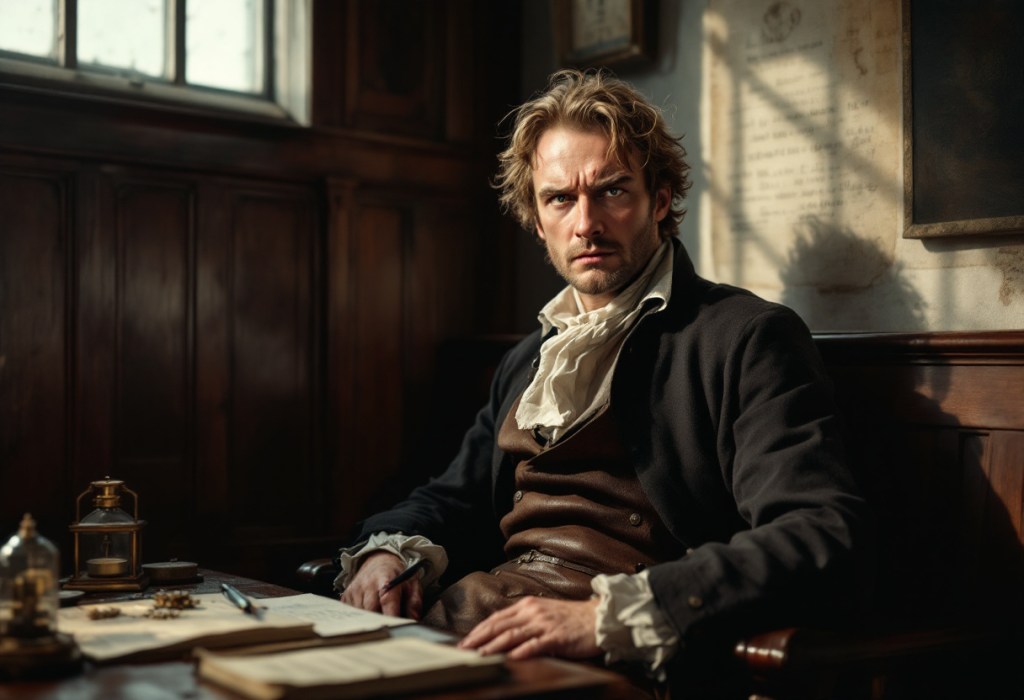
20th September 1765
I sit now in the shadowed pew of St. Bartholomew’s, the morning service concluded, yet my soul finds no rest in these hallowed stones. The Reverend’s discourse upon the perils of prideful inquiry doth ring still in mine ears, and I am sore vexed by his words. He speaketh of knowledge as though it were the very fruit that tempted our first parents, yet how can the Almighty have gifted us with such curious minds if He meant us not to employ them?
Mine hands are stained this day – not with honest earth or simple craft, but with the crimson evidence of my latest endeavour. The mechanism I have contrived to harness the electrical fluid did give me such a shock as to split the skin upon my knuckles, and the blood that flowed seemed a most fitting sacrifice upon the altar of natural philosophy. Yet what manner of blood-offering is acceptable? That of beasts upon the Temple mount, or that which flows from a man’s own labour in pursuit of understanding?
I am much troubled by thoughts of the colonists’ rebellion against His Majesty’s stamp duties. They cry out against taxation, yet do they not see that knowledge itself is taxed most heavily? Each discovery demands its tribute in toil, in sleepless nights, in the very essence of one’s being poured out like wine upon the ground. The learned men of London speak grandly of their experiments whilst I, in this provincial place, must beg leave of the parish for materials to pursue even the meanest investigations.
It came to me during the Psalm – the sixty-eighth, wherein David singeth of the God who rideth upon the heavens – what manner of collection of sacred songs doth most please mine ear? If I were to name my most cherished treasury of melody, it would be Tate and Brady’s metrical rendition of the Psalms, bound in that worn leather volume my father left me. When the congregation riseth to sing “O God, our help in ages past,” mine heart is lifted despite all earthly vexations. Yet even in this sacred music, I hear the mechanical principles of sound and vibration, the mathematical harmonies that speak of divine order – and this knowledge maketh the singing both more wondrous and more troubling to my conscience.
The sacrifice of our Saviour upon the Cross was perfect and complete, yet still we are called to offer up ourselves as living sacrifices. But what of the sacrifice of ignorance? Can it be righteous to remain willingly blind to the workings of Creation when such understanding might serve both God and man? The blood that stained my instruments today may be but a small libation compared to that which future generations shall spill in their quest for knowledge – yet I pray it be counted worthy in the sight of Heaven.
Lord, grant me wisdom to discern when curiosity serveth Thy glory, and when it doth lead toward that ancient pride which brought ruin upon our race.
Eighteenth-century Britain and its Atlantic empire faced fiscal strain and political unrest, culminating in the 1765 Stamp Act and colonial resistance that questioned parliamentary taxation without representation. Passed to help finance troops after the Seven Years’ War, the Act required revenue stamps on legal and commercial papers, newspapers, and playing cards, provoking boycotts, petitions, and riots across the colonies. The Stamp Act Congress met in New York in October 1765, articulating rights and grievances while urging repeal within a framework of loyal protest. Parliament repealed the Act in 1766 but simultaneously issued the Declaratory Act, asserting authority “in all cases whatsoever,” intensifying tensions that led toward the American Revolution.
Bob Lynn | © 2025 Vox Meditantis. All rights reserved. | 🌐 Translate

 Vox Meditantis
Leave a comment