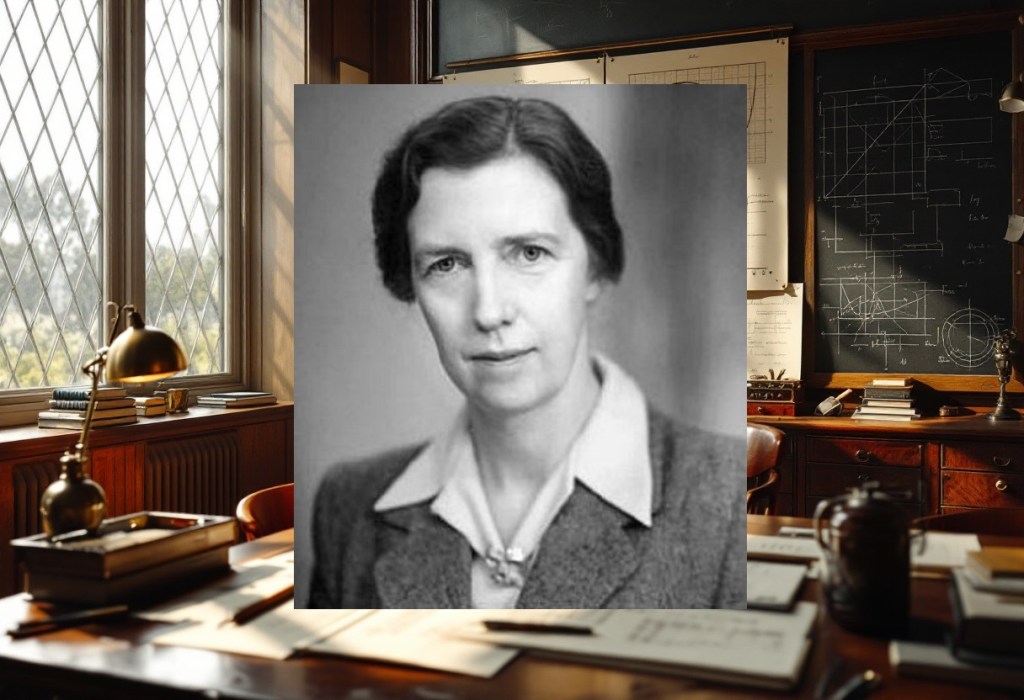
Dame Mary Lucy Cartwright (1900-1998) stands as one of mathematics’ most quietly revolutionary figures, a woman whose work laid the groundwork for chaos theory decades before the field gained recognition. Together with J.E. Littlewood, she investigated the strange behaviour of nonlinear differential equations in the 1940s, uncovering patterns that would later reshape our understanding of complex systems from weather patterns to market fluctuations. Her contributions to mathematical analysis and differential equations earned her the distinction of being the first woman mathematician elected to the Royal Society, though her greatest legacy may be the invisible scaffolding she built beneath modern chaos theory. In an era when women faced considerable barriers in academic mathematics, Cartwright’s story illuminates not only the foundations versus fame divide in scientific progress, but also the vital yet often unrecognised contributions that make breakthrough discoveries possible.
Dame Mary, thank you for joining us today. I’m speaking to you from 2025, where your work with Littlewood on nonlinear differential equations is now recognised as foundational to chaos theory. How does it feel to know that your 1940s research anticipated an entire field of modern science?
Well now, I do hope you’re not expecting me to claim I knew we were founding anything grand at the time. Johnny [Littlewood] and I were simply trying to sort out some rather stubborn equations the Radio Research Board had sent round. They were having trouble with their radar apparatus – curious oscillations that shouldn’t have been there according to the textbooks.
That 1938 memorandum from the Department of Scientific and Industrial Research changed the course of your career. What drew you to respond when others might have ignored it?
The thing was, I’d been working on van der Pol’s equation in my function theory research, so when the memorandum mentioned similar oscillatory behaviour, I thought, “Well, that’s rather interesting.” Most pure mathematicians wouldn’t have touched it with a ten-foot pole – applied problems were considered rather beneath us then. But I’ve always held that some of the most elegant mathematics emerges from the real world. Besides, it gave me an excuse to collaborate with Johnny, who was infinitely cleverer than I was at seeing the deeper structures.
You’re being modest. Can you walk us through what you and Littlewood discovered? For our readers familiar with differential equations, what made the forced van der Pol equation so remarkable?
Right. The equation we were studying was of the form ÿ – k(1-y²)ẏ + y = bλk cos(λt + a), where k is large. Now, van der Pol himself had studied the unforced version in the 1920s, but adding that sinusoidal forcing term with the right parameter values… what we found was that for certain ranges of the parameters b and λ, the solutions exhibited extraordinary behaviour. Instead of settling into simple periodic oscillations as one might expect, they displayed what we termed “an infinite number of unstable subharmonic solutions.” The phase portrait became tremendously complicated – solutions that started arbitrarily close together would diverge dramatically over time.
That sounds like what we now call sensitive dependence on initial conditions – the butterfly effect.
Butterfly effect – how wonderfully poetic. We were rather less romantic in our terminology. We simply noted that the solutions displayed “remarkable complexity” and that small changes in starting conditions led to “entirely different asymptotic behaviour.” Johnny was fascinated by the topology of it all – he could see we were dealing with something that had never been properly classified mathematically.
The key insight was recognising that if subharmonic solutions of different periods coexisted, as van der Pol and van der Mark had observed experimentally, then by Birkhoff’s earlier work on surface transformations, the dynamical system must contain what we’d now call a strange attractor.
Your 1945 preliminary paper caused quite a stir, didn’t it?
“Quite a stir” is generous. Most mathematicians ignored it entirely. Pure mathematicians thought it was too applied, applied mathematicians thought it was too abstract, and physicists didn’t know what to make of it. We published the full proofs twelve years later in Acta Mathematica – Johnny’s “monster paper,” as we called it. All 117 pages of dense analysis.
Freeman Dyson later wrote that when he heard you lecture in 1942, he could see the beauty of your work but not its importance. He said it took decades for the mathematical community to recognise what you’d achieved.
Freeman was quite honest about that, and I respected him for it. The trouble was, we’d stumbled onto something that didn’t fit into any existing mathematical category. It wasn’t classical mechanics, it wasn’t statistical mechanics, it wasn’t the sort of neat, tidy analysis that won prizes. We were describing deterministic systems that behaved unpredictably – a contradiction in terms according to the physics of the day.
Let’s talk about your path into mathematics. You grew up in a vicarage in Northamptonshire – how did the daughter of a country rector end up revolutionising mathematical physics?
Father was rector of St. Michael’s in Aynho. Rather a scholarly man himself, actually – he encouraged all his children to think carefully about problems. I was educated at home by governesses until I was eleven, then off to various boarding schools. Mathematics wasn’t my first love, mind you. I initially read classics at Oxford – thought I’d become a classicist.
What changed your mind?
A single lecture on mathematical analysis in my second year. The lecturer was demonstrating the concept of a limit, and suddenly I saw that mathematics possessed the same logical rigour as Latin grammar, but with infinitely more scope for discovery. Virgil’s verses were beautiful, but they were already written. In mathematics, there were theorems waiting to be proved, problems waiting to be solved.
And you made this switch despite being one of only a handful of women studying mathematics?
Well, one doesn’t choose one’s interests based on crowd sizes, does one? I was rather fortunate at St. Hugh’s – the atmosphere was supportive, if challenging. The real test came when I finished my degree in 1923. I was the first woman to achieve a first-class degree in the Mathematical Final Honours School, which was gratifying, but then what? Teaching was the expected path for women.
But you didn’t stay in teaching.
I taught for a few years – first at Alice Ottley School in Worcester, then at Wycombe Abbey. Perfectly good schools, dedicated pupils. But I kept solving mathematical problems in my spare time, rather like an addiction, I suppose. In 1928, I applied for a research fellowship at Cambridge. G.H. Hardy was willing to supervise my doctoral research, which was rather more generous than he needed to be.
Hardy famously argued that pure mathematics was useless – “real mathematics has no effect on war,” he wrote. Yet your work became crucial to Britain’s radar defence. How do you reconcile that?
Poor Hardy! He wrote that in 1940, just as Johnny and I were discovering that our “useless” pure mathematics was precisely what the Radio Research Board needed to understand their radar problems. The irony wasn’t lost on me, though I was far too polite to mention it to him directly.
The truth is, Hardy was both right and wrong. Pure mathematics is indeed beautiful in its own right and shouldn’t be judged solely on its applications. But the boundaries between pure and applied mathematics are far more porous than he’d have admitted. Some of the most elegant theoretical work emerges from practical problems, and some of the most practical solutions come from abstract theory.
During the war, you also packed parachutes for the Red Cross. You once said that felt more immediately useful than your mathematical work.
Absolutely. When you’re packing a parachute, you know exactly how your work will help someone – quite literally a matter of life and death. With the mathematical research, we were working on something that might or might not prove useful, and we wouldn’t know for years whether we’d been barking up the wrong tree entirely.
There was something wonderfully meditative about the parachute work as well. Precise, repetitive, essential – and it left one’s mind free to wander over mathematical problems. Some of my best insights came while my hands were busy with silk and cord.
You’ve mentioned Johnny Littlewood several times. What was that collaboration like?
Oh, Johnny was marvellous to work with. Completely unpretentious despite being one of the finest mathematical minds in Britain. He had this ability to see patterns where others saw only confusion. I’d bring him a messy calculation, and he’d immediately spot the underlying structure.
We had complementary strengths, I think. I was more methodical, better at the detailed analytical work. Johnny had this intuitive grasp of topology and dynamics that was quite extraordinary. He could look at a phase portrait and immediately understand what it meant geometrically. Together, we could tackle problems that would have stymied either of us alone.
There’s something I need to correct from the historical record. You’ve been described as the first woman elected to the Royal Society, but actually, you were the first woman mathematician. How important is that distinction?
It’s quite important, actually. Kathleen Lonsdale and Marjory Stephenson were elected in 1945, two years before me – both absolutely brilliant scientists. Kathleen’s work on crystallography was groundbreaking, and Marjory’s contributions to bacteriology were immense. I was simply the first from mathematics, which says more about mathematics’ resistance to women than about any special merit on my part.
Speaking of resistance – what barriers did you face as a woman in mathematics?
The barriers were rarely overt. No one posted signs saying “No Women Allowed.” It was more subtle – the assumptions that women couldn’t handle abstract reasoning, that we’d abandon mathematics for marriage, that we were taking places from “more deserving” men.
I remember one colleague suggesting that perhaps I’d be more comfortable in statistics, as it involved “less rigorous thinking.” Another wondered aloud whether women had the stamina for extended mathematical research. These weren’t malicious comments, exactly – they were simply reflections of how limited most people’s imagination was regarding women’s intellectual capabilities.
How did you respond to such attitudes?
With theorems. I found that a well-constructed proof was far more persuasive than any argument about women’s capabilities. Let the mathematics speak for itself, I thought. If the work was sound, eventually it would be recognised.
Looking back, perhaps I was too patient with such attitudes. But confrontation wasn’t my nature, and I genuinely believed that excellence would eventually overcome prejudice. It did, in my case, though it took rather longer than it should have.
You became Mistress of Girton College in 1949. What was it like to be in a position of institutional leadership?
Rather intimidating at first, I must admit. Girton was founded to prove that women could achieve the same intellectual standards as men, but by the 1940s, we were facing new challenges. The question wasn’t whether women could think – we’d settled that – but whether we could lead institutions, shape policy, influence the direction of education.
I tried to create an environment where young women could pursue any intellectual path that interested them, without feeling they had to justify their ambitions or apologise for their abilities. We had brilliant students in mathematics, physics, classics, history – I wanted them to feel that the world was genuinely open to them.
During your time at Girton, you continued publishing mathematical research well into the 1980s. What drove that persistence?
Pure stubbornness, I suspect. Once you’ve tasted the pleasure of discovering something new about how the universe works, it’s rather difficult to stop. Even administrative duties couldn’t completely distract me from mathematics.
I was particularly interested in continuing the work on differential equations, extending some of the techniques Johnny and I had developed. The field was evolving rapidly by the 1960s – computers were beginning to make certain calculations feasible that had been impossible by hand, and new theoretical frameworks were emerging.
Let me ask about a specific moment of self-reflection. Looking back at your career, is there anything you’d do differently or any mistakes you’d acknowledge?
I think I was too modest about our early chaos work. When other mathematicians began receiving credit for “discovering” dynamical systems theory in the 1960s and 70s, I said nothing. I thought the mathematics would speak for itself, that proper attribution would eventually sort itself out.
Perhaps I should have been more assertive about ensuring our contributions were recognised. Not for personal glory, mind you, but because it matters for the historical record – and particularly for young women entering mathematics. They need to see that women have always been part of the great discoveries, even when we weren’t initially credited.
Freeman Dyson mentioned receiving an “indignant letter” from you shortly before you passed away, scolding him for crediting you with more than you deserved. What was that about?
Oh dear, Freeman probably exaggerated my indignation. I simply wanted to correct the record where some well-meaning people were overstating my individual contributions. Mathematics isn’t a solo endeavour – it’s built through collaboration, correspondence, building on others’ work. I couldn’t bear the thought of being portrayed as some sort of solitary genius when the reality was much more collaborative.
Your work is now applied to weather prediction, market analysis, engineering control systems, even heartbeat monitoring. Did you ever imagine such diverse applications?
Never in my wildest dreams. When we were puzzling over those radar equations, we thought we were solving a rather narrow technical problem. The idea that the same mathematical principles would apply to stock markets and cardiac rhythms and atmospheric circulation… it’s quite humbling, actually.
It demonstrates something I’ve always believed: mathematics reveals deep patterns in nature that transcend the specific contexts where we first discover them. The equations don’t care whether they’re describing radio oscillations or population dynamics – the underlying structures are universal.
What advice would you give to young women entering STEM fields today, particularly those facing scepticism about their abilities?
First, trust your own judgment about your capabilities. Others may doubt you, but you know what you can achieve better than they do. Don’t let external scepticism become internal doubt.
Second, find problems that genuinely fascinate you. Mathematics can be difficult and frustrating – you need genuine intellectual curiosity to sustain you through the challenging periods. If you’re only doing it to prove a point about women’s abilities, you’ll burn out. Do it because the questions compel you.
Third, don’t underestimate the importance of collaboration. Some of my best work emerged from partnerships with colleagues who complemented my strengths and compensated for my weaknesses. Building relationships across the field is just as important as building technical expertise.
Finally, you’ve lived to see chaos theory become a major field of study, with applications across science and engineering. How do you want to be remembered?
I’d rather like to be remembered as someone who helped mathematics become a bit more inclusive, and who contributed a small piece to our understanding of how complex systems behave. If young mathematicians occasionally discover something useful by building on work Johnny and I did decades ago, that would be quite satisfying.
But honestly, I’ve never been particularly interested in how I’ll be remembered. The mathematics itself – the theorems, the insights, the connections between seemingly unrelated phenomena – that’s what matters. Individual recognition fades, but mathematical truth endures.
Dame Mary, thank you for this conversation. Your quiet revolution in mathematics has indeed endured, and continues to shape how we understand complex systems across countless fields.
Thank you. It’s been rather pleasant to reflect on it all. Now, if you’ll excuse me, I believe I have some differential equations waiting to be solved.
Letters and emails
Following our interview with Dame Mary Cartwright, we’ve received an overwhelming response from readers eager to explore more aspects of her remarkable life and groundbreaking contributions to mathematics. We’ve selected five letters and emails from our growing community who want to ask her more about her life, her work, and what she might say to those walking in her footsteps.
Lien Tran, 32, Data Scientist, Singapore
Dame Mary, you mentioned that computers in the 1960s began making certain calculations feasible that were impossible by hand. I’m curious about your computational methods in the 1940s – when you and Littlewood were mapping those complex phase portraits and tracking solution trajectories, what manual techniques did you use to visualise the behaviour of your equations? Did you develop any clever shortcuts or graphical methods that might still be useful for modern mathematicians trying to build intuition about nonlinear systems?
Oh my dear, what a splendid question! You’ve touched on something that still gives me nightmares when I think about those early calculations. People today simply cannot fathom the sheer tedium of tracking solution curves by hand, point by laborious point.
Johnny and I developed what we rather grandly called our “graphical artillery” – though it was hardly as sophisticated as that sounds. We used enormous sheets of graph paper, the sort you could spread across an entire table, with the finest grid markings we could obtain. For each initial condition, we’d compute the solution numerically using Euler’s method or the Runge-Kutta technique, calculating perhaps fifty or a hundred points along each trajectory. Frightfully slow work – a single solution curve might take an entire afternoon to plot properly.
The real trick was learning to spot patterns in the phase portraits. We’d pin dozens of these large sheets to the walls of my study, creating what looked rather like a mad mathematician’s wallpaper. Johnny had this marvellous ability to step back and see the forest for the trees – he’d walk along these walls of graphs, hands clasped behind his back, muttering things like “Aha! Look how that basin boundary twists there!”
We developed a sort of shorthand notation system for marking critical points, periodic orbits, and regions where solutions seemed to behave chaotically. Little symbols scattered across our graphs like a secret code. I kept detailed logbooks – columns and columns of initial conditions, parameter values, and notes about the resulting behaviour.
One technique that proved invaluable was what we called “stroboscopic sampling.” Rather than plotting continuous trajectories, we’d mark only the points where a solution crossed a particular plane in phase space – rather like photographing a spinning wheel with a flash that fires at regular intervals. This reduced the visual clutter enormously and helped reveal the underlying geometric structures.
The most frustrating part was checking our work. With no mechanical calculators worth mentioning, arithmetic errors were constant companions. We’d often spend days tracking down a discrepancy, only to discover I’d misplaced a decimal point somewhere in the calculations.
I must say, your modern computational tools would have saved us years of drudgery. But there’s something to be said for the intimacy you develop with equations when you’ve computed every point by hand – you begin to sense their personality, if I may put it that way. The computer gives you the answer, but the hand calculation teaches you to think like the equation itself.
Andrés Gutiérrez, 28, Physics PhD Student, São Paulo, Brazil
What if the Radio Research Board hadn’t sent out that memorandum about radar oscillations in 1938? Do you think you would have eventually discovered the same chaotic phenomena through your pure mathematics research on function theory, or was that practical engineering problem truly essential for pointing you toward the behaviours that became chaos theory? I wonder whether pure mathematics alone would have led you down this path.
What a fascinating speculation, young man! You’ve hit upon something that’s troubled me for decades, actually. Would we have stumbled onto chaos without that blessed memorandum from the Radio Research Board?
The honest answer is… I rather doubt it. You see, my original interest in van der Pol’s equation was purely theoretical – I was investigating certain properties of entire functions, following work that Nevanlinna had done in the 1920s. The unforced van der Pol equation was simply a convenient example for testing some ideas about the growth of solutions. Perfectly respectable mathematics, but hardly earth-shattering.
Without that practical prod from the radio engineers, I suspect I’d have published a tidy little paper on function theory and moved on to other problems. The forced equation – with that sinusoidal driving term – that’s what opened Pandora’s box, so to speak. And I wouldn’t have had any reason to consider forcing if the engineers hadn’t been tearing their hair out over those peculiar radar oscillations.
But here’s the curious thing: once Johnny and I began working together on the problem, we realised that similar phenomena were lurking everywhere in the mathematical literature, just waiting to be recognised. Birkhoff’s work on surface transformations, Poincaré’s studies of celestial mechanics, even some of the peculiar behaviours that meteorologists had noticed in their weather models. The pieces were scattered about, but no one had assembled the jigsaw puzzle.
So perhaps someone else would have eventually connected these dots. Poincaré himself came remarkably close in his studies of the three-body problem – he saw the possibility of what he called “homoclinic tangles,” though he rather recoiled from their implications. If he’d pursued that line of inquiry more boldly…
The war certainly accelerated everything. Suddenly, practical problems that had been beneath the notice of pure mathematicians became matters of national importance. Radar, ballistics, cryptography – all requiring sophisticated mathematical analysis. It created an atmosphere where the boundaries between pure and applied mathematics became rather more porous.
I think the fundamental insights would have emerged eventually, but perhaps twenty or thirty years later, and possibly from the physics community rather than from mathematicians. Someone working on plasma physics or nonlinear optics might have encountered similar phenomena and recognised their significance.
What’s rather poetic about the whole business is that our “useless” pure mathematics proved essential for Britain’s defence, whilst solving practical engineering problems led us to some of the most abstract and beautiful mathematical structures imaginable.
Nomsa Khumalo, 45, Mathematics Professor, Cape Town, South Africa
You spoke about being ‘too modest’ regarding recognition for your early chaos work. As someone who now mentors young women in mathematics across Africa, I’m struck by how this pattern of undervaluing our contributions persists globally. Beyond individual recognition, how do you think mathematical institutions could have better supported collaborative discoveries like yours and Littlewood’s? What structural changes might have ensured that partnership-based breakthroughs receive proper historical credit?
Professor Khumalo, your question strikes right to the heart of something that troubled me throughout my career, and clearly troubles you still. How I wish I could report that we’d solved these problems by now, but it seems the pattern of undervaluing collaborative work – particularly when women are involved – persists across continents.
The mathematical establishment of my era was frightfully hidebound about recognition. Individual genius was celebrated; collaboration was viewed with suspicion, as though sharing credit somehow diminished the achievement. When Johnny and I published our chaos work, reviewers kept trying to parse out who had contributed what, as if mathematics were a matter of personal property rather than collective understanding.
The Royal Society, bless them, did eventually recognise my work, but it took considerable lobbying behind the scenes. G.H. Hardy, despite his occasional blindness about women’s capabilities, proved instrumental in ensuring I received proper consideration. But one shouldn’t need a champion of Hardy’s stature to secure recognition for solid mathematical work.
I think institutions could have adopted several practices that would have helped enormously. First, joint publication should carry equal weight with solo work in promotion decisions. Too often, collaborative papers were viewed as “lesser” achievements, discouraging the very partnerships that produce breakthrough discoveries.
Second, learned societies might have established clearer protocols for crediting collaborative work. When Stephen Smale began receiving accolades for dynamical systems theory in the 1960s, no one bothered to mention that Johnny and I had laid much of the groundwork twenty years earlier. A proper historical accounting might have prevented such oversights.
Third – and this is crucial for your work mentoring young women – mathematical departments could have created more opportunities for cross-generational collaboration. Too often, senior mathematicians worked in isolation, whilst junior researchers struggled alone with problems that might have benefited from experienced guidance.
The Cambridge system, for all its faults, did foster some genuine intellectual partnerships. But it was frightfully informal – success depended entirely on personality matches and chance encounters. A more structured approach to facilitating collaboration might have prevented talented mathematicians from working in isolation.
What gives me hope is hearing about your mentoring work across Africa. Building networks of support, ensuring that contributions are properly documented and credited, creating opportunities for meaningful collaboration – these are precisely the institutional changes we needed decades ago.
The mathematics itself doesn’t care about nationality or gender, but mathematical institutions certainly do. Changing those institutions remains the great unfinished business of our profession.
Emil Fischer, 38, Chaos Theory Researcher, Vienna, Austria
Dame Mary, you described your collaboration with Littlewood as combining your methodical analytical approach with his intuitive grasp of topology and dynamics. In chaos theory today, we often use sophisticated computational tools and visualisation software, but I suspect we might be losing some of that geometric intuition you both possessed. How important do you think it is for modern chaos theorists to develop that kind of visual, intuitive understanding of dynamical systems alongside our computational methods?
Dr. Fischer, you’ve touched upon something that rather worries me about the modern direction of chaos theory. I fear we may indeed be losing something essential in our rush towards computational sophistication.
You see, Johnny possessed what I can only describe as a geometric soul. He could look at a differential equation and immediately visualise how its solutions would behave in phase space – not through calculation, but through some deep intuitive grasp of topology. When we were puzzling over those peculiar van der Pol trajectories, he’d sketch rough diagrams on the backs of envelopes, showing me how the flow must twist and fold to produce the observed behaviour.
I remember one afternoon when we were particularly stuck on understanding the structure of our strange attractor. Johnny stood at the blackboard, drew a few seemingly random curves, and announced, “The solutions must do something like this.” It looked like complete nonsense to me at first – just a tangle of lines. But when we finally computed enough trajectories to verify his intuition months later, his sketch proved remarkably accurate.
This kind of geometric insight can’t be replaced by computer visualisations, no matter how sophisticated. The machine shows you what happens, but it doesn’t teach you why it happens. Johnny could predict the behaviour of solutions in parameter regions we’d never explored, simply by understanding the underlying geometric constraints.
I think the key is what Poincaré called “mathematical intuition” – the ability to see patterns and structures before you can prove they exist. This develops only through intimate familiarity with specific examples, working through calculations by hand until you begin to think like the equations themselves.
My advice to modern chaos theorists would be this: before you run your magnificent computer simulations, spend time with simple examples. Plot trajectories by hand. Draw phase portraits on paper. Study the classical cases – the pendulum, the van der Pol oscillator, the Lorenz equations – until you can predict their behaviour without calculation.
Computational tools are marvellous servants but terrible masters. They can explore parameter spaces we could never reach by hand, reveal structures too complex for manual analysis. But they shouldn’t replace the geometric intuition that comes from wrestling directly with the mathematics.
The most profound insights in chaos theory have always come from mathematicians who combined computational power with deep geometric understanding. Smale’s horseshoe construction, for instance, emerged from his topological intuition about how stretching and folding create complex dynamics.
Don’t let the computers do all your thinking for you, young man.
Savannah Mitchell, 26, Climate Modelling Researcher, Toronto, Canada
It’s fascinating that your work now underpins climate models, which are crucial for understanding global warming – something completely unimaginable in your era. I’m wondering about the philosophical implications: when you’re working on abstract mathematical problems, how do you balance the excitement of pure discovery with the responsibility that comes when your work eventually influences major societal decisions? Do mathematicians have an ethical obligation to consider potential applications?
Miss Mitchell, your question about climate modelling rather takes my breath away. To think that our little excursion into nonlinear differential equations might influence decisions about the very future of the planet… it’s both thrilling and deeply sobering.
In my era, we had the luxury of working on mathematics for its own sake, largely insulated from immediate consequences. When Johnny and I were puzzling over those radar equations, the worst that could happen was that some wireless sets might malfunction. We certainly weren’t contemplating the fate of polar ice caps or entire island nations.
But you’ve raised a profound question about mathematical responsibility that I’ve wrestled with considerably, particularly after witnessing how our theoretical work contributed to radar development during the war. There’s something rather unsettling about discovering that your abstract musings might determine whether aeroplanes find their targets or whether storms can be predicted accurately.
I think mathematicians do bear a certain ethical obligation, though perhaps not in the way you might expect. Our primary duty is to the mathematics itself – to ensure our proofs are sound, our calculations accurate, our reasoning rigorous. Once we release mathematical tools into the world, we cannot control how others employ them, but we can jolly well make certain those tools are reliable.
The real ethical challenge lies in communication. When climate scientists use our chaos theory to model atmospheric behaviour, they’re building upon mathematical foundations that most policymakers couldn’t possibly understand. We mathematicians have a responsibility to explain our work’s limitations clearly – where the models are robust, where they’re speculative, what the uncertainties mean in practical terms.
I’ve watched with some alarm as mathematical models have become almost mystical objects in public discourse. Politicians cite them as absolute truth or dismiss them as complete fiction, rarely understanding that the reality lies somewhere between. We must resist both the temptation to oversell our results and the tendency to retreat into pure abstraction when practical applications become controversial.
Perhaps the most important ethical principle is humility. Mathematics reveals patterns in nature, but nature remains far more complex than our equations can capture. Climate models based on chaos theory can illuminate possibilities and probabilities, but they cannot predict the future with absolute certainty.
What excites me about your generation is that you’re grappling with these ethical questions from the outset of your careers. In my day, we rather stumbled into applications after the fact. You have the opportunity to build responsibility into the very foundations of your mathematical work.
That’s a tremendous privilege, and an enormous responsibility.
Reflection
Dame Mary Lucy Cartwright passed away on 3rd April 1998, at the remarkable age of 97, having witnessed chaos theory evolve from an obscure mathematical curiosity into a cornerstone of modern science. Through our conversation, several striking themes emerged that illuminate both her era’s constraints and her extraordinary resilience within them.
Perhaps most powerfully, Cartwright’s reflections revealed the profound gap between mathematical discovery and recognition. Her admission of being “too modest” about early chaos work resonates with countless women whose contributions have been minimised or overlooked entirely. The historical record often portrays her collaboration with Littlewood as secondary to his genius, yet her own account suggests a far more equal partnership – one where her methodical precision complemented his intuitive leaps.
What differs most sharply from standard biographies is Cartwright’s emphasis on the accidental nature of breakthrough discoveries. Rather than the narrative of inevitable progress, she presents a more honest picture: brilliant minds stumbling onto revolutionary insights while solving mundane engineering problems. Her characterisation of their “monster paper” as largely ignored for decades challenges romanticised notions of immediate scientific recognition.
The historical record remains frustratingly incomplete regarding the precise dynamics of mathematical collaboration in her era. How many other women’s contributions were absorbed into their male colleagues’ legacies? How many foundational discoveries emerged from informal partnerships that formal academic structures failed to document properly?
Today’s challenges in mathematics – from climate modelling to artificial intelligence – still grapple with the nonlinear phenomena Cartwright first mapped. Modern chaos theorists like Edward Lorenz, Mitchell Feigenbaum, and Benoit Mandelbrot built directly upon her foundational work, though she remained characteristically modest about this lineage.
Cartwright’s story offers both inspiration and warning. Her mathematical legacy endures precisely because she prioritised rigorous truth over recognition. Yet her experience reminds us that excellence alone cannot overcome institutional barriers – we must actively work to ensure that today’s hidden figures don’t remain hidden for posterity.
Who have we missed?
This series is all about recovering the voices history left behind – and I’d love your help finding the next one. If there’s a woman in STEM you think deserves to be interviewed in this way – whether a forgotten inventor, unsung technician, or overlooked researcher – please share her story.
Email me at voxmeditantis@gmail.com or leave a comment below with your suggestion – even just a name is a great start. Let’s keep uncovering the women who shaped science and innovation, one conversation at a time.
Editorial Note: This interview represents a dramatised reconstruction based on extensive historical research into Dame Mary Cartwright‘s life, work, and documented statements. While grounded in factual sources including her published papers, biographical accounts, and recorded observations from colleagues, the conversational format and specific responses are imaginative interpretations designed to illuminate her contributions to mathematics and the broader themes of her era. Direct quotes and technical details have been carefully researched for accuracy, but readers should understand this as a creative exploration of historical themes rather than a verbatim transcript. The goal is to honour Cartwright’s legacy while making her remarkable story accessible to contemporary audiences.
Bob Lynn | © 2025 Vox Meditantis. All rights reserved. | 🌐 Translate

 Vox Meditantis
Leave a comment