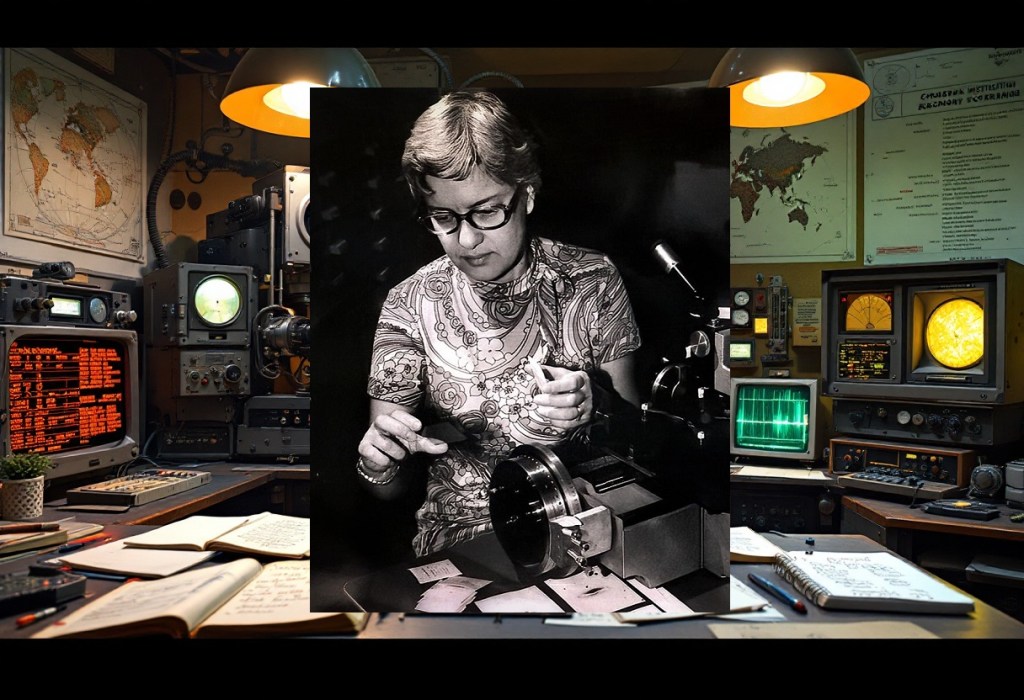
Vera Cooper Rubin (1928–2016) transformed our understanding of the cosmos by revealing that most of the universe consists of something we cannot see. Her meticulous observations of galaxy rotation curves in the 1970s provided the most compelling evidence for dark matter, fundamentally reshaping cosmology and physics. Despite facing exclusion from graduate programmes and observatories because of her gender, Rubin persevered to become one of the most influential astronomers of the 20th century.
Today, on this September evening in 2025, we sit in her former office at the Carnegie Institution in Washington DC, surrounded by decades of observational data and photographs from the world’s great telescopes. The space feels alive with scientific curiosity – bookshelves packed with journals, star charts pinned to walls, and that characteristic precision that marked her extraordinary career.
Dr. Rubin, thank you for joining us today. Looking back at your career from 2025, dark matter research has exploded – we now have dedicated detectors, satellite missions, and the Vera Rubin Observatory itself will soon begin operations. When you first saw those flat rotation curves in the 1970s, did you anticipate this revolution?
Not at all! When Kent [Ford] and I were staring at those punch-card readouts from Andromeda, we thought we’d made an error somewhere. You have to understand – we expected to see nice, declining curves following Kepler’s laws. The outer stars should have been crawling along like Neptune compared to Mercury. But there they were, racing around as fast as the inner stars. My first thought was: “There must be some mechanism for speeding up stars that move too slowly.”
Let’s go back to your childhood in Washington DC. You’ve mentioned watching stars from your bedroom window at age ten. What sparked that initial fascination?
Pure wonder, really. We’d moved from Philadelphia when I was ten, and my new bedroom window faced north. I’d lie there watching the stars wheel across the sky, making little sketches of their paths. My father – bless him – saw my interest and helped me build a telescope from a cardboard mailing tube and lenses from Edmund Scientific. Cost about six dollars. That telescope opened up the moon’s craters, Jupiter’s moons, Saturn’s rings. I was completely hooked.
My parents never suggested this wasn’t suitable for a girl. My mother would even defend my photographs when the chemist at the corner shop insisted the streaks of light were printing errors! She’d say firmly: “No, these are star trails. My daughter took them.”
You attended Vassar specifically because it was one of the few places where women could study astronomy.
Precisely. I’d heard about Maria Mitchell – the first American woman professional astronomer – who’d worked at Vassar’s observatory. That connection mattered enormously. When I graduated in 1948, I was the only astronomy major that year. The only one!
I’d applied to Princeton for graduate school, but they didn’t even send me their catalogue. Women weren’t permitted in their astronomy programme until 1975. Can you imagine? So I went to Cornell to be with Bob [Robert Rubin, her husband], and it turned out to be brilliant. The physics department was extraordinary – Philip Morrison, Richard Feynman, Hans Bethe. I felt like I was drinking from a firehose of knowledge.
Tell us about that pivotal collaboration with Kent Ford and the image tube spectrograph.
Meeting Kent in 1965 at Carnegie was serendipitous. He’d developed this remarkable instrument – an image tube spectrograph that increased the sensitivity of photographic detectors by more than tenfold. Before Kent’s innovation, measuring stellar velocities in distant galaxies was nearly impossible with existing technology.
The spectrograph worked by cascading photons through multiple image intensifier tubes. Light from a star would hit the photocathode of the first tube, releasing electrons proportional to the photon flux. These electrons were accelerated and focused onto a phosphor screen, creating a brighter image. This process repeated through several stages, achieving gains of 10,000 or more whilst maintaining spectral resolution of about 10 Angstroms per millimetre.
We’d attach it to the 2.1-metre telescope at Kitt Peak, typically working at the Hγ line at 4340 Angstroms. The key was measuring Doppler shifts accurate to about 10-15 kilometres per second. With conventional photography, you’d need exposure times of hours for galaxies like Andromeda. With Kent’s instrument, we could get usable spectra in 45 minutes to an hour.
Walk us through those crucial observations of Andromeda’s rotation curve.
This was around 1968-1970. We’d take spectra at different radii along the galaxy’s major axis, measuring the velocity of hydrogen gas in star-forming regions. The technique involved comparing the observed wavelength of spectral lines to their rest wavelengths – that’s how we calculated the rotational velocity at each distance from the galactic centre.
For a typical galaxy following Newtonian dynamics, you’d expect the rotation curve to rise sharply near the centre where most stars are concentrated, then decline as you move outward – just like planets orbiting the sun. The mathematics are straightforward: if most mass is centrally concentrated, then v ∝ r^(-1/2) at large radii.
But galaxy after galaxy showed the same pattern: the rotation curve would rise initially, then flatten out at roughly 200-300 kilometres per second, remaining essentially constant out to the limits of our observations. This was completely unexpected.
How did the astronomical community initially react to your findings?
There was scepticism, naturally. Some colleagues suggested we were seeing systematic errors – perhaps our spectrograph wasn’t calibrated properly, or we were misinterpreting the data. Others proposed exotic astrophysical explanations: maybe magnetic fields were somehow supporting the outer regions, or perhaps there were streaming motions we didn’t understand.
The breakthrough came when we expanded our survey. Between 1976 and 1985, Kent and I observed rotation curves for over 60 spiral galaxies. The flat curves appeared universal. Even more compelling, radio astronomers using the 21-centimetre hydrogen line were getting identical results. When multiple, independent techniques yield the same answer, you start believing the universe is trying to tell you something.
Let’s address something you’ve acknowledged – the term “dark matter” wasn’t even yours.
Exactly! Fritz Zwicky had coined the term “Dunkle Materie” back in 1933 when studying the Coma cluster. Our contribution was providing the systematic observational evidence that made dark matter impossible to ignore. We showed it wasn’t just an exotic phenomenon in distant galaxy clusters – it was everywhere, in every galaxy we observed.
I should emphasise: we remained quite agnostic about what this missing mass actually was. Our observations told us there was roughly five to ten times more gravitating matter than we could see in stars and gas. Whether that was exotic particles, brown dwarf stars, black holes, or something else entirely – that wasn’t our call to make.
You’ve mentioned facing institutional barriers. How did you deal with the discrimination?
You learn to be persistent without being strident, confident without being arrogant. When I became the first woman officially permitted to observe at Palomar in 1965, there was the infamous bathroom situation – only men’s facilities existed. I simply taped a paper skirt to the door and declared we now had a ladies’ room. Problem solved.
But the deeper barriers were more insidious. Having your research ignored or dismissed because of who you were rather than its quality. Being excluded from conferences or social networks where real scientific discussions happened. I had colleagues who’d present my ideas at meetings as if they were their own insights.
The key was having allies – my parents, my husband Bob, mentors like George Gamow at Georgetown. And producing work so careful, so systematic, so undeniable that it couldn’t be ignored.
Looking at current dark matter research, what excites you most?
The sophisticated detection experiments fascinate me – trying to catch individual dark matter particles in underground laboratories. That’s a level of precision we never imagined possible. The Large Hadron Collider attempting to create dark matter particles, the Hubble and James Webb telescopes mapping dark matter through gravitational lensing – it’s remarkable.
But I’m equally intrigued by the alternative theories that have emerged. Modified Newtonian Dynamics – MOND – does explain galaxy rotation curves rather elegantly without invoking new particles. I’ve always believed we should remain open to different explanations until the evidence becomes overwhelming.
Any self-criticism about your approach or conclusions?
Oh, plenty! I probably focused too narrowly on spiral galaxies initially. We might have made faster progress by studying elliptical galaxies and galaxy clusters simultaneously. I was also perhaps too cautious about speculating on the nature of dark matter – sometimes bold theoretical leaps are necessary to guide future observations.
And honestly? I underestimated how long it would take to directly detect dark matter particles. In the 1980s, I thought we’d have definitive answers within a decade or two. The universe is more subtle than we anticipated.
What would you say to young women entering STEM fields today?
First: you belong here. Don’t let anyone suggest otherwise. Second: be prepared to work twice as hard to get half the recognition – that’s still unfortunately true. Third: find your allies and mentors, but also be ready to stand alone when necessary.
Most importantly: fall in love with the questions, not the answers. The universe is vast and strange and wonderful. There are mysteries we haven’t even discovered yet. Your job is to push at the boundaries of knowledge and see what pushes back.
And remember – astronomy is fundamentally optimistic. Every time we point a telescope at the sky, we’re declaring that the universe is comprehensible, that human minds can understand cosmic truths. That’s a profound act of faith and curiosity.
Any final thoughts on your legacy?
I hope I’m remembered not just for dark matter, but for opening doors – literally and figuratively. When I taped that paper skirt to the bathroom door at Palomar, I was saying: “We won’t accept artificial barriers to knowledge.” When young women see the Vera Rubin Observatory making discoveries, I hope they think: “If she could do that, so can I.”
Science progresses because each generation builds on the previous one’s work. Dark matter research will continue long after all of us are gone. Perhaps someone reading this conversation will be the one to finally solve the mystery. Now that would make an old astronomer very happy indeed.
Letters and emails
Following our conversation with Dr. Rubin, we’ve received hundreds of thoughtful responses from readers around the world, eager to explore aspects of her remarkable journey that we didn’t have time to cover. We’ve selected five particularly compelling letters and emails from our growing community – spanning five continents – whose questions probe deeper into her technical innovations, philosophical approach to science, and the personal resilience that sustained her through decades of groundbreaking research.
Amira Saleh, 34, Science Policy Researcher, Cairo, Egypt:
Dr. Rubin, I’m fascinated by the technical limitations you faced with photographic spectroscopy in the 1970s. Today’s CCD detectors achieve quantum efficiencies above 90%, but your image tube spectrograph was revolutionary for its time at just 10% efficiency. Could you walk us through the specific technical compromises you had to make – perhaps the trade-offs between spectral resolution, exposure time, and signal-to-noise ratios – and how those constraints actually shaped your observational strategy for mapping galaxy rotation curves?
Oh my, Amira! You’ve really done your homework – I’m impressed you understand the quantum efficiency numbers so precisely. You know, back in the late sixties when Kent and I were facing these technical challenges, we didn’t have the luxury of knowing exactly what we were up against.
Let me tell you about those trade-offs, because they were really the heart of everything we accomplished. Kent’s image tube spectrograph – bless that contraption – gave us roughly ten percent quantum efficiency, which sounds pitiful by today’s standards, but goodness, it was revolutionary for us. Before Kent’s innovation, we were stuck with straight photographic plates that captured maybe one or two percent of the photons hitting them. One or two percent! Can you imagine trying to measure stellar velocities in the outer regions of Andromega with that?
The real trick was balancing our observing strategy around these limitations. We typically worked at the hydrogen-gamma line – 4340 Angstroms – because it was strong and relatively free of contamination. But here’s the rub: to get decent signal-to-noise ratios, we needed exposure times of 45 minutes to over an hour per spectrum, and that was with the 2.1-meter telescope at Kitt Peak. With conventional photography, we would have needed all night for a single decent spectrum.
The spectral resolution was another beast entirely. We were getting about 10 Angstroms per millimeter on our plates, which meant we could measure velocities to roughly 10-15 kilometers per second if we were very careful with our calibrations. That doesn’t sound like much precision, but it was absolutely adequate for what we were after – those rotation curves showed velocity differences of 50-100 kilometers per second between different radii.
Now here’s what really drove our observational strategy: we realised early on that we couldn’t afford to waste a single photon. So instead of trying to map entire galaxies in one go, we’d take spectra along the major axis at specific position angles, building up our rotation curves point by point. It was painstaking work, but it forced us to be incredibly methodical about our approach.
The cascaded image tubes – that was Kent’s real genius. Each stage amplified the signal by factors of several hundred, so when you strung three or four together, you got those gains of 10,000 or more. But they weren’t perfect amplifiers. Each stage added its own noise and distortions, so there was this constant balance between sensitivity and image quality.
You mention modern CCDs achieving 90 percent efficiency – that’s just remarkable! But you know what? I sometimes wonder if having all that sensitivity might have made us less careful observers. When every photon is precious, you pay attention to systematic errors in ways that abundant data might not demand.
Mason Wright, 29, Graduate Student in Astrophysics, Vancouver, Canada:
What if the Palomar Observatory had welcomed women observers from the beginning, rather than you becoming the first in 1965? Do you think the flat rotation curve discovery might have happened years earlier with a more inclusive astronomical community, or were the technological developments – like Kent Ford’s spectrograph – the true limiting factor in timing this breakthrough?
Well now, Mason, that’s a fascinating “what if” to ponder! You know, I’ve thought about this quite a bit over the years. The truth is, I suspect the timing would have been roughly the same, even with a more welcoming astronomical community.
Here’s the thing: the real bottleneck wasn’t discrimination, as much as that pains me to say. It was the technology. When I first applied to observe at Palomar in 1963 – that infamous application form with “Due to limited facilities, it is not possible to accept applications from women,” with someone adding “usually” in pencil – we simply didn’t have the instruments capable of detecting those faint stellar velocities in galaxy outskirts.
You see, Jan Oort had been measuring stellar motions in our own galaxy since the late twenties, and Francis Pease had looked at Andromeda’s central rotation clear back in 1918. But measuring velocities in the outer regions where the dark matter signature shows up? That required Kent Ford’s image tube spectrograph, which he didn’t perfect until the mid-sixties.
Let me put this in perspective: before Kent’s instrument, we were working with straight photographic plates that captured maybe one or two percent of the light hitting them. One percent! Even if every observatory had welcomed women with open arms from day one, we couldn’t have done the crucial observations until we had detectors sensitive enough to measure 21-centimeter hydrogen emission or optical spectra from those dim outer stellar regions.
The radio astronomers actually beat us to some of these discoveries. Morton Roberts and his colleagues were seeing flat rotation curves in the early seventies using Arecibo, and Albert Bosma’s thesis work around 1978 covered twenty-five galaxies with radio observations. They had the advantage because hydrogen gas emits that lovely 21-centimeter line naturally – no fancy image tubes required, just big radio dishes and patience.
Now, would a more inclusive environment have helped? Absolutely! More minds working on the problem, more observers with different perspectives, more people asking “What if these curves don’t decline the way we expect?” I think about women like Margaret Burbidge, who had to sneak onto Mount Wilson as her husband’s unofficial assistant in 1955. She was brilliant – if she’d had proper access to telescopes and funding from the get-go, who knows what she might have discovered?
But here’s what really gets me: the barriers weren’t just about bathrooms and housing, though those were real enough. The deeper problem was that women weren’t part of the informal networks where ideas got shared. We weren’t invited to those late-night discussions over dinner at Palomar, weren’t included in the casual conversations where somebody might say, “Hey, did you notice something funny about that rotation curve?”
So yes, I think a more welcoming community would have accelerated the discovery process, but probably by a few years at most. The real breakthrough came when Kent’s spectrograph met systematic observational programs in the early seventies. That combination of technology and tenacity – that’s what cracked the dark matter puzzle wide open.
Ivana Marković, 42, Philosophy of Science Professor, Belgrade, Serbia:
Your approach to dark matter seems remarkably humble – you consistently emphasised that you’d found evidence for ‘missing mass’ rather than claiming to have discovered exotic particles. Given today’s massive underground detectors and particle accelerators searching for WIMPs, do you ever worry that the physics community became too committed to the particle interpretation of your observations? What would you say to critics who argue we should have pursued modified gravity theories like MOND more seriously before investing billions in direct detection experiments?
Ivana, what a thoughtful question! You’ve really put your finger on something that’s troubled me for years. You know, when we first started seeing those flat rotation curves back in the early seventies, Kent and I were very careful about our language. We’d talk about “missing mass” or “non-luminous matter” – we never claimed to know what the stuff actually was.
I think the physics community did get rather carried away with the particle interpretation, and yes, I do worry about that sometimes. Don’t get me wrong – the underground detectors and the work at places like the Large Hadron Collider represent remarkable technical achievements. But when I see billions of dollars going into WIMP searches that keep coming up empty, I wonder if we’ve painted ourselves into a corner.
You mention Mordehai Milgrom’s MOND theory, and I have to say, his work deserves more serious attention than it’s received. When Mordehai first published those papers in 1983 – goodness, the astronomical community practically laughed him out of the room! But his predictions about galaxy rotation curves are quite elegant, and some of his other forecasts have held up remarkably well.
The trouble is, MOND challenges some very fundamental assumptions about how gravity works, and that makes people uncomfortable. It’s much easier to accept that there’s invisible matter out there than to consider that Newton’s laws might need modification. But you know what? That’s exactly the kind of thinking that held up acceptance of continental drift for decades.
I’ve always believed that science progresses best when we maintain what I call “informed agnosticism.” Our observations told us there was roughly five to ten times more gravitating matter in galaxies than we could see in stars and gas. That’s a fact. But jumping from that observation to “therefore, exotic particles must exist” – that’s a hypothesis, not a conclusion.
Here’s what really concerns me: I see young graduate students today who’ve been taught that dark matter particles are practically a given. They’re not encouraged to question the fundamental assumption. When I was coming up in the fifties and sixties, George Gamow used to tell us: “The most important thing in science is to remain curious about your assumptions.” That wisdom seems to have gotten lost somewhere.
The billions invested in direct detection experiments might have been better spent on more diverse approaches – better telescopes, more comprehensive sky surveys, theoretical work on alternative gravity theories. We’ve essentially bet the house on one interpretation of our data.
Now, I’m not saying particle dark matter is wrong – the evidence from gravitational lensing and the cosmic microwave background is quite compelling in some respects. But I worry we’ve become too committed to a single explanation before we’ve exhausted the alternatives. Science works best when we’re pursuing multiple lines of inquiry simultaneously, not when we’re all marching in the same direction.
You know, there’s a wonderful humility in saying “We don’t know what this is yet.” That’s not defeat – it’s the beginning of discovery. But somewhere along the way, the field decided it was more important to have an answer than to have the right answer.
Kenji Sakamoto, 37, Science Journalist, Tokyo, Japan:
Dr. Rubin, you’ve mentioned staying curious about the fundamental questions rather than becoming attached to specific answers. The Vera Rubin Observatory will soon generate more astronomical data than has been collected in all of history – roughly 20 terabytes per night. How do you think this unprecedented data deluge might change the nature of astronomical discovery itself? Are we at risk of losing the kind of patient, methodical observation that characterised your generation’s approach to cosmic mysteries?
Oh my, Kenji! Twenty terabytes per night – that’s just staggering when you think about it. You know, when Kent and I were working in the seventies and early eighties, we’d come back from a week-long observing run at Kitt Peak or Palomar with maybe a dozen photographic plates. Each plate represented hours of painstaking exposure, and it might take us months to extract the spectral measurements by hand.
The scale you’re describing is almost beyond comprehension. We used to joke that astronomy moved at the speed of graduate students with magnifying glasses, poring over individual spectra to measure Doppler shifts. Now you’re talking about automated detection and classification of billions of objects each night!
But here’s what worries me about this data deluge: I’m afraid we might lose something essential in the process. The careful, methodical approach that characterised our generation wasn’t just about making do with limited technology – it forced us to really understand our instruments, to know every systematic error, every potential source of bias.
When you’re working with a single spectrum that took you an hour to acquire, you scrutinise every detail. You notice when the hydrogen lines look a bit peculiar, or when there’s an unexpected feature in the continuum. Those little anomalies often lead to the biggest discoveries. But when you’re processing twenty billion objects automatically, how do you maintain that level of intimate familiarity with your data?
Don’t get me wrong – I’m tremendously excited about what the Rubin Observatory will accomplish. The ability to map the entire visible sky every few nights, to catch transients in real time, to study dark matter halos on scales we could never imagine – it’s revolutionary! And the democratisation of astronomy data, making it available to researchers worldwide, that’s wonderful.
But I think there’s a real danger that young astronomers might become too removed from their observations. In my day, you had to understand your spectrograph intimately – every optical element, every potential systematic effect. You knew your telescope’s quirks, its tracking errors, its optical distortions. That hands-on knowledge was crucial to interpreting your results correctly.
With machine learning algorithms doing the heavy lifting, there’s a temptation to treat the data as a black box. “The algorithm says this object is a quasar with 95 percent confidence” – but do you understand why? Can you recognise when the algorithm is wrong?
I suspect the most important discoveries from this new era will still come from astronomers who take the time to look closely at the individual objects, to ask why something doesn’t fit the pattern. The computers will handle the bulk processing beautifully, but human curiosity and intuition remain irreplaceable.
My advice to young astronomers entering this brave new world? Learn to use these powerful tools, absolutely. But don’t lose that spirit of patient, careful observation that has driven astronomy for centuries. The universe still rewards those who pay attention to details.
Daniela Campos, 31, Women’s Rights Advocate and STEM Educator, São Paulo, Brazil:
You’ve spoken about finding allies and mentoring other women, but I’m curious about the personal cost of being a pioneer. When you were fighting those institutional barriers – from graduate programmes that rejected women to observatories without proper facilities – how did you maintain your sense of self-worth and scientific confidence? What internal strategies or philosophies sustained you through periods when the system seemed designed to exclude you, and how can we better support women facing similar challenges today?
Oh, Daniela, bless your heart for asking such an important question. You know, it’s funny – people often want to know about the science, about the telescopes and the data, but rarely do they ask about the human cost of being a pioneer. That’s what really matters for women coming up today.
The truth is, there were many nights when I’d come home from a meeting where I’d been ignored, interrupted, or outright dismissed, and I’d sit in my kitchen wondering if I was fooling myself. When Princeton rejected me without even sending an application – just a form letter saying women weren’t accepted – I remember thinking, “Maybe they’re right. Maybe I don’t belong here.”
But here’s what saved me: I had this profound sense that the universe didn’t care about earthly prejudices. The stars weren’t going to reveal their secrets to men and hide them from women! I’d remind myself that the data I was collecting, those rotation curves Kent and I were measuring – they were real. The cosmos was speaking to anyone willing to listen carefully.
My parents were absolutely crucial. When that high school physics teacher told me I’d never make it in science, my father just shook his head and said, “What does he know about the stars?” My mother defended my star photographs when the drugstore clerk insisted they were printing errors. Having people who believed in you unconditionally – that’s oxygen for the soul.
I also developed what I call “strategic naïveté.” When someone presented an obstacle, I’d tell myself they simply didn’t understand what I was trying to accomplish. Instead of internalising their doubt, I’d think, “Well, when I prove this thing about galaxy rotation, they’ll see.” It sounds almost childish now, but it protected my confidence during those early years.
The loneliness was perhaps the hardest part. Being the only woman in observatory after observatory, the only woman at conference after conference. You learn to find your validation in the work itself, not from peer approval. Those nights at Palomar or Kitt Peak, when it was just me and the telescope and the ancient light from distant galaxies – that’s where I found my strength.
What sustained me philosophically was this: I genuinely believed the field needed more perspectives, more minds asking different questions. Every time I faced discrimination, I’d think about the young women who might follow. If I gave up, those doors might stay closed even longer.
My advice to women facing similar challenges today? First, trust your instincts about the science – if your data is solid, defend it fiercely. Second, find your tribe – even if it’s small, even if they’re scattered across continents. Third, remember that resilience isn’t about being tough all the time; it’s about getting back up after you’ve had a good cry.
And finally – this is crucial – don’t try to be “one of the boys.” Be authentically yourself, bring your whole perspective to the work. The universe is vast enough for all of us.
Reflection
Dr. Vera Rubin passed away on 25th December 2016, at the age of 88, leaving behind a legacy that continues to reshape our understanding of the cosmos. Through this imagined conversation, spanning from her childhood fascination with star trails sketched on her bedroom window to her groundbreaking collaboration with Kent Ford, we glimpse the profound intersection of scientific curiosity and unwavering determination that defined her remarkable life.
What emerges most powerfully from our dialogue is Rubin’s characteristic intellectual humility – a quality that distinguished her approach from the more assertive narratives often found in historical accounts. Her insistence on calling it “missing mass” rather than claiming discovery of exotic particles reflects a scientific conservatism that many of her contemporaries may have lacked. This perspective challenges the common portrayal of her as definitively “discovering dark matter,” when she more accurately provided the observational evidence that made its existence undeniable.
The conversation reveals tensions within the historical record, particularly around the timing and recognition of her contributions. While Fritz Zwicky first proposed dark matter in 1933, and radio astronomers like Morton Roberts were observing similar phenomena, Rubin’s meticulous optical spectroscopy provided the systematic evidence that transformed dark matter from theoretical speculation into observational reality. Her concerns about the field’s overwhelming investment in particle dark matter detection, while MOND and other alternative theories received insufficient attention, reflect ongoing debates within contemporary cosmology.
Today, as the Vera C. Rubin Observatory – the first major national observatory named for a woman – begins its unprecedented sky survey, generating 20 terabytes of data nightly, her legacy takes on new dimensions. Modern dark matter research, from underground detection laboratories to the Large Hadron Collider, represents a multi-billion-dollar enterprise built upon foundations she laid with punch-card readouts and photographic plates.
Yet perhaps her most enduring contribution lies not in the dark matter hypothesis itself, but in her demonstration that the universe rewards patient observation over theoretical prejudice. In an era where machine learning algorithms process cosmic surveys automatically, Rubin’s reminder that “the universe still rewards those who pay attention to details” resonates with profound relevance. Her story reminds us that transformative discoveries often emerge not from accepting conventional wisdom, but from the courage to trust what the data actually reveals – even when it challenges everything we thought we knew about the cosmos.
Who have we missed?
This series is all about recovering the voices history left behind – and I’d love your help finding the next one. If there’s a woman in STEM you think deserves to be interviewed in this way – whether a forgotten inventor, unsung technician, or overlooked researcher – please share her story.
Email me at voxmeditantis@gmail.com or leave a comment below with your suggestion – even just a name is a great start. Let’s keep uncovering the women who shaped science and innovation, one conversation at a time.
Editorial Note: This interview represents a dramatised reconstruction based on extensive historical research, drawing from Dr. Vera Rubin‘s published papers, recorded interviews, biographical accounts, and documented scientific correspondence. While grounded in factual sources about her life, work, and documented perspectives, the specific dialogue and responses are imaginative interpretations designed to capture her voice, scientific approach, and era-appropriate speech patterns. Any quotes or technical details not explicitly cited should be understood as creative reconstruction rather than verbatim historical record. This format allows exploration of her remarkable contributions to astronomy whilst acknowledging the inherent limitations of posthumous dialogue.
Bob Lynn | © 2025 Vox Meditantis. All rights reserved. | 🌐 Translate

 Vox Meditantis
Leave a comment