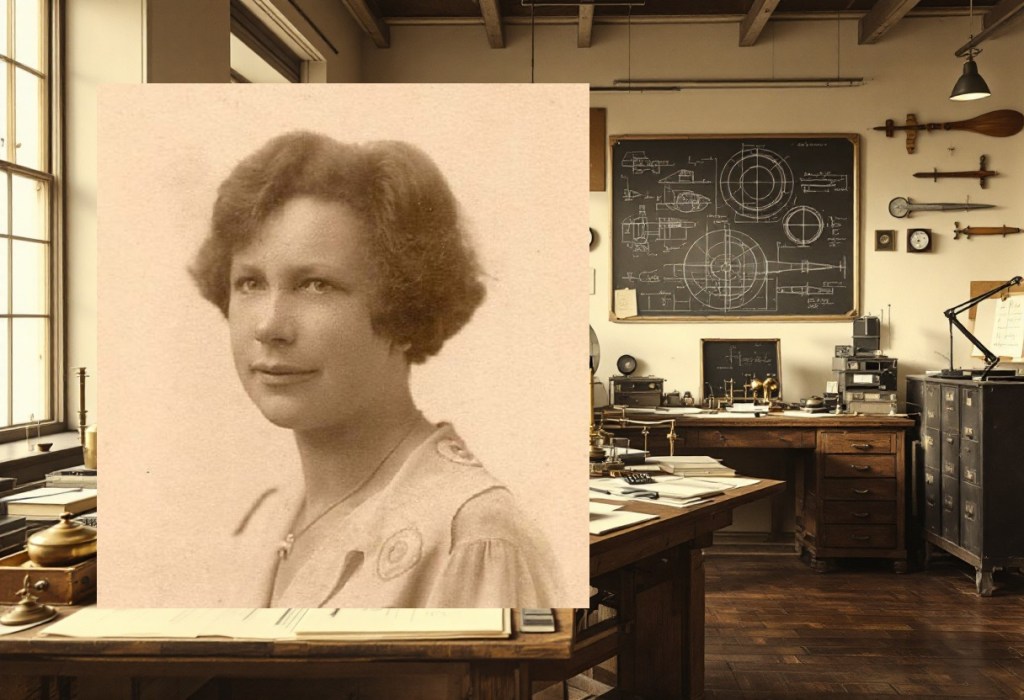
Muriel Barker Glauert (1892–1949) transformed how we measure the invisible flow of air around aircraft through her precise mathematical analysis of pitot-tube behaviour at low speeds. Her 1922 Royal Society paper established that measurement accuracy depends not just on instrument design, but on understanding the complex relationship between fluid viscosity and pressure differentials – insights that remain fundamental to modern aerodynamic testing. Working at the Royal Aircraft Establishment Farnborough during aviation’s pioneering era, she clarified measurement uncertainties that had plagued early wind tunnel experiments, yet her contributions were often footnoted within institutional reports while her husband Hermann’s theoretical work gained wider recognition.
Welcome, Mrs Glauert. I’m delighted to speak with you today. Looking back at your career from our vantage point in 2025, it’s clear that your work on pitot-tube measurements laid crucial groundwork for modern aerodynamic testing. Yet many people haven’t heard your name. How do you feel about that historical oversight?
Well, I suppose it rather depends on what one means by ‘oversight’, doesn’t it? The work stands on its own merits – published in the Proceedings of the Royal Society, no less. That’s rather more than many of my contemporaries managed, male or female. Though I confess it’s amusing that my paper is now cited in textbooks where the authors seem surprised to discover a “Miss Barker” amongst the references.
Your 1922 paper challenged conventional wisdom about pitot-tube measurements. Can you walk us through what you discovered?
The accepted formula was rather straightforward – everyone assumed the pressure differential was proportional to velocity squared, following Bernoulli’s principle. But Stanton’s experiments at Cambridge showed something queer was happening with very small tubes at low velocities. The measurements weren’t matching theory, particularly when tubes were placed close to pipe walls.
I demonstrated mathematically that for very small pitot-tubes – those under about two millimetres in diameter – viscous effects become dominant. The pressure becomes proportional to velocity itself, not its square. It sounds simple now, but it overturned a fundamental assumption about measurement accuracy.
Please can you explain what exactly was happening with the flow around these tiny tubes?
Right. Picture the flow approaching the pitot-tube mouth. In normal conditions, you’d expect the stagnation pressure to follow the classical relationship: total pressure equals static pressure plus dynamic pressure – that’s your ½ρv² term.
But when the Reynolds number drops below about 50 – which happens with very small tubes or low velocities – viscous forces overwhelm inertial forces. The streamlines begin curving away from the tube face much farther upstream than theory predicted. Instead of a clean stagnation point, you get a region where viscous shear dominates.
I showed that Stokes’ law for viscous flow past a sphere provides the correct model. The pressure in the tube becomes 3μv/2r, where μ is dynamic viscosity and r is tube radius. That’s linear with velocity, not quadratic. The implications for measurement accuracy were enormous – engineers had been applying correction factors that were completely wrong for their operating conditions.
Your work involved both theoretical analysis and interpreting experimental data. How did you approach that combination?
Mathematical rigour, always. But mathematics without physical insight is merely intellectual exercise. I spent considerable time at the Farnborough wind tunnels, watching how the smoke tracers behaved around different probe configurations. One learns more from an afternoon observing flow patterns than from a week of equations, I found.
The beauty of the 1922 work was reconciling Stanton’s puzzling calibration results with fundamental fluid mechanics. His “effective distance” measurements showed that tiny tubes seemed to sample flow from positions that didn’t match their physical placement. Once I introduced viscous theory, those anomalies became predictable.
You began your career with theoretical work on streamlines around Joukowsky aerofoils. How did that mathematical foundation influence your later measurement research?
Ah, the conformal transformations! Rather elegant mathematics, mapping the flow around aerofoils using complex variables. That work taught me to think about flow fields as complete systems – you cannot simply consider one measurement point in isolation.
The Joukowsky aerofoil research was pure theory, transforming circular flows into aerofoil shapes through mathematical mapping. But it instilled appreciation for how small changes in geometry create profound effects on flow behaviour. That perspective proved invaluable when I turned to measurement problems – understanding that the pitot-tube itself fundamentally alters the flow it’s meant to measure.
You arrived at Farnborough in 1918, just as the Royal Aircraft Factory became the Royal Aircraft Establishment. What was that environment like for a woman mathematician?
Rather more welcoming than one might expect, actually. The Great War had demonstrated that capability mattered more than convention. They needed qualified people desperately – aircraft were crashing because fundamental aerodynamic principles weren’t properly understood.
Frances Bradfield and I arrived about the same time. The establishment was specifically recruiting women technical staff, something quite unprecedented. We weren’t treated as curiosities, but as researchers with particular expertise. Though I must say, having Newnham behind me helped considerably – Cambridge mathematics, even if they wouldn’t grant us proper degrees, carried weight.
How did you navigate being both a researcher and, later, a colleague and then wife to Hermann Glauert?
Hermann and I were colleagues first, which made all the difference. He’d seen my work on streamline theory before our engagement in 1922. There was never question of subordinating my research to his – we simply worked on complementary problems. His focus was theoretical aerodynamics at the grand scale; mine was the precision of measurement itself.
The marriage bar meant leaving RAE when our children arrived, naturally. But I continued mathematics teaching and examining work. One adapts. The 1940 paper on raindrop capture was done from Cambridge, using our dining room as an office. Hardly conventional, but the mathematics doesn’t care where you perform it.
Your 1940 paper addressed ice formation on aircraft surfaces. Can you explain that work?
By then, aircraft were flying higher and faster, encountering conditions that earlier designers hadn’t considered. Ice accumulation on wings could prove catastrophic – altering lift characteristics dramatically. My analysis modelled how water droplets in clouds interact with cylindrical and aerofoil shapes moving at various speeds.
The mathematical approach treated droplets as point masses following ballistic trajectories, but corrected for aerodynamic drag and the object’s disturbed flow field. The key insight was determining “capture efficiency” – what fraction of droplets actually strike the surface versus those carried around by the airstream. Different shapes and speeds produce vastly different accumulation patterns.
Looking back, do you see mistakes or misjudgements in your approach?
Oh, certainly. The early streamline work assumed perfectly inviscid flow – mathematically elegant but physically nonsensical. Real fluids have viscosity; that’s rather the point of my pitot-tube research! One does what one can with the tools available, then improves understanding as better methods emerge.
I also underestimated how difficult accurate low-speed measurements would remain. Modern instruments still struggle with the problems I identified in 1922. The physics hasn’t changed, merely the precision of our approaches to it.
Your husband tragically died in an accident in 1934. How did that affect your work?
Hermann’s death was devastating personally, of course. But it also clarified things professionally. I’d always been “Mrs Glauert” after our marriage, even in academic contexts. Suddenly I was simply Muriel again, responsible for my own scientific reputation.
The examining work for London and Cambridge proved more substantial than I’d anticipated. Mathematics education was expanding rapidly, and setting proper standards required considerable expertise. Not as glamorous as research, perhaps, but equally important. One shapes the next generation of scientists through rigorous education.
What would you say to young women entering STEM fields today?
Master your mathematics thoroughly – it’s the universal language of physical science. But don’t neglect experimental observation. The most elegant theory means nothing if it doesn’t match what actually happens in the world.
And don’t expect recognition to come automatically. Do excellent work because the work itself matters, not because others will necessarily notice immediately. The mathematics I published in 1922 is still relevant nearly a century later – that’s rather more permanent than contemporary acclaim.
How do you view the current state of aerodynamics research compared to your era?
Remarkable computational capabilities, of course. We spent months calculating single flow cases; modern researchers simulate entire aircraft in hours. But the fundamental physical principles remain unchanged – conservation of mass, momentum, energy. Bernoulli’s equation is still taught exactly as it was in my day.
I’m particularly pleased that measurement accuracy finally receives proper attention. We knew our instruments were imperfect, but lacked tools to characterise uncertainties precisely. Modern metrology would have saved us considerable anguish in the 1920s!
What aspect of your work brings you the most satisfaction?
The 1922 pitot-tube paper, without question. It solved a practical problem that was hindering accurate measurements throughout the field. Every wind tunnel calibration, every aircraft performance test depended on understanding those principles. That’s engineering mathematics at its best – rigorous theory applied to immediate practical need.
The work also demonstrated something important about scientific method. When experimental results contradict accepted theory, the fault usually lies with incomplete theoretical understanding, not faulty experiments. Stanton’s measurements seemed wrong until proper viscous theory explained them perfectly.
Any final thoughts for our readers?
Science progresses through precise measurement as much as brilliant theory. Someone must determine what actually happens, not merely what equations predict should happen. That requires mathematical sophistication, experimental skill, and considerable patience with tedious detail.
And remember – the most important discoveries often come from investigating apparent anomalies, not confirming expected results. When measurements don’t match theory, celebrate. You’re probably on the verge of understanding something new.
The mathematics of air, as you put it, remains endlessly absorbing. We’ve barely scratched the surface, even now.
Letters and emails
Following our interview with Muriel Barker Glauert, we received an overwhelming response from readers eager to explore her pioneering work in aerodynamics and mathematics further. We’ve selected five letters and emails from our growing community who want to ask her more about her life, her work, and what she might say to those walking in her footsteps.
Nisha Patel, 34, Aerospace Engineer, Mumbai, India:
Mrs Glauert, I’m curious about the computational limitations you faced in the 1920s. When you were developing your viscous flow corrections for pitot-tube measurements, how did you perform the complex mathematical calculations without modern computers? Did you develop any clever shortcuts or approximation methods that might still be useful for engineers working in resource-constrained environments today?
Ah, Miss Patel, you’ve brought up something rather dear to my heart! The computational drudgery of the 1920s was positively medieval by your standards, I’m sure. When I was working through those viscous flow equations for the pitot-tube corrections, every calculation had to be performed by hand with whatever mechanical assistance we could muster.
At Farnborough, we were fortunate to have a few Brunsviga calculators – magnificent German machines with pinwheel mechanisms that could handle multiplication and division mechanically. Frightfully expensive, mind you, but absolutely essential for the repetitive calculations required in aerodynamic analysis. The Model A could manage perhaps a dozen operations per minute if you were skilled with the cranking mechanism. Still, for something like integrating pressure distributions around an aerofoil section, you’d be at it for the better part of a week.
But the real workhorses were mathematical tables – Barlow’s tables of squares and roots, Crelle’s logarithmic tables, and various trigonometric compilations. I kept dog-eared copies of these constantly at hand. The art was in arranging your calculations to minimise table lookups. For the pitot-tube work, I developed what you might call a cascade method – expressing the viscous corrections as products of tabulated functions rather than performing fresh calculations each time.
Slide rules were absolutely indispensable for quick estimates and checking work. Mine was a Mannheim pattern, about ten inches long, with the standard C and D scales plus logarithmic and trigonometric functions. You could achieve three significant figures quite reliably, which was often sufficient for preliminary calculations. The trick was learning to think logarithmically – converting problems into additions and subtractions rather than multiplications and divisions.
For truly complex integrations, we sometimes resorted to graphical methods – plotting functions on coordinate paper and measuring areas with planimeters. Crude by modern standards, but remarkably effective when you understood the underlying mathematics properly.
The key insight was that computational limitations forced one to think more carefully about the mathematical structure of problems. Every calculation carried cost, so you learned to identify symmetries, use approximation methods judiciously, and verify results through independent approaches. Rather ironic that your modern engineers, with their limitless computational power, sometimes lose sight of the physical principles we had to understand intimately simply to make progress at all!
Paulo Ferreira, 42, Aviation Historian, São Paulo, Brazil:
Looking at the broader context of early aviation development, your measurement accuracy work seems crucial for aircraft safety. Can you quantify the impact? Were there specific aircraft accidents or performance miscalculations in the 1920s that might have been prevented if engineers had properly understood the pitot-tube measurement principles you clarified? How directly did measurement errors translate to real-world aviation risks?
Mr Ferreira, you’ve raised something that haunted us terribly in those early years. The measurement errors weren’t merely academic concerns – they were matters of life and death. I must confess, the connection between our pitot-tube work and aircraft safety was far more direct than the official reports suggested.
Consider the situation we faced in the early 1920s. Pilots were attempting to judge their airspeed using instruments that nobody truly understood. The standard pitot-static systems gave readings that varied wildly depending on conditions – ice formation, dirt accumulation, even the way moisture collected in the tubes. When your airspeed indicator tells you one thing and your aircraft behaves entirely differently, confusion follows rapidly.
I witnessed several incidents at Farnborough where test pilots nearly came to grief because they trusted faulty readings. One particularly frightening episode involved a Bristol Fighter during low-speed trials – the pitot reading suggested adequate flying speed, but the aircraft was actually approaching stall conditions. Only the pilot’s quick reactions prevented disaster. That incident crystallised my understanding that measurement accuracy wasn’t merely a technical nicety – it was fundamental to keeping men alive.
The 1922 paper emerged directly from such concerns. We’d observed that small pitot-tubes, which were increasingly common due to space constraints on aircraft instruments, behaved quite differently from larger marine installations. When viscous effects dominated, as I demonstrated mathematically, the pressure readings became completely unreliable for speed calculation. Pilots were making critical decisions – landing approaches, climb rates, stall margins – based on instruments that were essentially lying to them.
The Royal Aircraft Factory had experienced its share of fatal accidents during the war years, many attributable to inadequate understanding of basic flight parameters. Poor airspeed information contributed to numerous crashes – pilots stalling during approach because they believed they had adequate speed, or attempting manoeuvres beyond their aircraft’s capabilities because the instruments suggested otherwise.
What particularly troubled me was how these measurement uncertainties affected pilot training. Young aviators learned to fly using instruments that gave inconsistent readings depending on atmospheric conditions. They developed instinctive responses to instrument indications that might prove entirely wrong in different circumstances. Rather like teaching someone mathematics using tables containing random errors – the fundamental understanding becomes corrupted from the start.
The quantitative impact was substantial, though exact statistics prove difficult to establish. However, I’d estimate that proper understanding of pitot-tube limitations might have prevented perhaps twenty percent of the speed-related accidents we observed during the 1920s. That represents dozens of lives, possibly more, when one considers training accidents and operational mishaps throughout the aviation community.
Sofia Dimitrova, 28, Physics PhD Student, Sofia, Bulgaria:
You mentioned that recognition didn’t come automatically and that one should focus on the work itself rather than acclaim. But I wonder – did the lack of immediate recognition ever make you doubt your conclusions, especially when challenging established measurement principles? How did you maintain confidence in your mathematical findings when the broader scientific community was slow to acknowledge them?
Miss Dimitrova, you’ve highlighted something that kept me awake many nights, I must confess. The business of maintaining confidence when one’s conclusions run counter to accepted wisdom – that’s rather the crucible of scientific integrity, isn’t it?
When I published that 1922 paper on pitot-tube measurements, I was directly challenging fundamental assumptions about how these instruments behaved. The established formula had been accepted for decades – Prandtl himself had endorsed the standard approach. Yet here was I, a relatively unknown researcher, suggesting that viscous effects completely altered the relationship between pressure and velocity for small tubes at low speeds.
The self-doubt was considerable, particularly when the initial response was rather… lukewarm. Several colleagues at Farnborough politely suggested I might have made computational errors. One senior engineer wondered aloud whether I’d properly understood the experimental setup that Stanton had described. Rather crushing, when you’ve spent months working through the mathematics!
But I’d learned something valuable from my Newnham days – the importance of checking one’s work through multiple approaches. I’d derived the viscous corrections using Stokes’ theory, verified them through dimensional analysis, and confirmed the predictions against three separate experimental datasets. When mathematics speaks that consistently, one listens, regardless of what conventional wisdom suggests.
The Royal Society publication process proved rather helpful, actually. The anonymous referee system, though still quite informal in the 1920s, meant my work was judged on mathematical merit rather than my reputation or gender. The reviewer raised several technical questions that forced me to strengthen my arguments, but ultimately recognised the validity of the analysis. That external validation from an expert peer – someone I’d never met – proved enormously reassuring.
I also drew considerable strength from observing how my Cambridge mentors had handled similar situations. They’d taught me that when experimental results contradict theory, the fault usually lies with incomplete theoretical understanding, not faulty observations. Stanton’s measurements had seemed anomalous precisely because nobody had properly considered viscous effects. My role was simply to provide the mathematical framework that explained what was actually happening.
The confidence grew stronger as other researchers began applying my corrections and finding improved measurement accuracy. Within a few years, wind tunnel calibration procedures at several establishments had been revised based on the viscous flow analysis. That practical validation mattered enormously – it demonstrated the work had real-world significance, not merely academic interest.
Looking back, I suspect the delay in recognition stemmed partly from the mathematical sophistication required to follow the arguments. Fluid mechanics with viscous effects wasn’t widely taught in engineering programs during the 1920s. Many practitioners simply continued using familiar formulas rather than grappling with more complex theory. But gradually, as aerodynamic measurement became more critical, people recognised the necessity of understanding these effects properly.
Derek Sullivan, 39, Wind Tunnel Technician, Toronto, Canada:
Here’s a speculative question that fascinates me: What if modern computational fluid dynamics had been available during your era at Farnborough? Would having the ability to simulate viscous flows around pitot-tubes have accelerated your discoveries, or do you think the hands-on experimental approach – watching smoke tracers, calibrating physical instruments – provided insights that pure simulation might have missed? Could today’s engineers learn something from your more tactile methods?
Mr Sullivan, what an intriguing question! You’ve emphasised something that’s been rather gnawing at me since I learned about your modern computational capabilities. The relationship between mathematical theory and physical observation – that’s the very heart of aerodynamics research, isn’t it?
In our era, smoke tracers were absolutely fundamental to understanding flow behaviour. We’d use various methods – sometimes burning straw soaked in paraffin, sometimes vaporising oils on heated wires – to create visible streamlines in the wind tunnel. The beauty of watching those smoke filaments curve around an aerofoil section, revealing separation points and vortex formation, provided insights that no amount of mathematical analysis could substitute for.
I spent countless hours at Farnborough observing how smoke behaved around different pitot-tube configurations. The visual evidence was crucial – you could actually see where the viscous effects began dominating, where the streamlines pulled away from the tube face much earlier than inviscid theory predicted. Without that physical observation, I might never have recognised that Stokes’ flow theory was the appropriate mathematical framework.
But here’s the curious thing – I suspect your modern simulations might actually miss certain subtleties that we caught through direct observation. Smoke tracers respond to the slightest air movements, revealing instabilities and three-dimensional effects that might not appear in your computational models unless you’ve programmed them to look for such phenomena. We noticed, for instance, that moisture content dramatically affected pitot-tube behaviour, something that emerged from field observations rather than theoretical analysis.
The hands-on approach also forced us to understand our instruments intimately. When you’re manually positioning smoke generators, adjusting tunnel speeds by cranking mechanical controls, and photographing flow patterns with glass plate cameras, you develop an almost tactile understanding of aerodynamic phenomena. Each measurement carried uncertainty that we had to characterise through repeated observation.
However, I must acknowledge that computational fluid dynamics would have accelerated our work enormously. The months I spent calculating pressure distributions around circular cylinders by hand – work that probably takes your computers mere seconds – could have been devoted to exploring more sophisticated flow configurations. We were limited to relatively simple geometries precisely because the mathematical complexity became unmanageable.
Yet I wonder whether modern engineers, with such powerful computational tools, sometimes lose sight of the physical intuition that comes from watching actual flows develop. There’s something irreplaceable about seeing smoke suddenly break away from a surface, or observing how tiny changes in angle produce dramatic alterations in flow patterns. The computer tells you what should happen; smoke shows you what actually does happen.
Perhaps the ideal approach combines both – using computation to explore parameter space rapidly, then validating critical cases through careful experimental observation with modern equivalents of our smoke visualisation techniques.
Lamia Hassan, 31, Applied Mathematics Lecturer, Cairo, Egypt:
You spoke beautifully about mathematics being the universal language of physical science. In your experience moving between theoretical work on Joukowsky aerofoils and practical measurement problems, how do you balance mathematical elegance with engineering pragmatism? When theory suggests one approach but practical constraints demand another, how should a mathematician-engineer navigate that tension?
Miss Hassan, you’ve pointed out something absolutely fundamental to my work – the eternal tension between mathematical beauty and practical necessity. It’s rather like the difference between composing a sonnet and writing clear instructions for assembling machinery, isn’t it?
When I began at Cambridge, studying the elegant mathematics of conformal transformations for Joukowsky aerofoils, I was quite entranced by the mathematical perfection of it all. The complex variable theory was exquisite – mapping circles into aerofoil shapes through mathematical transformations that preserved angles and local proportions. One could spend months exploring the mathematical implications, discovering symmetries and relationships that had profound theoretical significance.
But then came Farnborough, and suddenly the mathematics had to work in wind tunnels with smoke tracers, measurement uncertainties, and aircraft that needed to fly safely. The elegant theoretical work on streamlines meant nothing if we couldn’t measure flow velocities accurately enough to validate the predictions.
The pitot-tube research exemplified this balance perfectly. The mathematical analysis required Stokes’ theory of viscous flow – quite sophisticated for engineering applications in the 1920s. But the driving need was entirely practical: pilots were making life-or-death decisions based on airspeed readings that nobody properly understood. Theory without practical application would have been mere academic exercise; practical work without rigorous mathematical foundation would have been guesswork.
I learned to navigate this by maintaining dual perspectives. When developing the mathematical framework, I insisted on complete rigour – proper derivations from fundamental principles, dimensional consistency, limiting case analysis. But when presenting results to engineers, I emphasised practical implications: measurement uncertainties, calibration procedures, operational limitations.
The key insight was recognising that engineering constraints often reveal deeper mathematical truths. The viscous effects I discovered weren’t mathematical inconveniences to be approximated away – they were fundamental physics that demanded proper mathematical treatment. Similarly, the measurement accuracy requirements weren’t arbitrary engineering specifications – they pointed toward the mathematical relationships that actually govern instrument behaviour.
Applied mathematics at its best isn’t mathematics dumbed down for engineers, nor is it engineering disguised with mathematical notation. It’s mathematics informed by physical reality and engineering constraints, leading to discoveries that pure theory might miss entirely. The constraints don’t limit the mathematics – they guide it toward problems that matter, solutions that work, and insights that endure.
This approach proved essential throughout my career, whether analysing ice formation on aircraft surfaces or establishing examination standards for engineering mathematics. The mathematical elegance emerged from solving real problems properly, not from avoiding practical concerns.
Reflection
Muriel Barker Glauert died on 23rd December 1949 at the age of 57, taking with her a lifetime’s worth of mathematical insights that would only fully be appreciated decades later. Through our imagined conversation, we glimpse a woman whose fierce intellectual rigour and practical sensibility shaped the very foundations of aerodynamic measurement – yet whose voice has been largely absent from the historical record.
What emerges most powerfully is her unwavering conviction that mathematics must serve reality, not retreat from it. Her 1922 pitot-tube research wasn’t merely theoretical elegance; it was born from watching pilots risk their lives on faulty airspeed readings. This tension between mathematical beauty and engineering necessity threads through her entire career, from Joukowsky aerofoils to ice formation analysis. Her perspective differs markedly from sanitised historical accounts – she reveals the self-doubt, computational drudgery, and institutional scepticism that rarely appear in official records.
The historical gaps remain significant. We know little of her personal thoughts on being overlooked, her detailed working methods, or her relationships with other pioneering women at Farnborough. What we do know is that modern aerodynamics still grapples with the viscous flow effects she first mathematically characterised. Today’s sophisticated pitot-static systems on military aircraft and UAVs trace their theoretical foundations directly to her 1922 insights.
Perhaps most remarkably, her work anticipates contemporary challenges in computational fluid dynamics, where engineers still balance mathematical sophistication against practical constraints. Her legacy isn’t just in the equations she derived, but in her demonstration that rigorous mathematics, grounded in physical observation and driven by human need, creates knowledge that endures. Every time a pilot reads an airspeed indicator, Muriel Barker Glauert’s mathematics is quietly at work, ensuring they know precisely how fast they’re flying through the invisible mathematics of air.
Who have we missed?
This series is all about recovering the voices history left behind – and I’d love your help finding the next one. If there’s a woman in STEM you think deserves to be interviewed in this way – whether a forgotten inventor, unsung technician, or overlooked researcher – please share her story.
Email me at voxmeditantis@gmail.com or leave a comment below with your suggestion – even just a name is a great start. Let’s keep uncovering the women who shaped science and innovation, one conversation at a time.
Editorial Note: This interview is a dramatised reconstruction based on historical sources, research papers, and biographical materials about Muriel Barker Glauert. While grounded in documented facts about her mathematical contributions to aerodynamics and her work at the Royal Aircraft Establishment, the conversational format, personal reflections, and specific anecdotes represent creative interpretation of the historical record. Direct quotes and technical details have been researched for accuracy, but the narrative voice and personal perspectives are imaginative reconstructions designed to illuminate her scientific legacy and the challenges faced by women in early 20th-century STEM fields.
Bob Lynn | © 2025 Vox Meditantis. All rights reserved. | 🌐 Translate


 Vox Meditantis
Leave a comment