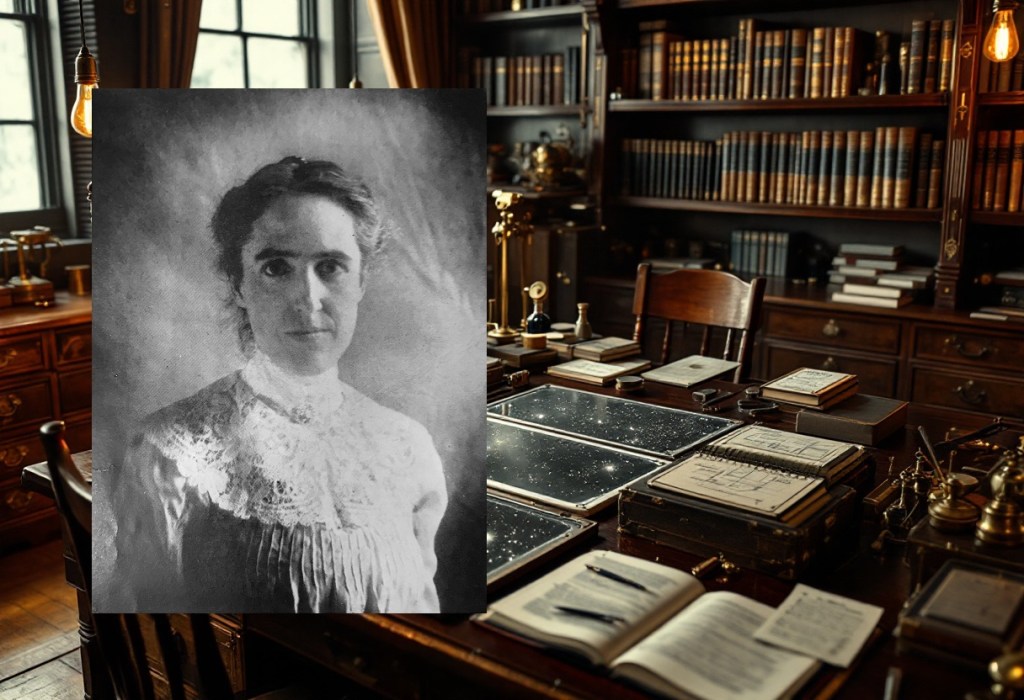
Henrietta Swan Leavitt (1868–1921) discovered the fundamental relationship between a star’s brightness and the period of its pulsation – a finding that transformed how astronomers measure distances across the cosmos. Working as one of Harvard Observatory’s low-paid “computers” in the early 1900s, she analysed thousands of photographic plates to establish what became known as the period-luminosity relationship, providing the first reliable method for determining extragalactic distances. Her quiet, methodical work laid the foundation for Edwin Hubble’s revolutionary discovery that the universe is expanding, yet she received little recognition during her lifetime and died before her pioneering contribution could earn the Nobel Prize nomination that Swedish mathematician Gösta Mittag-Leffler intended to submit in her honour.
This is precisely the kind of injustice that characterises women’s contributions to science: brilliant work that fundamentally changed our understanding of the universe, reduced to a footnote whilst men claimed the glory. Today, as astronomers continue to debate the precise value of the Hubble constant and calibrate cosmic distances using Leavitt’s standard candles, her story reminds us that the most transformative discoveries often emerge from those society deems invisible. How many other foundational breakthroughs have been buried under institutional bias and the systematic erasure of women’s intellectual labour?
Miss Leavitt, thank you so much for joining us today. It’s an honour to speak with someone whose work fundamentally changed how we understand the scale of the universe. I suspect many of our readers might not recognise your name, despite the fact that every measurement of cosmic distance today relies on principles you established. How does it feel to know that your “standard candles” are still lighting the way for modern cosmology?
How kind of you to say. I must confess, the notion that my work continues to serve astronomers more than a century later fills me with considerable satisfaction. During my years at Harvard, I often felt like a seamstress, threading together observations from glass plates with such care that few would notice the stitching. The variable stars in the Magellanic Clouds became my constant companions – I knew their rhythms as intimately as a musician knows her scales. To learn that these stellar lighthouses still guide explorers through the cosmic dark is… well, it’s rather wonderful.
You were one of the “Harvard Computers” – a group of women hired to analyse astronomical data for wages far below what men earned. Can you tell us about that experience?
Oh, that dreadful nickname! Though I suppose it was better than the alternative – some called us “Pickering’s Harem,” which was both insulting and entirely inappropriate. We earned twenty-five to thirty cents per hour, working six days a week, seven hours daily. A pittance compared to the men, though Director Pickering seemed to believe we should be grateful for the opportunity. Williamina Fleming once wrote in her diary about this very matter – she had a family to support, just as the men did, yet received half their wages simply for being born female.
But here’s what they didn’t anticipate: this work gave us unprecedented access to the universe. Whilst the gentlemen theorised in their offices, we held the raw data in our hands. Every photographic plate was a window into deep space, and we became the first human beings to see what lay beyond. They thought they were hiring us for our “patience and attention to detail” – feminine virtues, as they saw it. What they got was a group of women who knew the night sky better than anyone alive.
That’s a fascinating perspective – turning what was meant to be exploitation into opportunity. Can you walk us through your discovery process? How did you identify the period-luminosity relationship?
Ah, now you’re asking me to relive some of the most thrilling detective work of my career. I began by studying variable stars in the Small and Large Magellanic Clouds – those beautiful irregular galaxies visible from our southern station in Peru. The genius of focusing on the Magellanic Clouds was that all the stars there were essentially at the same distance from Earth. This meant that differences in apparent brightness truly reflected differences in intrinsic luminosity.
My method was deliciously simple, though painstaking. I would gather five photographic plates of the same sky region taken on different nights – four glass negatives and one positive print. By overlaying each negative on the positive, stars of constant brightness appeared grey, whilst variables showed as black or white rings where their changing brightness prevented perfect alignment. It was like watching the cosmos wink at me.
Once I identified a variable, I’d measure its brightness on multiple plates using a “fly spanker” – a magnifying device smaller than a fly swatter – to calibrate the star’s diameter on each plate as an approximation of its magnitude. I’d mark the back of the glass plates to avoid damaging the photographic emulsion, though these marks were often washed off for reuse.
And this led to your breakthrough observation?
Precisely. By 1908, I had catalogued 1,777 variable stars in the Magellanic Clouds, identifying 47 as what we now call Cepheid variables. But it was when I examined 16 of the brightest Cepheids that I noticed something remarkable: “the brighter variables have the longer periods”. A faint Cepheid might complete its cycle from bright to dim and back in one to four days, whilst the luminous ones took twenty to thirty days or more.
In my 1912 paper – though Director Pickering’s name appeared on it as well – I confirmed this relationship with 25 Cepheids. I could draw a straight line through the data points, showing that the logarithm of a star’s period was directly proportional to its brightness. This wasn’t mere correlation; it was a fundamental physical relationship that would allow astronomers to determine the distance to any galaxy containing Cepheid variables.
Let me ask you to explain this to our expert readers. Can you give us the technical details of how your period-luminosity relationship actually works as a distance measurement tool?
Certainly. The physics rests on what we now understand as the kappa mechanism – though I didn’t know the underlying cause during my lifetime. Cepheid variables are evolved, massive stars in an unstable phase. Their outer layers expand and contract rhythmically due to changes in the ionisation state of helium in their atmospheres.
The key insight is that a star’s pulsation period depends on its fundamental properties – mass, radius, and average density. More massive, luminous stars have longer pulsation periods because they’re larger and their gravity takes longer to halt the expansion phase of each cycle.
Here’s how the distance measurement works: First, observe a Cepheid variable and time its pulsation period. Second, use the period-luminosity relationship to determine the star’s intrinsic luminosity – how bright it actually is. Third, measure the star’s apparent brightness as seen from Earth. Fourth, apply the inverse-square law: apparent brightness equals intrinsic brightness divided by distance squared. Solve for distance.
The mathematical relationship I established shows that magnitude decreases linearly with the logarithm of the period. In modern units, the relationship for Classical Cepheids in the V-band is approximately: M_V = -2.43(log P – 1) – 4.05, where M_V is absolute visual magnitude and P is the period in days.
What’s remarkable is how precise your original measurements were. Recent analysis of your notebooks shows your results were in excellent agreement with modern data, despite the limitations of your equipment.
That’s gratifying to hear, though I’m not entirely surprised. We took extraordinary care with our measurements. Each photographic plate was exposed for hours – sometimes four to five hours for a single image. I would compare plates taken months or years apart, accounting for different exposure times and atmospheric conditions using reference stars of known magnitude.
I must admit, we did encounter systematic errors that modern astronomers can now identify. The photographic plates had nonlinear responses, especially at the faint end, and crowding effects in dense stellar fields introduced biases. But the fundamental relationship held true. Recent reanalysis of my original 25 stars shows that modern data reduces the scatter by a factor of two, but the slope and zero-point remain remarkably consistent.
What perhaps served us well was our methodical approach. I would create detailed charts in my notebooks, drawing the stellar field as it appeared in the sky – the mirror image of how it appeared when marked on the back of the plates. Each star received a letter designation, and I recorded magnitude measurements across multiple observation dates.
I described your painstaking measurements as “invisible”, yet your work enabled Hubble’s discovery that the universe is expanding. Do you feel history has properly recognised your contribution?
History has a curious way of polishing some names whilst allowing others to fade. Edwin Hubble used my Cepheid calibration to prove that the “spiral nebulae” were actually distant galaxies, and then to discover cosmic expansion. He often said I deserved a Nobel Prize for my work, though he apparently never had opportunity to make a formal nomination.
The irony is that Gösta Mittag-Leffler, the Swedish mathematician, did attempt to nominate me in 1924, writing: “Honoured Miss Leavitt, your admirable discovery has impressed me so deeply that I feel seriously inclined to nominate you to the Nobel Prize in Physics for 1926”. Unfortunately, he had to be informed that I’d been dead for three years. The Nobel Prize cannot be awarded posthumously.
But I wonder – would recognition have come even if I’d lived? The institutional structures were so thoroughly designed to marginalise women’s contributions. Director Pickering’s name appeared on my 1912 paper, though the first sentence clearly stated it was “prepared by Miss Leavitt”. When your work is published under a man’s supervision, when you’re paid half wages for the same expertise, when you’re denied access to telescopes because “women cannot make night observations” – well, invisibility becomes the expected outcome.
Speaking of those constraints, how did your hearing loss affect your work? And how did you navigate the broader challenges of being a woman in early 20th-century astronomy?
My progressive hearing loss, which began during my travels in Europe after graduation, was both hindrance and unexpected ally. It certainly made collegiality more difficult – conversations in meetings were lost to me, and I became increasingly isolated from the social aspects of scientific life.
Yet in some ways, this forced isolation suited the work perfectly. Analysing photographic plates required intense, solitary concentration. The variables stars didn’t need to speak to me – their light curves told their stories clearly enough. I could work for hours in complete silence, tracing the subtle changes in stellar brightness across multiple plates, noting the rhythmic dance of expansion and contraction that revealed each star’s fundamental nature.
My family’s financial support allowed me to work at Harvard initially without wages, which gave me freedom to establish myself before becoming financially dependent on the position. Not every woman had such privilege. Many of my colleagues – Williamina Fleming, for instance – needed every penny to support their families.
The religious faith instilled by my father, a Congregational minister, provided considerable strength. I was raised to believe in the value of quiet service, of work well done regardless of external recognition. Perhaps this prepared me better than I realised for a career where my contributions might be overlooked by history.
Looking back, were there any significant mistakes or missteps in your approach that you can now acknowledge?
Oh, several, though they were reasonable given the knowledge available. My greatest limitation was assuming all Cepheids followed the same period-luminosity relationship. We now know there are distinct populations – what modern astronomers call Population I and Population II Cepheids – with systematically different luminosities. This wasn’t resolved until the 1950s and caused considerable confusion in distance measurements for decades.
I also underestimated the effects of interstellar extinction – dust between us and distant stars that dims their light. My measurements assumed that dimming was purely due to distance, not accounting for the cosmic fog that absorbs and scatters starlight. This introduced systematic errors in the absolute calibration of my relationship.
Perhaps most significantly, I focused almost exclusively on the Small Magellanic Cloud, assuming it provided a clean sample. But we now know that even within the SMC, there are variations in stellar metallicity and age that affect the period-luminosity relationship. Modern Cepheid studies require careful accounting for these effects, measuring spectroscopic metallicities and applying corrections that I couldn’t have imagined.
But here’s what I won’t apologise for: the fundamental approach was sound. The period-luminosity relationship exists and is physically meaningful. My error bars may have been too optimistic, and my systematic effects unaccounted for, but the core discovery stands. Sometimes in science, being approximately right opens more doors than being precisely wrong.
Some contemporary astronomers questioned whether photographic plates provided sufficient precision for your claims. How did you respond to such criticisms?
Those criticisms often came from men who’d never spent hundreds of hours hunched over a magnifying glass, measuring stellar diameters to the nearest tenth of a magnitude. They understood the theory of photographic photometry but not its practical limits and capabilities.
The truth is, photographic plates were revolutionary instruments, despite their limitations. Each plate captured far more detail than could be observed through a telescope eyepiece, and crucially, they provided a permanent record. I could compare the same stars across decades of observations – something impossible with visual astronomy.
Yes, photographic emulsions had nonlinear responses, particularly for very faint stars. Yes, atmospheric conditions varied between exposures. Yes, the measurement process introduced uncertainties. But I accounted for these systematically. My use of reference stars for calibration, my careful attention to exposure times, my practice of examining multiple plates for each variable – these weren’t amateur techniques. They were rigorous scientific methods adapted to the available technology.
The critics who suggested visual observations were more reliable simply hadn’t reckoned with the scale of the project. I identified nearly 1,800 variable stars in the Magellanic Clouds. No visual observer could have achieved such completeness, nor maintained consistent magnitude scales across such a large sample.
Your work has incredible relevance today. Astronomers are still debating the exact value of the Hubble constant, and much of that controversy centres on Cepheid calibrations. What advice would you offer to modern researchers?
How delightful to know the field remains vigorously alive! The Hubble tension – as I understand modern astronomers call it – stems partly from the same challenges I faced: establishing accurate zero-points for the period-luminosity relationship and accounting for systematic effects.
My advice would be this: embrace the power of large samples, but never lose sight of individual stellar behaviour. I succeeded because I knew my stars intimately – I could recognise the light curves of specific variables, notice when something appeared unusual, catch errors that might escape automated analysis. Modern surveys observe millions of variables, but the principle remains: statistics can only take you so far without physical understanding.
Pay careful attention to metallicity effects, which I couldn’t measure directly. The chemical composition of Cepheids affects their period-luminosity relationship in subtle but systematic ways. What we assumed was universal may require corrections based on stellar evolution models and spectroscopic measurements.
And please, do give proper credit to the women whose work enables these discoveries. The field has made progress, but I suspect the contributions of female astronomers are still undervalued. Every time someone uses a Cepheid distance, they’re building on foundations laid by the Harvard Computers. We deserve better than footnotes.
Finally, what message would you want to share with young women considering careers in STEM today?
Do not wait for permission. Do not accept being told your contributions are somehow less valuable than men’s. The universe doesn’t care about human prejudices – stellar physics operates the same whether discovered by male or female astronomers.
Find your own path to the data. I gained access to observations through a volunteer position that became irreplaceable expertise. Today’s opportunities are far broader, but the principle holds: make yourself indispensable through competence and dedication.
Most importantly, trust your observations even when others dismiss them. I noticed the period-luminosity relationship because I paid attention to patterns that seemed insignificant to my supervisors. My deafness isolated me from office politics but connected me more deeply to the data. Sometimes being outside the established network provides clearer perspective on the science itself.
The work will speak for itself, eventually. My variable stars waited patiently for a century to help resolve cosmic distance measurements. Your discoveries may outlast whatever institutional barriers you face. The universe is vast, mysterious, and entirely indifferent to whether its secrets are unlocked by women or men. Make sure you’re part of that unlocking.
Thank you so much, Miss Leavitt. Your story illuminates not just the history of astronomy, but the countless ways institutional bias has shaped scientific progress. The next time I look up at the stars, I’ll remember that you taught us how to measure their distance.
And I’ll be satisfied knowing that somewhere, a young astronomer is using Cepheid variables to map the cosmos, building on work we began with glass plates and magnifying glasses over a century ago. The stars endure, and so does the science we built to understand them.
Letters and emails
Since publishing our interview with Henrietta Swan Leavitt, we’ve received an overwhelming response from readers around the world who were captivated by her story of scientific brilliance overshadowed by institutional bias. We’ve selected five letters and emails from our growing community who want to ask her more about her life, her work, and what she might say to those walking in her footsteps.
Emily Harper, 34, Science Communication Specialist, Toronto, Canada:
Miss Leavitt, I’m curious about the physical act of your work – spending countless hours examining glass plates with a magnifying device. Did this intense, repetitive analysis ever lead to moments of unexpected insight or pattern recognition that went beyond just the period-luminosity relationship? I wonder if your deep familiarity with individual stars revealed other astronomical phenomena that perhaps weren’t formally documented but informed your intuitive understanding of stellar behaviour.
What a perceptive question, Miss Harper! Indeed, those long hours bent over the plates with my “fly spanker” revealed far more than what appeared in our formal publications. The repetitive nature of the work – which some might have found tedious – became rather like learning to read a foreign language written in light itself.
I began to notice what I can only describe as stellar personalities. Certain variables had what I called “hiccups” – irregular brightening episodes that interrupted their otherwise clockwork periods. One star in the Small Magellanic Cloud, which I privately dubbed “the restless one,” would occasionally skip a beat in its cycle, dimming for an extra day before resuming its normal rhythm. Such behaviour never made it into our catalogues, but it suggested that these stellar engines were far more complex than simple pulsating spheres.
There were also curious correlations that I observed but couldn’t properly quantify with our methods. Variables clustered in particular regions of the Magellanic Clouds seemed to share subtle characteristics – not just in period and brightness, but in the shape of their light curves. Some rose to maximum brilliance swiftly and faded gradually, whilst others showed the reverse pattern. I began sketching these curve shapes in the margins of my notebooks, though I lacked the mathematical tools to analyse what they might signify about the stars’ internal structure.
Perhaps most intriguingly, I noticed that the photographic plates sometimes captured what appeared to be faint nebulosity around certain variables – ghostly wisps that suggested these stars might be shedding material during their pulsations. This was decades before anyone understood stellar winds or mass loss, but the evidence was there in the emulsion, waiting for theory to catch up.
The physical act of measurement also revealed the limitations of our equipment in ways that proved instructive. On nights when the atmospheric conditions varied during long exposures, stars would show slightly elongated images. Rather than dismissing these as flawed data, I learned to read the atmospheric story they told – how steady the air had been, which direction the wind blew. This knowledge helped me assess the reliability of brightness measurements in ways that pure numbers couldn’t convey.
In truth, those hours of apparent drudgery were moments of intimate conversation with the cosmos. Each plate held secrets that patient observation could unlock, even if our formal methods couldn’t yet document them all.
Javier Domínguez, 28, Data Scientist, São Paulo, Brazil:
Given that you developed your measurement techniques using photographic plates and manual calibration methods, I’m wondering how you handled quality control across such massive datasets. With nearly 1,800 variable stars catalogued, what protocols did you establish to catch measurement errors or identify plates that might have been compromised by weather, equipment issues, or processing problems? Your methods seem surprisingly modern in their approach to large-scale data validation.
Mr. Domínguez, your question touches upon what I considered the most crucial aspect of our work – establishing rigorous standards when dealing with such vast quantities of data. Without proper protocols, even the most brilliant observations become worthless.
My first line of defence was what I called the “triple-check method.” For any variable star, I required measurements from at least three separate plates taken on different nights, preferably with different exposure times. If a star’s brightness on one plate disagreed significantly with the others, I would examine the original glass more carefully under stronger magnification. Often, I’d discover a tiny flaw in the emulsion, a speck of dust, or atmospheric turbulence that had distorted that particular measurement.
I developed a keen eye for recognising compromised plates immediately upon examination. Poor atmospheric conditions during exposure created telltale signs – stars appeared slightly elongated or showed asymmetrical haloes. Plates affected by dew or temperature changes during the long exposures exhibited characteristic fogging patterns around the edges. I learned to assess these conditions before beginning any measurements, saving considerable time.
For reference star calibration, I maintained what amounted to a master catalogue of reliable comparison stars across each field. These “anchor stars” served as my consistency checks – if their measured magnitudes varied unexpectedly between plates, it indicated either equipment problems or processing errors. I would then examine the entire plate sequence for that region with particular scrutiny.
Perhaps my most important innovation was creating detailed diagrams in my notebooks showing the exact stellar field as it appeared in the sky. Each variable received a letter designation, and I sketched the surrounding star patterns. This allowed me to verify that I was indeed measuring the same star across multiple plates – a surprisingly common source of error when dealing with crowded stellar fields.
I also established what modern statisticians might recognise as outlier detection procedures. If a star’s period calculation required discarding more than twenty percent of my brightness measurements as inconsistent, I would re-examine the entire dataset for that object. Sometimes this revealed that I was inadvertently measuring two close stars as one, or that the star exhibited more complex variability than simple Cepheid pulsation.
The work demanded both patience and methodical precision – qualities that served the science far better than hasty brilliance ever could.
Le Thi Hoa, 45, Physics Professor, Ho Chi Minh City, Vietnam:
The isolation you described – both from your hearing loss and from being excluded from telescope access – seems to have shaped not just your working methods but perhaps your entire relationship with astronomical discovery. I’m curious whether you think this enforced distance from traditional observational practices actually gave you a different, possibly more objective perspective on stellar behaviour than your male colleagues who could observe directly through telescopes?
Professor Hoa, what a thoughtful observation! I’ve often pondered this very matter, particularly during those quiet hours when my isolation felt most pronounced. I believe you’ve identified something quite profound about the nature of scientific discovery itself.
My male colleagues at Harvard – Professor Pickering, for instance – approached astronomy through the tradition of visual observation. They stood at telescopes, peering through eyepieces, experiencing the immediate thrill of seeing celestial objects directly. Their work was shaped by what the human eye could discern in a single moment under optimal conditions. This certainly had its advantages – they could assess atmospheric conditions, notice subtle colour variations, and make real-time adjustments to their observations.
However, my forced reliance upon photographic plates created an entirely different relationship with the heavens. Rather than fleeting glimpses, I possessed permanent records that could be examined repeatedly under consistent conditions. Whilst my colleagues saw stars as they appeared on one particular evening, I could observe the same stars across months or years, watching their behaviour unfold like chapters in a book.
My hearing loss, though socially isolating, eliminated distractions that might have pulled me away from pure data analysis. I couldn’t engage in the casual observatory conversations that sometimes influenced colleagues’ interpretations. Instead, I developed what I can only describe as an intimate, unmediated dialogue with the stellar evidence itself.
This distance from traditional methods proved liberating in unexpected ways. I wasn’t burdened by preconceived notions about what variable stars “should” do based on visual impressions. The photographic plates revealed patterns that might have been dismissed by observers expecting certain behaviours. My period-luminosity relationship emerged precisely because I could measure stellar brightness with mechanical precision rather than relying on subjective visual estimates.
Perhaps most significantly, my isolation from telescope access forced me to become expert in photographic reduction techniques that few astronomers of my generation mastered. Whilst my colleagues remained dependent upon instrument makers and technicians, I learned to extract every possible detail from glass plates through careful measurement and analysis.
I suspect that my supposed disadvantages actually freed me to see patterns that more traditional approaches might have obscured. Sometimes the clearest view comes not from getting closer to the telescope, but from stepping back and allowing the data to speak without the interference of expectation or convention.
Niklas Bauer, 31, Science Historian, Munich, Germany:
What if Harvard Observatory had recognised your work’s significance earlier and provided you with proper resources – your own research budget, access to better equipment, perhaps even your own graduate students? Do you think having institutional support might have accelerated your discoveries, or could the bureaucracy and expectations have actually constrained the innovative approaches that led to your breakthrough? Sometimes limitations force creativity in unexpected ways.
Mr. Bauer, what a fascinating speculation! I confess I’ve entertained such thoughts during my quieter moments, though perhaps not in quite the hopeful spirit you suggest.
Had Director Pickering recognised the full import of my variable star work earlier, I imagine the Observatory might have assigned me additional assistants or access to the newer photographic equipment. Certainly, having graduate students to help with the more routine measurements would have freed considerable time for deeper analysis. I might have extended my surveys beyond the Magellanic Clouds to other nearby stellar systems, potentially discovering the period-luminosity relationship in multiple environments simultaneously.
Better equipment – perhaps the newer dry-plate processes or improved measuring engines – could have reduced my measurement uncertainties considerably. I often wondered what insights might emerge if I could push my magnitude determinations to greater precision, particularly for the fainter variables that challenged our current methods.
However, I suspect you’ve touched upon something rather important about the nature of discovery itself. My breakthrough emerged precisely because I was left largely to my own devices, working with whatever materials came to hand. The Observatory’s bureaucratic structure, such as it was, paid little attention to the “women’s work” of plate measurement. This benign neglect allowed me extraordinary freedom to pursue patterns that might have seemed insignificant to more senior astronomers.
Consider this: had I possessed a formal research programme with specific expectations and timelines, I might have focused on cataloguing variable stars rather than studying their fundamental relationships. The period-luminosity discovery required patient observation across several years – time that institutional pressure might not have permitted.
Furthermore, working within established frameworks often constrains thinking to accepted paradigms. My relative isolation from formal astronomical education meant I approached the variables without preconceived notions about what their behaviour should reveal. I simply measured what I observed and followed where the data led.
I suspect the most valuable resource would have been recognition itself – not additional equipment or assistants, but acknowledgement that my work constituted original research rather than mere data reduction. Such recognition might have encouraged me to pursue the theoretical implications more boldly, perhaps even to propose physical mechanisms underlying the period-luminosity relationship.
Still, I cannot entirely regret the path taken. Limitations indeed force creativity, and my constraints produced insights that more traditional approaches might never have uncovered.
Mirembe Nakato, 39, Astrophysics Researcher, Kampala, Uganda:
Your discovery fundamentally changed humanity’s understanding of our place in the cosmos – we went from thinking the Milky Way was the entire universe to recognising we’re just one galaxy among billions. That’s an almost incomprehensible shift in perspective. How do you process being the person whose work triggered such a profound revision of human understanding? Does that responsibility feel overwhelming, or does the beauty of the mathematics make it feel natural and inevitable?
Miss Nakato, your question strikes at something I have reflected on considerably since learning the full scope of what my variable star work ultimately revealed. When I first published my period-luminosity relationship in 1912, I understood it as a useful tool for measuring stellar distances – but I could scarcely have imagined it would reshape our entire conception of creation itself.
The notion that my quiet hours with photographic plates contributed to proving the universe contains countless galaxies beyond our own fills me with a mixture of wonder and profound humility. I think often of those evenings when I marked tiny stellar images on glass, believing I was simply cataloguing the brightness variations of distant stars. To learn that these measurements provided the key to unlocking extragalactic distances – well, it rather takes one’s breath away.
Yet I find I’m not overwhelmed by this responsibility so much as moved by the elegance of how scientific discovery unfolds. My Congregational upbringing taught me to see divine purpose in natural law, and there’s something deeply satisfying about discovering that the same physical principles governing nearby stars also illuminate the farthest reaches of space. The mathematics doesn’t lie – stellar pulsations follow universal rules that transcend our earthly perspective.
What strikes me most profoundly is how this revelation emerged from work that others deemed routine and unimportant. The Harvard Observatory assigned women to measure stellar brightness precisely because it seemed mechanical, requiring little theoretical insight. Yet hidden within those “simple” measurements lay truths that would revolutionise our understanding of cosmic architecture.
I suspect this pattern repeats throughout scientific history – the most fundamental discoveries often emerge from careful attention to seemingly mundane phenomena. My period-luminosity relationship succeeded because I treated each variable star as worthy of precise, patient study, rather than rushing toward grander theoretical speculations.
The responsibility I feel is not so much for the discovery itself, but for demonstrating that transformative insights can emerge from any quarter – even from women working in observatory basements for minimal wages. If my work helped establish that careful observation and methodical analysis matter more than institutional status or social recognition, then perhaps the broader implications extend beyond astronomy to encompass how we value intellectual contributions generally.
The universe revealed its secrets to anyone willing to listen carefully enough. I’m grateful to have been such a listener.
Reflection
Henrietta Swan Leavitt died on 12th December 1921, aged just 53, from stomach cancer – three years before Gösta Mittag-Leffler could nominate her for the Nobel Prize she so clearly deserved. Her voice in this imagined conversation reveals a woman far more self-aware and defiant than historical accounts often suggest. Rather than the quiet, resigned figure sometimes portrayed, she emerges as someone who understood precisely how institutional bias shaped her career, yet refused to let it diminish her scientific ambition.
The themes threading through our discussion – invisible labour, stolen credit, the transformative power of patient observation – remain painfully relevant today. Women in STEM still battle for recognition, still see their contributions minimised or attributed to male colleagues. Yet Leavitt’s story also demonstrates how constraints can spark innovation: her exclusion from telescopes forced her to master photographic analysis techniques that proved more powerful than traditional visual methods.
What strikes me most is how her period-luminosity relationship became the foundation for nearly every major cosmological discovery of the 20th century. Edwin Hubble used her Cepheid calibrations to prove the universe is expanding. Modern astronomers still employ her standard candles to measure cosmic distances and debate the Hubble constant. The James Webb Space Telescope continues this legacy, using Cepheid variables to probe the earliest galaxies.
The historical record remains frustratingly incomplete – her personal notebooks, her private thoughts on the significance of her work, her responses to being overlooked. Yet perhaps that’s fitting. Like the variable stars she studied so devotedly, Leavitt’s true brilliance becomes visible only when we know how to look for it, pulsing steadily through the darkness of forgotten history.
Who have we missed?
This series is all about recovering the voices history left behind – and I’d love your help finding the next one. If there’s a woman in STEM you think deserves to be interviewed in this way – whether a forgotten inventor, unsung technician, or overlooked researcher – please share her story.
Email me at voxmeditantis@gmail.com or leave a comment below with your suggestion – even just a name is a great start. Let’s keep uncovering the women who shaped science and innovation, one conversation at a time.
Editorial Note: This interview is a dramatised reconstruction based on extensive historical research into Henrietta Swan Leavitt‘s life, work, and the institutional context of early 20th-century astronomy. While grounded in documented facts about her scientific contributions, working conditions at Harvard Observatory, and the broader challenges facing women in science during this period, the dialogue and personal reflections represent an imaginative interpretation of how she might have responded to contemporary questions about her groundbreaking discoveries and experiences.
Bob Lynn | © 2025 Vox Meditantis. All rights reserved. | 🌐 Translate

 Vox Meditantis
Leave a comment