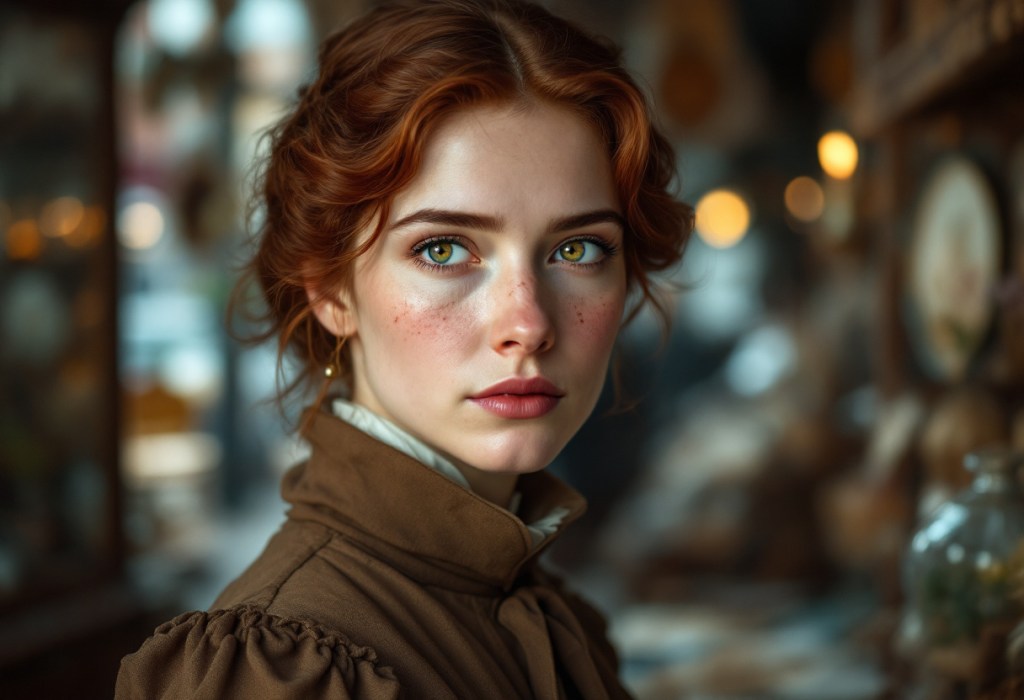
11th September 1855
The glass cases of Covent Garden’s botanical suppliers cast strange reflections this morning, each specimen preserved behind its transparent barrier like memories trapped in amber. I find myself drawn repeatedly to these merchant stalls, ostensibly to procure materials for my botanical illustrations, yet truly seeking something I cannot name. The fern fronds and pressed flowers seem to mock my scholarly pursuits – nature captured, catalogued, and sold as mere curiosities whilst the living world beyond these market walls grows ever more distant from our industrial ambitions.
Word has reached London of Sevastopol’s fall this very day. The telegraphic dispatches speak of victory, yet I cannot reconcile this triumph with the terrible cost in human suffering. As I examined a collection of Crimean lichens this afternoon – specimens gathered, no doubt, from those very battlefields – I was struck by how these humble organisms continue their ancient work of breaking down stone and creating soil, regardless of the empires that rise and fall above them. In the curved glass of the vendor’s magnifying lens, I glimpsed my own eye reflected alongside the delicate structure of moss, and wondered which of us was truly the subject under observation.
Mrs. Ward, the elderly woman who tends the pressed flower stall, asked me today what word holds the greatest fascination for me. Without hesitation, I replied: “Correspondence.” Not merely the letters we exchange with distant friends, but that deeper harmony between all living things – the way a leaf’s veins mirror the rivers that nourish it, how the spiral of a shell echoes the very Milky Way above. This correspondence speaks to the Divine Architect’s unified design, yet we seem increasingly deaf to its whispered lessons as we pursue our dominion over the natural world.
The market’s cobblestones, slick with September rain, reflected the grey heavens like countless dark mirrors. In each puddle, I observed the inverted world – chimneys pointing downward toward some subterranean sky, vendors’ faces rippling in the disturbed water. Perhaps this is how the Almighty views our earthly endeavours: everything reversed, our greatest achievements appearing as mere shadows in the true order of creation.
I returned home with specimens of hart’s-tongue fern and samples of coal dust from the Welsh valleys – strange companions, yet both speak to time’s vast passage. The fern represents life persisting in the damp recesses of our changing world, whilst the coal bears witness to ancient forests compressed into the very fuel that drives our modern age. In the lamplight, as I arranged these findings upon my writing desk, I saw my face reflected in the darkened window, superimposed upon the gaslit street beyond, and felt the weight of being suspended between the natural world I study and the artificial one I inhabit.
The correspondence I seek grows ever more elusive, yet I persist in this quiet rebellion against the age’s presumptions, hoping that careful observation might yet reveal the threads that bind all creation together.
The mid-Victorian era and the Crimean War frame this entry, with the fall of Sevastopol in September 1855 marking a decisive Allied victory after an eleven-month siege. Britain, France, the Ottoman Empire, and Sardinia fought Russia chiefly over influence in the declining Ottoman domains and access to Black Sea routes. Battlefield disease, supply failures, and military mismanagement drew intense public scrutiny, while advances such as rail transport, the electric telegraph, and professional nursing emerged amid the conflict. Sevastopol’s capture hastened peace negotiations, leading to the Treaty of Paris (1856), which neutralised the Black Sea and curtailed Russian power, though the settlement’s balance proved temporary and tensions later resurfaced.
Bob Lynn | © 2025 Vox Meditantis. All rights reserved. | 🌐 Translate

 Vox Meditantis
Leave a comment