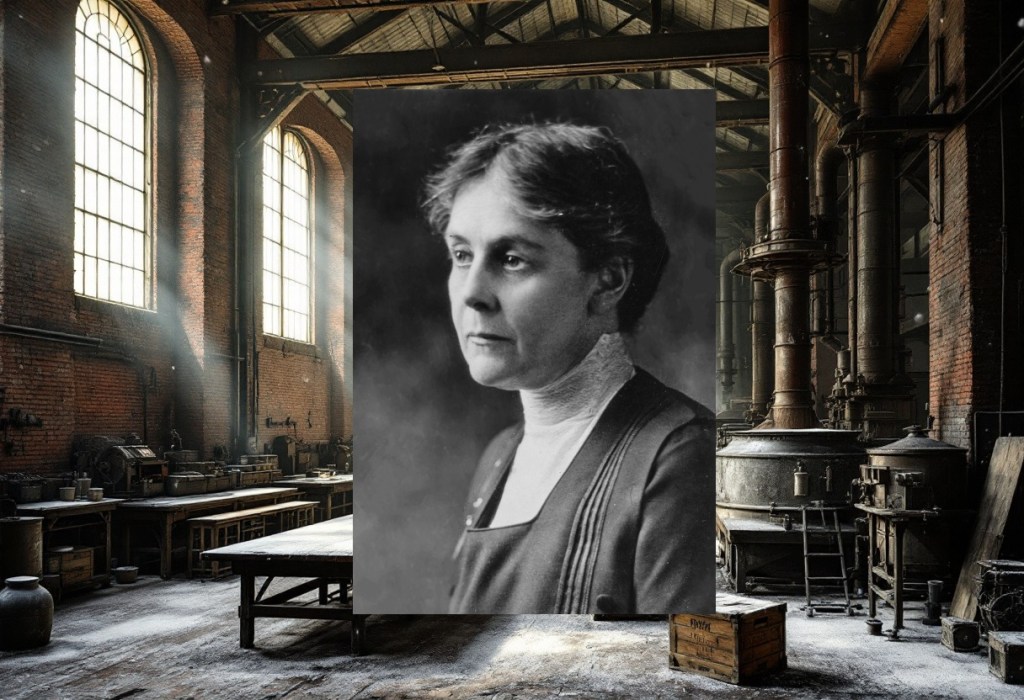
Alice Hamilton (1869-1970) transformed industrial medicine from a European curiosity into an American necessity, establishing the scientific foundation for modern workplace safety through painstaking detective work and unflinching courage. Her investigations into lead poisoning, mercury exposure, and industrial toxins directly challenged powerful business interests and helped secure workers’ rights to safe employment. The Occupational Safety and Health Act, passed three months after her death in 1970, codified many principles she had championed for five decades.
Thank you for speaking with us today, Dr. Hamilton. I want to begin with your early path into medicine. What drew a young woman from Fort Wayne, Indiana, to pursue such an unconventional career in 1890?
Medicine appealed to me precisely because it would allow me to go anywhere I pleased – to far-off lands or to city slums – and be quite sure I could be of use anywhere. My mother raised all her daughters to believe we could achieve as well as any man, and I was always drawn to science despite my dreadful education in mathematics. I convinced my father to let me try a year at the local medical college, though he doubted I was tough enough for such work. I proved him wrong rather quickly.
Your education took you from Michigan to Germany to Johns Hopkins. What was that experience like as a woman in scientific training?
Quite challenging, I must say. At Johns Hopkins, we women students had to sit behind a screen during anatomy lectures because our presence was deemed too distracting for the men. The German universities were even worse – I was barred from attending autopsies in Leipzig and forbidden from conducting animal experiments in Munich. Only Professor Ludwig Edinger in Frankfurt treated me as a serious scientist. These restrictions taught me early that a woman in science must find alternative paths to knowledge.
You moved to Hull House in 1897, which profoundly shaped your career. How did living there transform your understanding of medicine?
Hull House opened my eyes to how deep and fundamental are the inequalities in our democratic country. Living among the working-class immigrant communities of Chicago, I heard constantly about their dreadful working conditions. I should never have taken up the cause of the working class had I not lived at Hull House. Jane Addams and Florence Kelley showed me that scientific knowledge without social application is merely academic vanity.
Now, let’s talk about your revolutionary approach to industrial medicine. Can you walk us through your “shoe-leather epidemiology” methods?
That term wasn’t mine originally, but it fits. When I investigated the Illinois industries in 1910, no one knew which factories used industrial poisons or how workers were being poisoned. I had to develop my own methods because the European literature simply didn’t apply to American conditions.
First, I studied the technical details of each industry. Then came the real work – observing factory processes, checking hospital records, interviewing labour leaders and pharmacists. Most crucially, I met with workers in their homes, union halls, and even saloons where they had courage to speak out what was in their minds. Factory owners would never admit to problems, but workers told the truth when their bosses weren’t listening.
Can you give us a specific technical example of how you solved a poisoning case?
Certainly. I found a Polish worker in a hospital suffering from colic and double wrist drop – classic signs of lead poisoning. He claimed to work at a sanitary-ware factory enamelling bathtubs. The existing literature made no mention of lead in bathtub paint, and when I visited, the managers assured me no lead was used. They showed me workers applying what looked like harmless white enamel.
But something felt wrong. I tracked down the worker at his home, and he told me I’d only seen the final touching-up process. The real enamelling happened at another factory where workers sprinkled powdered enamel over red-hot tubs. I obtained a specimen – it contained 20% soluble lead. Thus I nailed down the fact that sanitary-ware enamelling was a dangerous lead trade in the United States.
What specific quantitative methods did you develop to prove lead poisoning when diagnostic tests didn’t exist?
I imposed a rigid standard on myself. I would not accept a case as positive unless there was a clear “lead line” – a deposit of black lead sulphide visible along the gum margin of the front teeth. This was caused by hydrogen sulphide from food decay reacting with lead in the gum cells.
In the Illinois Survey, we identified 77 industrial processes exposing workers to lead and documented 358 unquestionable cases of workplace lead poisoning. When I expanded to the national investigation, I found that American factories had higher poisoning rates than European ones, despite industry claims of superior conditions.
What technical innovations did you introduce in measuring workplace exposures?
I realised early that lead poisoning came primarily from inhaling lead dust and fumes, not from workers failing to wash their hands as employers claimed. I measured air contamination wherever possible – in one case finding 8.0 milligrams of lead per cubic meter of air when the safe limit was 0.5 milligrams. A worker breathing that air for ten hours would inhale 36 milligrams of lead daily, while medical experts said 10 milligrams could cause severe symptoms in weeks.
How did you gain access to factories when you had no legal authority to enter?
Being a woman was actually an advantage. When I approached factory gates and said, “I am interested in the health and welfare of your workers and your children,” they would let me in. If a man had made the same request, they would have refused him entry. I was usually treated courteously, though I suspect many owners thought I was some sort of social butterfly who would write a flattering report.
You mentioned discovering unexpected sources of lead exposure. Can you elaborate?
Indeed! Beyond the obvious trades like paint manufacturing and pottery glazing, I discovered lead in freight car seals, coffin trim, polishing cut glass, and wrapping cigars in so-called “tinfoil” which was actually lead. Each discovery required detective work – following up on workers’ symptoms, tracing supply chains, testing materials that supposedly contained no lead.
What was your experience like becoming Harvard’s first female faculty member in 1919?
The university wanted my expertise but not my presence. I was barred from the Faculty Club, couldn’t obtain football tickets, and was forbidden from marching in commencement processions. They also insisted I teach only one semester yearly so I could continue my field investigations – which suited me perfectly since I preferred the factory floor to the lecture hall.
I never received a promotion during my sixteen years there, remaining assistant professor until forced retirement at 65. But the work mattered more than the title. My students – all men, since Harvard still didn’t admit women – learned that industrial medicine required getting one’s hands dirty.
You warned about lead in gasoline as early as 1925. What did you predict would happen?
I spoke against adding lead to petrol at a Public Health Service conference, warning of the environmental and health consequences. My concerns were dismissed. It was estimated later that 68 million children were exposed to lead from automobile fuel. This shows how industry profits often outweigh public health until the damage becomes undeniable.
Looking back, what mistakes did you make in your early investigations?
I was perhaps too trusting of factory managers initially, accepting their word that certain processes were safe. The bathtub enamelling case taught me that owners will conceal dangerous processes even when they’ve agreed to show you everything. I also underestimated how political my work would become – I thought scientific evidence would speak for itself.
Your peace activism during World War I led to FBI surveillance. How did politics affect your scientific career?
The FBI monitored me for decades because of my association with various peace and civil rights organisations. They considered my connections to groups like the American Committee for Democracy and Intellectual Freedom as evidence of communist sympathies. This surveillance damaged my reputation and limited my opportunities, particularly during the Cold War years.
But I never regretted speaking out. Scientists have a responsibility to use their knowledge for social good, even when it’s politically inconvenient. My work at Hull House taught me that pure research divorced from human welfare is morally bankrupt.
How did you handle criticism from colleagues who felt your work was too applied rather than theoretical?
Many dismissed my interdisciplinary approach as mere “applied” science rather than serious research. But what good is theoretical knowledge if it doesn’t improve human lives? I combined medicine, chemistry, and social reform because industrial poisoning is not just a medical problem – it’s a social justice issue.
The proof is in the results. Worker safety laws in Illinois and other states followed directly from my investigations. Sometimes “applied” science has more lasting impact than pure research.
What technical advances in occupational medicine are you most proud of?
Establishing the connection between workplace exposures and specific diseases through rigorous epidemiological methods. Before my work, industrial illness was largely anecdotal. I developed protocols for hospital record analysis, workplace air sampling, and worker interviews that became standard practice.
I also helped establish three distinct specialties: occupational medicine, industrial toxicology, and industrial hygiene. Each requires different skills but they must work together to protect workers effectively.
You studied many toxins beyond lead – mercury, benzene, carbon disulfide. Which was most challenging to investigate?
Carbon disulfide in the viscose rayon industry was particularly insidious because it causes mental disease, vision loss, and paralysis – symptoms easily attributed to other causes. Workers and doctors didn’t connect the neurological problems to workplace exposure. I had to persuade the Department of Labour to investigate despite industry resistance, documenting how this chemical was destroying workers’ minds and bodies.
What would you say to young women entering STEM fields today who face institutional barriers?
Don’t let them make you invisible. I sat behind screens and was excluded from ceremonies, but I made sure my work spoke louder than their prejudices. Find alternative paths when the main roads are blocked – I couldn’t get a PhD at Johns Hopkins, so I went to Europe. When European universities barred me from lectures, I found professors willing to work with me privately.
Most importantly, connect your scientific work to human needs. Technical expertise without social conscience produces clever people who solve the wrong problems.
The Occupational Safety and Health Act was passed just three months after your death. How do you view that timing?
Rather appropriate, don’t you think? I spent 60 years documenting the need for federal workplace safety standards. It’s fitting that the law finally came into being as I departed. Sometimes social progress moves glacially, but it does move.
What do you hope your legacy will be?
That I proved science can be a tool for social justice. Industrial medicine exists not to serve corporate interests but to protect workers’ health and dignity. Every person deserves to return home safely from their job – that principle guided everything I did.
I also hope I demonstrated that being barred from the faculty club matters less than being welcomed into workers’ kitchens. The real laboratories of occupational medicine are factories and homes, not just university buildings.
Letters and emails
Our interview with Dr. Alice Hamilton has sparked tremendous interest from readers worldwide, with hundreds of letters and emails pouring in from scientists, advocates, and curious minds eager to learn more about her groundbreaking work in occupational medicine. We’ve selected five particularly thoughtful questions from our growing community – voices from five different continents who want to explore her technical innovations, ethical dilemmas, and advice for those walking in her footsteps today.
Anika Johansson, 34, Environmental Scientist, Stockholm, Sweden:
Dr. Hamilton, your air sampling methods in the 1910s were remarkably sophisticated for the era – measuring lead concentrations down to 0.5 milligrams per cubic meter when most factories didn’t even acknowledge contamination existed. What specific equipment and analytical techniques did you develop or adapt from other fields to achieve such precision? I’m curious whether any of your measurement innovations could still be relevant today, particularly in regions where modern monitoring equipment isn’t readily available.
Miss Johansson, you pose a fascinating question about my measuring methods. I confess that when I began investigating industrial poisons in 1910, the field was so new that we had to fashion our own instruments and techniques from whatever was at hand.
For air sampling, I relied initially on rather primitive methods. We had no fancy equipment like your modern laboratories possess. I would collect dust samples by placing clean glass plates in various spots around a factory floor, then examine the settled particles under a microscope after allowing them to accumulate for known periods. This gave me rough estimates of the dust load workers faced.
When I needed more precise measurements, I borrowed techniques from other fields. My pathology training at Johns Hopkins proved invaluable – I adapted methods for measuring bacterial concentrations in laboratory cultures to estimate lead particles in factory air. I would sometimes use simple absorption methods, drawing known volumes of air through solutions that would capture the lead, then testing these solutions using wet chemistry techniques available at the time.
The most reliable method I developed was what you might call “biological sampling.” Since we lacked instruments to measure air contamination directly, I studied the workers themselves as living indicators of exposure levels. I established that rigid standard – accepting no case as lead poisoning unless I could observe the clear “lead line” along the gum margin, that telltale black deposit of lead sulphide. This biological marker gave me confidence in my diagnoses when factory owners claimed their air was perfectly safe.
I also learned to calculate exposure by observing work patterns. If I knew a factory process generated visible lead dust, and I could time how long workers remained in that environment, I could estimate their daily dose even without precise air measurements. One memorable case involved workers breathing air so thick with white lead dust that I could barely see across the room – I didn’t need instruments to know that was dangerous!
The ingenuity came from necessity, Miss Johansson. When investigating the sanitary-ware factories, I had to trace the industrial process backwards from the hospital bed to find where the real lead exposure occurred. Factory managers would show me the clean “touching-up” rooms while hiding the dangerous enamelling ovens where workers sprinkled lead powder over red-hot tubs. Only by obtaining actual specimens of the enamel powder and having it analysed by university chemists could I prove it contained 20% soluble lead.
Looking back, I believe our methods remain relevant precisely because they didn’t rely on expensive machinery. When modern equipment isn’t available – as you suggest might be the case in some regions – the principles still hold true: observe the work process carefully, collect physical samples for analysis, document worker symptoms, and never accept management assurances without independent verification.
The most important equipment I possessed was a sharp eye, a sceptical mind, and comfortable walking shoes!
Satoshi Yamamoto, 41, Industrial Toxicologist, Kyoto, Japan:
Your transition from bacteriology to industrial toxicology was quite unusual for the time. What specific aspects of your pathology training proved most valuable when investigating chemical poisoning? I’m particularly interested in how you adapted microscopic analysis techniques and disease progression models from infectious disease work to understand how industrial toxins affected workers’ bodies at the cellular level.
Mr. Yamamoto, your question touches upon something quite dear to my heart – the way my training in one field opened doors to understanding another. You see, when I began studying industrial diseases in 1910, I had to become something of a detective, and my pathology training proved absolutely essential.
My work with Simon Flexner at Johns Hopkins was particularly valuable – he taught me to examine tissues with a critical eye, looking for the subtle changes that disease processes leave behind. When I started investigating lead poisoning, I applied these same principles to understanding how industrial toxins affected workers’ bodies at the cellular level.
The microscopic analysis techniques I learned were crucial. When examining blood samples from lead-poisoned workers, I could identify the characteristic basophilic stippling in red blood cells – those tiny blue dots that appear when lead interferes with haemoglobin synthesis. My training in bacteriology at Northwestern University also taught me to culture specimens and examine them for pathological changes, skills that proved invaluable when studying the effects of mercury vapor on workers’ nervous systems.
But perhaps most important was understanding disease progression models. In pathology, we learn that diseases follow predictable patterns – there’s always a sequence from initial exposure to cellular damage to clinical symptoms. I applied this framework to industrial poisoning. For instance, in studying carbon disulfide exposure in the viscose rayon industry, I could predict that workers would first show subtle neurological changes, then vision problems, and finally paralysis if exposure continued.
My bacteriology work taught me about dose-response relationships too. Just as we understood that certain concentrations of bacteria would produce disease, I learned to correlate the intensity and duration of chemical exposure with the severity of symptoms. This was revolutionary thinking at the time – most people assumed workers either got sick or they didn’t, with no middle ground.
The most fascinating adaptation was using what we might call “tissue pathology” principles on entire factory environments. I learned to read a workplace the way I once read tissue samples – looking for the telltale signs of contamination, studying the patterns of worker illness, tracing the pathways by which poisons entered the body. When investigating that bathtub factory, for example, I applied my training in following disease vectors. Just as I might trace the source of an infection, I traced the lead poisoning back through the industrial process until I found the real source.
My understanding of cellular metabolism proved essential when studying benzene poisoning in the rubber industry. I knew that benzene would damage bone marrow cells responsible for blood production, so I looked for specific changes in blood counts among exposed workers. This knowledge allowed me to detect poisoning cases that might otherwise have been missed.
The infectious disease work also taught me about latent periods – the time between exposure and symptom appearance. This concept proved crucial in industrial medicine, where workers might not show signs of poisoning until months or years after initial exposure. My pathology training helped me understand that cellular damage was occurring long before clinical symptoms appeared.
Most importantly, my scientific training taught me never to accept superficial explanations. Factory managers would claim their workers were simply “weak” or “unfortunate,” but I knew to look deeper – to examine the actual mechanisms by which industrial processes were damaging human tissue. This rigorous approach to causation, learned in the pathology laboratory, became the foundation of everything I accomplished in industrial medicine.
Zola Mthembu, 29, Labour Rights Advocate, Johannesburg, South Africa:
In your Hull House years, you witnessed how economic desperation forced workers to accept dangerous conditions rather than risk unemployment. When you investigated factories, how did you balance revealing the truth about workplace hazards with the knowledge that exposing these conditions might lead to plant closures and job losses for the very people you were trying to protect? Did you ever encounter situations where communities resisted your findings because they feared economic consequences?
Miss Mthembu, you’ve touched upon one of the most painful aspects of my work – the terrible choice between exposing dangerous conditions and protecting workers’ livelihoods. Living at Hull House taught me that poverty makes people desperate, and desperate people cannot afford principles when their children are hungry.
I encountered this dilemma repeatedly during my investigations. In one Illinois lead works, I found conditions so dreadful that forty men were kept home during my visit because they showed obvious signs of poisoning. The management had literally torn out the ceiling to hide the red lead dust before my arrival. When I confronted the owners, they promised reforms – but I knew that exposing such widespread poisoning might prompt them to close the plant rather than invest in expensive safety measures.
The workers themselves often resisted my findings, and I came to understand why. In Chicago’s immigrant communities, a dangerous job was still better than no job at all. During one investigation, wives would whisper to me about their husbands’ trembling hands and strange behaviour, but they begged me not to name their families in my reports. They feared their men would be dismissed as troublemakers if management learned they had spoken to me.
Jane Addams helped me understand this terrible paradox. The settlement taught us that industrial workers lived in what she called “a sea of poverty, disease, and misery”. Factory owners deliberately chose foreign-born labour because it was “cheap and submissive,” knowing these men had no alternatives. When I met Bulgarian immigrants who lasted only weeks in lead smelting plants before going mad, I realised they took these jobs because starvation was a more immediate threat than lead poisoning.
The most heartbreaking case involved a young man making battery paste who moistened his fingers on his tongue – a habit that killed him in ten days. His widow had five children and no other means of support. When I published details of his death, other workers in similar trades were dismissed simply for asking about safety measures. The family blamed me for making their situation worse, and they were not entirely wrong.
I learned to balance revelation with discretion. Before writing my official reports, I would meet privately with factory managers to discuss my findings. I discovered that most owners genuinely didn’t understand the connection between their processes and workers’ illnesses. When I showed Edward Cornish of the National Lead Company twenty-two cases of severe poisoning from his plants, he was initially “both indignant and incredulous.” But once convinced, he instituted dust prevention measures and employed doctors for weekly worker examinations.
This approach – what I called the “personal touch” – proved more effective than public shaming. I could secure immediate improvements for workers while avoiding plant closures that would devastate entire communities. The Illinois legislature passed our occupational disease law in 1911 precisely because I had demonstrated that safety measures were practical and affordable, not just morally necessary.
But you’re right to probe this tension, Miss Mthembu. Sometimes communities did resist my work because they feared economic consequences more than health risks. In one mining town, the company doctor warned me that investigating “dead fingers” syndrome among stonecutters might prompt the quarry to mechanise operations and eliminate jobs. The workers themselves asked me to keep quiet until they could find alternative employment.
I came to believe that true protection for workers required changing the entire economic structure, not just exposing individual hazards. This is why my work expanded beyond medicine into labour law and social reform. Safety regulations without economic security merely forces workers to choose between slow poisoning and quick starvation.
The cruel irony was that the most dangerous jobs often paid the least, trapping workers in a cycle where poverty forced them to accept conditions that perpetuated their poverty. Breaking that cycle required not just scientific investigation, but political action – which is why I never regretted my association with Hull House and the settlement movement, despite the professional costs.
Logan Brooks, 27, Safety Engineer, Vancouver, Canada:
Here’s a thought experiment: imagine you could travel back to 1910 with today’s knowledge about climate change, global supply chains, and emerging technologies like nanotechnology or artificial intelligence. Knowing what you do now about how industrial practices can have far-reaching consequences, what would you investigate first, and how might you modify your ‘shoe-leather epidemiology’ approach to tackle these modern challenges that transcend individual factories or even nations?
Mr. Brooks, what a fascinating thought experiment you’ve posed! Indeed, if I could return to 1910 with today’s knowledge of global interconnectedness and long-term consequences, I would approach my investigations quite differently.
First, I would examine the global supply chains of industrial poisons far more carefully. In my original investigations, I traced lead poisoning back to individual factories, but today I understand that these toxins travel across oceans and continents. I would investigate not just where lead was used, but where it was mined, refined, and shipped. The children working in Bolivian lead mines, the smelter workers in Wales – all were part of the same poisonous web that was affecting Chicago factory workers.
My “shoe-leather epidemiology” would need to become what we might call “steamship epidemiology” – following industrial processes across national boundaries. When I discovered that American lead poisoning rates exceeded European ones, I should have asked why our industrial practices were more dangerous, not just documented the difference. Today I would investigate whether American companies were deliberately exporting their most hazardous processes to countries with weaker protections.
Climate change would demand an entirely new approach to industrial investigation. In 1910, I focused on immediate worker health, but knowing what I know now about atmospheric carbon, I would study how industrial processes affect the global environment. The coal-burning steel mills that gave workers carbon monoxide poisoning were also filling the atmosphere with greenhouse gases that would warm the planet for centuries.
I would pay far more attention to women and children. My original work concentrated on male factory workers, but today’s knowledge shows how industrial toxins affect reproduction, fetal development, and family health across generations. I would investigate how lead exposure in fathers damaged their children’s intellectual development – a connection we barely understood in my time.
The new technologies you mention would require entirely different investigative methods. Nanotechnology particles are invisible even under the microscopes we used in 1910. I would need to develop new ways of tracking exposures and health effects when the dangerous materials cannot be seen or easily measured. Perhaps I would focus more on biological markers in workers’ blood and urine rather than environmental sampling alone.
For artificial intelligence and modern automation, I would study not just the physical hazards but the social disruption. Just as I learned at Hull House that poverty forces workers to accept dangerous conditions, I would investigate how technological unemployment creates desperation that makes workers vulnerable to new forms of exploitation.
My approach to factory managers would be different too. In 1910, I could sometimes convince individual owners to improve conditions through personal appeals. But knowing how global corporations operate today, I would focus more on international standards and legal frameworks that could regulate entire industries simultaneously.
Most importantly, I would document everything with an eye toward future generations. My original reports focused on immediate reforms, but today I would emphasise long-term consequences and irreversible changes. When I investigated tetraethyl lead in gasoline during the 1920s, I warned about immediate worker poisoning but underestimated how thoroughly this poison would contaminate the entire planet.
The great challenge would be convincing people to care about problems that seem distant in time or geography. In 1910, factory owners could see their workers getting sick, which made my arguments concrete and immediate. Climate change and global supply chain exploitation are harder to visualise, requiring new forms of evidence and persuasion that my generation never developed.
But the fundamental principle would remain the same – following the evidence wherever it leads, no matter how powerful the interests that prefer to keep it hidden.
Camila Rojas, 38, Public Health Researcher, São Paulo, Brazil:
You mentioned feeling envious of Russian women doctors who seemed more accepted by male colleagues during your 1924 Soviet visit. Looking back across your entire career, what do you think was the most significant cost of operating as a pioneering woman in science – beyond just the obvious barriers like being excluded from Harvard’s Faculty Club? Did your gender ever become an unexpected advantage in ways that male colleagues might not have experienced?
Miss Rojas, you ask about a profound question that has haunted me throughout my career – the true cost of being a pioneering woman in science. Looking back across these many decades, I believe the most significant cost was not the obvious barriers you mention, but something far more insidious: the constant need to prove that my work was “serious” science rather than mere social meddling.
The exclusion from Harvard’s Faculty Club was irritating, certainly, and the prohibition against football tickets was absurd. But these slights were nothing compared to the persistent suggestion that my investigations into industrial poisoning were somehow less rigorous because they served social reform purposes. Male colleagues would dismiss my work as “applied” rather than pure science, as if helping workers made my research less valid.
The most painful cost was intellectual isolation. I could never engage in the casual scientific conversations that happened in faculty clubs or at professional dinners where women weren’t welcome. Think of all the insights that emerge from informal discussions – the connections between fields, the chance remarks that spark new investigations. I was cut off from that collegial exchange that nourishes scientific thinking.
My visit to Soviet Russia in 1924 opened my eyes to what I was missing. There I found women doctors who seemed to be accepted by their male colleagues as absolute equals. The head of Moscow’s best hospital was a tall, blonde woman with a mixed staff under her command. Medical school was filled with girl students – some 70 percent of graduates were women, they told me. I confess I felt a stab of envy watching these Russian women work alongside men without the constant need to justify their presence.
Being unmarried was both a necessity and a sacrifice. I firmly believed a responsible woman must choose between career and motherhood – one cannot serve both masters fully. I once wrote rather harshly about a cousin planning to combine medicine with marriage, calling it “nonsense” and warning of “degeneration” if we lost our mothers to professional pursuits. Yet I wonder now if that adamant tone masked my own uncertainty about the path I had chosen.
The personal loneliness was considerable. My sisters provided companionship, but I sometimes wondered what conversations, what intimacy, what different perspective on life I might have gained through marriage and children. When I saw the devotion between Jane Addams and Mary Smith at Hull House, I understood there were forms of partnership I would never experience.
But you ask about unexpected advantages, and there were several. Being a woman made factory owners less suspicious – they saw me as some sort of harmless social butterfly rather than a government inspector. I could gain access to workplaces that might have been closed to male investigators. Workers’ wives would confide in me about their husbands’ symptoms in ways they never would have spoken to a man.
My outsider status also forced me to develop investigative methods that proved more effective than traditional approaches. Unable to rely on official channels or professional networks, I learned to gather information through unconventional means – meeting workers in saloons, visiting their homes, gaining their trust through genuine concern for their welfare.
Most importantly, my position taught me that scientific knowledge divorced from human welfare is morally bankrupt. The Hull House experience showed me that the most important questions in science often arise not in laboratories but in the lived experiences of ordinary people. This understanding made my work more relevant and lasting than if I had pursued some abstract research topic deemed “appropriate” for a lady scientist.
The greatest cost, Miss Rojas, was the constant energy spent fighting battles that my male colleagues never faced – proving competence rather than advancing knowledge, justifying my presence rather than pursuing my investigations. Yet perhaps this struggle gave my work an urgency and purpose that pure academic research might have lacked. I learned early that knowledge without action is merely intellectual vanity.
Reflection
Dr. Alice Hamilton passed away on 22nd September 1970, at the remarkable age of 101, having witnessed a century of industrial transformation and fought tirelessly for worker protection until the very end. Her death came at a symbolic moment – just three months later, Congress passed the Occupational Safety and Health Act, finally codifying into federal law many of the principles she had championed for six decades.
Our conversation reveals themes that transcend Hamilton’s era: the ingenuity required when conventional paths are blocked, the moral courage to challenge powerful interests, and the overlooked nature of women’s contributions to science. Her “shoe-leather epidemiology” wasn’t just methodology – it was revolutionary thinking that placed human welfare at the centre of scientific inquiry. Where official histories emphasise her technical achievements, Hamilton herself highlighted the personal costs of pioneering work: the intellectual isolation, the constant need to prove legitimacy, and the professional loneliness of being excluded from collegiate networks that nourish scientific thinking.
Some gaps persist in understanding Hamilton’s full impact. Her international influence, particularly through her League of Nations work, remains understudied. Her prescient warnings about lead in petrol, dismissed in 1925, proved devastatingly accurate when 68 million children suffered exposure over subsequent decades. The contested nature of her legacy – was she primarily a scientist or social reformer? – reflects broader tensions about applied versus pure research that persist today.
Hamilton’s afterlife has been remarkable. NIOSH dedicated its Cincinnati laboratory to her memory in 1987. Modern occupational health specialists like David Christiani recognise that her work established “three differentiated specialties: occupational medicine, industrial toxicology, and industrial hygiene”. Today’s environmental justice movements, workplace safety regulations, and corporate accountability standards all trace back to her investigations.
Perhaps most powerfully, Hamilton proved that science divorced from social conscience produces clever solutions to the wrong problems. Her legacy challenges every researcher to ask: who benefits from my work, and who bears its risks?
Who have we missed?
This series is all about recovering the voices history left behind – and I’d love your help finding the next one. If there’s a woman in STEM you think deserves to be interviewed in this way – whether a forgotten inventor, unsung technician, or overlooked researcher – please share her story.
Email me at voxmeditantis@gmail.com or leave a comment below with your suggestion – even just a name is a great start. Let’s keep uncovering the women who shaped science and innovation, one conversation at a time.
Editorial Note: This interview is a dramatised reconstruction based on extensive historical sources, including Dr. Alice Hamilton‘s published writings, correspondence, scientific reports, and biographical accounts. While grounded in documented facts about her life, work, and era, the dialogue and personal reflections represent an interpretive portrait designed to illuminate her contributions to occupational medicine and the challenges she faced as a pioneering woman in science. All technical details and historical events referenced are sourced from the scholarly record.
Bob Lynn | © 2025 Vox Meditantis. All rights reserved. | 🌐 Translate


 Vox Meditantis
Leave a comment