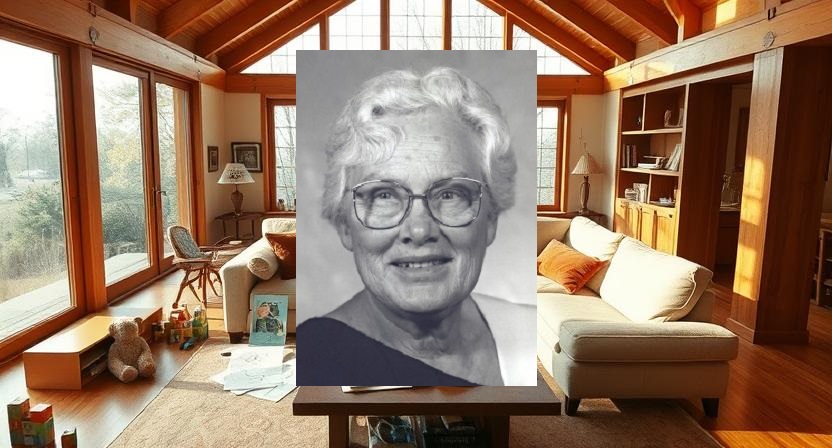
Mary Ellen Rudin (1924-2013) proved that impossible mathematical objects could exist, constructing topological spaces that defied decades of conjectures and transformed the landscape of modern mathematics. Her 1971 creation of the first Dowker space demolished a twenty-year-old conjecture and established her as one of the most formidable counterexample builders in topology. Working from the living room sofa of her Frank Lloyd Wright home whilst four children played around her, she pioneered the application of advanced set theory to geometric problems, proving that spaces could behave in ways that challenged mathematicians’ fundamental assumptions about normality and continuity.
Her story matters today because Rudin demonstrated how creative mathematical thinking can flourish outside conventional academic structures, whilst her topological innovations continue to influence computer science, data analysis, and modern geometric topology applications.
Mary Ellen, it’s wonderful to meet you here today. I understand you worked on some of the most challenging problems in topology, often describing them as puzzles. Could you start by telling us how you first discovered mathematics?
Oh my, it wasn’t really a discovery at all – it was more like mathematics found me! I was just a perfectly ordinary girl growing up in the wilds of Texas. My daddy was a civil engineer for the State Highway Department, so we’d pack up and move wherever his road-building projects took us. When I was small, we spent a lot of time around Leakey – that’s in southwest Texas, spelled just like the Senator’s name – and it was about as primitive as you could get. No electricity, no running water, no telephone. Our only contact with the outside world was the mail truck that came twice a week.
But you know, those conditions were actually perfect for a future mathematician, though I didn’t know it then. We had to make our own entertainment, and our games were very elaborate – purely in the imagination. We’d decide this tree was a castle and that rock was whatever we needed it to be, depending on whether we wanted to be Hollywood stars or ancient queens. I think that’s something that contributes to making a mathematician – having time to think and being in the habit of imagining complicated things.
That imaginative play sounds like it prepared you well for constructing mathematical spaces later. How did you end up studying with the famous R.L. Moore at the University of Texas?
Well, I certainly didn’t plan on it! I finished high school early and went to the University of Texas in 1941, not because I particularly wanted to study mathematics, but because I enjoyed school and my family valued education tremendously. My mother had been a teacher before marriage, and she expected I should earn my living doing something interesting.
At Texas, you had to take courses in all subjects your first two years. I took a bit of everything – astronomy, geology, physics, mathematics – and I liked them all just fine. But when it came time to choose a major, I needed one more course to graduate, and Moore’s course in the foundations of mathematics fit my schedule. That’s the only reason I took it!
But Moore – Professor R.L. Moore – he was something else entirely. The Moore Method meant you learned by discovering things yourself. He’d give us definitions and axioms, then problems to solve, but we weren’t allowed to read any books or get help from anyone. If you wanted credit for a result, it had to be your own work. You’d go to the board and present your solution, and the other students would point out errors.
That sounds quite intimidating. How did you adapt to this unique teaching approach?
Oh, it was terrifying at first! I remember Moore would often start by calling on the weakest student – or at least the one who’d contributed least recently. Sometimes nobody could solve the problem, and he’d just dismiss us and tell us to go think some more.
But I found I rather liked it. I’m very geometric in my thinking, you see. I’d lie on my dormitory bed with pencil and paper, drawing little pictures and trying this thing and that thing. I’m interested in how ideas fit together. I’m not good with numbers at all – Walter says I think one number is just like any other number – but I can visualise spaces and see how they behave.
The funny thing is, I later discovered that other students would secretly go to the library and look things up, but I never thought to do that. I was so used to making things up from my childhood games that it seemed natural to just figure it out myself.
Your thesis work created a counterexample to one of Moore’s own axioms. That must have been quite bold for a graduate student.
Well, I didn’t think of it as bold at the time! I was just working on the problem he’d given me. My thesis was about constructing an example of a non-separable Moore space that satisfies the countable chain condition. I published those results in three papers in the Duke Mathematics Journal.
Steve Watson later said that this work “represents one of the greatest accomplishments in set-theoretic topology,” but also that “the mathematics in these papers is of such depth that, even forty years later, they remain impenetrable to all but the most diligent and patient readers”. I suppose that’s rather typical of my work – it’s not hard to read because the writing is difficult, it’s hard because it’s just hard mathematics.
Let me ask you about your most famous achievement – constructing the first Dowker space in 1971. Can you explain what made this such a significant breakthrough?
Ah yes, the Dowker space. That really was like solving a jigsaw puzzle with no picture on the box – you know the pieces must fit together somehow, but you can’t see what the final image should look like.
The story begins with Clifford Hugh Dowker’s work in 1951. He proved that for any normal space X, the following are equivalent: X being a “Dowker space,” X cross the unit interval failing to be normal, and X failing to be countably meta-compact. But Dowker conjectured that no such spaces existed – that every normal space would have a normal product with the unit interval.
For twenty years, topologists tried to prove Dowker’s conjecture. The problem drove research in the field because it connected so many fundamental concepts about how spaces behave.
Walk us through your construction – how did you build this “impossible” space?
First, I should mention that I actually constructed a Dowker space twice. In 1955, I used what’s called a Suslin tree – a mathematical object whose existence is consistent with standard set theory but can’t be proven within it. That construction worked, but it depended on an axiom that might not be true.
But the breakthrough came in 1970 when I constructed a Dowker space using only standard ZFC set theory – no extra assumptions needed. This space was built as a subspace of an infinite product using what’s called the box topology.
The box topology is crucial here. In the usual product topology, basic open sets are allowed to be “non-trivial” in only finitely many coordinates. But in the box topology, a basic open set can be non-trivial in every coordinate simultaneously. This creates much stranger behaviour.
My space had cardinality – an enormous size. The construction required carefully balancing the space’s properties: it had to be normal (separating disjoint closed sets with disjoint open sets) but its product with the unit interval had to fail this normality condition.
What was your process for developing this construction? How do you approach such complex problems?
Well, as I mentioned, I do all my mathematics lying on the sofa in our living room! It’s a Frank Lloyd Wright house with 150 windows and everything opens onto this two-story living room. When my children were small, I’d be there with my pencil and paper, drawing pictures while they climbed all over me.
I think topology problems are like putting together a jigsaw puzzle when you don’t have the picture on the box. You know the pieces must fit somehow, but you can’t see what the final image should be. You try different combinations, you rotate pieces, you step back and look at what you have so far.
For the Dowker space, I had to understand exactly what properties I needed. The space had to be normal – that meant any two disjoint closed sets could be separated by disjoint open neighbourhoods. But when I formed the product, this separation property had to fail. The box topology was the key insight, because it creates much more complex interaction between coordinates than the ordinary product topology.
You mentioned that understanding required both intuition and rigorous proof. How do these work together in your research?
Mathematical intuition and formal proof aren’t opposites – they’re partners in a dance. My geometric intuition tells me what should be true, what constructions might work, where the interesting behaviour might hide. But then the formal machinery of set theory and topology lets me make these intuitions precise and verify they actually work.
Sometimes my intuition is wrong, of course! I’ll think I understand how a space should behave, then the formal proof reveals I’ve missed something crucial. But usually the intuition points me in the right direction, even if the details need sorting out.
For topology, I think geometrically even when dealing with very abstract spaces. I can visualise how points relate to each other, how neighbourhoods interact, where the pathological behaviour occurs. It’s rather like having a mental model of the space that I can manipulate and test.
Your work involved advanced set theory – Martin’s Axiom, forcing, independence results. How did you navigate this highly technical area?
Well, I should confess – I never did forcing arguments myself! I used the results that other researchers like Paul Cohen had proven about which statements were independent of ZFC, but I didn’t construct the models myself.
What I did was recognise when these set-theoretic tools could solve topological problems. Many of my papers use statements like Martin’s Axiom or the axiom ♢ that are true in some models of set theory but not in others. I’d figure out which axiom would give me the construction I needed, then use results from the set theory literature.
For instance, my 1976 construction of a small Dowker space used the Continuum Hypothesis. I could see that CH would give me the right cardinality constraints, even though the existence of such spaces remains open in ZFC alone.
It’s rather like being a craftsperson who knows which tools to use for different jobs, even if you don’t forge the tools yourself.
Let’s talk about another major achievement – your proof of the first Morita conjecture. What made this problem significant?
The Morita conjectures, formulated by Kiiti Morita in 1976, asked fundamental questions about when products of spaces inherit normality. The first conjecture asked: if X×Y is normal for every normal space Y, must X be discrete?
This connects to deep questions about how local properties of spaces relate to global behaviour of their products. It’s not obvious why requiring all products to be well-behaved should force a space to be discrete – to have no accumulation points.
I worked on this with Keiko Chiba and Teodor Przymusiński. We proved the first conjecture and showed that the second and third conjectures couldn’t be proven false using standard set theory. The techniques involved careful analysis of how normality behaves under products, plus sophisticated set-theoretic methods.
You also proved Nikiel’s conjecture in 1999, when you were 75 and had been retired for nearly a decade. Tell us about this remarkable late-career achievement.
Oh yes, that was particularly satisfying! Jacek Nikiel had conjectured in 1986 that a compact space is the continuous image of a totally ordered space if and only if it’s monotonically normal.
Monotonic normality means there’s a systematic way to assign neighbourhoods – given any point p in an open set U, there’s an open set H(p,U) containing p and contained in U, and these assignments interact well. It’s a strong but natural condition.
The problem required characterising which spaces arise as continuous images of ordered spaces. These are important because ordered spaces have such clean, understandable structure. If you can show a complicated space is the image of a simple ordered space, you’ve learned something fundamental about its nature.
The proof was quite technical, involving careful analysis of how monotonic normality constrains the local and global structure of spaces. Even at 75, I found the geometric intuition was still there – I could still visualise how the pieces should fit together.
Many of your constructions are called “counterexamples.” How do you view the role of counterexamples in mathematics?
Counterexamples are among the most important tools in mathematics! They prevent us from believing false theorems and force us to understand the true boundaries of our concepts.
In topology particularly, it’s easy to conjecture that all “nice” spaces should behave in certain ways. Someone might think: surely every normal space has property X, or certainly every compact space should have property Y. These conjectures often seem reasonable based on familiar examples.
But a single counterexample can destroy decades of accepted wisdom and redirect entire research programs. My Dowker space showed that normality and para-compactness could separate in ways people hadn’t imagined. The mathematical community had to rethink fundamental questions about product spaces and covering properties.
The art is constructing counterexamples that are minimally pathological – they violate the property you want to disprove, but they’re not so bizarre that they’re uninteresting. You want examples that illuminate genuine mathematical phenomena, not just freakish exceptions.
Looking back, you often described yourself as “following Walter’s career” rather than pursuing your own path. How do you view this characterisation now?
Well, I suppose that’s how I saw it then. Walter had clear career ambitions and a definite research programme. I was more… opportunistic, I suppose. I worked on problems that interested me without worrying much about building a systematic research agenda.
But looking back, I think I was perhaps too modest about my own contributions. The two-body problem – finding academic positions for both partners in a marriage – was much harder for women then than now. Universities simply didn’t expect to accommodate faculty wives who were also serious researchers.
I was fortunate that Wisconsin was willing to promote me from part-time lecturer directly to full professor in 1971. That’s almost unheard of! They recognised the quality of my work, even if I hadn’t followed a traditional career path.
And I did become the first Grace Chisholm Young Professor of Mathematics. That meant a lot to me – honouring a woman mathematician who had also struggled with the constraints of her era.
Was there tension between your role as a mother and your mathematical career?
Not really, no. I never saw any contradiction between being a mathematician and being a housewife – if anything, I was more driven to be a housewife. I liked doing mathematics in the middle of the living room with the children climbing all over me. I needed to feel comfortable and confident to do mathematics, and being in the centre of family life made me feel that way.
I think the key was never trying to separate these roles. Mathematics wasn’t something I did in isolation – it was part of our family life. The children grew up seeing that their mother thought about mathematical problems the way other people might work crossword puzzles or knit.
Of course, Walter needed more privacy for his work. He had a proper study where he could concentrate without interruption. But I never wanted a study. I liked knowing what was going on around me.
Let me ask about a professional misjudgement – can you share a time when your mathematical intuition led you astray?
Oh my, where do I start? Mathematical intuition is wonderful when it works, but it can also lead you down completely wrong paths.
I remember spending months on a problem where I was convinced that certain spaces had to be metrizable – that they could be given a distance function that generated their topology. I had this geometric picture in my mind of how the points should relate to each other, and it seemed obvious that a metric should exist.
But when I tried to construct the metric explicitly, everything fell apart. The constraints I needed were contradictory. It took me far longer than it should have to realise that my geometric intuition was simply wrong – these spaces couldn’t be metrized at all.
The lesson is that intuition is a starting point, not an ending point. It suggests what to try, but you must always verify with rigorous proof. Sometimes the most interesting mathematics emerges when your intuition fails and you have to understand why.
You worked during a time when the Moore Method was quite controversial. What’s your assessment of it now?
The Moore Method had both strengths and serious weaknesses. On the positive side, it forced students to think independently and develop their own mathematical intuition. You couldn’t just memorise techniques from textbooks – you had to understand the underlying concepts well enough to rediscover them yourself.
I think it helped me become good at constructing counterexamples, because I’d spent so much time building mathematical objects from scratch rather than just applying existing theorems.
But the Method also had troubling aspects. Moore was quite authoritarian, and he had some problematic views about who could succeed in mathematics. There were barriers for women and minorities that weren’t justified by mathematical ability.
And the Method only works for certain types of mathematics. It’s fine for topics like point-set topology where you can build intuition from relatively simple axioms. But it wouldn’t work for areas requiring extensive background knowledge or computational techniques.
I never used the Moore Method myself when I started teaching, because I guess I didn’t believe in it. I preferred a more collaborative approach where students could ask questions and learn from each other as well as discovering things independently.
Your mathematical legacy continues through the Mary Ellen Rudin Young Researcher Award. How do you hope today’s young mathematicians will build on your work?
I hope they’ll be fearless about tackling problems that seem impossible! Some of my most important work came from refusing to accept that certain mathematical objects couldn’t exist. When everyone believes something is impossible, that’s often the most interesting time to look for counterexamples.
I also hope they’ll remember that mathematics is ultimately about understanding, not just proving theorems. The goal is to see why things work the way they do, to build intuition about the structure of mathematical reality.
And I’d particularly encourage young women not to worry too much about following conventional career paths. Some of my best work happened because I was willing to follow my curiosity rather than trying to build a systematic research programme. If a problem interests you and you can see a way to attack it, go ahead and try – even if it doesn’t fit neatly into anyone else’s research agenda.
Finally, what advice would you give to someone trying to understand your approach to mathematical research?
Remember that topology problems are like jigsaw puzzles without the picture on the box. You know the pieces must fit together somehow, but you can’t see what the final image should be. You have to be patient, try different combinations, be willing to start over when something doesn’t work.
Don’t be afraid to draw pictures, even of very abstract spaces. Mathematics is visual, even when it doesn’t seem to be. If you can see how the mathematical objects behave, you’re halfway to understanding them.
And most importantly – make sure you feel comfortable and confident when you work. Whether that’s in a quiet study or in the middle of a bustling family room, find the environment where your mind works best. Mathematics requires both technical skill and creative insight, and creativity flourishes when you’re relaxed and happy.
The impossible spaces I built were impossible only until someone figured out how to construct them. There are undoubtedly many more impossible things waiting to be discovered by the next generation of mathematicians. I hope they have as much fun finding them as I did!
Letters and emails
Since our interview with Mary Ellen Rudin was published, we’ve received an overwhelming response from readers around the world who want to explore her mathematical insights and personal journey even further. We’ve selected five particularly thoughtful letters and emails from our growing community – spanning five continents – whose questions probe deeper into her technical methods, her unconventional career path, and what she might say to those walking in her footsteps today.
Ayumi Kobayashi, 34, Data Scientist, Tokyo, Japan:
Professor Rudin, your work with box topology and infinite products has fascinating parallels to high-dimensional data analysis we use in machine learning today. When you were constructing these complex topological spaces in the 1970s without computational tools, how did you verify that your constructions actually had the properties you intended? Were there moments when you discovered your space behaved differently than expected, and how did you troubleshoot those surprises?
Oh my goodness, Ayumi, what a wonderful question! You’re absolutely right about the parallels – though I have to confess, when I was building those spaces in the 1970s, I never could have imagined that someday machines would be crunching through high-dimensional data sets the way you describe.
You ask about verification without computational tools – well, that was both the blessing and the curse of working in pure mathematics back then. Everything had to be checked by hand, step by careful step. When I was constructing that first ZFC Dowker space in 1970, I’d spend hours – sometimes days – just verifying that each part of the construction actually worked the way I claimed it would.
The box topology was particularly tricky because it behaves so differently from the ordinary product topology. In the product topology, you can only have “non-trivial” behaviour in finitely many coordinates at once. But in the box topology, every single coordinate can be doing something interesting simultaneously. That creates incredibly complex interactions that you simply can’t visualise in any ordinary sense.
My verification process was quite primitive by your standards, I’m sure! I’d work with pencil and paper, drawing countless little diagrams to represent how the neighbourhoods behaved. For infinite products, I couldn’t draw the whole thing, of course, but I could sketch representative pieces and use mathematical induction to extend the arguments. I’d check each property separately – normality, the failure of the product to be normal, the cardinality constraints, everything.
Oh my, did I discover surprises! I remember one construction where I was absolutely convinced the space would have a particular covering property, but when I worked through the details carefully, it turned out that the very thing that made it satisfy the main conditions I wanted also prevented it from having this other property I’d expected. That sent me back to the drawing board for weeks.
The troubleshooting process was rather like detective work. When something didn’t behave as expected, I’d have to trace through every step of the construction, checking each axiom and each logical deduction. Sometimes the error was in my intuition about how the space should behave. Other times, I’d made a computational mistake – perhaps miscounting cardinalities or misapplying a set-theoretic principle.
Ken Kunen used to joke that my office hours were really “diagnosis sessions” where students would bring me their constructions that weren’t working, and we’d figure out together what had gone wrong. It was rather like debugging code, except our “code” was written in the language of set theory and topology.
The most challenging part was verifying the normality properties. To show a space is normal, you need to demonstrate that any two disjoint closed sets can be separated by disjoint open neighbourhoods. But to show the product fails normality, you need to find specific disjoint closed sets that can’t be separated. Finding those pathological sets required a kind of mathematical intuition that I’m not sure could be easily automated, even today.
I suppose your modern verification methods would have caught my errors much more quickly than my pencil-and-paper approach! But I do wonder whether having such powerful computational tools might sometimes discourage the kind of deep geometric thinking that led me to these constructions in the first place. There’s something about working through the details by hand that forces you to really understand what’s happening in the space.
Luka Vuković, 42, Philosophy of Science Professor, Belgrade, Serbia:
Your comment about topology problems being like ‘jigsaw puzzles without the picture on the box’ suggests a particular view of mathematical truth – that the solution exists and must be discovered rather than invented. But when you constructed counterexamples that disproved long-standing conjectures, were you uncovering hidden mathematical reality, or were you creating new mathematical objects? How do you see the relationship between mathematical discovery and mathematical creation?
Oh my, Luka, that’s such a deep question! You know, I’ve been thinking about this puzzle for decades – whether I was uncovering mathematical truths that were already “there” somehow, or whether I was creating new objects that never existed before.
When I constructed that first Dowker space, there were moments when it genuinely felt like I was excavating something that had been buried in the mathematical landscape all along. The space seemed to reveal its properties to me as I built it, almost like it was telling me its own story. But then again, I was making so many choices – which set-theoretic axioms to use, how to define the topology, which construction method would work – that it’s hard to deny the creative, inventive aspect.
I think the jigsaw puzzle metaphor I’m so fond of captures both sides of this question. The pieces – the basic mathematical concepts, the axioms, the logical rules – those feel discovered to me. They seem to be fundamental features of how mathematical reasoning works, regardless of who’s doing the reasoning. But the picture we make when we put those pieces together? That feels more invented.
When I was working on counterexamples, I was often trying to show that certain mathematical objects could exist even though people thought they couldn’t. Take my screenable Dowker space – I had to use the set-theoretic axiom ♢++ in the construction. Now, ♢++ is this peculiar axiom that other researchers had proven could be true in some models of set theory but not in others. Was I discovering that spaces satisfying ♢++ could have these strange properties, or was I inventing a space that happened to work under that axiom?
I lean toward thinking that the relationship between the axiom and the space’s behaviour was already there – that was discovered. But the particular space I constructed, with all its intricate details, that felt like invention. Burton Jones once interrupted me during a workshop when I was explaining a particularly complex construction and asked, “What allows you to say that?” I told him it was “God-given,” but what I meant was that some insight about how the mathematical pieces fit together had come to me. But translating that insight into a rigorous construction – that required invention.
You know, I never thought much about mathematical Platonism or formalism when I was actually doing the work. Those philosophical frameworks seemed awfully grand for what felt like very practical problems. I was trying to build spaces with specific properties, and I used whatever tools seemed most likely to work. If Martin’s Axiom gave me the cardinalities I needed, I’d use Martin’s Axiom. If the Continuum Hypothesis provided the right framework, I’d work within CH.
But looking back, I suppose I was something of a mathematical Platonist in practice. I really did believe that the topological relationships I was exploring had a kind of objective reality. When I proved that certain conjectures were false, it felt like I was correcting mistaken beliefs about what was already true, not like I was arbitrarily choosing one definition over another.
The counterexamples particularly convinced me that mathematical truth isn’t just a matter of convention. If someone conjectured that all normal spaces were paracompact, and I showed them a normal space that wasn’t paracompact, I wasn’t just proposing an alternative definition of “normal” or “paracompact.” I was showing that their conjecture described a relationship that didn’t actually hold in mathematical reality.
At the same time, the creative aspect of my work was undeniable. Each construction required imagination, intuition about which approach might work, aesthetic judgments about elegance and simplicity. Mathematics isn’t just logic – it requires the same kind of creative problem-solving that you’d use in engineering or art.
I think maybe the discovery-invention dichotomy is too simple. Mathematical objects exist in a sense – there are objective facts about which spaces can have which properties, which axioms imply which theorems. But accessing those truths, building constructions that reveal them, finding the right language to describe them – that’s invention. We invent our way toward discovering what was always there.
Lauren Davis, 28, Graduate Student in Pure Mathematics, Toronto, Canada:
I’m struck by how you described never having a proper office and doing your best work on the living room sofa. As someone struggling to find my own creative process in academia, I’m curious – did you ever feel pressure to conform to more ‘professional’ working styles? And when you became the Grace Chisholm Young Professor, did institutional expectations change how you approached your research, or were you able to maintain that same informal, family-centred approach?
Oh Lauren, bless your heart! You’ve hit right on something I think about quite a lot. You know, I came from what I always call the “housewives’ generation” – there was just no question in my mind that I’d have children and that I’d follow Walter wherever his career took us. That was simply how things were done in those days.
Now, did I feel pressure to conform to more professional working styles? Well, the funny thing is, I never really had to! You see, for most of my career I wasn’t in a regular faculty position at all. When we came to Wisconsin in 1959, there was this nepotism rule that prevented me from having a real professorship because Walter already had one. So I stayed a “lecturer” for twelve whole years – from 1959 until 1971.
But you know what? That arrangement had its advantages! I didn’t have to serve on committees, I didn’t have to play departmental politics, and I didn’t have to prove to anybody that I was a mathematician. The pressure was entirely from within – I did mathematics because I wanted to do it and enjoyed doing it, not because it would further my career.
I set up my workspace right there in our Frank Lloyd Wright house with its 150 windows and that wonderful two-story living room. I’d be lying on the sofa with my pencil and paper, working out topological constructions while the children climbed all over me. Catherine and Eleanor were born in the first two years after Walter and I married, and then we had Robert and Charles later on. People used to ask me how in the world I managed to do serious mathematics with four children around, but honestly, I needed to feel comfortable and confident to think clearly, and being in the centre of family life made me feel exactly that way.
I had this absolutely fantastic woman named Lila Hilgendorf who helped with the children. She’d been a farmer’s wife with six children of her own, and she was just wonderful with ours. When I’d walk into the house, she’d walk out, and when I had to go somewhere, she was there. We had that arrangement until she died – she was absolutely the best mother I ever saw.
When I became the Grace Chisholm Young Professor in 1981, things did change somewhat. Grace Chisholm Young was herself a mathematician who’d struggled with the constraints women faced in her era, so carrying that title meant a great deal to me. It was a way of honouring not just my work, but the whole tradition of women who’d persevered in mathematics despite the obstacles.
But even then, I never felt I had to change my working style fundamentally. I suppose I was fortunate that by the time I got promoted to full professor in 1971 – they jumped me straight from lecturer to full professor, which was almost unheard of – my reputation in the mathematical community was strong enough that people accepted my rather unconventional approach.
You know, I think there’s something important about finding your own creative process and sticking with it, even if it doesn’t look like what everyone else is doing. Mathematics isn’t like factory work where everyone has to follow the same procedure. It’s creative work, and creativity flourishes under different conditions for different people.
I always told my students – and I hope this helps you, dear – that you have to find the environment where your mind works best. For me, that was never a quiet office with the door closed. I needed the energy of family life around me. Other mathematicians need complete silence and isolation. Both approaches can produce excellent mathematics.
The important thing is not to let other people’s expectations of how you “should” work interfere with discovering how you actually do work best. If you can do your best thinking while walking around campus, then walk around campus! If you need music playing, play music! The mathematics is what matters, not whether you’re following someone else’s idea of proper professional behaviour.
Esteban Cabrera, 31, Applied Mathematician, Buenos Aires, Argentina:
Here’s a fascinating thought experiment: imagine you had started your career with today’s computational tools, collaborative platforms, and computer-assisted proof systems like Lean or Coq. Do you think these technologies would have accelerated your counterexample constructions, or might they have actually hindered the kind of geometric intuition that made your work so powerful? Would Mary Ellen Rudin with modern tools have solved different problems entirely?
Oh, Esteban, what a delightfully mind-bending question! You’re asking me to imagine myself with tools that sound almost like science fiction from where I sit in the 1970s. Computer-assisted proofs? Interactive proof systems? My goodness!
You know, the four colour theorem was just proven using a computer in 1976, and that caused quite a stir in the mathematical community. Some folks are still arguing about whether it’s really a “proof” if a human being can’t check every step by hand. So the idea of routine computer assistance in mathematical proof-checking – well, that’s quite something to contemplate!
I think about this question often, actually, because my geometric intuition has been so central to everything I’ve done. When I was constructing that Dowker space, I’d lie there on the sofa with my pencil and paper, drawing little pictures of how neighbourhoods should behave, visualising how the box topology would create those strange interactions between coordinates. Could a machine have helped me see those relationships?
On one hand, I suspect your modern computational tools would have made the verification process much more reliable. Goodness knows I spent countless hours checking and rechecking that each part of my constructions actually had the properties I claimed! If some kind of automated system could have verified that my space was indeed normal, or that its product with the unit interval failed normality, that would have saved me weeks of tedious hand-calculations.
But here’s what worries me about relying too heavily on such tools: I wonder whether they might make mathematicians intellectually lazy. My geometric intuition developed precisely because I had to work everything out by hand, drawing pictures, manipulating the concepts in my head until I really understood what was happening in those spaces. When Burton Jones asked me what allowed me to make a particular claim in one of my constructions, I told him it was “God-given” – but what I really meant was that I’d developed such an intimate understanding of how these topological objects behaved that I could sense their properties almost intuitively.
Would I have developed that same deep understanding if machines had been doing the verification for me? I’m not sure. There’s something about the slow, painstaking process of working through details by hand that forces you to really grapple with the mathematical concepts. When you have to draw every neighbourhood, check every property step by step, you develop a kind of geometric insight that I’m not certain could be automated.
On the other hand, I suspect I might have tackled much bigger problems with computational assistance! My constructions were often limited by what I could reasonably verify by hand. With more powerful tools, I might have been able to explore spaces of much higher cardinality, or work with more complex set-theoretic axioms.
You mention proof assistants like Lean and Coq – these sound fascinating! If they could have helped me be more confident in my constructions while still requiring me to understand the underlying geometric relationships, that might have been the perfect combination.
I think the key question is whether modern tools would enhance geometric intuition or replace it. If they’re designed to help mathematicians see patterns and relationships more clearly, to visualise complex structures that are hard to draw by hand, then I think they could be wonderful. But if they encourage people to just follow mechanical procedures without really understanding what’s happening mathematically, then something important would be lost.
What I’ve always loved about topology is how it forces you to think creatively about space and continuity. The problems I worked on weren’t just computational challenges – they required genuine insight about how mathematical objects could behave. I suppose my question for your generation would be: do these powerful tools help you develop that kind of insight, or do they sometimes substitute for it?
One thing I’m certain of – if I’d had access to such tools, I probably would have made some spectacular mistakes very efficiently! Nothing beats the human mind for creative error-making.
Ifeoma Balogun, 39, STEM Education Researcher, Lagos, Nigeria:
You mentioned that the Moore Method had ‘troubling aspects’ regarding barriers for women and minorities, yet it clearly worked well for you personally. As someone now working to make STEM more inclusive across Africa, I’m wondering – if you could redesign mathematical education today, what elements from your Texas experience would you preserve, and what would you completely reimagine to ensure brilliant minds from all backgrounds could flourish?
Oh Ifeoma, what a thoughtful and important question! You’re absolutely right that the Moore Method had some real problems when it came to including everyone fairly. This is something I’ve thought about a great deal over the years, particularly after I started teaching myself and saw how different approaches worked for different kinds of students.
You see, Moore himself had some very troubling views about who could succeed in mathematics. He simply didn’t believe that women or minorities had the same mathematical abilities as white men. That created an atmosphere where certain students felt they had to prove themselves in ways others didn’t. Even though the Method worked for me personally, I recognise now that I was probably one of the exceptions he grudgingly allowed rather than someone he truly welcomed.
The competitive aspect of the Moore Method – students presenting at the board, being challenged by classmates, having to defend their proofs under pressure – that created additional barriers for folks who were already feeling like outsiders. If you’re the only woman in the room, or the only Black student, that kind of public scrutiny can feel quite different than it does for someone who fits the expected mould.
When I started teaching myself, I quickly decided I didn’t believe in the Moore Method. Oh, I kept some elements – I think students do need to work through problems themselves rather than just watching someone else solve them. But I tried to create a much more collaborative atmosphere where students could ask questions, learn from each other, and feel supported rather than constantly tested.
If I were redesigning mathematical education today, especially thinking about brilliant minds from all backgrounds, I’d want to preserve that sense of discovery and independent thinking that the Moore Method could foster. There’s real value in having students construct their own understanding rather than just memorising procedures. But I’d wrap it in a completely different social environment.
First, I’d make sure every student felt welcomed and valued from day one. That means acknowledging different learning styles, different cultural approaches to problem-solving, different ways of expressing mathematical ideas. Not everyone thinks the way I do – lying on the sofa, drawing pictures, working things out geometrically. Some students are more algebraic in their thinking, others more computational, others more verbal.
I’d also eliminate that harsh competitive element. Instead of having one student present while others try to find holes in their reasoning, I’d have students work in small groups, presenting to each other, building on each other’s ideas. The goal would be collective understanding rather than individual triumph.
And goodness, I’d make sure students had access to the broader mathematical literature! One of the most limiting aspects of my education under Moore was that I never read any mathematical papers until after I finished my thesis. I had no idea how mathematical language was actually used in the profession. That kind of isolation might have preserved some theoretical purity, but it certainly didn’t prepare me well for the mathematical community.
For students from backgrounds that haven’t traditionally been welcomed in mathematics, I think it’s particularly important to show them the connections between mathematical thinking and their own cultural traditions of problem-solving, pattern recognition, logical reasoning. Mathematics isn’t some foreign thing that only certain kinds of people can do – it’s a human activity that builds on ways of thinking that exist in every culture.
I’d also want multiple pathways into advanced mathematics. Not everyone learns best through pure abstraction. Some students might come to topology through applications in computer science or data analysis. Others might understand geometric concepts better through hands-on construction or visual representation.
The key insight I’ve gained over the years is that mathematical ability isn’t rare or special – it’s much more widespread than our traditional teaching methods suggest. But our methods have to match students where they are, not force them all into the same narrow approach that happened to work for someone like me.
What I’d preserve from my own experience is that sense of mathematics as creative, playful, puzzle-solving activity. The joy I felt working on those construction problems, the satisfaction of seeing how pieces fit together – that’s what I’d want every student to experience, regardless of their background or the path that brought them to mathematics.
Reflection
Mary Ellen Rudin passed away peacefully at her home in Madison on 18th March 2013, at the age of 88. Her death marked the end of a remarkable mathematical journey that challenged fundamental assumptions about how brilliant work gets accomplished and recognised.
Throughout our conversation, several themes emerged that illuminate both her individual genius and the broader challenges facing women in STEM. Her famous assertion that topology problems were “like jigsaw puzzles without the picture on the box” reveals not just her problem-solving approach, but her ability to find clarity in mathematical chaos. Her insistence on working from the family sofa whilst children climbed around her challenges academic orthodoxy about what professional mathematical work should look like.
Perhaps most striking was her self-assessment as someone who “followed Walter’s career” rather than pursuing her own path. This perspective, whilst reflecting the constraints of her era, arguably undervalues her extraordinary achievements. Her construction of the first Dowker space didn’t just solve a twenty-year-old problem – it redefined what mathematicians thought was possible in topological spaces.
The historical record contains gaps and uncertainties about the full extent of her contributions. Many of her most innovative techniques remain embedded in dense technical papers that few have fully unpacked, and her informal mentoring of students and colleagues likely influenced mathematics in ways that standard academic measures cannot capture.
Today, Rudin’s work enjoys a vibrant afterlife. The Mary Ellen Rudin Young Researcher Award, established by Elsevier in 2013, continues to recognise emerging talent in topology. More significantly, her Dowker spaces have found unexpected applications in modern computational topology, particularly in analysing asymmetric networks and persistent homology diagrams used in data analysis. Her counterexample constructions inform contemporary work in geometric topology, where researchers still employ her techniques for building spaces with prescribed pathological properties.
The mathematical community that knew her described studying her papers as earning “power to which few have access”. For today’s researchers navigating an increasingly collaborative and computational landscape, Rudin’s story offers both inspiration and provocation: that mathematical insight cannot be mechanised, that creativity flourishes under diverse conditions, and that the most profound discoveries often emerge from questioning what everyone assumes to be impossible.
Her legacy reminds us that mathematics advances not just through building upon existing knowledge, but through the courage to construct entirely new mathematical realities – impossible spaces that exist only because someone dared to build them.
Who have we missed?
This series is all about recovering the voices history left behind – and I’d love your help finding the next one. If there’s a woman in STEM you think deserves to be interviewed in this way – whether a forgotten inventor, unsung technician, or overlooked researcher – please share her story.
Email me at voxmeditantis@gmail.com or leave a comment below with your suggestion – even just a name is a great start. Let’s keep uncovering the women who shaped science and innovation, one conversation at a time.
Editorial Note: This interview represents a dramatised reconstruction based on extensive historical research, mathematical papers, biographical accounts, and recorded interviews with Mary Ellen Rudin throughout her career. While grounded in documented facts about her life, work, and expressed views, the conversational format and specific responses are interpretive reconstructions designed to illuminate her mathematical contributions and personal perspectives. Readers should understand this as a creative historical interpretation rather than a verbatim transcript, crafted to honour both her scientific legacy and her distinctive voice as remembered by the mathematical community.
Bob Lynn | © 2025 Vox Meditantis. All rights reserved. | 🌐 Translate

 Vox Meditantis
Leave a comment