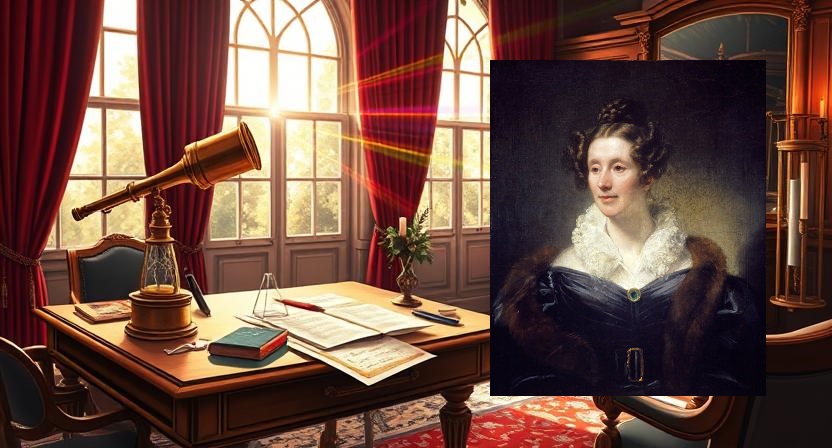
Mary Somerville stands as one of the most influential yet undervalued figures in the history of science, a woman whose intellectual bridgebuilding fundamentally shaped how we understand the natural world. Born in 1780 in the Scottish Borders, she became the first person to be officially called a “scientist” – a term coined specifically to describe her interdisciplinary approach to knowledge. Her groundbreaking translations and original works brought complex continental mathematics to British shores, made her the tutor of Ada Lovelace, and earned her recognition as the “Queen of Science” in Victorian Britain.
Despite institutional barriers that denied her formal education, Somerville’s tenacious self-study led to discoveries in magnetism, predictions that contributed to Neptune’s discovery, and textbooks that educated generations. Yet her holistic vision of interconnected sciences – precisely what made her extraordinary – has often been overlooked in an era increasingly obsessed with narrow specialisation. Today, as we recognise the vital importance of interdisciplinary research and science communication, her story offers profound lessons about intellectual courage, the power of synthesis, and the ongoing struggle for women’s recognition in science.
It’s wonderful to meet you, Mrs Somerville. I’m particularly intrigued to be speaking with the person for whom the word “scientist” was first coined. How does it feel to know that William Whewell created that term specifically to describe your work in 1834?
Oh, my dear, if only you knew the full circumstances! Mr Whewell was quite beside himself trying to describe what I had accomplished in my “Connexion of the Physical Sciences.” He wrote that curious review, praising the work to the heavens whilst simultaneously marvelling that a woman could grasp such matters. “Some women,” he wrote with evident astonishment, “have advanced so far in philosophy as to look with dry eyes upon oxygen and hydrogen!” Can you imagine? As if the mere sight of chemical formulae should send us into vapours!
But what truly exercised him was the scope of my work – how I had woven together astronomy, physics, chemistry, and geography into a coherent whole. He recognised something that escaped many of his contemporaries: that these branches of natural philosophy were not separate kingdoms but parts of a greater empire. “What do you call someone who studies science in general?” he wondered aloud, and settled upon “scientist” by analogy with “artist.”
The irony was not lost on me that whilst my male colleagues styled themselves “men of science” or “natural philosophers,” they needed an entirely new word to encompass what I was doing. I suspect Mr Whewell understood, perhaps better than he intended, that my approach represented something different – not merely the accumulation of facts within narrow boundaries, but the illumination of connections between seemingly disparate phenomena.
Your childhood education was quite limited compared to your male contemporaries. Can you walk us through how you became so formidable in mathematics despite these constraints?
Limited? My dear, that’s rather like saying a desert is somewhat dry! I received precisely one year of formal schooling at age ten – enough to learn reading and writing, and a smattering of French. My family considered this quite sufficient for a young lady. Mathematics was viewed as decidedly unwholesome for the female mind.
But providence works in curious ways. At thirteen, I glimpsed some algebraic symbols in a ladies’ magazine – of all places! – and these strange markings captivated me entirely. I pestered everyone I could find to explain them, much to my parents’ dismay. My father worried that too much study would damage my health, whilst my mother feared it would make me unmarriageable.
My true education began in earnest during my first widowhood. When Captain Greig died in 1807, I found myself with a comfortable inheritance and, for the first time in my life, the freedom to pursue my own course. I set about acquiring proper mathematical texts – Newton’s Principia, Euler’s works, Lagrange’s treatises. I had to teach myself French to access the continental mathematicians whose methods were far more advanced than what passed for mathematics in Britain at the time.
The key was disciplined self-instruction. I would rise before dawn, work through mathematical problems whilst the household slept, then fulfil my domestic duties during the day. When I remarried my dear William in 1812, I gained not just a husband but a true intellectual companion who encouraged my studies rather than hindering them.
Let’s talk about your first major scientific contribution – your 1826 paper on the magnetic properties of violet light. Can you explain what you discovered and why it mattered?
Ah, now we come to proper experimental work! In 1813, Professor Morichini in Rome claimed he could magnetise steel needles by exposing them to violet rays of the solar spectrum. Several attempts to replicate this in Pavia and Montpellier had failed, and I suspect many thought the whole business rather fanciful. But the unusually clear summer of 1825 in London provided perfect conditions for such delicate experiments.
I constructed my apparatus with considerable care. Using an equiangular prism of flint glass fixed in a window-shutter, I cast a spectrum onto a panel some five feet distant. The crucial insight was realising that if violet light could indeed magnetise steel, the effect would not be uniform along the needle’s length. So I covered precisely half of each test needle with paper, exposing only one end to the violet rays.
The results, after repeated trials, were unmistakable. Needles exposed with their points in the violet region consistently acquired polarity – the exposed end becoming a north pole, the covered end a south pole. I tested this rigorously using my magnetic compass, which I had fashioned from a magnetised sewing needle mounted in cork with a glass cap.
What made this work significant was not merely confirming Morichini’s observation, but demonstrating the precision required for such investigations. The magnetic effect was genuine but exceedingly subtle – requiring perfect atmospheric conditions, careful apparatus design, and repeated measurement. It was, if I may say so, a proper piece of experimental natural philosophy.
The Royal Society published this work in their Philosophical Transactions – the first paper by a woman to appear there, aside from Caroline Herschel’s astronomical observations. More importantly, it established that I could conduct original research, not merely translate the work of others.
Your translation of Laplace’s “Mécanique Céleste” became “The Mechanism of the Heavens.” But this was far more than a translation, wasn’t it? Can you walk us through the technical challenges and your innovations?
Indeed, calling it merely a translation does grave injustice to the labour involved! Lord Brougham approached me in 1827, hoping I might produce a condensed English version of Laplace’s five-volume masterwork for his Society for the Diffusion of Useful Knowledge. What he envisioned was a popular treatise that working men might read.
But once I began working through Laplace’s mathematics, I realised the impossibility of such simplification. The French master had compressed decades of the most advanced analytical methods into elegant but impenetrable formulae. Where Laplace might devote a single line to a transformation that would baffle most British mathematicians, I required pages of detailed exposition.
Take, for instance, his treatment of planetary perturbations. Laplace employed what we call the method of successive approximations, using infinite series and partial differential equations that were utterly foreign to British mathematical practice. I had to reconstruct each derivation step by step, translating not merely from French to English, but from the analytical methods of continental Europe to forms that Cambridge-trained mathematicians could follow.
My innovation lay in providing what modern pedagogues might call “scaffolding.” For every major theorem, I supplied multiple approaches – geometric intuition alongside analytical rigour, numerical examples alongside general proofs. I added extensive footnotes explaining terminology, inserted intermediate steps that Laplace omitted, and provided physical interpretations of mathematical abstractions.
The work took me four years, during which I corresponded extensively with John Herschel, Augustus De Morgan, and Charles Babbage. Sir John, in particular, helped me navigate the most challenging sections on lunar theory and the three-body problem.
The result was not Laplace’s work translated, but Laplace’s work made comprehensible to English readers. It became the standard text at Cambridge and remained so for half a century. More importantly, it demonstrated that the superior analytical methods of the continent could be successfully transplanted to British soil.
In your “Connection of the Physical Sciences,” you made a prediction about Uranus that later led to the discovery of Neptune. Can you explain that insight?
Ah, that observation in my third edition of 1836! It demonstrates precisely what I mean by the connexion of the physical sciences – how careful attention to anomalies in one branch can illuminate discoveries in another.
The orbit of Uranus had been troubling astronomers since its discovery by William Herschel in 1781. Despite our best calculations incorporating the gravitational influences of Jupiter and Saturn, the planet persisted in deviating from its predicted path. These discrepancies were small but measurable – the kind of error that sets a natural philosopher’s mind racing.
Now, Newton’s inverse square law had proven itself remarkably reliable for all other celestial mechanics. The success of perturbation theory in explaining the complex dance of Jupiter and Saturn’s mutual influence suggested our mathematical methods were sound. So if our calculations were correct and our theory reliable, what could account for Uranus behaving so obstinately?
The most elegant solution was to suppose another gravitational influence – a trans-Uranian planet whose pull was causing these observed perturbations. I wrote in that edition: “The difficulties in the theory of Uranus may arise from the action of an undiscovered planet.” It was, I confess, more hypothesis than calculation, but it was founded upon solid reasoning.
Young John Couch Adams read that passage and set himself the formidable task of calculating where such a planet might lie. His work, along with that of Urbain Le Verrier in France, led to the telescopic discovery of Neptune in 1846. I take no credit for the mathematical tour de force they accomplished, but I am rather proud that my synthesis of existing knowledge pointed toward the possibility.
This exemplifies why I believe so firmly in the interconnectedness of natural phenomena. An anomaly in orbital mechanics, interpreted through gravitational theory, revealed the existence of an entirely new world.
You were Ada Lovelace’s mathematics tutor. What was she like as a student, and how did you nurture her extraordinary mind?
Ada! What a remarkable young woman – brilliant, restless, and utterly unafraid of intellectual challenges. She came to me in 1834, barely nineteen but already displaying that peculiar combination of Byron’s imaginative fire and her mother’s mathematical precision. Lady Byron was most anxious that Ada’s education should emphasise rational subjects to counteract any inherited poetical tendencies!
Ada possessed what I can only describe as a architectural mind – she could perceive the underlying structure of mathematical relationships with startling clarity. Where many students stumble over computational details, Ada grasped the broader patterns. She would write to me with questions that often revealed insights I had not myself considered.
I remember one letter where she described her fascination with Babbage’s Analytical Engine. She wrote, “I am afraid that when a machine, or a lecture, or anything of the kind comes in my way, I have no regard for time, space, or any other ordinary obstacles.” That sentence captures her essence perfectly – a mind that would not be bounded by conventional limitations.
My approach with Ada was to encourage her to see mathematics not as mere calculation but as a language for describing natural relationships. We worked through problems in analytical geometry, differential calculus, and the theory of functions. But I always emphasised the conceptual foundations rather than rote procedures.
What made Ada special was her ability to envision applications beyond pure mathematics. When she studied the Analytical Engine, she immediately grasped its potential for operations beyond arithmetic – for manipulating symbols according to logical rules. Her famous Note G, describing what we might now call programming concepts, emerged from this broader vision.
I fear Ada’s mathematical talents were never fully realised. Marriage, children, and sadly her gambling consumed energies that might have produced extraordinary discoveries. But in our correspondence, I glimpsed a mind capable of genuine innovation. She signed her letters “Ever yours, mathematically” – a phrase that perfectly captured her devotion to our shared pursuit.
You mention that you made some professional misjudgements along the way. Can you share one mistake that taught you something important?
Indeed, I was by no means infallible! One error that still causes me some embarrassment concerns my interpretation of certain magnetic phenomena. In my enthusiasm following the success of my solar spectrum experiments, I became rather too eager to discover magnetic effects everywhere.
I convinced myself, around 1828, that I had detected magnetic properties in various organic substances – silk fibres, plant materials, even human hair. I spent months conducting elaborate experiments, carefully documenting what I believed were magnetic orientations in these materials. I was preparing papers for the Royal Society, quite confident in my observations.
Fortunately, before publishing, I sought advice from Michael Faraday, who was then beginning his great researches into electromagnetic phenomena. With his characteristic thoroughness, Faraday helped me design more rigorous control experiments. We discovered that my “magnetic” effects were largely artifacts of air currents, temperature variations, and subtle mechanical disturbances I had failed to account for.
The humiliation was considerable, but the lesson invaluable. I had allowed my desire to make discoveries cloud my experimental judgement. Faraday taught me that extraordinary claims require extraordinary evidence, and that the most dangerous errors come from seeing patterns where none exist.
This experience made me far more cautious in my subsequent work, but also more collaborative. I learned to seek independent verification before drawing conclusions, and to design experiments that could potentially falsify my hypotheses rather than merely confirm them.
The mistake ultimately strengthened my scientific method. In my later books, I was scrupulous about distinguishing between well-established facts and speculative interpretations. It is better to be cautious and correct than bold and mistaken.
How do you view the increasing specialisation in science that was occurring during your lifetime? Your interdisciplinary approach seems quite different.
This growing compartmentalisation troubles me greatly! I observe my younger colleagues retreating into ever-narrower domains – chemists who refuse to consider astronomical phenomena, mathematicians who disdain physical applications, naturalists who ignore the quantitative methods that might illuminate their observations.
They mistake the trees for the forest entirely! Nature does not recognise the artificial boundaries we impose upon knowledge. The same fundamental principles – attraction, repulsion, periodicity, conservation – operate whether we are studying planetary motions, chemical affinities, or the circulation of ocean currents.
Consider the profound connections I attempted to illuminate in my “Connexion of the Physical Sciences.” The tides that rise and fall in our harbours are governed by the same gravitational forces that maintain planetary orbits. The magnetism that orients a compass needle relates to the great magnetic field surrounding our Earth, which in turn influences the aurora borealis dancing in polar skies. Light, heat, magnetism, and chemical action are not separate phenomena but different manifestations of underlying unities.
Yet I see specialists who spend their entire careers studying one narrow aspect of these interconnected systems whilst remaining wilfully ignorant of the broader relationships! They remind me of scholars who might study individual letters without ever learning to read complete sentences.
The danger extends beyond mere intellectual limitation. True understanding – the kind that enables prediction and control – emerges from perceiving patterns across different domains. My prediction about the trans-Uranian planet arose precisely because I could synthesise gravitational theory, observational astronomy, and perturbation mathematics.
I fear this specialisation stems partly from the increasing professionalisation of natural philosophy. When knowledge becomes a means of earning academic position rather than understanding creation, men naturally seek niches where they can establish exclusive expertise. But nature rewards synthesis, not isolation.
What do you think your legacy will be? How would you like to be remembered?
I hope to be remembered not merely as an exceptional woman who overcame barriers – though those barriers were real enough – but as someone who demonstrated the power of synthetic thinking in natural philosophy. If my work has value, it lies in showing that the greatest insights emerge from connecting seemingly disparate phenomena.
My “Mechanism of the Heavens” may have introduced British mathematicians to continental analytical methods, but more importantly, it showed that complex mathematical relationships could be made comprehensible without sacrificing rigour. Knowledge need not be esoteric to be profound.
The textbooks that followed – particularly my “Physical Geography” – educated thousands of students across decades. If young minds learned from my work to see the Earth as a dynamic, interconnected system rather than a collection of isolated facts, then I have contributed something lasting.
I am especially proud of my role in encouraging other women to pursue scientific studies. Ada Lovelace was only one of many young ladies who sought my guidance. Each time I demonstrated that a woman could master advanced mathematics or conduct original research, I opened doors for others to follow.
But above all, I hope my example shows that intellectual curiosity need not be constrained by artificial boundaries – whether those boundaries are defined by gender, nationality, or academic discipline. The universe operates according to unified principles, and understanding those principles requires minds willing to cross conventional borders.
If future generations remember Mary Somerville as someone who helped tear down the walls between different branches of knowledge, who showed that translation and exposition are forms of discovery in themselves, and who proved that a woman’s mind can navigate the most challenging intellectual terrain – well, that would be legacy enough for any natural philosopher.
What advice would you give to women entering STEM fields today?
My dear young women, you possess advantages I could scarcely have imagined, yet you face challenges that would have seemed familiar to me. The institutional barriers have largely crumbled – universities admit you, societies welcome you, careers await you. But subtler obstacles remain, and you must navigate them with both intelligence and strategy.
First, master your foundations ruthlessly. I succeeded partly because I knew mathematics better than many of my male contemporaries – they could not dismiss my work as amateurish. Excellence becomes your shield against those who would question your presence in scientific circles. Learn not just the facts but the methods, not just the results but the reasoning behind them.
Second, resist the pressure to work in isolation. My greatest achievements emerged from collaboration and correspondence with other natural philosophers. Build networks, seek mentors regardless of their gender, and never hesitate to ask for guidance. The myth of the solitary genius serves no one well, least of all women entering fields where they may feel outnumbered.
Third, embrace the power of synthesis and communication. My reputation was built not merely on original research but on making complex ideas accessible. The ability to translate between different domains of knowledge, to explain difficult concepts clearly, to see connections others miss – these are profound scientific skills, not mere pedagogical afterthoughts.
Do not let anyone convince you that interdisciplinary work is somehow less rigorous than narrow specialisation. The greatest challenges facing your generation – climate change, disease, technological disruption – require minds capable of integrating knowledge across traditional boundaries. Your natural inclination toward collaborative, synthetic thinking may be precisely what science needs.
Finally, remember that your presence in these fields transforms them, whether you intend it or not. Each time you ask different questions, approach problems from new angles, or bring diverse perspectives to bear on scientific challenges, you expand the possibilities for everyone who follows. You are not merely adding to existing knowledge – you are changing the very nature of how knowledge is created.
The term “scientist” was coined to describe my work because I did not fit existing categories. Do not be afraid to burst through categories yourselves. Science needs minds that refuse to be contained by conventional boundaries – whether those boundaries are disciplinary, methodological, or social. Trust your intellectual instincts, master your tools, and never apologise for the unique perspective you bring to understanding our magnificent, interconnected universe.
Letters and emails
Following our conversation with Mary Somerville, we’ve received hundreds of letters and emails from readers around the world who were captivated by her insights on interdisciplinary science, her groundbreaking discoveries, and her reflections on overcoming barriers in Victorian academia. We’ve selected five particularly thoughtful questions from our growing community – spanning continents and generations – who want to explore deeper aspects of her life, her technical methods, and what wisdom she might offer to those walking in her footsteps today.
Amina Boubacar, 34, Environmental Physicist, Lagos, Nigeria:
Mrs Somerville, your magnetism experiments required such precise atmospheric conditions – I’m curious about the practical challenges of conducting delicate measurements in 1820s London with its coal smoke and industrial pollution. How did you identify and control for environmental factors that might interfere with your results, and what improvised techniques did you develop when proper scientific instruments weren’t available to women?
Miss Boubacar, your inquiry goes to the very heart of experimental natural philosophy! Indeed, conducting delicate magnetic measurements in London during the 1820s presented formidable challenges that would test any investigator’s ingenuity.
The coal smoke you mention was a perpetual vexation. Our drawing room in Hanover Square, where I conducted much of my work, faced constant assault from the sooty emissions of countless domestic fires and manufactories. On particularly heavy days, the very air seemed to shimmer with suspended particles that could interfere with optical observations. I learned to time my experiments for the early morning hours, when household fires had not yet been kindled and the air maintained some measure of clarity.
But the greater difficulty lay in isolating magnetic effects from the countless sources of disturbance in a bustling metropolis. Iron carriages rattling past, the great quantities of ferrous metal in neighbouring buildings, even the steel stays in ladies’ corsets – all could influence my magnetised needles in ways both subtle and profound. I found it necessary to conduct preliminary surveys of my experimental chamber using a simple compass, mapping areas where external magnetic influences appeared minimal.
Temperature variations proved equally troublesome. Our domestic arrangements required fires to be lit and extinguished at regular intervals, creating thermal currents that could deflect my delicate apparatus. I took to recording not merely my experimental observations but the state of every fire in the house, the outdoor temperature, and even the direction of prevailing winds.
As for instruments, you are quite correct that proper scientific apparatus remained largely inaccessible to ladies of my station. I fashioned my own magnetometer from sewing needles, cork stoppers, and glass tumblers – materials readily available in any well-appointed household. My spectrum apparatus was constructed using a carpenter’s prism and window shutters, whilst my magnetic compass employed a darning needle magnetised against a lodestone borrowed from my son’s collection of curiosities.
The key insight was recognising that precision comes not from elaborate machinery but from careful attention to variables and rigorous repetition of trials. I would conduct the same experiment dozens of times under varying conditions, noting every circumstance that might influence the result. This methodical approach – born of necessity rather than choice – ultimately served me better than the most sophisticated instruments, for it taught me to question every assumption and account for every possible source of error.
Perhaps the very constraints imposed upon me as a woman forced a more thorough understanding of experimental method than might have emerged from ready access to costly apparatus.
Daisuke Mori, 42, Data Science Professor, Kyoto, Japan:
If you could witness how modern computational methods have transformed astronomy – where we now simulate entire galaxies and detect gravitational waves – would you see this as validation of your belief in mathematical unity across physical phenomena? Or do you think something essential about understanding nature gets lost when we rely so heavily on computational power rather than analytical insight?
Professor Mori, your description of these computational marvels fills me with the most extraordinary mixture of vindication and awe! To think that machines might simulate entire stellar systems – why, it surpasses even Mr Babbage’s most ambitious dreams for his Analytical Engine. When Charles first described to me his vision of mechanical calculation, I glimpsed the possibility, but this exceeds my wildest imagination.
Indeed, I see this as the most profound validation of mathematical unity across natural phenomena! What are these gravitational waves you mention but the very undulations I suspected must propagate through space when massive bodies accelerate? In my “Connection of the Physical Sciences,” I argued that light, heat, magnetism, and gravitation were but different manifestations of fundamental forces – and now you tell me that machines have detected the ripples in space itself caused by celestial collisions. It is precisely the kind of interconnection I championed!
But your concern about the loss of analytical insight touches upon something that troubles me deeply. When I laboured through Laplace’s transformations, working each step by hand, I gained an intimate understanding of how mathematical relationships emerge from physical principles. Every integration, every series expansion, every substitution taught me something about the underlying nature of celestial mechanics.
There is a particular quality of understanding that emerges from wrestling personally with mathematical difficulties – a kind of intuitive grasp that I fear no amount of computational power can replace. When I derived the conditions for planetary stability, I could feel in my very bones why certain orbital configurations must fail whilst others endure.
My worry is that if natural philosophers become merely operators of calculating machines, they may lose the capacity for what I might call “mathematical imagination” – the ability to perceive new relationships, to sense when an equation hints at undiscovered phenomena, to recognise the elegant simplicity underlying apparent complexity.
However, I would embrace these computational methods as powerful extensions of analytical reasoning, not replacements for it. Just as my telescope revealed celestial objects invisible to the naked eye whilst requiring my trained intellect to interpret what I observed, so these machines might reveal patterns in nature too complex for manual calculation whilst still demanding human insight to understand their meaning.
The essential task remains unchanged: to perceive the unity underlying natural diversity, whether that perception emerges from hand calculation or mechanical computation.
Elodie Laurent, 28, Science Policy Researcher, Lyon, France:
You navigated the tension between being celebrated as an exceptional woman whilst simultaneously having to prove you belonged in scientific circles at all. Looking back, do you think your strategy of excellence-as-protection was the right approach, or do you sometimes wonder if a more confrontational stance against institutional exclusion might have opened doors faster for the women who came after you?
Miss Laurent, you pose a question that has haunted my quieter moments for decades. Indeed, I chose the path of what you aptly call “excellence-as-protection,” believing that unassailable competence would shield me from the cruder forms of dismissal. But I confess, there are times when I wonder if this strategy inadvertently reinforced the very barriers I sought to overcome.
You see, by accepting the terms of engagement set by male institutions – proving myself worthy by their standards rather than challenging those standards themselves – I may have implicitly endorsed the notion that women must be exceptional to participate in natural philosophy at all. Every time I demonstrated my mastery of Lagrangian mechanics or celestial perturbations, I was saying, in effect, “See, I can think like a man,” rather than arguing that feminine modes of reasoning might offer valuable perspectives on natural phenomena.
There were moments when a more confrontational stance might have served the greater good. When the Royal Astronomical Society elected me as an honorary member in 1835, I graciously accepted whilst remaining silent about the fact that I could neither attend meetings nor participate fully in the Society’s activities. A bolder woman might have used that platform to demand equal treatment rather than simply expressing gratitude for partial recognition.
I think particularly of the younger women who sought my guidance. When they encountered obstacles in their own studies, I counselled patience, persistence, and the cultivation of undeniable expertise. But perhaps I should have encouraged them toward more direct challenges to institutional exclusion. Ada Lovelace had the social position to demand recognition on her own terms – yet I guided her toward mathematical excellence rather than intellectual rebellion.
However, I must acknowledge that my circumstances constrained my choices considerably. As a woman dependent upon social approval for my very ability to continue my work, direct confrontation might have resulted in complete exclusion rather than gradual acceptance. The scientific establishment tolerated my presence partly because I posed no apparent threat to existing hierarchies.
But you raise a crucial point about opening doors for others. Perhaps my strategy of accommodation, whilst necessary for my own survival, inadvertently made the path more difficult for subsequent generations by establishing a precedent that women must prove themselves exceptional rather than simply competent. A more militant approach might indeed have accelerated progress, though at considerable personal cost.
The question remains whether individual sacrifice for broader principle represents wisdom or mere folly.
Tyler Grant, 39, Applied Mathematics Researcher, Toronto, Canada:
Your ‘Connection of the Physical Sciences’ argued against the fragmentation of knowledge into separate disciplines. Today we face similar debates about whether AI and machine learning represent genuinely new ways of understanding nature, or simply powerful tools for pattern recognition. How would you approach integrating these technologies into natural philosophy while preserving the conceptual unity you championed?
Mr Grant, your inquiry about these artificial intelligences and machine learning presents the most fascinating extension of ideas that Charles Babbage and I discussed during our correspondence! When Charles described his vision for the Analytical Engine – a machine capable of following logical instructions to manipulate symbols – I glimpsed possibilities that even he seemed hesitant to fully embrace.
You describe these technologies as potentially representing “genuinely new ways of understanding nature,” and I find myself both intrigued and cautious. If I understand correctly, these machines can detect patterns in vast quantities of observations that would overwhelm human analytical capacity. This seems a natural evolution of the observational methods we employ in astronomy, where we gather countless measurements of stellar positions and planetary motions to discern underlying mathematical relationships.
The crucial question, it seems to me, is whether these machines merely accelerate existing forms of pattern recognition or whether they represent a fundamentally different approach to natural philosophy. When I worked through Laplace’s perturbation theory, I was seeking to understand not merely what the planets do, but why they must behave according to discoverable mathematical principles. The “why” emerges from perceiving the logical necessity underlying apparent complexity.
If these artificial minds can reveal connections between phenomena that escaped human notice – say, between atmospheric disturbances and magnetic variations, or between chemical composition and stellar behaviour – then they serve the cause of conceptual unity I have always championed. But if they simply provide correlations without illuminating the causal relationships that govern natural processes, they may prove less valuable than they initially appear.
My approach would be to treat these technologies as powerful extensions of human reasoning rather than replacements for it. Just as my telescope revealed celestial objects invisible to naked sight whilst requiring my trained intellect to interpret their significance, so these mechanical minds might detect patterns too subtle for human perception whilst still demanding philosophical insight to understand their meaning.
The danger lies in mistaking correlation for causation, in allowing the machine’s facility with vast quantities of data to substitute for the deeper work of understanding why nature operates according to discoverable principles. The conceptual unity I championed emerges not from accumulating observations but from perceiving the elegant simplicity underlying apparent diversity.
These artificial intelligences should serve natural philosophy, not supplant the philosophical inquiry that gives meaning to empirical discovery.
Juliana Vargas, 31, Science Communication Specialist, São Paulo, Brazil:
What if William Whewell had never coined the term ‘scientist’ to describe your work – do you think the scientific community might have developed differently? Would the absence of that unifying label have made interdisciplinary research more accepted, since there wouldn’t be pressure to fit into the category of ‘scientist’ as distinct from ‘natural philosopher’ or other broader intellectual traditions?
Miss Vargas, what a remarkably thoughtful question! You invite me to imagine an entirely different trajectory for natural philosophy, and I find myself quite captivated by the possibilities. Indeed, I suspect the coining of “scientist” may have had more profound consequences than even Mr Whewell anticipated when he penned that curious review.
Before William settled upon “scientist,” the practitioners of natural philosophy bore wonderfully diverse appellations – we were “natural philosophers,” “men of science,” “cultivators of knowledge,” even “devotees of nature’s mysteries.” Each term carried different implications about the scope and purpose of our investigations. A “natural philosopher” suggested someone engaged with the broadest questions of existence, whilst a “natural historian” implied careful observation of particular phenomena.
The creation of “scientist” as a distinct professional category may indeed have encouraged the very compartmentalisation I have spent my career opposing! Once we possessed a single term to describe all who studied natural phenomena, it became easier to establish boundaries – to declare certain approaches more properly “scientific” than others, to exclude investigations that seemed too speculative or too broad in scope.
Without that unifying label, I suspect natural philosophy might have remained more closely allied with other intellectual pursuits. The connections between mathematical analysis, poetical imagination, and philosophical reflection might have seemed more natural and necessary. After all, when Newton composed his Principia, he saw no contradiction between mathematical rigour and metaphysical speculation about the nature of space and time.
Consider how the term “scientist” gradually came to imply a particular methodology – controlled experimentation, quantitative measurement, peer review within specialised communities. These are valuable practices, to be sure, but they may have inadvertently discouraged the kind of synthetic thinking that connects different domains of knowledge. A “natural philosopher” might naturally consider both physical principles and their broader implications for human understanding, whilst a “scientist” might feel pressure to restrict attention to measurable phenomena.
Perhaps most significantly, the emergence of “scientist” as a professional identity may have made it easier to exclude those who approached natural knowledge from unconventional angles. The boundaries of scientific respectability became more clearly defined, and those who worked across traditional boundaries – particularly women like myself – found ourselves perpetually defending our right to participate.
Without that label, natural philosophy might have remained more open, more diverse, more willing to embrace different ways of understanding our magnificent universe.
Reflection
Mary Somerville died in Naples on 29th November 1872, aged 91, still working on mathematical problems until her final weeks. Her voice in this conversation reveals themes that resonate powerfully today: the intellectual courage required to bridge disciplines, the strategic navigation of institutional barriers, and the transformative power of making complex knowledge accessible.
What emerges most strikingly is Somerville’s unflinching honesty about her mistakes and strategic choices. Her acknowledgment that excellence-as-protection may have inadvertently reinforced exclusionary practices offers a more nuanced perspective than traditional biographical accounts, which often present her as an unproblematic pioneer. Her reflections on failed experiments and professional misjudgements humanise a figure sometimes rendered impossibly perfect by historical distance.
The interview illuminates contested aspects of her legacy. While she clearly mentored Ada Lovelace, the extent of their mathematical collaboration remains debated among historians. Her prediction about the trans-Uranian planet, whilst genuine, was more speculative insight than rigorous calculation. These uncertainties remind us that historical figures, like their scientific theories, are provisional reconstructions subject to revision.
Somerville’s interdisciplinary vision feels remarkably contemporary as we confront climate change, artificial intelligence, and other challenges requiring synthetic thinking across traditional boundaries. Her work found new appreciation in the late 20th century through feminist historians of science and scholars studying scientific translation. Modern researchers cite her not merely as a historical curiosity but as a pioneer of science communication and interdisciplinary methodology.
Perhaps most profoundly, her story demonstrates that the greatest scientific contributions often emerge not from narrow expertise but from minds brave enough to perceive unity underlying apparent diversity – a lesson desperately needed as we face an uncertain future requiring all human intellectual resources.
Who have we missed?
This series is all about recovering the voices history left behind – and I’d love your help finding the next one. If there’s a woman in STEM you think deserves to be interviewed in this way – whether a forgotten inventor, unsung technician, or overlooked researcher – please share her story.
Email me at voxmeditantis@gmail.com or leave a comment below with your suggestion – even just a name is a great start. Let’s keep uncovering the women who shaped science and innovation, one conversation at a time.
Editorial Note: This interview represents a dramatised reconstruction based on extensive historical sources, including Mary Somerville’s autobiography, scientific papers, correspondence, and contemporary accounts. While grounded in documented facts about her life, work, and era, the conversational format and specific responses are imagined interpretations designed to illuminate her contributions to mathematics, astronomy, and natural philosophy. Readers should consider this a creative exploration of historical themes rather than verbatim historical testimony.
Bob Lynn | © 2025 Vox Meditantis. All rights reserved. | 🌐 Translate


 Vox Meditantis
Leave a comment