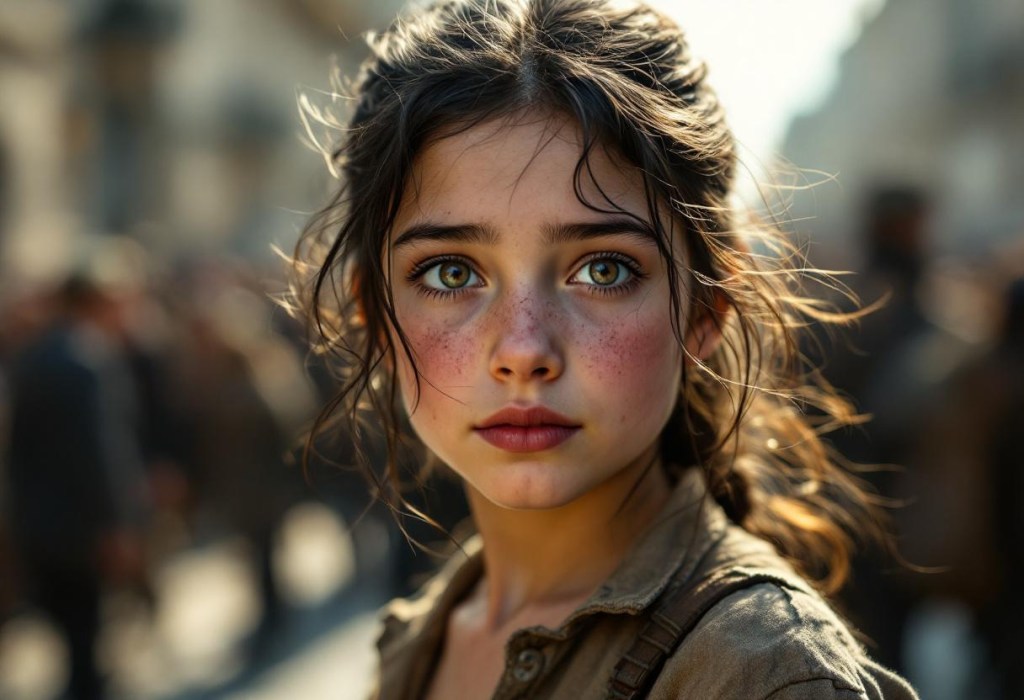
Paris, France – 26th August, 1944
I wake to sounds I do not recognise.
For four years – nearly all my remembered life – the mornings have begun with the rumble of German lorries on the Champs-Élysées below our flat, their diesel engines coughing like sick men. But today, something else drifts through the thin walls: voices raised in song, and beneath it all, the bronze voice of Saint-Sulpice calling across Paris without fear.
La Marseillaise. Someone is singing our forbidden song.
I press my face to the window, still thick with the dust of summer, and peer through glass that has known no proper cleaning since the Occupation began. The blackout curtains – those heavy, suffocating things Maman hung in 1940 – lie crumpled on the floor where I tore them down three days ago when we first heard the distant thunder of Allied guns. Grand-père said it was too soon, too dangerous, but I could not bear another dawn behind that dreadful cloth.
Now light pours into our small room like water through a broken dam, real light, not the thin grey seepage we have lived with for so long. It catches the dust motes and makes them dance, and for a moment I imagine they are celebrating too.
“Marie-Claire?” Grand-père’s voice carries from the kitchen, rough with sleep and cigarettes he can no longer afford. “Come, child. The coffee is ready.”
I pad across the cold floor in my worn slippers – the ones with holes that Maman darned and re-darned until the wool became more needle than thread. In the kitchen, Grand-père Henri sits hunched over our small table, his weathered hands wrapped around a chipped cup that steams with ersatz coffee. The smell is bitter, familiar, nothing like the rich aroma I sometimes dream about from before the war.
“Listen,” I whisper, settling beside him on the wooden chair that wobbles when I lean forward. “Do you hear them singing?”
His grey eyes, still sharp despite his seventy-three years, meet mine over the rim of his cup. “I hear them, ma petite. The whole city is waking up.” He gestures toward the window with one gnarled finger. “Look there – Madame Rousseau has hung her tricolour from the balcony. First time since they came.”
I follow his gaze and see our neighbour’s flag, faded but defiant, snapping in the August breeze. Below in the street, people are gathering – more people than I have seen together in daylight for years. They move differently this morning, with purpose instead of the careful, mouse-like scurrying I remember.
“Grand-père,” I begin, breaking off a piece of the black bread that tastes of sawdust and necessity. “Before the war… what did children do for stories? For amusement, I mean.”
He sets down his cup with the careful precision of someone who has learned not to waste anything. “Why do you ask such a thing, child?”
“I was thinking…” I struggle to find words for the strange feeling that has been growing in my chest since the bombs stopped falling. “Madame Laurent downstairs, she told me once about moving pictures she saw as a girl. And Père Michel spoke of puppet shows that came to the church square. But I cannot imagine such things. Not really.”
Grand-père is quiet for a long moment, studying my face as if seeing it for the first time. When he speaks, his voice carries the weight of memories I cannot share.
“Ah, Marie-Claire. Before the guerre, there were such wonders.” He leans back in his chair, and I see him travelling somewhere in his mind, somewhere I cannot follow. “There was the théâtre des marionnettes in the Luxembourg Gardens – wooden puppets dancing on strings, telling stories of princes and dragons. And the lanterne magique, projected pictures on a white sheet that seemed to move by themselves.”
“Pictures that moved?” I cannot keep the wonder from my voice.
“Indeed. And cinéma, great dark halls where hundreds of people would sit together, watching adventures unfold on enormous screens. Charlie Chaplin, with his funny walk and sad eyes. And before that, when I was your age…” His voice grows softer, more distant. “There were travelling players who came through our village near Verdun. Actors with painted faces who performed in the square while mothers sold chestnuts and fathers argued politics at the café.”
I try to imagine such normality, such innocence, but it feels as foreign as the German words I learned to recognise for survival. “What was it like, Grand-père? To be a child when the world was not at war?”
He reaches across the table and takes my small hand in his large, scarred one. The fingers are twisted from old wounds – some from the first war, some from working in the textile factory until it closed in ’42 – but his grip is still strong.
“It was like this morning, ma chérie. Like waking to unexpected music.”
Before I can ask what he means, a new sound cuts through the singing from the street: engines, powerful and deep, but different from the German machines I know so well. My body goes rigid with learned fear, every muscle tensing for flight or hiding, even as my mind tells me these may be the sounds of liberation.
Grand-père sees my reaction and squeezes my hand gently. “Easy, child. Those are not Boche motors.”
But I cannot help myself. Four years of terror do not disappear with dawn’s light. I am on my feet before I realise it, moving towards the window with the careful steps of prey that has learned to freeze at any unusual sound.
“Marie-Claire.” His voice stops me. When I turn, I see something new in his expression – not just the patient endurance that has carried us through these dark years, but something that might be hope. “Come back and sit. Tell me what you see.”
I return to my chair but cannot relax. The engines are growing louder, and with them comes the sound of many voices, shouting in what might be joy or might be alarm. After so long, I have forgotten how to distinguish between celebration and chaos.
“I see people in the street,” I report, my voice small. “More than I have ever seen together. And they are not running away.”
“No,” Grand-père agrees, rising slowly from his chair and moving to stand behind me. His hands rest on my shoulders, warm and steady. “They are running towards something, I think.”
Through the window, we watch as our neighbours pour from buildings like water from broken pipes. Children I have not seen in daylight for months emerge blinking into the August sun. Women clutch handkerchiefs and call to friends across the narrow street. Men stand straighter than they have in years.
And still the engines approach, growing louder with each moment.
“Grand-père,” I whisper, my heart hammering against my ribs like a trapped bird. “What if – “
“Hush, ma petite.” His grip tightens slightly on my shoulders. “Listen to the bells. When have you heard such ringing? Saint-Sulpice, Saint-Germain, even Notre-Dame herself. They sing of freedom, not of sorrow.”
As if summoned by his words, a great cheer rises from the street below. I see Monsieur Dubois, the baker who has had no flour for real bread in two years, leap onto a chair and wave his cap above his head. Madame Rousseau is crying, but her face is bright with something I have almost forgotten how to recognise.
“They are coming,” Grand-père says quietly, and I know he does not mean the Germans.
The engines are very close now, and I can hear something else – tracks on cobblestones, the distinctive sound of armoured vehicles, but these accompanied by cheers instead of silence. My body still wants to hide, still expects jackboots and harsh commands, but my heart begins to beat with something other than fear.
“Grand-père,” I ask, turning to look up at him, “when someone asks me someday what I watched as a child, what will I tell them?”
His eyes, those sharp grey eyes that have seen two wars and the space between them, grow bright with unshed tears. “Perhaps, ma chérie, you will tell them you watched Paris remember how to breathe.”
The first tank rounds the corner onto our street just as he speaks, and the sun catches the white star on its turret – not the black cross we have learned to fear, but something else entirely. Something that might mean hope.
***
The streets swallow us whole.
By the time Grand-père and I descend to the Champs-Élysées, the avenue has become a living river of humanity. Bodies press against us from every direction – housewives clutching market baskets they have forgotten to fill, children perched on their fathers’ shoulders, old men weeping openly as they lean on walking sticks carved from chair legs. The smell is overwhelming: unwashed wool, cheap tobacco, the metallic tang of excitement, and underneath it all, the lingering ghost of fear that has lived in our clothes for four years.
“Stay close,” Grand-père murmurs, his weathered hand finding mine as we push deeper into the crowd. But staying close proves impossible. The throng moves like water finding its level, carrying us towards the Arc de Triomphe where something magnificent is beginning.
A roar builds from the western end of the avenue – not the harsh bark of German commands or the wail of air-raid sirens, but something I have never heard before: the voice of Paris unleashed. It rolls towards us like thunder, and I feel it in my chest, in my bones, in the spaces between my ribs where terror has lived for so long.
“Vive de Gaulle! Vive la France!” The cry erupts from a thousand throats at once, and suddenly I understand what Grand-père meant about watching Paris breathe. This is the city’s first deep breath in four years, and it shakes the very stones beneath our feet.
Then I see him.
General Charles de Gaulle strides down the centre of the Champs-Élysées as if he owns not just the street but the very air above it. He is impossibly tall, impossibly straight, and the crowd parts before him like wheat before wind. His uniform is immaculate despite the long years of exile, and his képi sits precisely on his grey head. But it is his face that captures me – stern and proud, with the expression of a man who has never doubted this moment would come.
“Mon Dieu,” whispers Grand-père beside me. “He looks like a king returning to reclaim his throne.”
Behind de Gaulle march the soldiers of Leclerc’s 2nd Armoured Division, their boots striking the cobblestones in perfect rhythm. These are not the goose-stepping Germans who have haunted our nightmares, but French boys – our boys – with tricolour patches on their shoulders and weapons that speak of liberation rather than occupation. Their faces are young and tired and blazing with something that might be glory.
The crowd surges forward, and I find myself pressed against the rough wool of Madame Barthélémy’s coat. She smells of lavender water and desperation, and when she turns to look at me, her face is streaming with tears.
“Ma petite,” she gasps, gripping my shoulders with hands that shake. “We are free. Do you understand? We are free!”
But freedom, I discover, sounds like chaos. The cheering has become a physical force that makes my ears ring. Flowers rain from windows – roses saved from secret gardens, geraniums smuggled from hidden pots, even weeds pulled from between cobblestones and thrown with desperate joy. Paper flutters through the air like snow: old newspapers, torn books, anything that can be torn and tossed in celebration.
A young woman near me pulls off her headscarf and waves it above her head, her dark hair flying loose for the first time in years. “No more hiding,” she cries to no one and everyone. “No more whispering!”
I look for Grand-père but see only a sea of bodies. Panic flutters in my chest – the old, familiar fear of being alone in a hostile world. But then his hand finds my shoulder, steady and warm.
“I am here, ma chérie. I am here.”
The parade continues its magnificent procession towards Notre-Dame, and we are carried along by the human tide. I catch glimpses between the bodies: Allied vehicles rumbling slowly through the crowd, soldiers in unfamiliar uniforms smiling and waving, French resistance fighters with their crude armbands walking beside men in perfect military dress.
“Grand-père,” I shout over the din, “they are so young!”
He follows my gaze to a group of maquisards – resistance boys who cannot be much older than sixteen, their faces still soft despite the hardness in their eyes. One of them catches me staring and grins, tipping his beret with mock formality.
“Young, yes,” Grand-père replies, his voice tight with something I cannot identify. “But they have seen enough to make them old.”
A church bell begins to toll – deep, bronze notes that cut through even this magnificent cacophony. Then another joins it, and another, until all of Paris seems to be singing in bronze and iron. The sound rolls over us like a blessing, like an absolution for four years of survival at any cost.
“When I was in the first war,” Grand-père says suddenly, his mouth close to my ear, “we dreamed of such moments. In the trenches near Verdun, when the shells fell like rain and the mud was red with blood, we told ourselves stories about what victory would look like.”
I turn to study his profile – the sharp nose, the jaw clenched with old pain, the eyes that have seen too much.
“Did it look like this?” I ask.
“No, petite. It was nothing like this. Victory then was just… silence. The guns stopped, and we crawled out of our holes like rats blinking in daylight. But this…” He gestures at the glorious chaos surrounding us. “This is what we should have dreamed.”
Crack.
The sound cuts through celebration like a blade through silk. For a heartbeat, no one moves – four years of occupation have taught every Parisian to recognise the report of a rifle. Then someone screams, and the magnificent crowd becomes a stampede.
Bodies surge in every direction at once. I am lifted from my feet by the press of terrified flesh, carried helplessly as grown men and women revert to their most primitive instincts. The celebration has become a rout in seconds.
“Down!” Grand-père’s voice cuts through the panic. His arm sweeps around my waist, pulling me behind the shelter of a newspaper kiosk that has somehow survived four years of war. The wooden structure shudders as bodies slam against it.
Crack. Crack.
More shots, close enough now that I can hear their echoes bouncing off the limestone facades. German snipers, I realise with sick certainty. Hidden in apartments, on rooftops, behind shuttered windows – the last desperate gasps of the Reich making their final statements.
“Les salauds,” Grand-père mutters, pressing me lower. “Even now, even in defeat, they cannot let us have this moment clean.”
A woman runs past us, her hat askew and her handbag clutched against her chest like armour. A man in a blue working jacket stumbles and falls not three metres from our hiding place, but when Grand-père starts to rise, I grab his sleeve.
“No! Stay here!”
“But he may be hurt – “
“You cannot help him if you are shot too!”
The man struggles to his feet and limps away, apparently whole. Around us, the great crowd has fragmented into a hundred smaller groups, each seeking shelter where they can find it. The joyous thunder of liberation has become a dozen conversations conducted in urgent whispers.
“Merde,” someone hisses from behind a parked car. “After all this, they would deny us our freedom?”
“They cannot,” replies another voice, female and fierce. “We will not let them.”
Grand-père’s arm tightens around me. I can feel his heart beating against my shoulder – fast, but steady. Not the frantic rhythm of panic, but the measured pulse of a man who has faced death before and found it wanting.
“Grand-père,” I whisper, “what happens now?”
He is quiet for a long moment, listening to the sporadic rifle fire and the defiant songs that have begun to rise again from the hidden crowd. When he speaks, his voice carries the weight of seven decades and two wars.
“Now, ma petite, we learn what courage looks like when it wears civilian clothes. Look around you – do you see anyone running home? Do you see anyone surrendering this day to a few hidden cowards with guns?”
I peer around the kiosk and realise he is right. The crowd has not dispersed. It has simply… adapted. People crouch behind cars and doorways, but they have not fled. They wait, and they sing “La Marseillaise” in voices that dare the snipers to silence them.
“They are watching history write itself,” Grand-père continues, echoing his earlier words with new meaning. “Just as you are, child. Just as we all are. And history, I think, will remember that on this day, Paris refused to cower.”
As if summoned by his words, the parade begins to move again. I see de Gaulle himself, still walking tall and straight despite the gunfire, his stride never faltering. If he fears the snipers, he gives no sign. The crowd, seeing his courage, begins to emerge from their hiding places.
The celebration resumes, but it is different now – deeper, more defiant. These are people who have chosen joy in the face of death itself.
“Voilà,” Grand-père murmurs. “That is what we watched as children, you and I. We watched ordinary people become extraordinary.”
***
The sun hangs low over Paris as we make our way home through streets I no longer recognise.
The cobblestones beneath our feet are the same ones I have walked for twelve years, but everything else has transformed. Where once we hurried with downcast eyes and muffled footsteps, now couples stroll arm-in-arm, their faces turned skyward. Children run freely between the legs of Allied soldiers who share cigarettes with men wearing resistance armbands. The very air tastes different – cleaner somehow, as if four years of held breath have finally been released.
“Look there, ma petite,” Grand-père murmurs, nodding towards a café that has been shuttered since 1941. Through its grimy windows, I can see the flicker of candlelight and hear the clink of glasses. “Chez Margot is serving wine again. Real wine, not that piquette they tried to pass off during the Occupation.”
We pause outside, and I press my face to the glass. Inside, a dozen people crowd around two small tables, their voices rising in animated conversation. A woman with grey hair pinned severely back throws her head back and laughs – actually laughs – at something a young soldier has said. The sound carries through the glass like music I had forgotten existed.
“They are not afraid to be heard,” I observe, marvelling at this simple thing that feels like a miracle.
“No, child. Fear has packed its bags and left Paris tonight.”
As we continue towards home, I notice the small details that speak of liberation. Windows stand open despite the cool August evening, spilling golden lamplight onto the pavement. Monsieur Arnaud, the clockmaker, has removed the wooden boards from his shop front for the first time in years. His window display catches the dying light – dozens of timepieces marking this moment, this hour, this breath of freedom.
“Grand-père,” I say, stopping suddenly in the middle of the Rue de Rivoli. “I think I understand now.”
He turns to face me, his weathered features soft in the twilight. “What do you understand, ma chérie?”
“About what I watched. What we watched.” I gesture around us at the transformed city, at the people who move without fear, at the very stones that seem to pulse with new life. “Other children might remember puppet shows or moving pictures, but we…”
“Yes?”
I struggle to find words for the revelation that has been growing in my chest all day. “We watched something more important. We watched courage being born in ordinary people. We watched neighbours become heroes. We watched a city remember its own heart.”
Grand-père’s eyes grow bright, and he reaches out to touch my cheek with one gentle finger. “You see clearly, petite. Clearer than many who are three times your age.”
We resume walking, passing beneath streetlamps that burn without blackout curtains for the first time since I was eight years old. The light falls across our path in pools of gold, and I realise that this too is part of what I have watched – the slow return of illumination to a world that had grown too dark.
“But it was not always courage we watched,” I continue, my voice growing stronger with each word. “Sometimes we watched fear. Sometimes we watched people make terrible choices because they were hungry or scared or simply tired of being brave.”
“That too is part of the great performance,” Grand-père agrees. “The full human drama, played out on the stage of history. You have seen more truth in twelve years than most people witness in a lifetime.”
As we turn onto our own street, I see that Madame Rousseau’s tricolour still flies from her balcony, but now it is joined by others. Red, white, and blue flutter from every window, some hastily sewn from scraps of cloth, others carefully preserved through four years of hidden waiting. The whole street has become a celebration of colour after so long in German grey.
We climb the narrow stairs to our flat, and I can hear voices through thin walls – not the whispered conversations of the Occupation, but full-throated discussions that rise and fall like music. Somewhere above us, someone is playing an accordion, and the melody drifts down the stairwell like a blessing.
In our small kitchen, Grand-père lights the oil lamp and sets it on the table where we shared ersatz coffee this morning. The light catches his face, highlighting the deep lines that speak of two world wars and the spaces between them.
“Sit with me a moment before sleep,” he says, settling into his familiar chair. “Tell me what you will remember of this day.”
I take my place across from him, but I am not the same girl who sat here at dawn. Something has shifted in the hours between, something that makes me straighter, more certain.
“I will remember the sound,” I begin. “Not just the cheering or the gunfire, but the sound of a city waking up. The sound of people remembering how to speak without fear.”
“And what else?”
“The faces. Madame Barthélémy crying with joy. That young maquisard tipping his beret. Even General de Gaulle, walking tall while the snipers tried to steal his moment.” I pause, searching for the right words. “They were all performing in the greatest show ever written – the story of freedom choosing itself over comfort, of courage choosing itself over safety.”
Grand-père nods slowly. “And when you are grown, ma petite, and someone asks you what shows you watched as a child?”
The answer comes without hesitation now, clear and strong. “I will tell them I watched heroes being born. I will tell them I watched my city teach itself to breathe again. I will tell them that my childhood entertainment was not fantasy or make-believe, but the truest story ever told – the story of people refusing to surrender their humanity, even when the world grew dark around them.”
He reaches across the table and takes my hand, his weathered fingers warm and steady. “You will tell them you watched the performance that matters most – real courage in real time, played out by real people who chose to be more than their circumstances demanded.”
Later, as I prepare for bed, I go to the window that overlooks the Champs-Élysées. The avenue is quieter now, but not empty. Small groups of people still walk its length, unwilling to let this day end completely. Some carry bottles and sing softly. Others simply stroll in silence, as if testing the reality of their freedom with each step.
I push the window fully open – something I have not dared to do at night since I was eight years old – and lean out into the August air. The sounds of liberated Paris rise to meet me: distant laughter, the clip-clop of horse hooves, someone playing a violin in a courtyard below. These are the sounds of a city that has remembered how to live without fear.
Above the rooftops, stars begin to appear – the same stars that shone over Paris during the Occupation, but somehow they seem brighter tonight, less distant. Or perhaps it is simply that I can see them clearly now, without the weight of blackout curtains and constant dread.
As I watch, a shooting star streaks across the darkening sky, and I make a wish – not for myself, but for all the children who will grow up in the Paris we have witnessed being reborn today. May they know puppet shows and moving pictures and all the innocent entertainments of childhood. May they never have to watch the kind of performance that taught me what courage looks like when it wears an ordinary face.
But if they must, if the world grows dark again, may they have the wisdom to recognise greatness when they see it. May they understand, as I do now, that the most important stories are not the ones we watch passively from comfortable seats, but the ones we live through with dignity and hope.
I close the window but do not draw the curtains. Tonight, for the first time in four years, I will sleep in a room filled with starlight, in a city that has remembered its own name.
And tomorrow, when someone asks what shows I watched as a child, I will have an answer worthy of the performance I witnessed – the greatest show on earth, played out on the streets of Paris by ordinary people who chose to be extraordinary when it mattered most.
The End
On 26th August, 1944, the day after the German garrison surrendered Paris (19th–25th August), General Charles de Gaulle led a victory march along the Champs-Élysées amid sporadic sniper fire, marking the capital’s liberation after four years of occupation since 14th June 1940; the operation involved France’s 2nd Armoured Division, the U.S. 4th Infantry Division, and widespread Resistance uprisings across the city’s 20 arrondissements, with fighting concentrated at key nodes such as the Hôtel de Ville and police prefecture. In the weeks that followed, the Provisional Government reasserted French sovereignty, initiating purges, reconstruction, and cultural revival; the episode remains a global emblem of urban resistance, coalition warfare, and the political shaping of memory in postwar Europe.
Bob Lynn | © 2025 Vox Meditantis. All rights reserved. | 🌐 Translate

 Vox Meditantis
Leave a comment