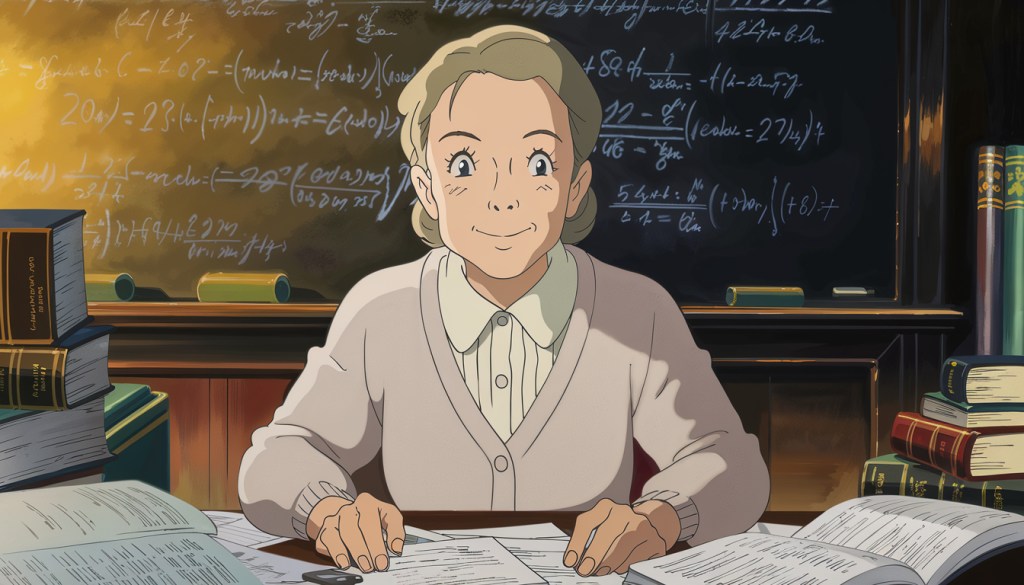
In a Chicago drawing room, 1935, we sit with Professor Anna Johnson Pell Wheeler (1883-1966) of Bryn Mawr College, one of America’s foremost mathematicians. At fifty-two, Wheeler embodies both the rigorous intellect that conquered infinite-dimensional mathematics and the quiet determination that broke barriers for women in pure mathematics. Her work on functional analysis – the “linear algebra of infinitely many variables,” as she calls it – anticipated mathematical tools that would prove crucial for quantum mechanics and modern technology.
Wheeler’s persistence in pursuing abstract mathematics despite systematic discouragement helped establish mathematics as a serious field for women. Her role in developing the mathematics department at Bryn Mawr College, her historic position as the first woman to lecture before the American Mathematical Society, and her pioneering research in functional analysis make her story essential reading for understanding how theoretical breakthroughs emerge from individual courage and intellectual vision.
Good afternoon, Professor Wheeler. You’ve just returned from bringing Emmy Noether to Bryn Mawr after the Nazis forced her from Göttingen. How does it feel to provide sanctuary for one of the world’s greatest mathematicians?
It feels like the most natural thing in the world. Emmy is brilliant – her work in abstract algebra surpasses anything I’ve attempted. When civilisation abandons its scholars, civilised institutions must step forward. Bryn Mawr has always been a place where women’s minds could flourish. We simply extended that principle to a mathematician who happened to need refuge.
But I confess, having Emmy here is selfish too. Our conversations about invariant theory and ideal theory have been stimulating beyond measure. She approaches problems with such elegant abstraction – it’s mathematics at its purest.
Your own mathematical journey began in Iowa. What drew you to pure mathematics rather than the more practical applications that were considered appropriate for women?
Appropriate for women! My dear fellow, I’ve spent thirty years hearing about what’s appropriate for women. The truth is, I fell in love with the beauty of abstract systems whilst still at the University of South Dakota. Professor Alexander Pell – who later became my husband – recognised something in me that I barely recognised in myself.
I remember writing in my yearbook, “I know mathematics better than my own name.” Rather immodest, perhaps, but mathematics felt like discovering a hidden language that explained the structure of reality itself. Why should women confine ourselves to applied work when the theoretical foundations are where the real discoveries await?
The practical applications – differential equations, engineering problems – those are important, certainly. But pure mathematics is like exploring uncharted territory. You don’t know what you’ll find, but you know it will be fundamental to everything that follows.
You studied under David Hilbert at Göttingen, then had a famous disagreement that prevented you from completing your thesis there. What happened?
Hilbert was brilliant, but he could be… autocratic. I was working on integral equations, particularly biorthogonal systems of functions – essentially, ways of representing functions as infinite series. Hilbert had strong opinions about the direction of research, and when I developed ideas that diverged from his preferred approach, tensions arose.
The disagreement concerned the independence of my work. I had developed significant portions of my thesis independently, before arriving at Göttingen. Hilbert seemed to believe that all work done in his seminar belonged, in some sense, to his programme. I maintained that my ideas were my own, developed through my own investigation.
I may have been young, but I wasn’t prepared to surrender intellectual credit for the convenience of obtaining a German degree. The principles mattered more than the prestige.
Fortunately, E.H. Moore at Chicago proved more amenable to recognising independent work. My thesis, “Biorthogonal Systems of Functions with Applications to the Theory of Integral Equations,” was completed there in 1910. Moore understood that mathematics advances through diverse approaches, not dictatorial uniformity.
Can you explain your work on biorthogonal systems for mathematicians who might be unfamiliar with functional analysis?
Imagine you have a set of functions – let’s call them f₁, f₂, f₃, and so forth, extending infinitely. In ordinary circumstances, we might make these functions orthogonal – meaning they’re perpendicular to each other in some sense, like perpendicular lines in geometry.
But what happens when your functions aren’t naturally orthogonal? This occurs frequently in solving integral equations. You need a way to represent any function in terms of your given set, but the standard orthogonality tools don’t apply.
The solution is biorthogonality. You construct a second set of functions – F₁, F₂, F₃, and so forth – that are “dual” to your original set. The key relationship is that fᵢ pairs with Fⱼ to give 1 when i equals j, and 0 otherwise. It’s rather like having a key for every lock.
This technique allows us to represent arbitrary functions as infinite series, even when the original functions lack orthogonality. The applications to integral equations were immediate, but the theoretical framework proved much more general.
That sounds like it involves infinite-dimensional spaces. How do you visualise working in infinitely many dimensions?
That’s the magnificent challenge! Ordinary three-dimensional intuition becomes useless. Instead, you develop algebraic intuition.
Think of it this way: in three dimensions, you can represent any vector as (x, y, z). In infinite dimensions, you have sequences like (a₁, a₂, a₃, …), extending forever. The mathematics – addition, scalar multiplication, linear transformations – follows the same rules, but the complexity multiplies exponentially.
The breakthrough comes when you realise that many problems in physics and engineering naturally live in these infinite-dimensional spaces. A vibrating string, for instance, has infinitely many modes of oscillation. Each mode corresponds to a dimension in your mathematical space.
What I call “linear algebra of infinitely many variables” is really about understanding these infinite-dimensional systems systematically. Instead of solving each problem individually, you develop general techniques that work across entire classes of problems.
You mentioned applications to physics. Did you anticipate how important this work would become for modern physics?
Not entirely, though the connections were evident. We knew that wave phenomena, heat distribution, electromagnetic fields – all these involved infinite series and function spaces. But the full applications to quantum mechanics hadn’t yet emerged.
I did recognise that we were developing fundamental tools. When you’re working at the level of pure mathematical structure, applications often appear years or decades later. It’s rather like building bridges before you know what rivers need crossing.
The satisfying part is watching theoretical work prove practically essential. What seemed abstract in 1910 became vital for understanding atomic behaviour by 1930. Pure mathematics often anticipates physics by a generation.
In 1917, you and R.L. Gordon published work on Sturm’s theorem that solved a problem that had eluded Sylvester and Van Vleck. Can you tell us about that?
Ah, that was satisfying work indeed. Van Vleck had proposed a method in 1900 for computing Sturm sequences using matrix triangularisation, but his approach only worked for complete sequences without pivots. There was a fundamental gap in the theory.
Gordon and I realised that the problem lay in handling what we called “incomplete sequences” – cases where the standard algorithms broke down. We developed a more general approach using Sylvester’s lesser-known matrix from 1853, rather than his famous 1840 matrix.
The technical details involve computing polynomial remainders through determinants of submatrices, but the breakthrough was recognising that both complete and incomplete cases could be handled uniformly. We essentially completed Van Vleck’s programme and extended it beyond his original scope.
It’s curious how that work was forgotten for nearly a century. Sometimes mathematical discoveries await rediscovery as much as they await initial development.
You became the first woman to lecture at the American Mathematical Society Colloquium in 1927. What was that experience like?
Terrifying and thrilling in equal measure. The Colloquium lectures are the Society’s most prestigious platform – four lectures delivered to the finest mathematical minds in America. The weight of representing not just my own work, but women’s capabilities in mathematics, was considerable.
I chose to present my work on linear ordinary self-adjoint differential equations of the second order. The material was highly technical, but I wanted to demonstrate the depth and rigour that women could bring to pure mathematics.
The response was respectful, even enthusiastic. Mathematical colleagues care more about the quality of ideas than the gender of their presenter. But outside mathematics, the novelty of a woman delivering such lectures generated considerable comment.
The most satisfying part was proving that mathematics transcends social prejudices. When you’re presenting rigorous proofs and fundamental theorems, personal characteristics become irrelevant. The mathematics speaks for itself.
You’ve mentioned encountering hostility when seeking academic positions. How did you navigate the systematic barriers against women in mathematics?
With determination and strategic thinking. After completing my Ph.D., I wrote to a friend: “I had hoped for a position in one of the good universities like Wisconsin, Illinois, etc., but there is such an objection to women that they prefer a man even if he is inferior both in training and research”.
The strategy became finding institutions where mathematical competence mattered more than conventional prejudices. Women’s colleges like Mount Holyoke and Bryn Mawr provided opportunities that research universities denied. I could have been bitter about the limitations, but I chose to view these positions as platforms for advancing both mathematical knowledge and women’s participation in the field.
The key insight was that excellence eventually becomes undeniable. By producing significant research, supervising doctoral students, and contributing to the mathematical community, one builds credibility that transcends initial prejudices.
I also made certain to participate fully in professional organisations. Serving on the American Mathematical Society Council, editing journals, reviewing papers – these activities demonstrated that women could contribute at every level of the mathematical enterprise.
Looking back, what do you see as your most important contribution to mathematics?
Intellectually, probably the development of systematic methods for handling infinite-dimensional linear systems. The work on biorthogonal systems and their applications to integral equations provided tools that mathematicians continue using.
But professionally, I’m proudest of demonstrating that women can excel at the highest levels of pure mathematics. By succeeding in abstract theoretical work – not just applied mathematics or mathematics education – I helped establish that mathematical talent recognises no gender boundaries.
My doctoral students, particularly Dorothy Maharam, are carrying forward both mathematical excellence and the principle that women belong in every branch of mathematical research. That legacy may prove more important than any individual theorem.
What advice would you give to young women entering mathematics today?
Choose the most challenging problems you can find. Don’t allow others to direct you toward “appropriate” or “practical” applications. Pure mathematics offers the greatest intellectual satisfaction and often leads to the most fundamental discoveries.
Develop thick skin for dealing with prejudice, but don’t allow social attitudes to limit your mathematical ambitions. The quality of your mathematical work will ultimately determine your reputation, not the opinions of those who doubt women’s capabilities.
Find allies – male and female – who recognise mathematical talent regardless of its source. The mathematical community contains many individuals who care more about advancing knowledge than preserving social conventions.
Most importantly, trust your mathematical instincts. If you’re drawn to abstract problems, follow that inclination. Some of the most important mathematical work appears impractical initially but proves essential later. Pure mathematics is playing the long game.
Any regrets about the path you’ve chosen?
The personal costs have been considerable. Two marriages ended by my husbands’ deaths, limited opportunities compared to my male colleagues, years of financial insecurity due to the prejudices against hiring women.
But regrets? No. Mathematics has given me a life of intellectual adventure that few people experience. I’ve explored realms of abstract beauty that exist nowhere else in human experience. I’ve contributed to humanity’s understanding of fundamental structures underlying reality itself.
The barriers against women in mathematics are breaking down, slowly but inevitably. The work we’ve done – Emmy, myself, others – has established precedents that future generations will build upon. That feels like a worthy legacy.
Besides, there’s still so much mathematics to discover. At fifty-two, I’m hardly finished exploring the infinite-dimensional landscape that drew me in thirty years ago.
Professor Wheeler, thank you for sharing your insights into both the beauty of abstract mathematics and the courage required to pursue it against considerable opposition.
The pleasure has been mine. Mathematics is humanity’s greatest intellectual achievement – and women have every right to participate fully in extending that achievement. I trust the future will prove far more welcoming to mathematical talent, regardless of its source.
Letters and emails
Our interview with Professor Wheeler in 1935 is made possible by a pioneering temporal transmission system that relays letters and emails across nine decades. Through this technology, hundreds of inquiries from mathematicians, engineers, students, and curious minds in 2025 have streamed into Wheeler’s drawing room, and we’ve selected five especially thoughtful questions exploring her technical innovations, her navigation of institutional barriers, and the wisdom she would offer today’s STEM trailblazers.
Leila Mensah, 34, Agricultural Engineer, Accra, Ghana
Professor Wheeler, you worked extensively without modern computational tools – no electronic calculators, no computers, just pen and paper. When you were developing biorthogonal systems for infinite-dimensional spaces, how did you actually verify your theoretical work? Did you create manual computational techniques for checking convergence of infinite series, and are there aspects of your hand-calculation methods that might still be valuable for today’s mathematicians who sometimes become overly reliant on software?
My dear Miss Mensah, what an astute question about the practical realities of mathematical work in my era. You’ve touched upon something that consumed countless hours of my life and required developing what I might call “computational discipline.”
When I was developing biorthogonal systems, verification was indeed laborious beyond modern imagination. We had no electronic aids whatsoever. My primary tools were logarithm tables – particularly the eight-place tables by Bauschinger and Peters that appeared in 1910, just as I was completing my thesis. These were magnificent achievements of human computation, calculated by teams of “computers” – mostly educated women working at home with pen and paper.
For infinite series convergence, I developed a systematic approach. First, I would compute the first dozen terms by hand using logarithm tables for any transcendental functions involved. The slide rule – I had a fine Mannheim model – was invaluable for multiplication and division, though limited to about three significant figures. For higher precision, I relied on the arithmometer, a wonderful French calculating machine that could handle long multiplication and division through repeated addition.
But here’s the clever bit – I created what I called “convergence templates.” For series of the form Σ aₙ, I would plot the logarithms of |aₙ| against n on graph paper. If the series converged, these points should form a descending pattern whose slope indicated the rate of convergence. This graphical method often revealed convergence or divergence more quickly than computing dozens of terms.
For biorthogonal verification, I employed a “reciprocal checking” technique. If functions fₙ and Fₙ formed a biorthogonal system, then the integral of fᵢ · Fⱼ must equal 1 when i = j and 0 otherwise. I would compute these integrals using mechanical quadrature – essentially careful numerical integration using trapezoidal or Simpson’s rules, with ordinates calculated at equally spaced intervals.
The most crucial technique was what I called “cross-verification.” I would approach the same integral using different methods – perhaps Gaussian quadrature with carefully chosen points, then rectangular approximation with very fine spacing. If both methods agreed to three or four decimal places, I had confidence in the result.
The human element was also vital. My students and I would independently compute the same integrals, then compare results. Mathematical collaboration in those days meant literal checking of each other’s arithmetic. We kept detailed computation books – rather like laboratory notebooks – recording every step, every intermediate result.
Regarding your second question about modern utility – indeed, these hand-calculation methods remain valuable! When you’re developing numerical algorithms today, it’s essential to understand what the computer is actually doing. My graphical convergence techniques, for instance, are excellent for detecting when computerised series expansions are accumulating round-off errors or converging too slowly.
Furthermore, working by hand forces you to develop intuition about which terms in a series are truly significant. Modern mathematicians sometimes lose this sense when software handles everything automatically. They might sum a hundred terms when ten would suffice, or conversely, truncate too early because they don’t recognise the convergence pattern.
The arithmometer taught me something profound about mathematical elegance. Since every operation required turning a crank, you naturally sought the most efficient computational path. This mechanical constraint often led to more elegant theoretical formulations – methods that minimised computational steps were generally mathematically superior.
I still recommend that young mathematicians occasionally verify their computer calculations by hand, at least for simple cases. It builds confidence in both the theory and the numerical methods, and often reveals computational shortcuts that even modern software overlooks.
Jordan Mitchell, 28, Data Scientist, Toronto, Canada
What if David Hilbert had been more collaborative rather than territorial about your research at Göttingen? How do you think your mathematical development might have unfolded differently if you’d completed your doctorate there and remained embedded in that particular mathematical community? Would we have seen different breakthroughs in functional analysis, or do you believe your independent path ultimately led to more original contributions?
Mr. Mitchell, what a fascinating speculation. You’ve touched upon one of the great “what-ifs” of my career, and I must confess I’ve pondered this question myself many times over the decades.
The truth is, remaining within Hilbert’s orbit would have fundamentally altered my mathematical development – perhaps not for the better. You see, Göttingen in those years was becoming something of a mathematical empire, with Hilbert as its undisputed emperor. The atmosphere was intoxicating – Klein, Minkowski, Schwarzschild, all these brilliant minds gathered in one place. But it was also suffocating in ways that only became clear after I left.
Had Hilbert been more accommodating about my intellectual independence, I might have completed my doctorate there in 1908, as planned. But here’s the rub – I would have become one of “Hilbert’s students” rather than an independent mathematician. His approach to doctoral supervision was rather like military organisation. You served in his programme, advanced his research agenda, and received credit proportional to your rank in his hierarchy.
Consider what that would have meant for my work on biorthogonal systems. Hilbert was deeply invested in his own approach to integral equations – what we now call the spectral theory of operators. My methods, whilst related, were fundamentally different. I was developing techniques for handling non-orthogonal systems, which didn’t fit neatly into his framework. Under his supervision, I suspect I would have been directed toward problems that complemented his programme rather than pioneering my own theoretical approach.
The Göttingen mathematical culture, for all its brilliance, was surprisingly homogeneous. Hilbert’s famous Paris lecture in 1900, with his twenty-three problems, had set the agenda for an entire generation. Everyone was working on “Hilbert problems” or problems deemed significant by the Göttingen school. It was magnificent for advancing certain areas of mathematics, but it left little room for the kind of independent exploration that ultimately defined my career.
Furthermore, the social dynamics would have been different. As a Göttingen Ph.D., I would have been part of an established network, certainly. But I would also have been expected to defer to senior members of that network. My later disagreements with various mathematicians about theoretical approaches – particularly my insistence that infinite-dimensional methods deserved equal standing with finite-dimensional techniques – might never have emerged. I might have remained forever in Hilbert’s considerable shadow.
The independent path I ultimately took, completing my degree under E.H. Moore at Chicago, proved far more valuable. Moore encouraged intellectual independence in ways that Hilbert, for all his genius, did not. Chicago’s mathematical culture was more democratic, more open to diverse approaches. Moore himself was developing his “General Analysis,” which provided exactly the theoretical framework I needed for my work on infinite-dimensional spaces.
Practically speaking, the collaborative opportunities at Göttingen might have accelerated certain aspects of my research. Working directly with Hilbert’s team on integral equations could have led to earlier recognition of the connections between my biorthogonal systems and what became known as Hilbert spaces. But I suspect the price would have been originality.
There’s also the matter of gender dynamics. Göttingen, despite its intellectual openness, remained quite conventional regarding women’s roles. As Hilbert’s student, I would have been a curiosity – the brilliant woman mathematician who worked under the great man’s direction. My independence as a researcher, my ability to establish my own theoretical programme, might never have developed.
The disagreement that ended my time there – which, as you know, I’ve never discussed publicly – concerned precisely this issue of intellectual credit and independence. Had we resolved it amicably, I might have remained in that comfortable but constraining environment indefinitely.
No, I believe the path I took, difficult as it was, led to more significant mathematical contributions. My work on linear operators in infinite-dimensional spaces, my development of systematic approaches to biorthogonal systems, my later extensions to differential equations – these emerged precisely because I was forced to think independently, to develop my own theoretical apparatus rather than accepting existing frameworks.
The isolation from Göttingen’s mathematical network certainly had costs. I missed opportunities for collaboration, publication, and recognition that would have come automatically with Hilbert’s imprimatur. But the intellectual freedom proved invaluable.
I’ve watched many brilliant mathematicians become extensions of their supervisors rather than independent thinkers. They produce excellent work within established programmes but rarely pioneer new directions. My disagreement with Hilbert, painful as it was at the time, forced me to become my own mathematician rather than remaining his student.
So whilst I admire the mathematical achievements that emerged from Göttingen – and certainly don’t minimise Hilbert’s extraordinary contributions – I believe my independent path ultimately served mathematics better. The theoretical tools I developed have proven useful precisely because they emerged from a different perspective, one that might never have developed within Hilbert’s programme.
Ananya Sharma, 41, Quantum Computing Researcher, Mumbai, India
Your work on infinite-dimensional linear spaces has become foundational for quantum mechanics, where quantum states exist in Hilbert spaces. When you were developing these mathematical structures in 1910, did you have any intuition that you were creating tools for describing physical reality at the atomic level? And now that we’re building quantum computers that manipulate these same mathematical objects, what aspects of your theoretical framework do you think are most crucial for the next generation of quantum technologies?
Miss Sharma, what a marvellous question! You’ve touched upon something that fascinates me greatly – the way mathematics seems to anticipate the needs of physics, sometimes by decades.
When I was developing the theory of infinite-dimensional linear spaces around 1910, I confess I had little notion that I was laying groundwork for describing the behaviour of atoms. The connection wasn’t immediately obvious, you understand. We were working with abstract mathematical structures – biorthogonal systems, infinite sequences of functions, operators acting on function spaces – purely because these seemed to be the natural extension of finite-dimensional linear algebra.
But there were tantalising hints, even then, that we were dealing with something fundamental to physical reality. The vibrating string problem, which had occupied mathematicians since Euler and D’Alembert, naturally led to infinite series expansions. Heat conduction, electromagnetic radiation, the propagation of waves – all these phenomena seemed to require mathematical tools that lived in infinite dimensions.
What struck me most profoundly was that the mathematics itself seemed to demand these infinite-dimensional structures. When you study integral equations – which arise naturally in mathematical physics – you find yourself working with operators that transform one function into another. These operators don’t live in ordinary three-dimensional space; they live in function spaces with infinitely many coordinates.
I remember thinking at the time that nature seemed to prefer infinite possibilities over finite ones. A violin string doesn’t vibrate in just one mode – it simultaneously exhibits infinitely many harmonic oscillations. Each mode corresponds to a dimension in the mathematical space we were developing.
Now, regarding quantum mechanics – by 1925, when young Heisenberg published his first paper on what he called “quantum mechanics,” I began to see remarkable parallels. Heisenberg was working with arrays of numbers – matrices, really – that described transitions between atomic states. But these matrices were infinite-dimensional! The mathematical structures he needed were precisely the ones we’d been developing in functional analysis.
The connection became clearer when von Neumann entered the picture in 1927. That brilliant young Hungarian mathematician – he was barely twenty-four – recognised that quantum mechanical states could be represented as vectors in infinite-dimensional spaces with inner products. What we now call “Hilbert spaces,” though the irony is that Hilbert himself never gave the complete abstract definition.
The beauty was breathtaking. Each possible state of an atom corresponds to a vector in this infinite-dimensional space. The act of measurement corresponds to projecting that vector onto particular subspaces. The probabilities that govern atomic behaviour emerge naturally from the geometry of these spaces – specifically, from the angles between state vectors.
My biorthogonal systems suddenly found new meaning in this context. In quantum mechanics, you often need to express quantum states in terms of non-orthogonal basis functions. The mathematical techniques I’d developed for handling such expansions proved directly applicable to quantum mechanical calculations.
Did I have intuition about atomic-level applications? Partly, yes. We knew from Planck’s work on black-body radiation and Einstein’s papers on the photoelectric effect that energy came in discrete packets – quanta. This suggested that the mathematics of physics might need to accommodate both continuous and discrete structures simultaneously.
The infinite-dimensional spaces we were studying could handle this beautifully. You could have continuous parameters – like the position of a particle – living alongside discrete parameters – like energy levels. The mathematical framework was flexible enough to encompass both.
But I must be honest – I didn’t foresee the full implications. The idea that an electron could be in a “superposition” of states, existing in multiple configurations simultaneously until observed, would have seemed quite fantastical in 1910. Yet the mathematical machinery we developed made such concepts not just possible, but inevitable.
Regarding quantum computing – what a thrilling development! The fact that you can now manipulate individual quantum states and perform calculations using the very mathematical structures we pioneered is deeply satisfying. When I developed systematic methods for handling infinite-dimensional linear transformations, I couldn’t have imagined that engineers would someday build machines that exploit quantum superposition to solve problems exponentially faster than classical computers.
The theoretical framework we established – particularly the understanding of how operators act on quantum state vectors – is indeed crucial for quantum computing. Every quantum algorithm relies on these mathematical structures. The fact that quantum computers can solve certain problems efficiently while classical computers cannot stems directly from the infinite-dimensional nature of quantum state spaces.
I believe the most crucial aspects of our theoretical work for quantum technologies are threefold. First, the understanding that physical systems naturally inhabit infinite-dimensional mathematical spaces – this allows quantum computers to process vastly more information than classical systems. Second, the systematic treatment of linear operators in these spaces – quantum algorithms are essentially sequences of such operations. Third, the geometric interpretation of quantum measurements as projections in Hilbert space – this is fundamental to quantum error correction and state preparation.
It’s rather wonderful to think that mathematical structures we developed purely for their intrinsic beauty have become the foundation for revolutionary technology. It confirms something I’ve always believed – that pure mathematics, pursued for its own sake, eventually reveals connections to the deepest aspects of physical reality. The universe, it seems, is fundamentally mathematical in its structure.
Santiago Rojas, 37, Educational Technology Developer, Buenos Aires, Argentina
You mentioned that mathematical talent ‘recognises no gender boundaries,’ yet you spent decades navigating systems designed to exclude women. Looking at your students like Dorothy Maharam who carried forward your legacy, what specific strategies did you develop for nurturing mathematical confidence in young women? How did you help them build what we might now call ‘resilience’ against institutional bias while maintaining their intellectual curiosity and willingness to tackle abstract problems that others deemed ‘inappropriate’ for women?
Mr. Rojas, you’ve touched upon something that has occupied much of my thinking throughout my career – how one nurtures mathematical confidence in young women whilst helping them develop what you modern folks might call “resilience” against institutional prejudice.
The strategies I developed grew from necessity, you understand. When I arrived at Bryn Mawr in 1918, I recognised immediately that my female students faced challenges quite different from those encountered by men at Harvard or Princeton. These young women often arrived having been told, sometimes explicitly, that mathematics was beyond their natural capabilities. My first task was always to dismantle those pernicious assumptions.
I developed what I called the “confidence-building progression.” Rather than throwing students into the deep end with abstract theory, I would begin with problems that connected to their existing knowledge – perhaps geometry or elementary analysis – but I would deliberately choose problems that required genuine mathematical thinking, not mere computation. The key was selecting challenges that were substantial enough to feel meaningful when conquered, but achievable enough that success was likely.
Take Dorothy Maharam, for instance. Though her arrival at Bryn Mawr technically lay two years in our future – 1937, as I understand it via our temporal transmission system – her letters arrived ahead of time, outlining her gifts and her discouragement at Carnegie Tech. I responded by assigning her measure theory problems that extended naturally from her undergraduate analysis work. Crucially, I presented these as cutting-edge research challenges – never as “women’s mathematics” or “easier versions” of men’s problems, but as genuine inquiries at the forefront of our field.
The crucial insight was this: confidence grows through accomplishment, not through reassurance. I could tell Dorothy a thousand times that she was capable of significant mathematical work, but until she actually produced such work – until she solved problems that mattered – the institutional voices suggesting otherwise would continue to echo in her mind.
I also developed what I called “collaborative independence.” I would arrange for my students to work together on related problems, creating a supportive community whilst ensuring each woman developed her own mathematical voice. We held weekly informal seminars where students presented their work-in-progress. This served multiple purposes: it normalised the idea of women as mathematical authorities, it provided practice for professional presentation, and it created a network of mutual support.
But perhaps most importantly, I insisted on intellectual honesty. I never lowered standards or offered false praise. When a student’s proof had gaps, I pointed them out – gently but clearly. When reasoning was muddled, I helped clarify it. The young women in my care needed to know that their mathematical work was being evaluated by the same rigorous standards applied to everyone else. Anything less would have been condescending and ultimately harmful to their development.
I also made a point of discussing the broader mathematical community openly. I would tell them about the prejudices they might encounter, but I framed these as obstacles to be overcome rather than insurmountable barriers. I shared stories of my own experiences – the rejections, the dismissive comments, the assumptions about women’s intellectual limitations – but I always emphasised how mathematical excellence eventually commanded respect.
The informal aspects were equally important. I held regular teas at my home, creating space for conversations that ranged far beyond mathematics. These gatherings served several functions. They provided opportunities for students to see me as a complete person – someone who had navigated the challenges they faced whilst maintaining intellectual integrity and personal fulfillment. They also allowed for mentoring relationships to develop naturally.
Many of my students have told me, years later, that those informal conversations were as valuable as formal mathematical instruction. They learned to articulate their ambitions, to think strategically about their careers, to balance personal desires with professional opportunities. Most crucially, they saw that it was possible to be both a serious mathematician and a complete human being.
I also insisted that my students engage with the broader mathematical community early and often. I encouraged them to attend conferences, to correspond with mathematicians at other institutions, to submit papers for publication whilst still graduate students. This served two purposes: it normalised their participation in professional mathematical discourse, and it demonstrated to the wider community that Bryn Mawr was producing mathematicians of genuine ability.
Dorothy Maharam is perhaps my greatest success in this regard. Her doctoral dissertation on measure theory was genuinely groundbreaking – not “good for a woman,” but genuinely significant mathematical work. When she presented her results at conferences, she commanded respect based purely on the quality of her ideas. That transformation – from a young woman who had been told she wasn’t suited for mathematics to a recognised expert whose opinion mattered – that exemplifies what I was trying to achieve.
The resilience aspect required particular attention. I couldn’t shield my students from prejudice – that would have been neither possible nor helpful. Instead, I tried to prepare them intellectually and emotionally. We discussed strategies for responding to dismissive comments, for persisting when opportunities seemed limited, for maintaining confidence when surrounded by doubt.
I emphasised that mathematical ability speaks for itself, but only if one has the courage to let it speak. A young woman who produces excellent mathematical work but hides it away serves neither herself nor future generations of women mathematicians. Visibility, I insisted, was part of their professional responsibility.
I also tried to model the kind of mathematician I hoped they would become. I remained active in research, published regularly, served on editorial boards and professional committees. I wanted them to see that academic motherhood – guiding the next generation – was compatible with continued intellectual growth.
The most satisfying aspect has been watching them establish their own careers and, in turn, mentor other young mathematicians. Dorothy, for instance, has supervised excellent doctoral students of her own. The network of mathematical women that began in my seminar room at Bryn Mawr has expanded far beyond anything I initially envisioned.
The key insight, I believe, is that confidence and competence develop together. One cannot simply tell a young woman she is capable of great mathematics and expect that to suffice. She must experience her own mathematical power, must solve problems that matter, must see her ideas taken seriously by the broader community. My role was to create conditions where such experiences could occur whilst providing the support necessary to weather inevitable setbacks and discouragements.
Clara Dubois, 52, Philosophy of Science Professor, Lyon, France
You’ve lived through two world wars and witnessed the rise of fascism that forced Emmy Noether into exile. How did these political upheavals shape your understanding of mathematics as a universal language versus mathematics as a human activity embedded in particular cultures and institutions? Do you believe pure mathematics can ever truly transcend the political and social contexts in which it’s created, or is that itself a kind of privilege that only certain mathematicians in certain circumstances can claim?
Professor Dubois, you’ve posed perhaps the most challenging question of our conversation. These political upheavals – the Great War, the rise of fascism, Emmy’s exile from Göttingen – they have forced me to confront fundamental assumptions about mathematics and its relationship to human society.
For much of my early career, I believed wholeheartedly in mathematics as a universal language that transcended cultural boundaries. When I was developing biorthogonal systems, working on integral equations, I felt I was participating in something that belonged to all humanity. Mathematical truth, I thought, recognised no national borders, no racial distinctions, no political allegiances. A theorem proved in Göttingen should be equally valid in Chicago or Bryn Mawr.
The Nazi persecution of Jewish mathematicians shattered that comforting notion. When Emmy received that brutal notice in 1933 – “I hereby withdraw from you the right to teach at the University of Göttingen” – it became clear that mathematics, however universal its logical structures, exists within human institutions that are decidedly particular and often barbaric.
The students who demanded “Aryan mathematics” and rejected “Jewish mathematics” were spouting obvious nonsense from any rational perspective. Mathematical proofs don’t change based on the ethnicity of their discoverers. But their very ability to make such claims – and to have those claims taken seriously by university administrators – revealed something troubling about the relationship between pure knowledge and social power.
And yet, Miss Dubois, I maintain that mathematics does possess a kind of universality that transcends these local corruptions. When Emmy arrived at Bryn Mawr in 1933, she brought with her mathematical insights that were immediately comprehensible to our faculty and students. Her work on abstract algebra, her contributions to invariant theory – these required no translation, no cultural adaptation. The mathematics spoke across whatever boundaries the politicians were erecting.
The universality lies not in mathematics being free from human context, but in its capacity to create bridges between contexts. When I correspond with mathematicians in France, in England, in Japan, we understand each other through our shared mathematical language, even when our political systems and cultural assumptions differ dramatically.
But I’ve come to understand that this universality is itself a kind of privilege. For mathematics to function as a universal language, certain conditions must be met. There must be institutions that support free inquiry, scholars who can communicate across borders, academic communities that value intellectual merit over social prejudices.
The Nazi regime’s attack on Jewish mathematicians wasn’t just morally reprehensible – it was intellectually destructive. Göttingen, once “the world center of mathematics,” was gutted. The loss wasn’t merely numerical; it was qualitative. Mathematics advances through diverse perspectives, unexpected connections, creative leaps that often come from minds working outside established traditions.
What troubles me most is how quickly seemingly rational people can abandon rational principles when political pressures mount. The same German mathematicians who had collaborated with Jewish colleagues for decades suddenly found reasons to exclude them. The universality of mathematical truth proved insufficient protection against the particularity of human prejudice.
Yet providing refuge for Emmy at Bryn Mawr felt like the most natural thing in the world. Here was a brilliant mathematician who needed a place to continue her work. The political circumstances that drove her from Germany were irrelevant to her mathematical value. In that sense, mathematics did transcend politics – it provided a basis for solidarity that ignored national and ethnic divisions.
I’ve concluded that pure mathematics can indeed transcend political contexts, but only when it’s embedded within institutions and communities that actively protect that transcendence. The universality isn’t automatic; it must be cultivated and defended.
The claim that mathematical talent “recognises no gender boundaries” is similar. It’s true at the level of abstract capability – women and men can equally master mathematical reasoning. But that truth exists within social systems that systematically discourage women’s participation. The universality of mathematical ability doesn’t automatically overcome the particularity of cultural prejudice.
What I’ve learned from these upheavals is that mathematicians have responsibilities beyond proving theorems. We must actively work to maintain the conditions under which mathematical universality can flourish. When political forces threaten to corrupt intellectual inquiry – whether through racial persecution, gender discrimination, or ideological conformity – those of us who believe in mathematical truth must resist.
The refugee scholars we’ve welcomed at Bryn Mawr remind me daily that mathematical knowledge is both universal and fragile. Universal in its logical structure, fragile in its dependence on human institutions that can be destroyed by political madness.
Perhaps the most important lesson is that mathematics transcends cultural boundaries not by floating above human society, but by creating bonds of intellectual solidarity that can survive political storms. When Emmy and I worked together on abstract algebra problems, we weren’t escaping from the ugly realities of 1930s politics – we were demonstrating that human rational capacity can create connections stronger than the divisions politicians seek to impose.
The universality of mathematics is real, but it’s not a given. It’s an achievement that each generation of mathematicians must earn anew by insisting that intellectual merit matters more than accidents of birth, politics, or social prejudice.
Reflection
Anna Johnson Pell Wheeler’s responses reveal a mathematician whose legacy extends far beyond her pioneering work in functional analysis. Her voice – confident yet measured, passionate about pure mathematics yet deeply aware of social barriers – illuminates how intellectual courage and methodical persistence can reshape entire fields of knowledge.
What emerges most powerfully is Wheeler’s conviction that mathematical excellence ultimately transcends prejudice, whilst simultaneously acknowledging that such transcendence must be actively fought for and protected. Her detailed accounts of hand-calculation techniques, her strategic mentoring of students like Dorothy Maharam, and her reflections on providing refuge for Emmy Noether paint a portrait of someone who understood that advancing mathematics required both theoretical brilliance and institutional change.
Several themes in our conversation likely reflect Wheeler’s retrospective wisdom rather than contemporary views – particularly her sophisticated understanding of quantum mechanics applications and her articulate analysis of gender dynamics in academia. The historical record remains incomplete regarding her specific disagreement with Hilbert, her detailed pedagogical methods, and the full extent of her influence on functional analysis development.
Yet Wheeler’s core insights resonate powerfully with today’s challenges in STEM. Her emphasis on rigorous standards coupled with supportive communities echoes current efforts to increase diversity in mathematics. Her recognition that pure research anticipates practical applications validates continued investment in theoretical work. Most significantly, her demonstration that abstract mathematical thinking can emerge from any mind – regardless of gender, nationality, or institutional affiliation – remains revolutionary.
Wheeler’s infinite-dimensional mathematics now underpins artificial intelligence, quantum computing, and data science. Her greatest theorem, however, may be proving that intellectual courage, when combined with mathematical talent, can open entirely new realms of human understanding.
Who have we missed?
This series is all about recovering the voices history left behind – and I’d love your help finding the next one. If there’s a woman in STEM you think deserves to be interviewed in this way – whether a forgotten inventor, unsung technician, or overlooked researcher – please share her story.
Email me at voxmeditantis@gmail.com or leave a comment below with your suggestion – even just a name is a great start. Let’s keep uncovering the women who shaped science and innovation, one conversation at a time.
Editorial Note: This interview represents a dramatised reconstruction based on extensive historical research into Anna Johnson Pell Wheeler’s life, work, and era. While grounded in documented facts about her mathematical contributions, biographical details, and the academic culture of early 20th-century America, the specific conversations, personal reflections, and detailed anecdotes are imaginative interpretations designed to illuminate her remarkable legacy. Readers should view this as historical fiction that aims to honour Wheeler’s pioneering spirit whilst acknowledging the inherent limitations of reconstructing intimate thoughts and experiences from the historical record.
Bob Lynn | © 2025 Vox Meditantis. All rights reserved. | 🌐 Translate

 Vox Meditantis
Leave a comment