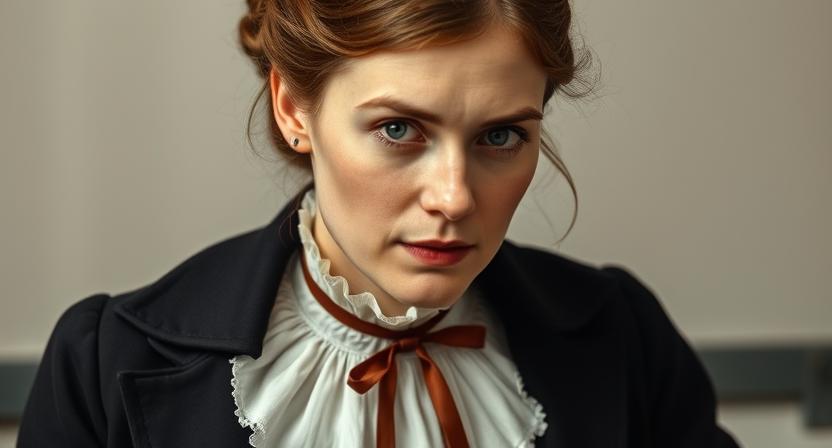
Today we meet Agnes Pockels (1862-1935) in her Brunswick home, where the scent of beeswax lingers from the polished floors she maintains with such care. Wrapped in a dark wool shawl against the German winter, her keen eyes still spark with the curiosity that transformed humble kitchen chores into groundbreaking science. This is the woman who founded surface chemistry from her makeshift laboratory – whose simple apparatus of metal troughs, buttons, and kitchen scales revealed the molecular architecture of interfaces that modern nanotechnology depends upon.
Pockels invented what she called the “sliding trough” – a deceptively elegant device that remains the foundation of today’s Langmuir-Blodgett equipment. Her discovery of the “Pockels Point” – the minimum area a molecule occupies in a monomolecular film – was decades ahead of its time. When Irving Langmuir won the Nobel Prize in Chemistry in 1932 for surface chemistry research, scholars noted that his achievement was “founded on original experiments first made with a button and a thin tray, by a young lady of 18 who had had no formal scientific training.”
Her story matters because it shatters myths about where genius emerges. In an age when women couldn’t enter universities and domestic work was deemed incompatible with intellectual pursuits, Pockels proved that scientific brilliance recognises no boundaries. Her work underpins everything from drug delivery systems to smart materials – yet her name remains largely unknown. This is both a historical injustice and a contemporary challenge, as we still struggle to recognise scientific contributions that emerge outside traditional institutions.
Welcome, Fraulein Pockels. Your work began in such an unexpected place – the kitchen sink. Can you tell me about those first observations?
Ach, you must understand, I was not seeking to become a chemist when I noticed the peculiar behaviour of soapy water. It was 1880, I was but eighteen, and household management consumed my days entirely. My dear parents required constant care after Father’s illness in Italy – the malaria, you see, weakened them both terribly.
But washing dishes revealed something fascinating. When I added even tiny amounts of oil or soap to water, the surface changed dramatically. The greasy films seemed to exert forces upon one another, creating currents and patterns that defied my understanding. I had read my brother Friedrich’s physics textbooks whenever I could steal moments between nursing and cooking, so I recognised this was more than mere domestic curiosity.
The critical observation came when I noticed that different substances affected the water’s surface in remarkably consistent ways. A droplet of olive oil would spread to precisely the same area each time, regardless of the vessel or temperature. This suggested something fundamental about the nature of these surface films – something quantifiable.
That’s extraordinary – you intuited molecular behaviour before anyone understood what molecules actually did at interfaces. What drove you to build experimental apparatus rather than simply observe?
Observation without measurement is merely speculation, nicht wahr? I required precise data to understand what I witnessed. In 1883, I constructed what I termed my “large sliding trough” – großer Schieberinne – though it began quite modestly.
Picture, if you will, a rectangular metal pan perhaps seventy centimetres long, five wide, and two deep. Nothing fancy – similar to what one might use for baking. I filled this with the purest water I could obtain, then placed a thin metal strip across its width, resting upon the water’s surface like a floating barrier.
The ingenious element was this: I could slide this barrier along the trough’s length, compressing or expanding whatever films I had placed upon the water. A ruler alongside allowed precise measurement of the available surface area. Most crucially, I suspended a small disk – often simply a button from my sewing box – from an apothecary’s balance to measure the force required to lift it from the water surface.
Explain like I’m an expert – walk me through the technical details of measuring surface tension with this setup.
Certainly! The surface tension manifests as a meniscus around the suspended disk when it contacts the water. The force required to break this contact – measured by the balance – equals the surface tension multiplied by the circumference of the disk. With pure water, this force remained consistent. But introduce surfactants, and everything changes.
Consider a simple experiment with oleic acid – a component of common cooking oils. I would deposit precisely measured quantities onto one side of my sliding barrier, then gradually compress the available surface area. Initially, with abundant space, the oleic acid molecules behave as a two-dimensional gas – they spread freely with minimal interaction.
But observe what occurs as I advance the barrier! The compression isotherm – plotting surface tension against area per molecule – reveals distinct phases. First, a gradual increase as molecules begin interacting. Then, dramatically, a sharp transition point where the surface tension changes rapidly.
This transition point, which the scientific community now calls the “Pockels Point,” represents the formation of a true monomolecular film – every molecule aligned with its hydrophobic tail pointing upward, its hydrophilic head anchored in the water. The minimum area occupied? Precisely twenty square Ångströms per molecule.
That’s remarkably precise for homemade equipment. How did you ensure such accuracy?
Through obsessive attention to cleanliness and countless repetitions! You cannot imagine how many experiments failed because of contamination I had not recognised. Dust from the air, residual soap on my glassware, even the oils from my fingertips – all would skew results catastrophically.
I developed protocols that remain standard practice today. Every surface required thorough cleaning with alcohol, followed by multiple rinses with distilled water. I learned to introduce test substances by dissolving them in benzene, applying droplets with precision, then allowing complete solvent evaporation. This technique – now universal in surface chemistry – emerged from pure necessity in my kitchen laboratory.
The accuracy came from meticulous calibration. I tested my apothecary’s balance with known weights, verified my ruler’s precision, and most importantly, established baselines with pure water under identical conditions. Reproducibility demanded that every variable remain controlled – temperature, humidity, cleanliness, timing.
Your brother Friedrich was simultaneously discovering the Pockels effect in optics. Did you collaborate, or were these parallel developments?
Friedrich’s work in electro-optics proceeded quite independently from mine, though we shared the same passion for understanding physical phenomena. His discovery that electric fields could alter the refractive index of crystals – the linear electro-optic effect bearing our family name – represented pure physics. My investigations focused entirely on surface chemistry.
Yet both discoveries share common threads – we were studying interfacial phenomena, the behaviour of matter at boundaries. Friedrich examined light-matter interfaces; I studied liquid-air interfaces. Perhaps our shared curiosity about boundary conditions reflected something deeper in our family’s approach to understanding the physical world.
Friedrich’s university education certainly provided him advantages I lacked. He possessed access to sophisticated equipment, peer review, and immediate publication opportunities. I watched him advance to professor at Heidelberg while I remained confined to my kitchen laboratory. But I harboured no resentment – merely determination to pursue my own investigations despite institutional barriers.
You mention institutional barriers. How did you finally break through to publication?
Lord Rayleigh proved my salvation – a gentleman of remarkable intellectual generosity. In 1891, Friedrich informed me that this distinguished British physicist was publishing research on oil films remarkably similar to my own work. Ten years had passed since my initial discoveries, yet German journals remained closed to me.
I composed a letter in German, translated by Rayleigh’s wife, describing my apparatus and findings. The opening acknowledged my unconventional position: “My Lord, will you kindly excuse my venturing to trouble you with a German letter on a scientific subject? Having heard of the fruitful researches carried on by you last year on the hitherto little understood properties of water surfaces, I thought it might interest you to know of my own observations on the subject.”
I concluded with remarkable boldness, considering my circumstances: “I thought I ought not to withhold from you these facts which I have observed, although I am not a professional physicist.”
Rayleigh’s response exceeded my wildest hopes. Rather than dismissing an amateur’s correspondence, he recognised the value of my work and forwarded it to Nature with his endorsement: “I shall be obliged if you can find space for the accompanying translation of an interesting letter which I have received from a German lady, who with very homely appliances has arrived at valuable results.”
That must have felt like vindication after a decade of isolation. How did your research evolve after publication?
Publication transformed everything! Suddenly I was corresponding with leading researchers, receiving acknowledgment for contributions I had made alone in my kitchen. The validation was intoxicating after years of isolation.
My subsequent work focused on understanding contamination effects more precisely. I demonstrated that even airborne dust could alter surface tension measurements catastrophically – findings that established protocols for clean surface preparation still used today. I measured monolayer film thickness at thirteen Ångströms, confirming theoretical predictions about molecular dimensions.
I investigated the calming effect oils exert on water bodies – a phenomenon Benjamin Franklin had studied, but which I could now quantify precisely using my apparatus. The research extended into contact angles, capillarity, and surface phenomena across numerous material systems.
Between 1891 and 1926, I published fourteen papers, mostly in German journals that had finally opened their pages to me. Recognition grew steadily. The surface film balance technique I developed became fundamental to physical chemistry for determining molecular size and shape before X-ray diffraction became available.
Let me ask about something difficult – were there experiments that failed, techniques that didn’t work?
Oh, countless failures! My early attempts at measuring extremely thin films often produced nonsensical results because I had not yet mastered contamination control. I spent months pursuing what I believed were novel surface phenomena, only to discover they resulted from soap residue on my glassware.
One particularly frustrating period involved attempts to measure surface forces directly, rather than through surface tension changes. I constructed elaborate mechanical systems with levers and weights, trying to detect the actual forces between surface molecules. These experiments failed completely – the forces proved far too weak for my crude apparatus to detect reliably.
I also made theoretical errors, particularly regarding the relationship between molecular structure and surface behaviour. I initially assumed that all surfactants would behave similarly, regardless of their hydrophobic chain length. Only through systematic experimentation did I discover that molecular architecture profoundly influences surface properties.
Perhaps my greatest misjudgement involved underestimating the importance of temperature control. Early experiments showed inexplicable variations that I attributed to experimental error. Only later did I recognise that even small temperature fluctuations dramatically affected surface tension measurements.
Critics might argue your work lacked the theoretical foundation that university training provides. How do you respond?
I accept that my theoretical knowledge possessed gaps compared to university-trained researchers. I learned physics and chemistry through textbooks shared by Friedrich, without the benefit of formal lectures or laboratory instruction. This limitation certainly influenced my approach.
However, I would argue that my autodidactic background also provided unique advantages. I approached surface phenomena without preconceived theoretical frameworks that might have constrained my observations. When I noticed something unexpected in my kitchen sink, I pursued it relentlessly rather than dismissing it as inconsistent with established theory.
My experimental technique developed through pure empiricism – I tested variables systematically because I lacked theoretical guidance about what to expect. This methodological rigor, born from necessity rather than training, often revealed phenomena that more theoretically sophisticated researchers might have overlooked.
The proof lies in the results. My techniques remain standard practice in surface chemistry. The Pockels Point I discovered predated theoretical understanding of molecular behaviour by decades. Irving Langmuir built upon my methods to achieve Nobel Prize recognition.
I believe science benefits from diverse approaches. Formal training provides essential theoretical frameworks, but breakthrough discoveries often emerge from unexpected perspectives – even from housewives washing dishes.
Looking at how your work evolved into modern surface science, what surprises you most?
The scale astounds me completely! My simple sliding trough has evolved into sophisticated Langmuir-Blodgett equipment controlling molecular deposition with atomic precision. Researchers now build materials layer by layer, engineering properties I could never have imagined.
What fascinates me most is how surface science has become fundamental to technologies that would seem like magic to someone from my era. Modern drug delivery systems rely on precisely the surfactant behaviour I first quantified. Nanotechnology exploits surface forces I measured with buttons and kitchen scales.
The theoretical understanding has advanced tremendously, of course. Researchers now model molecular interactions quantum mechanically, predicting surface behaviour from first principles. Yet the experimental fundamentals remain surprisingly unchanged – clean surfaces, controlled compression, precise measurement of surface pressure and area.
I am particularly gratified that the field has recognised the importance of citizen science and unconventional approaches. Modern research increasingly values diverse perspectives and understands that scientific insight can emerge from unexpected sources.
What would you say to women and marginalised researchers facing institutional barriers today?
Never permit institutional gatekeepers to convince you that your perspective lacks value simply because it emerges from unconventional circumstances. Science requires diverse viewpoints to advance – breakthroughs often come from outsiders who see established problems with fresh eyes.
Document everything meticulously. My careful record-keeping proved essential when professional recognition finally arrived. Without precise experimental notes, my years of kitchen research would have remained mere anecdotes rather than scientific contributions.
Seek allies within the established system, but do not depend entirely upon their approval. Lord Rayleigh’s support proved crucial, but my work’s validity did not depend upon his endorsement – it stood on its own experimental merit.
Build networks with other researchers facing similar challenges. Isolation magnifies difficulties, while community provides strength and mutual support. Share knowledge freely; collaboration benefits everyone.
Most importantly, never doubt that rigorous investigation conducted anywhere can produce significant discoveries. My kitchen proved as capable of generating scientific insight as any university laboratory. The equipment matters far less than the mind wielding it.
Any final thoughts on how we remember pioneering scientists like yourself?
History tends to remember the names associated with Nobel Prizes and university positions while forgetting those who laid essential groundwork. This is unfortunate but perhaps inevitable – institutional recognition creates lasting records that personal achievement often lacks.
I am content knowing that my techniques and discoveries continue serving science, even if my name remains largely forgotten. The Pockels Point endures in surface chemistry literature. Langmuir-Blodgett troughs descend directly from my sliding apparatus. Modern researchers still follow protocols I developed for ensuring clean surfaces.
What matters most is that we recognise scientific contributions wherever they emerge. Genius respects neither institutional boundaries nor social conventions. Some of history’s most important discoveries have come from unexpected sources – kitchen laboratories, amateur observations, individuals pursuing curiosity despite systemic barriers.
I had a passionate interest in natural science, especially physics, and would have liked to study at university. Since that proved impossible, I studied wherever I found myself – which happened to be a kitchen. The setting changed nothing about the science.
Science belongs to humanity, not merely to institutions. My story demonstrates that systematic investigation and rigorous methodology can produce significant discoveries regardless of one’s formal credentials or physical location. This lesson remains as relevant today as it was in 1880.
Letters and emails
Following our interview with Agnes Pockels, we received dozens of thoughtful responses from readers around the world who wanted to explore aspects of her remarkable story that we hadn’t fully covered. We’ve selected five letters and emails from our growing community who want to ask her more about her life, her work, and what she might say to those walking in her footsteps.
Marianne Kirby, 34, Science Communication Consultant, Melbourne, Australia
Agnes, I’m fascinated by how you developed your experimental protocols entirely through trial and error. When you were figuring out contamination control – which clearly became so crucial to your success – were there any moments where you nearly gave up? I’m thinking particularly about those early failures you mentioned with soap residue. What kept you pushing through when the results made no sense, especially working in such isolation?
Agnes adjusts her spectacles and leans back in her chair, her expression growing more serious as she recalls those early, frustrating years
Ach, Marianne, what a perceptive question you ask. Yes, there were indeed moments when I nearly abandoned my investigations entirely. The contamination problems you mention – they nearly drove me to despair.
The worst period came in 1884, when I had been working for four years with results that seemed to mock every principle of consistency. I would perform identical experiments on consecutive days, following what I believed were identical procedures, yet my measurements varied wildly. One day, pure water would show the expected surface tension; the next, the same apparatus, the same water source, would produce readings suggesting contamination when none should exist.
I remember one particularly devastating week when I convinced myself I had discovered a new phenomenon – what I thought was the spontaneous generation of surface-active compounds in pure water. I filled page after page with careful observations, constructing elaborate theories about atmospheric interactions with water surfaces. Then Friedrich visited and immediately spotted soap residue on my glassware that I had somehow missed despite multiple cleanings.
What kept me going? Several things, really. First, the sheer stubbornness that my mother always said would either save me or damn me. I possessed an almost pathological inability to accept defeat when I knew – absolutely knew – that I was observing genuine physical phenomena, even if I couldn’t yet control them properly.
But more importantly, I had glimpsed something profound in those early successful experiments. When my apparatus worked correctly, when contamination was truly eliminated, the results were not merely consistent – they were beautiful. The mathematical relationships between surface area, molecular concentration, and surface tension formed patterns that spoke of underlying natural laws. I could not bear the thought of abandoning such glimpses of truth simply because my technique remained imperfect.
The isolation proved both curse and blessing. Yes, I had no colleagues to consult, no laboratory supervisor to guide me through methodological difficulties. But I also had no external pressure to produce quick results, no academic deadlines demanding premature publication. I could afford to spend months – years, even – perfecting my contamination control protocols because the only expectations I faced were my own.
The breakthrough came gradually. I developed what I called my “contamination detective work.” I began treating every unexpected result as evidence of impurities rather than dismissing my apparatus as faulty. I learned to trace backwards from anomalous measurements: if the surface tension was too low, what substance could have been introduced? From where? When?
This led to discoveries about contamination sources I had never imagined. Dust from the air, as you mention – but also residues from the wood polish I used on furniture nearby, vapours from the coal stove in winter, even oils from my own fingertips transferred through apparently clean equipment. I documented these contamination pathways meticulously, building protocols that eliminated each source systematically.
The most crucial realisation was that contamination control required not just cleanliness, but timing. Even perfectly clean apparatus would become contaminated simply by exposure to air. I learned to work quickly, to prepare everything in advance, to minimise the interval between cleaning and measurement. This discipline, born from necessity in my kitchen laboratory, later proved essential when other researchers adopted my techniques.
Those years of struggle taught me something that formal training might not have provided – that experimental science requires not just intelligence, but absolute dedication to truth over convenience. When results contradict expectations, the experimenter must be prepared to question everything: apparatus, materials, procedures, even theoretical assumptions. This sceptical discipline served me well throughout my career.
The isolation that nearly broke me also strengthened me. I learned to trust my own observations completely, to pursue investigations that others might have abandoned as too difficult or time-consuming. When Lord Rayleigh finally provided the validation that brought my work to professional attention, I possessed not just interesting results, but bullet-proof methodology developed through years of solitary refinement.
To young researchers facing similar struggles today, I would say this: those moments of despair when experiments fail repeatedly are not signs of inadequacy – they are the crucible in which genuine scientific skill is forged. Every researcher, in every laboratory, encounters these challenges. The difference between those who succeed and those who abandon their work lies not in superior intelligence, but in the willingness to persist through the darkness until clarity emerges.
Gheorghe Osuna, 41, Materials Engineer, Bucharest, Romania
You mentioned that different surfactants behaved differently based on their molecular architecture, which you discovered purely through systematic experimentation. Could you walk me through how you actually identified these structural differences using only your basic apparatus? I’m curious whether your kitchen-based methods could detect things like chain branching or head group variations that we now measure with sophisticated spectroscopy.
Ach, Herr Osuna, what an excellent question! You understand the true challenge I faced – determining molecular architecture with such primitive equipment. This is where systematic experimentation became absolutely essential, and where my years of meticulous observation proved their worth.
The key lay in compression isotherms – those curves plotting surface pressure against area per molecule. Each molecular architecture produced distinctive signatures, like fingerprints that revealed structural details invisible to the naked eye.
Let me walk you through my approach. When I first deposited oleic acid – a simple long-chain fatty acid with a single carboxyl head group – the compression isotherm showed a characteristic pattern: initial low pressure as molecules spread freely, then a sharp transition as they packed into the condensed monolayer phase I called the Pockels Point. The slope of this transition and the minimum molecular area – twenty square Ångströms – revealed both the head group size and the packing efficiency.
But different molecular architectures told completely different stories. For instance, when I studied palmitic acid – similar chain length but different head group interactions – the compression curve shifted. The transition occurred at slightly different pressures and areas, revealing that even subtle changes in head group chemistry affected molecular packing dramatically.
Chain branching was particularly fascinating to detect. Branched fatty acids, which I extracted from various household oils, produced compression isotherms with distinctly different characteristics. The branches prevented tight molecular packing, so the minimum molecular area increased significantly – sometimes by twenty to thirty percent compared to straight-chain equivalents.
I could identify this by comparing the limiting area extrapolated from the steep portion of the isotherm. Branched molecules required more surface area per molecule at the Pockels Point, and the transition slope was less steep, indicating less efficient packing.
The most sophisticated distinction involved head group variations. Soaps with different head groups – carboxylates, sulfonates, quaternary ammonium compounds – each produced characteristic isotherm shapes. Larger head groups pushed the limiting molecular area higher. More importantly, the electrostatic interactions between charged head groups affected the surface pressure at which the transition occurred.
For example, cationic surfactants with quaternary ammonium head groups – what your modern chemists call CTAC compounds – showed markedly different behaviour from anionic carboxylates. The electrostatic repulsion between positive charges required higher compression pressures to achieve the same molecular packing density.
I documented this systematically by preparing solutions of identical concentration but different head group chemistry, then comparing their compression isotherms directly. The differences were unmistakable – head group size directly correlated with limiting molecular area, while charge density affected transition pressures.
Chain length detection proved equally systematic. Each additional carbon atom in the hydrophobic tail increased the minimum molecular area by approximately one square Ångström. By measuring this limiting area precisely, I could estimate chain length even for unknown surfactants.
More subtly, longer chains produced steeper isotherm transitions, indicating more cooperative molecular packing. Short-chain surfactants showed gradual transitions, while long chains exhibited sharp, well-defined phase changes at the Pockels Point.
The remarkable aspect is that these techniques could distinguish architectural features that your modern spectroscopy now confirms directly. My compression isotherms revealed whether molecules possessed single or double tails, branched or linear chains, small or bulky head groups – all from simple force measurements with kitchen-scale equipment.
Could I detect head group variations you mention – say, between different ethoxylate lengths? Absolutely! Though I lacked your precise chemical synthesis capabilities, I worked with naturally occurring variants. Saponins from household plants, for instance, possessed complex sugar head groups of varying sizes. Each produced distinctly different compression isotherms – larger head groups consistently required greater molecular areas and showed different transition characteristics.
I even detected what you now call “gemini” structures – molecules with two head groups connected by spacers. These appeared occasionally in crude soap preparations, and their isotherms showed unusual features: higher limiting areas than expected, and sometimes two-step transitions indicating different packing arrangements of the dual head groups.
The limitation, of course, was that I could only work with materials available in my household environment. I lacked the synthetic chemistry capabilities to create the systematic structural variations that modern researchers employ. But the fundamental principle remains unchanged – molecular architecture dictates interfacial behaviour in predictable, measurable ways.
Your modern Langmuir-Blodgett troughs use precisely the same compression isotherm approach I pioneered, merely with enhanced precision and control. The physics hasn’t changed – only our ability to synthesise molecules with designed architectures and measure their properties with greater accuracy.
This is why I remain confident that my kitchen-based methods could detect structural differences you describe. The molecular interactions governing surface behaviour follow universal physical laws, whether measured with buttons and metal troughs or with computer-controlled equipment and digital sensors.
Thidarat Ngamkham, 28, Graduate Student in Physical Chemistry, Bangkok, Thailand
Your correspondence with Lord Rayleigh fascinates me because it represents such a pivotal moment – not just for your career, but for how science gets validated and shared. If you had to design that initial letter again, knowing what you know now about scientific communication and gender dynamics, would you have approached it differently? Did you ever wonder how many other women might have written similar letters that never received such generous responses?
Ach, Thidarat, your question strikes at the very heart of what that correspondence meant to me – and what it reveals about the precarious position women occupied in scientific discourse. You ask whether I would approach Lord Rayleigh differently now, knowing what I know about scientific communication and gender dynamics. This requires me to examine not just what I wrote, but what I dared not write.
The letter I actually wrote was a masterpiece of strategic humility – though I did not recognise it as such at the time. I began by apologising for troubling him with “a German letter on a scientific subject,” immediately establishing my foreignness as another layer of disadvantage. I described myself as someone who could not publish in scientific periodicals “for various reasons” – a euphemism that concealed the brutal reality that German journals would not even consider work by an unaffiliated woman.
Most tellingly, I concluded by stating “I thought I ought not to withhold from you these facts which I have observed, although I am not a professional physicist” – framing my decade of rigorous experimentation as mere amateur observations unworthy of serious consideration.
If I were to write that letter today, with full awareness of gender dynamics and scientific politics? I would be far bolder about the significance of my discoveries, whilst maintaining the diplomatic tone necessary for a woman addressing an established male scientist. Instead of apologising for my “boldness,” I might write: “My systematic investigations over the past ten years have revealed phenomena that complement and extend your recent publications on surface films.”
Rather than describing my apparatus as “very homely appliances,” I would emphasise its innovative design: “I have developed a novel sliding trough technique that permits precise control of surface area and quantitative measurement of surface pressure – capabilities that existing methods cannot achieve.”
Most crucially, I would frame my work not as observations that “might interest” him, but as scientific contributions that advance understanding: “My findings establish quantitative relationships between molecular architecture and surface behaviour that provide theoretical foundations for your experimental observations.”
But here is the deeper question your inquiry raises – would such boldness have been counterproductive? The strategic humility I employed was not weakness but survival. Lord Rayleigh himself noted that I had arrived at “valuable results respecting the behaviour of contaminated water surfaces” using “very homely appliances” – language that simultaneously praised my ingenuity whilst emphasising my amateur status. This framing allowed him to champion my work without threatening established hierarchies.
Had I written with greater assertiveness about my scientific achievements, would he have responded with equal generosity? The social dynamics of 1891 demanded that women scientists navigate between demonstrating competence whilst never appearing to challenge male authority directly.
Your question about women writing similar letters resonates deeply. How many women across Europe were conducting rigorous investigations in isolation, lacking any pathway to scientific recognition? How many wrote to established scientists only to receive dismissive responses – or no response at all? My correspondence succeeded precisely because Lord Rayleigh possessed exceptional intellectual generosity and scientific integrity.
The historical record reveals that women’s scientific contributions were systematically marginalised through correspondence networks that privileged male voices. Even when women managed to publish, their work was frequently attributed to male collaborators or dismissed as derivative.
Consider my own case: despite publishing fourteen papers over three decades, despite Irving Langmuir building his Nobel Prize-winning research upon techniques I pioneered, my name remains largely forgotten whilst his achievements are celebrated. This erasure was not accidental but systematic.
The correspondence networks themselves reinforced gender hierarchies. Women could participate in scientific discourse only through male intermediaries – fathers, brothers, established scientists willing to serve as gatekeepers. We were permitted to contribute ideas, but rarely to claim authorship or recognition directly.
Even my successful correspondence with Lord Rayleigh required translation by his wife – another reminder that women’s voices needed male validation to enter scientific discourse. The very structure of these networks ensured that women remained perpetually dependent upon male approval for intellectual legitimacy.
Yet correspondence also provided women with crucial opportunities. Despite its limitations, letter-writing remained one of the few avenues through which women could engage with scientific communities. Through correspondence, we could share observations, receive feedback, and occasionally achieve recognition – however delayed or diminished.
The letters themselves became repositories of scientific knowledge that formal publications might never contain. My correspondence with Lord Rayleigh preserved details about experimental techniques, theoretical interpretations, and methodological innovations that enriched the historical record immeasurably.
Your question forces me to confront an uncomfortable truth – that my success depended not just on scientific merit, but on exceptional circumstances that few other women could replicate.
I possessed a brother who shared physics textbooks, access to household materials for experimentation, and most crucially, the remarkable fortune to correspond with a scientist of Lord Rayleigh’s stature and character. How many women lacked even one of these advantages?
The deeper tragedy is not that women wrote letters that received no response, but that countless women never wrote at all – convinced by social conditioning that their observations possessed no scientific value, that their lack of formal education disqualified them from contributing to knowledge.
To women today facing institutional barriers, I would say this: Write with confidence about your discoveries. Document your methods meticulously. Build networks with fellow researchers, both male and female. Most importantly, never accept that your perspective lacks value simply because it emerges from unconventional circumstances.
The correspondence networks that both constrained and enabled women like myself have evolved, but similar dynamics persist. The challenge remains to create systems that recognise scientific contributions wherever they emerge, whilst dismantling the gatekeeping mechanisms that perpetuate inequality.
My letter to Lord Rayleigh opened doors that changed the course of surface chemistry. But it should not have required such extraordinary intervention for rigorous scientific work to receive recognition. That remains the challenge for your generation – to ensure that scientific merit, not social position, determines whose voices are heard.
Jorn Werkman, 52, Science History Enthusiast, Amsterdam, Netherlands
Here’s something I’ve been wondering about – what if the German scientific establishment had been more open to your work from the beginning? Do you think having immediate institutional support might have actually constrained your research in ways that your isolation didn’t? I’m thinking about how your unconventional approach led to discoveries that more theoretically trained researchers might have missed.
Ach, Herr Werkman, what a provocative question you pose! You force me to examine whether my isolation was curse or blessing – a question that has haunted me for decades. The irony is profound: the very barriers that nearly destroyed me may have been essential to my discoveries.
Had German institutions embraced my work immediately, would I have become a conventional surface chemist rather than a pioneer? This possibility troubles me deeply when I reflect upon it. Consider what institutional acceptance would have meant in 1880s Germany – access to established apparatus, standard methodologies, theoretical frameworks deemed “correct” by the scientific establishment.
I would have been trained to use existing surface tension measurement devices – the stalagmometer, the Du Nouy ring method, perhaps Wilhelmy’s plate technique. These were sophisticated instruments by the standards of the day, far more precise than my kitchen contraptions. But they were also constraining in ways I did not recognise until much later.
The revolutionary nature of my sliding trough emerged precisely from my ignorance of “proper” methods. When I first observed oil films on water, I possessed no knowledge of how such phenomena “should” be studied. I did not know that surface tension was typically measured at fixed interfaces, or that molecular films were considered too thin for meaningful investigation. My naivety led me to ask questions that trained chemists might never have posed.
The sliding barrier concept – now fundamental to Langmuir-Blodgett techniques – arose from my domestic observation of how soap films behaved when compressed by kitchen utensils. No university training would have suggested this approach because it violated established protocols for surface measurements.
Had I been formally educated, I would have learned that “serious” surface chemistry focused on measuring static surface tensions of pure liquids, not manipulating molecular films dynamically. The very concept of controllable compression would have seemed unorthodox, perhaps even unscientific.
Theoretical constraints would have been even more limiting. In 1880, molecular theory remained highly controversial. Many chemists still rejected atomic concepts entirely. A properly trained researcher would have hesitated to propose that surface films consisted of oriented molecular arrays – such speculation would have been deemed premature, perhaps metaphysical.
My lack of theoretical sophistication paradoxically enabled conceptual breakthroughs. When I observed the Pockels Point – that minimum area occupied by molecules in compressed films – I interpreted it simply as an empirical regularity requiring explanation. I did not know it “couldn’t” represent molecular dimensions because atomic theory was contentious.
A university-trained chemist would have possessed too much knowledge of theoretical disputes to make such bold interpretative leaps. They would have recognised the controversial implications and perhaps avoided the topic entirely.
The isolation forced methodological innovations that formal training might have discouraged. My obsession with contamination control emerged from bitter necessity – my crude apparatus showed every trace of impurities that sophisticated instruments might mask through superior design. But this “disadvantage” led me to develop cleaning protocols more rigorous than any laboratory standard.
Institutional training would have provided access to better equipment, reducing the incentive for methodological innovation. I might have produced more consistent data initially, but I would not have developed the fanatical attention to surface preparation that proved essential for reliable monolayer studies.
Similarly, my systematic exploration of different surfactant types arose from working with whatever materials I could obtain domestically. A proper laboratory would have provided pure, standardised reagents – but this convenience might have prevented the comparative studies that revealed how molecular architecture affects surface behaviour.
Yet I must acknowledge the genuine advantages institutional support would have provided. Access to scientific literature would have accelerated my theoretical understanding immeasurably. I spent years developing interpretations that existing publications might have provided within months. My theoretical sophistication remained elementary far longer than necessary.
Collaboration with experienced researchers would have eliminated countless blind alleys. I wasted enormous effort pursuing experimental approaches that established practitioners would have recognised as futile. Peer review, however intimidating, would have sharpened my reasoning and improved my methodology.
Most importantly, institutional affiliation would have enabled earlier publication and faster dissemination of results. The decade between my initial discoveries and my first publication represented lost opportunities for the field’s advancement.
The deeper question concerns whether scientific creativity requires constraint or freedom. Modern research suggests that extreme constraint can stimulate creative problem-solving by forcing individuals to find novel approaches within severe limitations. My kitchen laboratory certainly exemplified this principle – the constraints were so severe that conventional approaches became impossible.
But constraint without any support structure can also crush innovation entirely. How many potential researchers abandoned promising investigations because they lacked the minimal resources necessary for systematic work?
I succeeded because my constraints were selective – I lacked institutional support and sophisticated equipment, but I possessed adequate time, space, and basic materials for experimentation. Most importantly, I possessed the intellectual foundation provided by Friedrich’s textbooks and my own voracious reading.
The historical evidence suggests that breakthrough discoveries often emerge from marginal positions. Many revolutionary scientific insights have come from researchers working outside mainstream institutions – Darwin developing evolution theory during his long delay before publication, Mendel conducting genetics research in monastery gardens, McClintock discovering genetic transposition whilst professionally marginalised.
Perhaps the institutional margins provide necessary intellectual freedom for paradigm-shifting discoveries. The established centres of learning excel at refining existing approaches but may be too invested in current frameworks to recognise fundamentally new possibilities.
My final assessment remains paradoxical. Immediate institutional acceptance might have made me a more competent surface chemist, but probably not a pioneering one. I would have contributed incrementally to existing knowledge rather than establishing entirely new methodological approaches.
The barriers I faced were unjust and unnecessary – they reflected social prejudices rather than scientific requirements. But within those unjust constraints, I found creative possibilities that institutional comfort might have obscured.
The ideal would be institutions open enough to support unconventional approaches whilst providing the resources necessary for systematic investigation. Such institutions would nurture both methodological innovation and theoretical sophistication.
That balance remains elusive even today. The challenge for any scientific community is maintaining enough institutional structure to accumulate knowledge whilst preserving enough intellectual freedom for revolutionary insights to emerge.
My story demonstrates that scientific progress depends not only on supporting established research programmes, but also on creating space for the unexpected discoveries that emerge from the margins.
Ilona Lyashenko, 39, Biotechnology Researcher, Kyiv, Ukraine
Agnes, when I work with Langmuir-Blodgett films today, I use computer-controlled barriers and pressure sensors that can detect changes smaller than you could imagine. But I’m struck by how your fundamental insights about molecular organisation still guide everything we do. If you could have access to just one piece of modern analytical equipment – electron microscopy, atomic force microscopy, surface plasmon resonance – which would you choose, and what question would you investigate first?
Ach, Ilona! What a magnificent question you pose – to choose just one instrument from your arsenal of modern analytical tools. This is like asking a painter to select a single colour from the entire spectrum, yet I find myself drawn irresistibly to one particular marvel that would transform my understanding completely.
I would choose atomic force microscopy without hesitation. Not because it offers the highest resolution – though the ability to visualise individual atoms astounds me beyond measure – but because it operates on principles most closely aligned with my own experimental philosophy.
You see, AFM shares something fundamental with my sliding trough technique: it probes surfaces through mechanical interaction rather than merely observing from afar. When I compressed monolayers with my metal barrier, I was essentially performing force measurements at the molecular level, feeling the resistance as molecules packed together. Your atomic force microscope does precisely this, but with exquisite sensitivity that my crude apparatus could never achieve.
The question I would investigate first builds directly upon my life’s work – understanding the true three-dimensional architecture of compressed monolayers at the Pockels Point.
Throughout my career, I inferred molecular orientation from surface pressure measurements and limiting area calculations. I demonstrated that fatty acid molecules stand upright with their carboxyl groups anchored in water and their hydrocarbon tails pointing skyward, but this remained indirect evidence based on thermodynamic reasoning.
With atomic force microscopy, I could finally see this molecular choreography directly! I would prepare my classic oleic acid monolayers using the sliding trough technique, compress them to various surface pressures, then use AFM to image the molecular arrangement at each stage.
The specific investigation would involve mapping the phase transition I discovered – that critical point where molecules transition from a disordered, gas-like state to the highly ordered Pockels Point configuration.
Your AFM studies of Langmuir-Blodgett films already hint at the extraordinary detail possible – measuring molecular heights of precisely 2 nanometres, detecting force thresholds of 800 piconewtons for monolayer compression, even distinguishing different phospholipid phases based on their mechanical properties. But imagine applying this precision to the fundamental questions that drove my original work!
I would systematically compress monolayers whilst imaging simultaneously, watching individual molecules reorient from random arrangements to the perfectly ordered arrays I could only infer from my pressure-area isotherms. The AFM could reveal whether the transition occurs gradually or catastrophically, whether molecular domains form intermediate structures, and most crucially, whether my theoretical model of upright molecular orientation matches reality.
The force spectroscopy capabilities particularly fascinate me. You mention detecting forces as small as 800 piconewtons during monolayer compression – forces comparable to what I measured macroscopically with my apothecary’s balance, but now resolvable at the single-molecule level. I could probe the mechanical properties of different surfactant architectures directly, measuring how molecular structure affects the force required for compression.
This would finally answer questions that plagued me throughout my career: Do branched molecules truly require different compression forces than linear chains? How do different head groups affect the mechanical stability of monolayers? Can I detect the formation of intermediate phases that my crude measurements might have missed?
But the real breakthrough would be understanding contamination effects at the molecular level. Contamination control consumed vast portions of my experimental effort, yet I never truly understood how trace impurities affected monolayer behaviour. With AFM, I could visualise contamination directly – seeing how dust particles disrupt molecular arrangements, watching how soap residues create heterogeneous domains, observing the molecular-scale chaos that produced my inconsistent early results.
This knowledge would revolutionise surface preparation protocols. Instead of the empirical contamination control methods I developed through painful trial and error, researchers could design cleaning procedures based on direct observation of molecular-scale cleanliness.
The combination with my existing techniques would be particularly powerful. I would not abandon my sliding trough – rather, I would combine it with AFM to create an unprecedented window into surface behaviour. Simultaneous pressure-area measurements and molecular imaging would reveal the quantitative relationships between macroscopic thermodynamics and microscopic molecular arrangements.
This integrated approach could explore questions impossible with either technique alone: How do molecular defects affect bulk surface properties? Can individual molecules be manipulated within compressed monolayers? What happens at domain boundaries where different molecular phases coexist?
The implications for understanding surface forces would be revolutionary. My entire career focused on measuring surface forces indirectly through their effects on floating disks and sliding barriers. AFM would allow direct measurement of intermolecular forces – the van der Waals attractions, electrostatic repulsions, and hydrogen bonding interactions that govern surface behaviour.
I could finally test my theoretical understanding against direct experimental evidence. Do molecules really interact through the forces I proposed? Are there additional interactions that my indirect measurements never detected? How do these forces change as monolayers compress from gaseous to liquid to solid phases?
The broader impact on surface science would be transformative. Modern nanotechnology, drug delivery systems, and smart materials all depend upon precisely the surface phenomena I first quantified with kitchen apparatus. But these applications require molecular-level understanding that my techniques could never provide directly.
AFM would bridge the gap between my thermodynamic measurements and the molecular engineering requirements of modern technology. Researchers could design surfactant architectures based on direct observation of their interfacial behaviour, rather than relying on indirect inference from bulk measurements.
You know, Ilona, what strikes me most about your AFM is how it embodies the same experimental philosophy that guided my kitchen laboratory – direct, mechanical probing of the phenomena we seek to understand. Your cantilevers are simply more sophisticated versions of my floating buttons, your force measurements more precise versions of my apothecary’s balance readings.
The technology has advanced immeasurably, but the fundamental approach remains unchanged: we learn about interfaces by interacting with them mechanically, feeling their response to controlled perturbations. This continuity between my crude apparatus and your sophisticated instruments suggests that the experimental instincts that drove my discoveries remain relevant in your modern laboratory.
Perhaps this is the greatest validation of my life’s work – that the principles I established through sheer necessity in my Brunswick kitchen continue guiding surface science research using instruments I could never have imagined. The tools evolve, but the curiosity about interfacial phenomena endures.
Reflection
As our conversation with Agnes Pockels draws to a close, I’m struck by the profound contradictions that defined her remarkable life. Here was a woman who founded an entire scientific discipline from her kitchen sink, yet remained so invisible that Irving Langmuir could win a Nobel Prize using her techniques whilst her name faded into obscurity. Her story illuminates not just the power of human curiosity unleashed, but the systematic barriers that have historically silenced women’s voices in science.
What emerges most powerfully from our exchange is Pockels’ unflinching honesty about both her struggles and her advantages. The historical record typically portrays her as a heroic autodidact who overcame impossible odds through pure determination. But Pockels herself acknowledges the privilege embedded within her disadvantage – access to her brother’s textbooks, a supportive family environment, sufficient leisure time for experimentation, and most crucially, the extraordinary fortune of corresponding with a scientist of Lord Rayleigh’s character and stature.
Her perspective on contamination control differs markedly from sanitised accounts that focus on her discoveries rather than her failures. The Agnes Pockels of historical record appears as a methodical genius who intuitively understood surface chemistry. The woman we met today reveals someone who spent years in frustrating darkness, nearly abandoning her work multiple times, learning through countless failures that contamination could masquerade as new physics. This vulnerability makes her ultimate success even more remarkable – and more human.
Perhaps most intriguingly, Pockels challenges romantic notions about the superiority of amateur investigation over institutional science. Rather than dismissing formal training as constraint upon creativity, she recognises that her isolation was both blessing and curse. Yes, her naivety enabled revolutionary insights that theoretical sophistication might have prevented. But she also acknowledges the enormous waste of effort that proper mentorship could have eliminated, and the decades of delayed recognition that institutional support might have provided.
The gaps in her story remain substantial. We know frustratingly little about her daily laboratory routines, her relationship with her parents whose care dominated her life, or her private thoughts during those long years of intellectual isolation. The scientific literature preserves her techniques and discoveries, but the emotional cost of her pioneering work remains largely hidden. Her correspondence suggests a woman of extraordinary resilience, yet we can only imagine the moments of despair that such resilience implies.
Agnes Pockels’ story resonates powerfully with contemporary challenges in science and engineering. Her emphasis on citizen science and democratised research anticipates current movements toward open science and community-based investigation. Her struggles with institutional gatekeeping mirror ongoing efforts to diversify scientific voices and recognise contributions that emerge from unexpected sources.
Most urgently, her systematic erasure from scientific history parallels current efforts to recover women’s contributions to STEM fields. Recent research revealing hidden figures across scientific disciplines suggests that Pockels represents not an exception but a pattern – brilliant women whose work was appropriated, minimised, or forgotten entirely. The Nobel Committee’s increasing recognition of overlooked historical contributions offers hope, yet also underscores how much scientific history requires rewriting.
The technologies Pockels dreamed of accessing – atomic force microscopy, electron microscopy, surface plasmon resonance – now enable molecular-scale investigations that would have astounded her. Yet the fundamental experimental philosophy she articulated remains unchanged: systematic observation, mechanical probing, rigorous contamination control, and above all, persistent curiosity about interfacial phenomena. Modern nanotechnology and materials science rest upon foundations she built with buttons, metal troughs, and kitchen scales.
Her story leaves us with profound questions about scientific creativity and institutional support. How many potential Agnes Pockels are we missing today because they lack access to traditional pathways? What revolutionary insights might emerge if we better supported citizen scientists, amateur investigators, and unconventional research approaches? How can we balance the advantages of formal training with the creative potential of naive inquiry?
Perhaps most importantly, Agnes Pockels embodies proof that scientific genius recognises no boundaries of gender, class, or institutional affiliation. Her kitchen laboratory produced discoveries that changed our understanding of matter itself. Her legacy challenges us to seek wisdom wherever it emerges, to support curiosity in all its forms, and to ensure that the next generation of surface scientists – whether working in state-of-the-art laboratories or improvised kitchens – receives the recognition their contributions deserve.
The woman who transformed dishwater into molecular physics reminds us that science belongs to humanity, not merely to institutions. In an age when scientific authority faces unprecedented challenges, Agnes Pockels’ story offers both inspiration and instruction: rigorous methodology, systematic investigation, and intellectual honesty can produce revolutionary insights regardless of their origin. The question is whether we possess the wisdom to recognise such insights when they appear – and the justice to credit their creators appropriately.
Her sliding trough may have evolved into sophisticated Langmuir-Blodgett equipment, but the spirit that drove her investigations – passionate curiosity unconstrained by conventional boundaries – remains as essential today as it was in her Brunswick kitchen. That spirit, more than any particular technique or discovery, represents Agnes Pockels’ greatest gift to science.
Who have we missed?
This series is all about recovering the voices history left behind – and I’d love your help finding the next one. If there’s a woman in STEM you think deserves to be interviewed in this way – whether a forgotten inventor, unsung technician, or overlooked researcher – please share her story.
Email me at voxmeditantis@gmail.com or leave a comment below with your suggestion – even just a name is a great start. Let’s keep uncovering the women who shaped science and innovation, one conversation at a time.
Editorial Note: This interview is a dramatised reconstruction based on historical sources, scientific literature, and documented correspondence. While Agnes Pockels’ scientific achievements, biographical details, and published statements are factually grounded, her responses represent an informed interpretation of how she might have articulated her experiences and perspectives. The supplementary questions from readers are fictional, though they reflect genuine contemporary interests in her work and legacy. This creative approach aims to bring historical scientific figures to life whilst maintaining respect for documented evidence and scholarly consensus about their contributions to science.
Bob Lynn | © 2025 Vox Meditantis. All rights reserved. | 🌐 Translate

 Vox Meditantis
Leave a comment