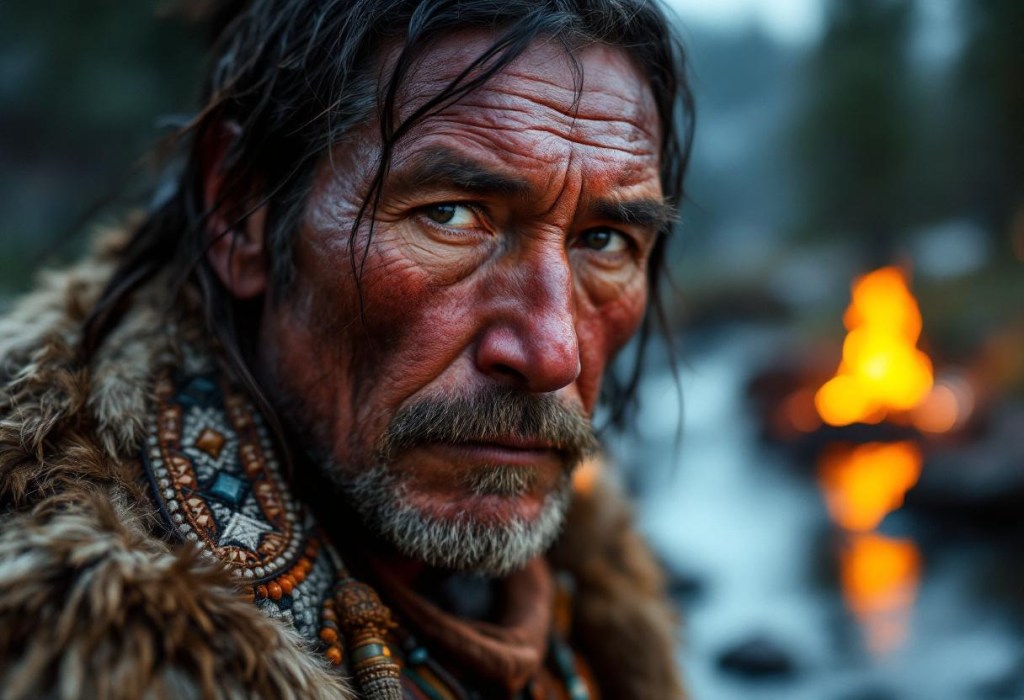
Bonanza Creek, Yukon Territory, Canada – 16th August 1896
The gold flakes beneath Skookum Jim’s fingernails caught the last threads of August light, tiny fragments of promise embedded in the creases of his weathered brown skin. He crouched at the edge of Bonanza Creek, the frigid water lapping at his mukluks, and studied these alien specks that might change everything – or nothing at all. Behind him, George Carmack’s axe rang against deadfall, the sharp crack echoing off the surrounding hills like gunshots in the wilderness.
Jim flexed his fingers, watching how the metal caught fire in the dying sun. His hands trembled, though not from the bitter wind that swept down from the peaks. In all his thirty-four years following trap lines and hunting trails through this country, he had never felt anything quite like the hollow flutter that had settled in his chest when Carmack’s pan first caught that impossible gleam.
“Jim! You gonna sit there all evening like a bloody statue?” Carmack’s voice carried the particular edge of a man trying to sound casual whilst his world tilted beneath his feet. “Fire won’t build itself, and this wind’s got teeth tonight.”
Rising slowly, Jim brushed the creek water from his hands and turned towards their makeshift camp. Carmack had chosen a decent spot – a small clearing protected by a stand of white spruce, close enough to the creek for water but elevated enough to avoid the worst of the mosquitoes. The American moved with the quick, nervous energy Jim had observed in many of his kind, as though stillness itself might allow doubt to creep in.
“Fire comes,” Jim said simply, gathering kindling from the pile Carmack had assembled. His English still carried the rhythms of Tagish in its cadences, each word considered before release. “Creek speaks louder than axe tonight.”
Carmack paused in his work, his beard-stubbled face creased with concern. “What’s she saying to you?”
Jim arranged the tinder with the methodical care his uncle had taught him as a boy – finest fibres at the centre, building outward in careful gradations. How could he explain what the creek whispered? That she sang of secrets disturbed, of the deep places where metal slept being torn open to daylight? That she carried the scent of change, swift and irreversible as spring flood?
“She says…” Jim struck flint to steel, nurturing the spark with gentle breath. “She says tomorrow different than today.”
The flame caught, and Jim fed it carefully whilst Carmack settled across from him with a grunt. They had worked together long enough – Jim and his brother-in-law Charlie helping Carmack work his claims along Fortymile Creek – that silence between them held no discomfort. But tonight the quiet felt dense with possibility and dread in equal measure.
Jim studied Carmack’s face in the growing firelight. The man’s blue eyes held a peculiar brightness, the pupils slightly dilated despite the flame between them. Jim had seen this look before, in the faces of prospectors fresh off the steamers from Outside, drunk on tales of fortune. But Carmack had been in this country long enough to know better. He had married Kate, Jim’s sister, had learnt to read the land’s moods, had felt the weight of northern winters. He should know that luck, like weather, could turn without warning.
“Reckon we ought to keep this quiet till we get back to Fortymile,” Carmack said, prodding at the fire with a green stick. “Can’t have word getting out ‘fore we stake proper claims.”
Jim nodded, though his stomach tightened at the thought of keeping secrets from Charlie, from Kate. His people did not hold with hoarding knowledge that might benefit the band. Yet he understood the white man’s way of claiming Earth’s gifts as personal property. The irony was not lost on him that he had become wealthy, if wealthy they truly were, by thinking like one of them.
“My people,” Jim said carefully, “they say gold is grandmother’s tears. Shed for what is lost when metal fever comes to the land.”
Carmack’s laugh held little humour. “Your grandmother cries expensive tears, then.”
The wind picked up, sending sparks spiralling into the darkening sky like fallen stars seeking their way home. Jim pulled his blanket closer and gazed across the fire at his brother-in-law. How different they must look to any watching spirits – the broad-shouldered Tagish man with his weathered face and careful eyes, and the lean American whose restless energy seemed to vibrate through his very bones.
“George,” Jim said quietly, “what you feel now? In here?” He touched his chest above his heart.
Carmack was quiet for a long moment, staring into the flames. When he spoke, his voice carried a note Jim had never heard before – something caught between wonder and terror.
“Feel like I’m standing at the edge of something mighty big, Jim. Like looking down into a canyon and not being able to see the bottom.” He met Jim’s eyes across the fire. “What about you? What’s this doing to your insides?”
Jim considered the question whilst above them the first stars began to pierce the darkening vault of sky. What did he feel? The flutter remained, but beneath it lay something deeper and more familiar – the same wariness that came when tracking fresh wolf sign, or when the wind shifted unexpectedly during a hunt.
“I feel…” Jim chose his words like selecting stones for a cairn, each one needing to bear weight. “I feel like winter coming early. Something beautiful, maybe. But something that changes everything it touches.”
***
The fire had settled into steady coals, painting the surrounding spruce trunks in shifting amber light, when Jim realised Carmack would not sleep tonight. His brother-in-law sat upright against his pack, feeding small sticks to the flames with mechanical precision, his eyes fixed on the dancing tongues of fire as though they might reveal prophecy in their movements.
Jim had dozed fitfully, drifting between wakefulness and dreams filled with the sound of rushing water. Each time he surfaced from sleep, Carmack remained in the same position, his silhouette rigid against the wilderness darkness. The man’s restlessness radiated outward like heat from the fire, disturbing the natural rhythms of the night.
“Can’t settle your mind?” Jim asked quietly, not wanting to startle him.
Carmack started anyway, then let out a long breath. “Didn’t know you were awake.” He tossed another branch onto the coals, sending up a shower of sparks. “Keep thinking about tomorrow. About riding into Fortymile and filing claims. About what comes after.”
Jim shifted beneath his blanket, studying his companion’s profile in the firelight. Carmack’s jaw worked as though chewing over words he couldn’t quite swallow. The American had always been a talker, filling silences with observations about weather, wildlife, the quirks of other prospectors. But tonight his usual chatter had condensed into something denser, more urgent.
“Been out here three years now,” Carmack continued, his voice barely above a whisper. “Three winters of frozen beards and summer mosquitoes thick as smoke. Three years of washing gravel for dust and flakes, always thinking the next pan might be the one.” He paused, poking at the fire again. “Never expected it to feel like this when it finally happened.”
“How does it feel?” Jim asked, though he thought he knew. He had seen this particular fever before, in the eyes of men fresh from Outside, drunk on tales of Californian fortunes. But Carmack had been seasoned by northern winters, tempered by the country’s harsh instruction. His fever ran deeper, more complex.
Carmack was quiet for so long that Jim began to think he wouldn’t answer. When he finally spoke, his words came slowly, as though pulled from some deep well within him.
“Like I’m carrying lightning in my chest. Like every nerve in my body’s been stripped bare and touched with electricity.” He turned to look directly at Jim, his eyes reflecting the fire’s glow. “But underneath all that excitement, there’s something else. Something that feels like… like standing at the edge of a cliff in fog, not knowing if the next step leads to solid ground or empty air.”
Jim understood. The gold promised everything and guaranteed nothing. It whispered of freedom whilst binding men to its service, spoke of security whilst destroying the certainties they had built their lives upon. He had watched prospectors arrive in the territory with hope blazing in their faces, only to see them broken by disappointment or, more cruelly, by the very success they had sought.
“Jim,” Carmack said suddenly, his voice carrying a note of genuine curiosity that cut through his restless energy. “You’ve been out here longer than most, seen more country than any white man I know. Lived through things that would kill lesser men.” He leaned forward slightly, the firelight catching the new lines around his eyes. “What positive emotion do you feel most often?”
The question hung in the night air like smoke from their fire, unexpected and somehow intimate. Jim felt his eyebrows rise despite himself. In all his years, through all the conversations around countless campfires, no one had ever asked him such a thing. White men spoke of practical matters – weather, game signs, the likelihood of finding colour in unexplored creeks. They did not probe the inner landscape of feeling.
“Strange question for prospector to ask,” Jim said carefully.
“Maybe.” Carmack shrugged, but his gaze remained fixed on Jim’s face. “But sitting here tonight, feeling all twisted up inside about what we found, it got me thinking about what actually sustains a man. What keeps him going when the country tries to break him.” He gestured toward the darkness beyond their fire’s reach. “This place strips everything down to bone. Takes away the small comforts, the easy pleasures. What’s left after that?”
Jim considered the question whilst overhead the aurora began its nightly dance, sheets of green light rippling across the star-drunk sky. What positive emotion did he feel most often? Joy seemed too simple a word, too light for the complex weaving of satisfaction and gratitude that ran through his days like underground water.
He thought of Kate’s laughter when she teased him about his careful ways. Of the moment three summers past when he had tracked a wounded caribou through dense willows and found not just the animal, but an entire herd sheltering in a hidden meadow – meat enough to feed the band through the hardest weeks of winter. Of mornings like this one, when the land revealed its secrets to those who knew how to listen.
“Recognition,” Jim said finally, the word emerging from some deep place he rarely examined. “I think… recognition is what I feel most.”
Carmack frowned, clearly puzzled. “Recognition? Of what?”
Jim gazed into the fire, gathering his thoughts like gathering kindling – each memory selected for its ability to illuminate the truth he was reaching toward.
“My uncle, he taught me to read sign when I was boy,” Jim began, his voice taking on the cadence of story-telling. “Not just track animals, but read the whole story land tells. Where water runs in spring, how wind shapes snow, which trees will fall in next storm.” He paused, remembering the old man’s patient instruction. “Uncle said most people, they walk through country but never see it. Never recognise what it offers.”
***
Dawn crept across Bonanza Creek like a careful hunter, painting the eastern ridges in shades of rose and gold whilst the valley below remained shrouded in blue shadow. Jim had watched the night surrender to morning from his place beside the dying fire, Carmack’s question still turning in his mind like a prayer wheel, each revolution revealing new facets of truth.
His brother-in-law dozed fitfully against his pack, finally claimed by exhaustion near the darkest hour before dawn. But Jim remained wakeful, his thoughts following the creek’s murmur as it carried pieces of their discovery downstream toward the Klondike River, toward the Yukon, toward a world that would soon turn its hungry gaze upon this quiet valley.
As the first direct rays of sunlight touched the water, transforming the creek into a ribbon of molten copper, Carmack stirred and sat up with a grunt.
“Morning already?” he mumbled, rubbing his eyes with the backs of his hands.
“Has been coming for some time,” Jim replied, adding the last of their kindling to coax flame from the banked coals. “Coffee?”
“Christ, yes.” Carmack stretched, his joints popping audibly in the crisp air. “Feel like I wrestled a grizzly all night.” He looked toward the creek, and Jim watched recognition flood back into his features – the memory of yesterday’s discovery, the weight of what lay ahead. “Still feels like a dream, doesn’t it?”
Jim measured coffee grounds into their battered pot with the same careful precision he applied to all tasks. “Dreams easier to wake from,” he said quietly.
They sat in companionable silence whilst the coffee brewed, watching the sun climb higher and the shadows retreat up the valley walls. Soon they would need to break camp, return to Fortymile, begin the business of transforming their discovery into legal claims. But for now, the morning held them in its stillness.
“You never finished answering my question,” Carmack said eventually, accepting the tin cup Jim offered him. “About recognition. What is it you recognise that brings you such feeling?”
Jim sipped his coffee – bitter and strong enough to wake the dead – and considered how to finish what he had begun in the darkness. The words felt more complex in daylight, harder to extract from the tangle of memory and emotion where they had formed.
“My people, we have word,” Jim began slowly. “Means something like… grateful seeing. When you look at world and recognise not just what is there, but what it offers. What it teaches.” He gestured toward the creek, now fully illuminated and sparkling in the morning light. “Like this water. Most men, they see obstacle to cross, or place to wash dishes. I see veins of earth, carrying stories from high places to low places.”
Carmack nodded, though Jim sensed he was reaching for understanding rather than grasping it fully.
“Yesterday, when gold showed itself in your pan,” Jim continued, “I felt recognition, yes. But not just of metal. Of moment when earth decides to trust human beings with her secrets.” He paused, watching a whisky jack land on a nearby branch, its bright eye studying their camp. “Recognition that some gifts come with great weight attached.”
“Weight?” Carmack asked.
Jim set down his cup and looked directly at his brother-in-law. “George, this gold – it will bring many men to this place. Men who see only the metal, not the stories beneath it. They will tear up the creek beds, cut down the forests, drive away the animals.” His voice carried no accusation, only the certainty of someone who had watched such transformations before. “This valley, it will never be quiet again.”
Carmack’s face grew sober. “You think we’ve made a mistake?”
“No mistake,” Jim said firmly. “Earth chose to show herself to us for reason. But…” He searched for words to convey the complex mix of gratitude and sorrow that filled him. “Recognition sometimes means seeing what will be lost as well as what will be gained.”
He stood and walked to the creek’s edge, kneeling to splash the icy water on his face. The cold shock cleared his thoughts, sharpened the edges of the moment. When he returned to the fire, Carmack was watching him with curious intensity.
“The positive emotion I feel most often,” Jim said, settling back onto his haunches, “is recognition of beauty that already exists. Of connection between all things. Of my place in story that began before I was born and will continue after I am gone.” He smiled, the expression transforming his weathered features. “This feeling, it does not depend on finding gold or having good luck. It depends only on remembering how to see.”
Carmack was quiet for a long moment, staring into his coffee as though it might hold answers. “Reckon that’s a kind of wealth most men never find,” he said finally.
“Yes,” Jim agreed. “And no prospector can steal it from you.”
They finished their coffee in silence, each man lost in his own thoughts. Around them, the wilderness continued its ancient rhythms – the whisky jack called to its mate, the creek sang its endless song, the wind whispered secrets amongst the spruce boughs. Soon enough, this peace would be shattered by the thunder of stampeders, the crash of mining equipment, the shouts of men drunk on gold fever.
But for now, in these final moments before they broke camp and returned to the world of claims and commerce, Jim allowed himself to feel the full weight of recognition. He saw the morning light painting everything in shades of gold more precious than any metal. He felt his connection to this land, to his people, to the complex web of relationships that sustained him through the hardest winters and the most uncertain seasons.
This, he knew, would endure long after the gold was gone. This would remain when the creek ran clear again and the mountains reclaimed their silence. This recognition, this grateful seeing – it was the true fortune he carried, the real treasure that no amount of earthly wealth could purchase or diminish.
Rising to pack their gear, Jim took one last long look at Bonanza Creek, knowing he would remember this morning for the rest of his days – not for the gold they had found, but for the moment when he had found words for the feeling that sustained him. The creek sparkled in the strengthening sunlight, beautiful and unchanged, still carrying its ancient stories toward the sea.
The End
On 16th August 1896, George Carmack, accompanied by his Tagish relatives Skookum Jim and Dawson Charlie, discovered gold on Bonanza Creek (then called Rabbit Creek) in the Yukon Territory, sparking the Klondike Gold Rush. The find drew an estimated 100,000 prospectors between 1896 and 1899, though only 30,000-40,000 actually reached the goldfields. By 1898, the rush had yielded roughly $29 million in gold, while Dawson City exploded in size, growing from just 500 residents to more than 17,000 in two years. For the indigenous Hän people, however, the impact was devastating: their population fell from about 8,000 in 1800 to only 1,500 by 1921, as disease, displacement, and environmental damage ravaged their homelands. The rush permanently reshaped northwestern Canada, accelerating the development of transportation routes that underpinned modern Yukon, British Columbia, and Alberta, while illustrating how resource booms could rapidly transform both landscapes and Indigenous communities across North America.
Bob Lynn | © 2025 Vox Meditantis. All rights reserved. | 🌐 Translate

 Vox Meditantis
Leave a comment