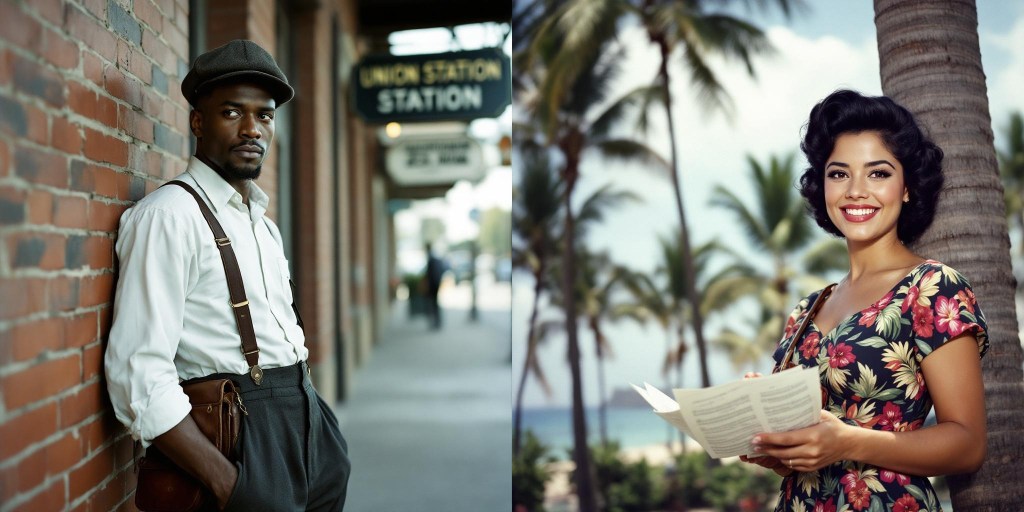
847 Pine Street, Jackson, Mississippi
15th November, 1949
My Dearest Minnie,
I find myself writing this letter by the familiar glow of my lamp, though tonight the words seem to catch in my throat before they reach the paper. Three times I have begun this correspondence, and three times I have crumpled the pages, watching my careful script disappear into the wastepaper basket like so many unspoken truths. There is something I must tell you, something that has been gnawing at my conscience like rust on railway tracks, and I fear that once these words are committed to ink, there will be no retrieving them.
Your last letter arrived on Tuesday – the one where you wrote so beautifully about the sunset over Diamond Head, comparing its colours to the music you played that evening. I carried your words with me as I moved through the station, and for a brief moment, I could almost hear the ocean breeze you described, could almost feel that Hawaiian warmth you speak of with such joy. But then Mr. Hutchins, the station supervisor, made one of his usual remarks about “keeping the coloured boys in line,” and the spell was broken. The bitterness that followed tasted sharp as iron filings.
I am nervous, my darling Minnie, nervous in ways that my war service never taught me to be. In the Pacific, I knew my enemies and could face them with rifle in hand. But how does a man fight an entire world that would see our love as something shameful, something impossible? How do I write to you of dreams and futures when every day here reminds me of the walls that stand between what is and what might be?
Yesterday, I witnessed something that has left me hollow with rage. A young Negro soldier, recently returned from Korea, was removed from the white waiting room by the local sheriff. The boy – and he was barely more than a boy – had been reading a book, bothering no one, simply waiting for his train home. As they dragged him away, I saw in his eyes the same confusion I carry in my heart. He had fought for democracy overseas, yet found none waiting for him here. I wanted to intervene, wanted to speak up, but I stood frozen, knowing that my job, my livelihood, my very ability to write these letters to you, all hang by the threadbare dignity I maintain through careful silence.
The bitterness burns because I know that even as I dream of someday holding your hand beneath those Hawaiian stars you describe so eloquently, the reality is that we live in different worlds – not just geographically, but in ways that matter deeply in 1949 America. Your Hawaii sounds like paradise not just for its beauty, but for its acceptance, its mixing of peoples and cultures that you write about so naturally. Here, love itself becomes a form of rebellion, and I am not certain I possess the courage that such rebellion demands.
I am nervous, too, about the intensity of my own feelings. In your last letter, you teased me about my “formal” writing style, and whilst your gentle mockery made me smile, it also made me realise how carefully I guard my words, even with you. The truth is, Minnie, that I love you with a ferocity that frightens me. I love the way your letters arrive like small miracles, carrying the scent of plumeria and the sound of your laughter across thousands of miles. I love your playful spirit that challenges my sometimes too-serious nature. I love your open heart that sees possibility where I see only obstacles.
But loving you has also made me bitter towards a world that would deny us the simple happiness that others take for granted. When I see young couples walking hand in hand down Capitol Street, I feel a sharp resentment that we may never know such public tenderness. When I read about the latest lynching in the Crisis, I wonder if dreaming of a future with you is not just naive, but dangerous.
Yet despite my fears, despite the bitterness that threatens to consume my faith in what we’re building, I continue to write. I continue to love you. Perhaps that is its own form of courage – not the dramatic kind found in war stories, but the quiet kind that persists in writing love letters when the world insists such love cannot be.
Your photograph sits beside my lamp as I write, and your smile reminds me that some things transcend the boundaries that men create. Hold fast to that joy, my darling Minnie. Let it be strong enough for both of us.
With all my love and hope,
Charles
Bob Lynn | © 2025 Vox Meditantis. All rights reserved. | 🌐 Translate

 Vox Meditantis
Leave a comment