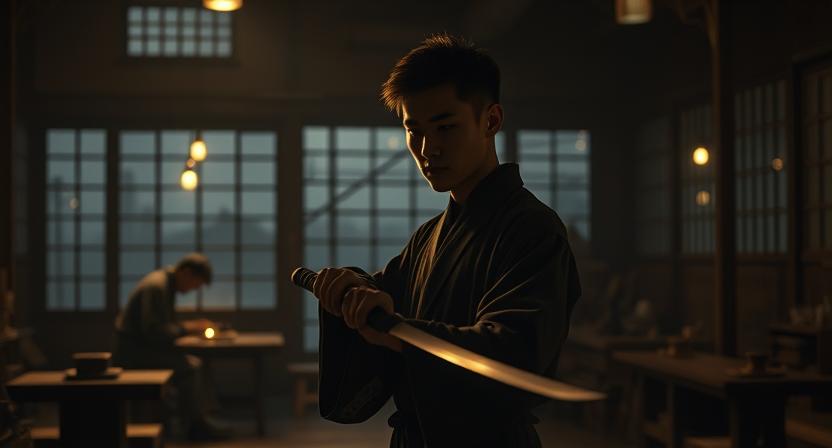
Tokyo, Japan – 30th July 1912
The morning mist clung to the cobblestones of our narrow street like incense smoke, dense with the finality of endings. From my workshop window, I could already hear the distant toll of temple bells across Tokyo, their bronze voices carrying news that would reshape our empire: Emperor Meiji was dead.
I pressed my palm against the cool glass, watching my breath fog the surface. Below, my father knelt in our courtyard beside the grinding wheel, his weathered hands moving with the same deliberate precision they had possessed for forty-seven years. Even on this momentous day—perhaps especially on this day—Ichiro Nakamura would not abandon his ritual. The curved blade before him caught the early light, its surface unmarred save for the microscopic imperfections only his trained eye could detect.
“Kenji-kun,” his voice drifted up through the morning air, formal as always when speaking of our craft. “The Tokugawa wakizashi requires attention before the ceremonies begin.”
I closed my eyes, feeling the familiar press of expectation settle upon my shoulders like a funeral shroud. For twelve generations, the men of our family had served the way of the sword—not as warriors, but as the humble guardians of steel’s soul. We were togi-shi, the polishers who revealed the hidden beauty within each blade, who maintained the spiritual connection between samurai and sword that had defined our nation for centuries.
But today, as the bells continued their mournful song and black banners unfurled across the city, I found myself thinking not of ancestral duty, but of the engineering plans hidden beneath my sleeping mat. Steam engines. Railway bridges. Electric power stations. The future that Emperor Meiji’s reforms had made possible—a future that called to me with voices my father could never hear.
I descended the narrow stairs, my footsteps echoing against the wooden walls lined with generations of our family’s work. Photographs of emperors and nobles, certificates of imperial recognition, and samples of our finest polishes created a shrine to tradition that seemed suddenly oppressive in the morning light.
“You are late,” Father observed without looking up from his work. His fingers moved across the blade’s surface with the delicacy of a monk copying sutras, each stroke guided by decades of muscle memory. “The hadori requires completion before noon.”
I knelt beside him on the familiar straw mat, my own hands automatically reaching for the finest grade of polishing stone. The ritual began as it always had—the preparation of water at precisely the correct temperature, the selection of stones arranged in order of increasing fineness, the breathing exercises that would centre our minds for the sacred work ahead.
But as I lifted the blade, its weight felt different somehow. Where once I had sensed the steel’s eager response to my touch, now I felt only cold metal, beautiful but lifeless. The Damascus patterns that had once seemed to flow like captured water now appeared merely decorative, relics of a world that was already disappearing even as we struggled to preserve it.
“Your hands are uncertain today,” Father murmured, his own movements never faltering. “Perhaps it is the burden of history. On such days, one feels the presence of all who have gone before us.”
Indeed, I could feel them—twelve generations of togi-shi watching from their positions in our family shrine. Their expectant faces seemed to blur together in my peripheral vision: my great-grandfather, who had polished the ceremonial blade for Emperor Komei’s funeral; my grandfather, whose skill had earned recognition from the Shogun himself; all the way back to our ancestor who had first taken up stone and water in service to the samurai class.
The irony was not lost on me that on the day we mourned one emperor and welcomed another, I contemplated the death of our own family’s imperial service.
“Father,” I began carefully, my voice barely above a whisper, “what do you think the new emperor will require of our craft?”
His hands paused for just a moment—so briefly that someone less familiar with his rhythms might have missed it entirely. “Emperor Taishō will honour the traditions that made our nation strong. The way of the sword endures because it represents something beyond mere technique. It is the soul of Japan itself.”
But even as he spoke these words, we both knew the world outside our workshop was changing with terrifying speed. The samurai class had been abolished during our own Emperor Meiji’s reign. Modern soldiers carried rifles, not katana. The ceremonial blades we maintained were becoming museum pieces, beautiful but increasingly irrelevant to a nation racing to match the industrial might of the West.
I resumed my polishing, letting the familiar motions soothe my troubled thoughts. The hadori process required complete attention—the final polishing that would reveal the hamon, the temper line that marked the blade’s soul. With each stroke, I was supposed to feel deeper connection to the centuries of craftsmen who had performed this same sacred act.
Instead, I found myself remembering yesterday’s conversation with Tanaka-san, the chief engineer at the Mitsubishi shipyard where I had been secretly studying modern manufacturing techniques. “Nakamura-kun,” he had said, his eyes bright with enthusiasm, “we are building the future of Japan. Steam turbines that will power entire cities. Ships that will carry our goods to every corner of the world. This is how we will claim our rightful place among the great nations.”
His words had ignited something within me that the ancient stones and water could not touch. Here was a different kind of artistry—one that shaped not just metal, but the destiny of our people. Where my father saw preservation of the past, I glimpsed participation in a glorious future.
The sound of approaching footsteps interrupted my reverie. Our neighbour, elderly Yamamoto-san, appeared at our gate, his formal black kimono already prepared for the day’s ceremonies.
“Nakamura-san,” he bowed deeply to my father. “The arrangements for the funeral procession have been announced. We are to gather at the Imperial Palace at the hour of the Horse.”
“Of course,” Father replied, setting down his tools with reverent care. “The emperor who brought us into the modern world deserves our highest honours.”
As Yamamoto-san departed, Father turned to me with an expression I had rarely seen—vulnerability beneath his customary composure. “Kenji-kun, today we witness the end of an era. Emperor Meiji transformed our nation from feudal isolation to modern power in just forty-five years. But in doing so, he also began the erosion of traditions that had sustained us for a millennium.”
He gestured toward the blade before us, its surface now gleaming with mirror perfection. “This wakizashi was forged in 1568, during the Sengoku period. It has survived the rise and fall of the Tokugawa, the Meiji Restoration, and now this transition to Taishō. Do you know why?”
I remained silent, sensing that this was more than a rhetorical question.
“Because each generation of our family chose to preserve rather than abandon, to perfect rather than replace.” His eyes met mine with an intensity that made me want to look away. “The question before you, my son, is whether you will continue this sacred trust or allow it to die with me.”
His words lingered in the air, heavy and inescapable. In that moment, I understood that he knew—perhaps had always known—about my clandestine visits to the shipyard, my growing fascination with engineering, my dreams of a life beyond the grinding wheel and polishing stones.
“Father,” I said carefully, “what if there are other ways to serve Japan? Other forms of craftsmanship that our nation requires?”
His expression hardened almost imperceptibly. “The way of the sword is not merely craftsmanship, Kenji-kun. It is philosophy, spirituality, connection to our ancestors and our identity as a people. Once lost, such things cannot be recovered.”
But as he spoke, the distant sound of a steam locomotive’s whistle echoed across the city, its mechanical song joining the continuing funeral bells in a strange harmony. Here was the voice of the future, calling with insistence that could not be ignored. Emperor Meiji himself had embraced such innovations, understanding that Japan’s survival depended upon her ability to adopt and master the technologies of the modern world.
“Perhaps,” I ventured, my heart pounding, “there are traditions worth preserving and others that must be transformed. Perhaps the true service to Japan lies not in maintaining the past unchanged, but in applying our skills to new challenges.”
The silence that followed stretched between us like a taut bowstring. Father’s hands remained motionless above the polished blade, his breathing barely audible. When he finally spoke, his voice carried a sadness that seemed to encompass not just our conversation, but the gravity of a civilisation in transition.
“I have spent my life believing that some things are sacred precisely because they remain unchanged. That our value as craftsmen came from our ability to preserve the techniques and wisdom of our ancestors exactly as they were passed down to us.” He lifted the wakizashi, examining its flawless surface in the morning light. “But perhaps… perhaps I have confused preservation with stagnation.”
His admission struck me like lightning, sudden and illuminating. For the first time, I glimpsed the possibility that choosing my own path need not mean betraying everything he had taught me.
“Father, the precision you have taught me, the attention to detail, the respect for materials and their properties—these are not limited to sword polishing. They are principles that can be applied to any craft, any endeavour.”
He set down the blade with infinite care, then turned to face me fully. “Show me,” he said simply.
From beneath my sleeping mat, I retrieved the engineering drawings I had been secretly preparing—plans for a new type of precision manufacturing equipment that would combine traditional Japanese attention to detail with modern industrial efficiency. As I spread the papers before him, I watched his eyes trace the careful measurements, the precise specifications, the marriage of ancient craftsmanship principles with contemporary technology.
“This machine,” I explained, my voice gaining confidence, “would produce components for steam engines with the same precision we achieve in blade polishing. The principles are identical—understanding the material, working within its natural properties, achieving perfect surface finish through patient technique.”
For long minutes, he studied the drawings in silence. Outside, the city continued its preparation for the imperial funeral, the sounds of a nation in transition providing counterpoint to our private moment of reckoning.
“Your grandfather,” he said finally, “once told me that the greatest challenge facing our family was not learning to polish swords, but understanding which battles were worth fighting.” He looked up from the drawings, and I saw in his eyes something I had never expected—pride mixed with profound sadness. “I believe you have found your battle, Kenji-kun.”
As the temple bells reached their crescendo and the first funeral processions began moving through the streets, I felt the legacy of twelve generations shifting from my shoulders. Not disappearing entirely, but transforming into something I could carry forward rather than backward.
That afternoon, as Emperor Meiji’s cortège wound through Tokyo’s streets and Japan formally entered the Taishō era, I attended my last sword-polishing session. Father and I worked together in comfortable silence, our hands moving in the ancient rhythms while our hearts prepared for different futures.
The tradition would end with him, yes. But the principles that had made our family’s work exceptional—precision, patience, reverence for craft, and dedication to service—these would continue in new forms. Perhaps that was the true inheritance: not the specific techniques, but the underlying commitment to excellence that could adapt to serve whatever challenges our changing nation might face.
As the sun set on Emperor Meiji’s reign and rose on Emperor Taishō’s, I understood that some traditions must die so that others might be born. The choice was not between honour and abandonment, but between preservation and transformation.
Tomorrow, I would begin my new life as an engineer. Tonight, I polished my last blade, letting its perfect surface reflect not the past, but all the possibilities yet to come.
The End
On 30th July 1912, Emperor Meiji died at age 59, ending the 45-year Meiji era that transformed Japan from feudal isolation into a modern industrial power. During his reign (1868-1912), Japan’s population grew from 35 million to 50 million whilst building over 20,000 kilometres of railway and establishing a constitutional monarchy. The Meiji Restoration abolished the samurai class in 1876, affecting approximately 400,000 warriors and their families, whilst traditional crafts like sword-making declined as Japan pursued Western technology and military modernisation. Emperor Taishō’s succession marked the beginning of the Taishō Democracy period (1912-1926), characterised by increased political participation and continued industrial expansion. This rapid transformation established the foundation for Japan’s emergence as a major world power and modern technological leader, fundamentally reshaping East Asian geopolitics and global trade patterns that continue to influence international relations today.
Bob Lynn | © 2025 Vox Meditantis. All rights reserved.

 Vox Meditantis
Leave a comment