Central Telegraph Office, St. Martin’s-le-Grand, City of London – 27th July 1866
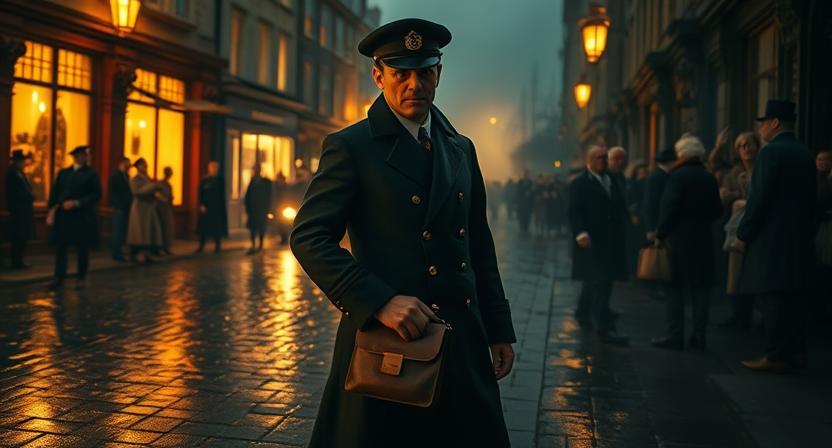
The brass telegraph key clicked triumphantly into the ether, and Captain Elias Wrenford felt something ancient die within his chest. Through the rain-streaked window of the Central Telegraph Office on Threadneedle Street, he watched as London erupted in celebration. Church bells pealed across the city, their bronze voices proclaiming what the newspapers would herald as mankind’s greatest triumph: the completion of the first permanent transatlantic telegraph cable.
Wrenford shifted the leather mail satchel against his shoulder, feeling the weight of two dozen letters destined for New York. In his weathered hands, they felt heavier than ship’s anchor chain. For twenty-three years, he had carried such correspondence across the Atlantic’s treacherous waters, his vessels threading between icebergs and storm fronts to deliver these precious fragments of human connection. Now, in the space of a single afternoon on 27th July 1866, his life’s work had become as obsolete as the age of sail.
“Remarkable, isn’t it, Captain?” A young clerk appeared at his elbow, spectacles gleaming with reflected gaslight. “Messages to America in mere minutes! No more waiting weeks for replies.”
Wrenford nodded, though his throat felt tight. “Remarkable indeed.”
But as the crowds surged past the window—gentlemen raising silk hats, ladies waving lace handkerchiefs, street vendors hawking commemorative broadsheets—he found himself thinking not of progress, but of loss. What dinosaur would he resurrect, if granted such impossible power? Not the great lizards that once roamed primordial forests, but something far more precious: the art of patient correspondence, the weight of considered words, the sacred trust between sender and bearer that had defined his existence.
The satchel contained letters written by souls who still believed in the old rhythms of communication. Writers who had chosen their words carefully, knowing they would traverse thousands of miles of hostile ocean before reaching their intended hearts. Unlike the staccato urgency of telegraphic code—those abbreviated snippets that reduced human emotion to mere dots and dashes—these letters contained the full spectrum of human experience.
Wrenford’s fingers found the envelope that had been troubling him since morning. Mrs. Honoria Bellamy of Bloomsbury had entrusted it to his care three days prior, when his ship, the Hibernia, had been scheduled to depart for New York. The woman’s pallor and laboured breathing had spoken of consumption’s inexorable advance, though she’d maintained the gentle dignity of her class.
“For my son Julian,” she’d whispered, pressing a half-sovereign into Wrenford’s palm alongside the envelope. “He’s established himself in Manhattan, you see. A fine practice in law. I’ve written to explain… to prepare him for what may come. The crossing will give me time to gather strength, perhaps to write again before…” Her voice had trailed into silence, but her meaning hung clear as morning fog.
Now, with the telegraph operational, Wrenford faced an impossible choice. He could rush to the nearest telegraph station and transmit news of Mrs. Bellamy’s condition in minutes. But doing so would violate the sacred covenant of her letter—written with the assumption that weeks would pass before its arrival, weeks during which she might recover, or at least compose final words with the deliberation that only time permits.
The crowd’s celebration grew more raucous, but Wrenford felt only the settling dusk of an era. He thought of the thousands of letters he’d shepherded across the Atlantic: declarations of love that had gestated during storm-tossed passages, business proposals refined through multiple drafts during weeks of uncertainty, condolences that arrived seasoned with salt spray and the weight of genuine contemplation.
What progress was this, he wondered, if it stripped communication of its soul?
The telegraph key clicked again, sharp and impatient. Wrenford watched a businessman dictate a message to the operator: “PRICE ACCEPTABLE STOP PROCEED STOP THISTLEWAITE AND SONS STOP.” A handful of words that would have filled pages in a proper letter, with context and courtesy, with the human warmth that made commerce more than mere transaction.
“Captain Wrenford?”
He turned to find a young woman in a practical grey dress, her intelligent eyes reflecting concern. “Miss Catherine Pembroke,” she introduced herself. “I write for The Lady’s Companion. Might I ask your thoughts on today’s achievement?”
Wrenford studied her face, recognising something of his own melancholy reflected there. “You’re seeking a contrary voice, Miss Pembroke?”
“I’m seeking truth,” she replied simply. “The papers speak only of triumph. But I’ve noticed older gentlemen like yourself watching today’s celebrations with… different expressions.”
“Different indeed.” Wrenford gestured towards the window. “They celebrate speed, Miss Pembroke. The compression of time and distance into something manageable, predictable. But what of the beauty found in patient waiting? What of the art of crafting words knowing they must sustain separation for weeks?”
She withdrew a small notebook. “May I?”
“By all means.” He paused, considering his words with the same care he’d once observed in his letter-writers. “I’ve carried correspondence for twenty-three years. Love letters that grew more eloquent with each revision during the crossing. Business letters that developed nuance through reflection. Condolences that arrived weighted with genuine sorrow, not merely dutiful obligation.”
“And now?”
“Now we reduce human connection to telegraphic shorthand. ‘LOVE STOP MISS YOU STOP SEND MONEY STOP.’” His voice carried the bitter tang of salt spray. “Where is the soul in such communication?”
Miss Pembroke scribbled rapidly. “But surely the speed of contact must comfort those separated by distance?”
“Speed, yes. But comfort?” Wrenford touched the letter in his satchel. “I carry words from a dying mother to her son. Written with love, with time, with the assumption that weeks of ocean crossing would allow for second thoughts, for additions, for the slow alchemy that transforms mere information into something approaching wisdom.”
“What will you do?”
The question hung between them like fog over the Thames. Through the window, the celebration continued, but Wrenford felt the weight of choice settling on his shoulders like a familiar storm-coat.
“If I could resurrect any dinosaur,” he said slowly, “it would not be some terrible lizard from prehistory. It would be the dying art of thoughtful correspondence. The understanding that some communications improve with time, like wine in a cellar or love in a heart.”
Miss Pembroke’s pen stilled. “You speak as though such things are already extinct.”
“Are they not?” Wrenford gestured towards the telegraph office. “When messages cross oceans in minutes, who will invest weeks in crafting the perfect phrase? When instant response becomes expected, who will treasure the anticipation of awaited letters?”
“Perhaps,” she suggested gently, “both forms of communication might coexist?”
Wrenford smiled, but it carried the sadness of autumn leaves. “Perhaps. But I fear the urgent will always drive out the important. The quick will consume the careful. The immediate will devour the eternal.”
He opened Mrs. Bellamy’s letter, reading again her careful script: My dearest Julian, by the time these words reach you, summer will have turned towards autumn in America, as it has in my heart. I write not to alarm, but to prepare, not to frighten, but to comfort. The doctors speak in measured tones about measured time, but I find myself grateful for these weeks of crossing, these days of salt air and contemplation that will carry my words to you…
“She chose ship over telegraph deliberately,” Wrenford murmured. “Knowing it would take weeks. Trusting in the slow alchemy of ocean crossing to season her words with proper weight.”
Miss Pembroke leaned forward. “And you’ll honour that choice?”
“I must.” He folded the letter carefully. “Some dinosaurs deserve resurrection, Miss Pembroke. Others—perhaps the most precious ones—deserve protection from extinction.”
As London’s celebration reached its crescendo, Captain Elias Wrenford shouldered his satchel and walked into the gaslit evening. Tomorrow, he would board the Hibernia for what might be his final crossing, carrying letters that represented more than mere communication—they were time-capsules of human thoughtfulness in an age increasingly devoted to speed.
Behind him, the telegraph key continued its urgent clicking, each pulse marking the death of an era when words travelled slowly enough to gather wisdom on their journey. But in his satchel, twenty-four letters waited patiently for their oceanic pilgrimage, carrying with them the dying art of measured thought and the revolutionary notion that some things—love, loss, hope, and human connection—improved with contemplation.
The dinosaur he chose to resurrect was not a creature of tooth and claw, but something far more fragile and infinitely more precious: the understanding that the most meaningful communications were worth waiting for.
The End
27th July 1866 marked the successful laying of the first permanent trans-Atlantic telegraph cable between Valentia Island, Ireland, and Heart’s Content, Newfoundland, slashing communication time between Europe and North America from around 10 days by steamship to less than 10 minutes. The 2,640 km copper-core cable, hauled into position by the converted warship Great Eastern, cost roughly £1.2 million (about £175 million today) and enabled an initial traffic of 400 telegrams per day at a tariff of £20 for 20 words. Its success ended four earlier failed attempts (1857-65) and triggered a global submarine-cable boom: by 1900, over 300,000 km of seabed cable linked five continents, fostering rapid expansion of international finance, news agencies, and diplomacy. The cable’s legacy lives on in today’s fibre-optic networks, which still trace many of the routes pioneered in 1866, underpinning the instantaneous global connectivity taken for granted in the 21st century.
Bob Lynn | © 2025 Vox Meditantis. All rights reserved.

 Vox Meditantis
Leave a comment