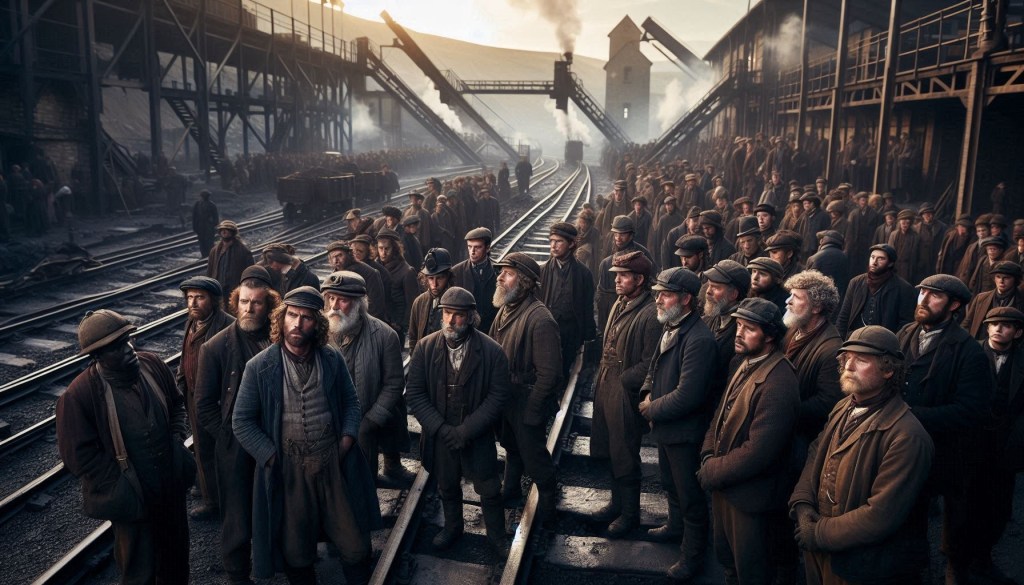
Killingworth Colliery, Northumberland, England – 25th July 1814
Folk always ask me how I came by the name Wheels, and truth be told, it’s a tale I’ve grown fond of telling in my advancing years. Sixty-three winters I’ve seen now, and still that morning of 25th July 1814 burns as bright in my memory as the coal fires that once lit our way down into the bowels of Killingworth pit.
I were but seventeen then, a collier’s apprentice with hands already blackened permanent-like from hauling coal wagons up from the depths. My father had worked these same tunnels, and his father before him, and I reckoned I’d follow their path to an early grave, lungs choked with dust and back bent double from years of crawling through seams barely three feet high.
That morning started no different from any other. The July sun had barely kissed the horizon when I stumbled from our cramped cottage, stomach gnawing with hunger and head still thick from the previous evening’s ale at the Miners’ Rest. The pit-head was already buzzing with excitement, more animated than I’d seen the lads in months. Something were brewing, and it had the older miners muttering in their beards whilst the younger ones jittered about like sparrows on a fence.
“What’s got everyone stirred up then?” I asked Jacky Armstrong, a stout fellow who’d been working the seams since before I were born.
His weathered face split into a grin that revealed more gaps than teeth. “Haven’t ye heard, young Tommy? Stephenson’s unveiling his contraption today. Reckons his iron horse can haul eight wagons of coal faster than our best pit ponies.”
I snorted with derision. George Stephenson, our chief engineer, were known for his ambitious notions. Brilliant, mind you—nobody could argue with his improvements to the winding engines—but this latest venture seemed pure madness. A machine that could replace horses? The very idea struck me as unnatural, almost blasphemous.
“Load of nonsense,” I declared, loud enough for several miners to hear. “No contraption of iron and steam can match the sure-footed strength of a good horse. Mark my words, Jacky—this’ll be Stephenson’s great folly.”
The words were barely out of my mouth when a hand fell heavy upon my shoulder. I turned to find myself face-to-face with the man himself—George Stephenson, all six feet of him, with those penetrating eyes that seemed to see straight through to a man’s soul.
“Young Hepburn,” he said in that measured way of his, the Northumberland accent thick as treacle. “I couldn’t help but overhear your assessment of my ‘folly.’ Perhaps you’d care to witness the demonstration before passing final judgement?”
My cheeks burned with embarrassment, but pride kept my chin raised. “Aye, Mr Stephenson. I’ll watch your iron horse, and I’ll stand by my words.”
His smile was patient, almost fatherly. “I respect a man who stands by his convictions, lad. Tell me—are you willing to wager on them?”
The gathered miners fell silent, sensing drama brewing. In the distance, I could hear the rhythmic chuff-chuff of steam building pressure, an alien sound that made my skin prickle with unease.
“What manner of wager?” I asked, trying to keep my voice steady.
“If my locomotive—I’ve named her Blücher, after the Prussian general who helped us defeat Bonaparte—if she can haul eight loaded wagons at four miles per hour along the tramway, you’ll work as my assistant for a month, learning how she operates.”
“And if she fails?”
“Then I’ll personally ensure you receive the finest pit pony in the colliery for your own use.”
The terms seemed generous, perhaps too generous. But with dozens of eyes upon me and my pride at stake, I could hardly back down. “Done,” I said, grasping his outstretched hand.
Within the hour, word had spread throughout the colliery. Men emerged from the depths, their shift temporarily forgotten, eager to witness what many believed would be either a triumph of human ingenuity or a spectacular catastrophe. Even the pit ponies seemed to sense the excitement, stamping their hooves and whinnying nervously in their stalls.
Then I saw her.
Blücher squatted upon the iron rails like some monstrous beetle, all gleaming brass fittings and painted ironwork. Steam hissed from various joints and valves, giving her an almost living presence that was both fascinating and terrifying. She were perhaps eight feet long and mounted on four wheels, with a tall chimney that belched white vapour into the morning air. The boiler, cylindrical and imposing, dominated her form, whilst connecting rods and cranks promised mechanical precision beyond anything I’d ever witnessed.
“She’s beautiful, isn’t she?” Stephenson appeared beside me, his voice filled with the pride of a father admiring his newborn child.
I wanted to scoff, to maintain my sceptical stance, but honesty compelled me to admit the machine possessed a certain fearsome elegance. “She’s… impressive,” I conceded grudgingly.
Eight wagons had been loaded with coal and positioned behind the locomotive, connected by iron coupling chains. The combined weight must have exceeded thirty tons—more than any single horse could hope to budge, let alone haul at speed.
Stephenson climbed aboard his creation, checking gauges and adjusting valves with the confident movements of long practice. “Stand clear, lads!” he shouted. “We’re about to make history!”
A lever was engaged, and Blücher shuddered like a living thing awakening from slumber. The connecting rods began their rhythmic dance, transferring power from the internal mechanisms to the driving wheels. Slowly, almost imperceptibly at first, the entire assembly began to move.
The crowd erupted in amazement and nervous laughter. Here was something beyond their comprehension—a machine that moved without external force, powered by nothing more than fire, water, and human ingenuity. The wagons, which would have required a team of six horses to shift, followed obediently behind as Blücher gained momentum.
But as wonder filled the faces around me, I noticed something troubling. One of the locomotive’s driving wheels was wobbling slightly, the mounting pin working loose from the repeated stress. At their current pace, it were merely a minor concern, but if Stephenson attempted to reach his promised four miles per hour…
“Mr Stephenson!” I shouted, cupping my hands around my mouth. “The starboard wheel!”
Either he couldn’t hear me over the mechanical noise, or he was too focused on his controls to pay attention. Blücher continued gathering speed, the loose wheel’s wobble becoming more pronounced with each revolution.
Without conscious thought, I broke from the crowd and began running alongside the locomotive. The other spectators shouted warnings, thinking I’d lost my wits, but I could see disaster approaching as clearly as storm clouds on the horizon. If that wheel came free at speed, the locomotive would derail, potentially killing Stephenson and destroying months of careful work.
“The wheel’s coming loose!” I bellowed, gesturing frantically.
This time Stephenson heard me. His eyes followed my pointing finger, and I saw understanding dawn in his expression. But by now Blücher was approaching her target speed, and stopping would require considerable distance.
What happened next, I still consider the most foolhardy action of my entire life. As the locomotive drew alongside me, I leaped forward and grasped one of the handholds mounted on her side. My boots scraped against the iron rails as I hauled myself up beside the controls.
“Can you stop her?” I gasped.
“Not quickly enough,” Stephenson replied grimly. “The wheel will come free before we can reduce steam pressure sufficiently.”
“Then we need to secure it.” I pointed to a length of rope coiled near the footplate. “If I can get that around the wheel mounting…”
“Far too dangerous, lad. You’ll be crushed if you fall.”
But I were already unwinding the rope, my mind working furiously. The locomotive’s design placed the driving wheels low and accessible, but reaching them whilst the machine was in motion would require precise timing and no small amount of luck.
“Keep her steady,” I instructed, as if I had any right to give orders to the chief engineer.
Stephenson’s jaw was set in grim concentration, but he nodded. “Be careful, Tommy.”
I lowered myself over the side of the footplate, clinging to the handholds whilst the iron rails rushed past mere inches below my dangling feet. The loose wheel was directly beneath me, its mounting pin now visibly working its way free with each rotation.
Timing my movements with the wheel’s revolution, I dropped the rope’s loop around the problematic assembly, then hauled myself back up with strength I didn’t know I possessed. The rope held, binding the loose components together long enough for Stephenson to gradually reduce speed and bring Blücher to a safe halt.
The silence that followed seemed to stretch for an eternity. Steam continued to hiss from various joints, and the iron rails ticked as they cooled, but the crowd of miners stood speechless, processing what they’d witnessed.
Then Jacky Armstrong’s voice rang out across the tramway: “Did you see young Tommy there, hanging off the wheels like he were born to it?”
“Aye!” shouted another. “Proper little wheels he turned out to be!”
“Wheels Hepburn!” someone else called, and the name was taken up by a dozen voices, then two dozen, until the entire gathering was chanting it with good-natured laughter.
I felt my face burning with embarrassment, but when I looked at Stephenson, his expression was one of profound respect and gratitude.
“It seems you’ve earned yourself a new name, lad,” he said quietly. “And you’ve also earned my lasting appreciation. Without your quick thinking, we might have lost everything today.”
“Does this mean I’ve won our wager then?” I asked, still breathless from the excitement.
Stephenson chuckled. “I’d say we both won today. Blücher proved herself capable, and you proved that even the most sceptical observer can become an ally when the situation demands it.”
He was right, of course. In those heart-stopping moments clinging to the side of that iron beast, something had shifted within me. The locomotive was no longer an unnatural abomination threatening our traditional ways—she was a marvel of human achievement, a glimpse into a future where machines and men might work together rather than in opposition.
True to his word, Stephenson took me on as his assistant for that promised month. Those thirty days stretched into thirty years, during which I helped him refine his designs and witnessed the birth of the railway age. I worked on Locomotion No. 1, the Rocket, and dozens of other engines that carried the industrial revolution across Britain and beyond.
But it all began on that July morning in 1814, when a seventeen-year-old collier’s apprentice earned his nickname by refusing to let progress derail itself through mechanical failure. The lads started calling me Wheels as a jest, but the name stuck because it captured something essential about that transformative day—the moment when I stopped being merely Tommy Hepburn and became part of something larger than myself.
George Stephenson changed the world with his locomotives, but he also changed me. He showed me that scepticism, when tempered with courage and quick thinking, could evolve into innovation. The iron horse I’d initially dismissed as folly became the foundation of everything I accomplished in life.
These days, as I sit by my cottage fire watching steam trains thunder past on the main line, I reflect on how that single moment of decision—to leap aboard Blücher and secure her loose wheel—shaped not just my identity but my entire destiny. Young folk today might laugh at the idea of a locomotive travelling four miles per hour, but they cannot imagine the breathtaking audacity of that achievement in 1814.
So when people ask about my nickname, I tell them it came from wheels—not just the iron wheels of Stephenson’s locomotive, but the wheels of progress itself, turning inexorably toward a future none of us could have imagined. Sometimes the greatest honour is simply to have played a small part in keeping those wheels turning when they might otherwise have come off the rails entirely.
That’s the story behind my nickname, and I reckon it’s a tale worth telling.
The End
On 25th July 1814 George Stephenson’s locomotive Blücher successfully hauled eight coal wagons—about 30 tons—along the Killingworth tramway at roughly 4 mph, marking the first practical use of steam power on an industrial rail line. Built in Northumberland for a colliery employing nearly 2,000 miners, the engine ran on 1.6 km of cast-iron rails that had previously relied on horse traction. Blücher’s performance encouraged Stephenson to design more powerful machines, leading to the 40 km Stockton & Darlington Railway in 1825 and the 56 km Liverpool & Manchester line in 1830. By 1850 Britain operated over 9,500 km of track, sparking worldwide adoption of railways that continue to shape modern transportation, trade and urban growth.
Bob Lynn | © 2025 Vox Meditantis. All rights reserved.

 Vox Meditantis
Leave a comment