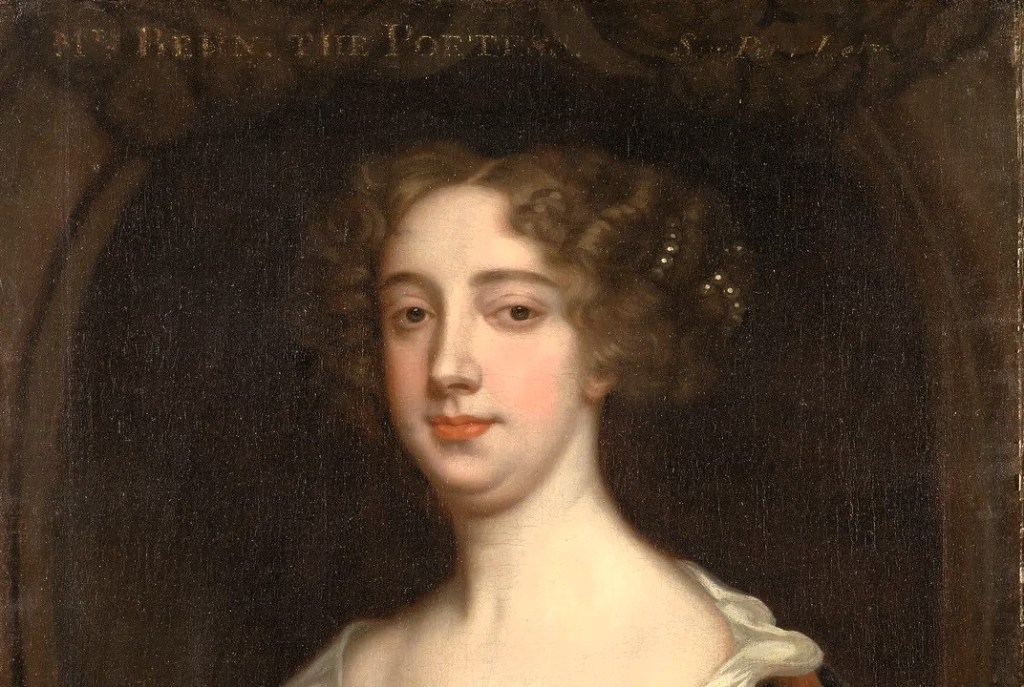
England likes to boast about its scientific revolution. Yet it forgets the woman who slipped Copernican astronomy into the nation’s bloodstream while the Royal Society still grumbled about wigs and wagers. Aphra Behn—spy, playwright, poet—also stood among the first popularisers of modern science. Her translation of Bernard de Fontenelle’s 1686 bestseller, the elegant Entretiens sur la pluralité des mondes, reached London in 1688 as A Discovery of New Worlds. With wit, nerve and a fierce belief in women’s intellect, Behn turned a Parisian garden dialogue into plain-spoken English, defended the right of “ladies” to philosophical learning and smuggled heliocentrism past clerical censors. A year earlier she had staged a farce, The Emperor of the Moon, whose slapstick revolved around telescopes, lunar inhabitants and the gullibility of men who confuse scientific discovery with childish fantasy.
For three centuries scholars pigeon-holed Behn as “England’s first professional female dramatist” and forgot the natural philosopher behind the mask. They were wrong. She was bold. And she still matters.
Dawn in a Hostile Firmament
Virginia Woolf famously urged women to “let flowers fall upon the tomb of Aphra Behn” because Behn had bought them “the right to speak their minds”. But liberty came at a price. Born 1640, baptised in Wye, Kent, Behn entered a world that mocked female intellect, criminalised debt and hanged nonconformists. She spied for Charles II in Antwerp, landed in debtor’s prison when the Crown refused to pay, then wrote her way to freedom with Restoration comedies. Through it all she read voraciously: Bacon, Descartes, Wilkins, Galileo. She kept her ears open when coffee-house savants enthused about “worlds upon worlds” circling myriad suns and when the bishop’s men snarled about heresy.
Behn understood the social stakes. Astronomy was no parlour game; it threatened theological certainties and male privilege. A woman who dared to discuss moons and comets risked ridicule or worse. Still she persisted.
Conversations That Changed the Conversation
Translating Fontenelle’s Cosmic Pluralism
Fontenelle’s original courted scandal in France by proposing that the Moon might be inhabited, that Earth was just another planet, and that every star was a distant sun. He sugar-coated the science as a flirtatious dialogue between a philosopher and a marquise. Behn grasped both its intellectual and its gender politics. Her 1688 translation does three radical things:
| Aspect | Fontenelle 1686 (French) | Behn 1688 (English) | Impact |
|---|---|---|---|
| Audience addressed in preface | “Ladies” as passive readers | Women as fellow thinkers eager for “a real taste of Philosophy” | Centres female intellect and agency |
| Treatment of controversy | Light irony about Church objections | Direct challenge to “those pedants who would monopolise Science” | Politicises access to knowledge |
| Style choices | Courtly French wit | Punchy English prose, strategic glosses, occasional expansion | Makes Cartesian astronomy accessible to the middling reader |
Behn refused slavish literalism. In her “Essay on Translated Prose” she argues that a translator must keep “the true meaning of the Author” yet clarify where French idiom obscures thought. She thus sharpens references to elliptical orbits, corrects Fontenelle’s playful exaggerations and adds footnotes on lunar geography gleaned from Robert Hooke’s Micrographia. Far from derivative, her version is a critical edition—a woman’s rebuttal to male condescension.
Lending the Telescope to the Public
London booksellers pounced. A Discovery of New Worlds sold briskly, aided by Behn’s reputation and by England’s appetite for anything that vexed Puritan literalists. Coffee-house pamphlets quoted her lines on plural worlds; schoolmasters railed against “that stage-woman’s licentious philosophy”. Yet her prose seeped into popular consciousness. When John Hughes compiled the 1715 compendium A Week’s Conversation on the Plurality of Worlds, he recycled whole paragraphs from Behn’s edition. She had become the gateway author for English cosmic pluralism.
Comedy as a Classroom: The Emperor of the Moon
Two years before the translation appeared, Behn tested the public mood with a play that danced between satire and science. The Emperor of the Moon (1687) dramatises Dr Baliardo, a self-styled natural philosopher bedazzled by his telescope. Con-men masquerading as lunar royalty exploit his obsession, while his daughter and niece orchestrate the farce to win freedom from paternal tyranny.
The plot skewers several targets:
- Blind faith in authority: Baliardo trusts printed “astronomical” tomes more than observation, echoing Cervantes’ Don Quixote.
- Male gatekeeping: The young women learn optics well enough to fool the men, exposing patriarchy’s brittle veneer.
- Political credulity: Behn alludes to Whig pamphleteers who conjured “Popish plots” out of thin air during the Exclusion Crisis.
Under the slapstick lurks a primer on lunar theory: reflected light, phases, the possibility of selenic seas. Audience laughter becomes inadvertent education. As one modern critic notes, Behn “directs the audience’s gaze toward the threat posed by enthusiasm to civil harmony” while sneaking in genuine astronomical discourse.
Why Was She Eclipsed?
- Genre bias: Literary historians privileged plays over prose and therefore missed A Discovery of New Worlds. Scientists dismissed it as “mere translation”, overlooking its editorial interventions.
- Sexism squared: A woman in the playhouse was already suspect; a woman in natural philosophy was unthinkable. Her critics cast her dramatic boldness as moral looseness and her scientific daring as “ape-ing the learned men”.
- Whig propaganda: After 1688 the Glorious Revolution recast intellectual heroes as Protestant, Latinate men of sober temperament. A Tory sympathiser who wrote bawdy dialogue could not fit the new pantheon.
Result? Her literary fame overshadowed her scientific voice. Edmund Gosse’s 1890 biography dismissed the Fontenelle translation in a footnote. The Royal Society ignored her entirely until the late twentieth century.
The Evidence We Cannot Ignore
| Scientific Contribution | Evidence of Behn’s Hand | Contemporary Effect |
|---|---|---|
| A Discovery of New Worlds (1688) | Preface signed “A.B.”, stylistic fingerprints and publisher’s ledger naming Aphra Behn | First widely circulated English exposition of Cartesian cosmology |
| Glosses on lunar tides, comets, sunspots | Added footnotes citing Galileo and Wilkins | Introduced English readers to cutting-edge observational data |
| The History of Oracles (1688) | Translation of Fontenelle’s critique of pagan superstition; dedication signed “A.B.” | Pioneered secular, comparative study of religion |
| Stagecraft in Emperor | Stage directions for telescope props and “astronomical machines” | Popularised telescopic imagery in Restoration theatre |
A Moral Reckoning
Public service should not be a boys-only club. Behn’s work advanced civic literacy—exactly what modern social democrats prize. She placed knowledge within reach of artisans, servants and, above all, women. She challenged the cosy alliance of Church dogma and male privilege that hoarded science for cloistered fellows. Her cry rings down the centuries: Let the marquise learn the stars; let the maid learn too.
Is it fair that Newton, Boyle and Halley adorn classroom posters while Behn languishes in endnotes? Is it decent that the woman who first taught English readers to imagine “inhabitants in the moon” becomes a trivia question? The hypocrisy is blinding. We celebrate “inclusive STEM” while erasing the inclusivity pioneer.
Stories That Humanise the Data
Consider the Bristol maid who bought Behn’s octavo in 1690, scrawling in the margin: “So then, our Earth doth move—remarkable!” The book survives in a provincial archive, its pages greasy from kitchen reading; science slipped into domestic hands. Or picture the Dorset Garden theatre where apprentices hooted at Baliardo’s blunders yet went home chattering about “worlds in Jupiter”. Knowledge crossed class lines because Behn carried it.
Dismantling Objections
Some detractors claim Behn only paraphrased Fontenelle and added nothing. Rubbish. Her expansions double as critique, tightening his loose metaphors and elevating female discourse. Others brand her work derivative because she lacked “mathematical rigour”. Yet the Royal Society’s own Philosophical Transactions routinely summarised discoveries for laymen—precisely Behn’s approach. She met contemporary standards for popular science; she exceeded them in gender politics.
Repetition for Impact
Aphra Behn translated the heavens.
Aphra Behn staged the heavens.
Aphra Behn defended women’s right to the heavens.
Remember it.
Where Do We Go From Here?
- Education: Insert Behn’s translation into GCSE science history modules; pair her with Newton to show that culture and calculation travelled together.
- Public commemoration: Westminster Abbey honours fourteen scientists in Poets’ Corner; Behn lies in the East Cloister. Move her. Give her a plaque that names her as translator of modern astronomy.
- Publishing: Fund an open-access critical edition of A Discovery of New Worlds with annotations on her scientific sources and feminist revisions.
Conclusion: Accountability Demands Memory
Behn died in 1689, body worn, wallet empty, quill unbroken. Male contemporaries gulped her ideas while mocking her morals. We have repeated the offence for three centuries. It is time to pay the debt. Name her a founder of public science. Teach her alongside Halley. Celebrate her courage to translate the sky in an era that denied her the vote, the university, the podium.
The next girl who wonders whether philosophy welcomes her deserves to meet Aphra Behn. Show her the page where Behn writes, “Let us boldly imagine new worlds.” Then ask: will we let those worlds remain untranslated? Or will we, at last, read the woman who first opened the English window on the plural universe?
Bob Lynn | © 2025 Vox Meditantis. All rights reserved.

 Vox Meditantis
Leave a comment