College Street, Winchester, England – 18th July 1817
The morning air hung heavy in the modest lodgings on College Street, thick with the promise of another sweltering July day. Cassandra Austen’s hands stilled on the worn wooden table as Mrs. David’s question lingered between them, deceptively simple yet weighted with implications that seemed to press against her chest like a physical burden.
“What foods would you like to make today, Miss Austen?”
The landlady’s voice carried the careful gentleness reserved for those in the shadow of grief, though death had not yet claimed its prize. In the next room, Jane lay sleeping fitfully, her breathing shallow and laboured, each exhalation a whispered reminder of time’s relentless march. The mysterious illness that had plagued her sister for months had settled into her very bones, leaving behind a fragile shell of the brilliant woman who had once filled their father’s rectory with laughter and wit.
Cassandra’s fingers traced the grain of the table, seeking comfort in its familiar roughness. The question should have been simple—it had been simple, once. In their childhood home at Steventon, surrounded by the abundant gardens and well-stocked larder of their father’s living, she had moved through the rituals of meal preparation with the unconscious ease of breathing. But here, in these cramped Winchester rooms, with Jane’s appetite reduced to the barest necessities and her own heart fracturing with each passing hour, the very act of choosing what to cook felt like standing at the edge of an abyss.
“I… I’m not certain,” she heard herself say, the words emerging with an honesty that surprised them both. Mrs. David’s expression softened further, if such a thing were possible, and she settled into the chair opposite, her weathered hands folding neatly in her lap.
“Perhaps something light?” the older woman suggested. “The heat has been dreadful, and invalids often find their appetites…”
She trailed off, unwilling to speak the truth they both knew. Jane’s appetite had become a ghost of its former self, appearing only in fleeting moments before vanishing again, leaving behind the hollow ache of watching someone beloved fade by degrees.
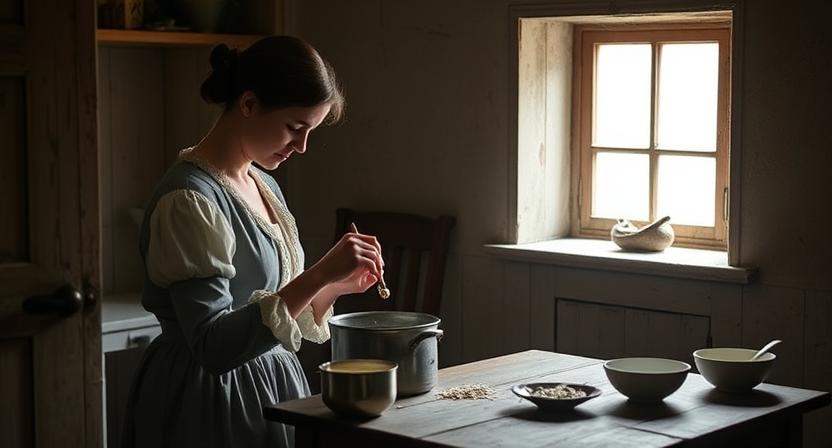
Cassandra rose abruptly, her skirts rustling against the table’s edge. “I shall prepare some gruel,” she said, her voice carrying the forced brightness of determination. “With a touch of wine, perhaps, to strengthen her. And tea, of course. Jane has always been partial to her morning tea.”
The ritual of preparation offered a blessed respite from thought. She moved through the familiar motions with practised efficiency, though her hands trembled slightly as she measured the oats. The small kitchen seemed to pulse with memories—not of this place, but of others. The great kitchen at Steventon, where she had learned these skills under their cook’s patient guidance. The modest quarters at Bath, where she had first begun to truly understand the weight of managing a household. And now, this final kitchen, where each meal might be the last she would ever prepare for her dearest companion.
The oats swirled in the pot, pale and unpromising. She added a generous measure of milk, remembering how Jane had always preferred her gruel thus—creamy and rich, despite the physician’s recommendations for plainer fare. Dr. Lyford had been quite specific about the invalid diet, speaking in measured tones about the digestive difficulties that accompanied Jane’s condition. But Cassandra had watched her sister’s face brighten at the taste of familiar comforts, and she would not deny her such small pleasures now.
As the mixture began to bubble softly, she found herself thinking of their last Christmas at Chawton. Jane had been well then, or well enough to laugh at Cassandra’s attempts to recreate their mother’s plum pudding. The kitchen had been filled with the scent of spices and the sound of Jane’s gentle teasing, her voice bright with the particular joy she took in observing the domestic chaos that inevitably accompanied holiday preparations.
“Cass,” she had said, flour dusting her dark hair like premature snow, “I do believe you’ve added enough brandy to render the entire neighbourhood quite senseless.”
The memory brought a smile to Cassandra’s lips, though it quickly faded as she stirred the gruel with renewed vigour. How many meals had they shared? How many conversations had unfolded over simple breakfasts and quiet dinners? The mathematics of sisterhood, she realised, were measured not in grand gestures but in the accumulation of ordinary moments—the butter passed without asking, the preference for strong tea remembered, the way Jane always left the last bit of jam for others.
The gruel had reached the proper consistency, smooth and nourishing. She ladled it into their finest bowl—a piece of porcelain that had belonged to their grandmother, decorated with delicate blue flowers that seemed to capture something of spring’s eternal promise. A small portion of wine followed, dark and rich, swirling into the pale mixture like hope bleeding into resignation.
Mrs. David had departed whilst she worked, leaving behind only the faint scent of lavender water and the echo of her kindness. Cassandra was grateful for the solitude; it allowed her to compose herself before facing Jane’s wakeful moments. These had become increasingly precious, islands of clarity in the ocean of her sister’s suffering.
She prepared the tea with equal care, selecting the finest leaves from their dwindling supply. The familiar ritual of warming the pot, measuring the leaves, waiting for the water to reach the perfect temperature—these actions carried the weight of countless mornings, countless conversations. Jane had always been particular about her tea, claiming that a poorly prepared cup could ruin an entire day’s writing. The irony was not lost on Cassandra that her sister’s writing days were now behind her, yet she continued to prepare the tea with the same meticulous attention to detail.
The sitting room was dim when she entered, the heavy curtains drawn against the morning sun. Jane lay propped against pillows, her face pale as parchment but her eyes alert. At the sight of the tray, her lips curved in what might have been a smile.
“Good morning, dearest,” Cassandra said, settling into the chair beside the bed. “I’ve brought your breakfast.”
Jane’s gaze fixed on the bowl with something approaching interest. “Gruel again?”
“With wine,” Cassandra replied, as if this small addition might transform the humble fare into something approaching a feast. “And your tea, prepared just as you like it.”
“You spoil me,” Jane whispered, though her voice carried a note of genuine affection. She allowed Cassandra to help her sit up straighter, her movements careful and deliberate. “What prompted Mrs. David’s question about cooking? I heard her speaking with you.”
Cassandra paused in her arrangement of the napkin, struck by the realisation that Jane had been listening. How much did she understand of her own condition? How much did she choose to acknowledge? They had always been honest with each other, but illness had introduced a new delicacy into their conversations, a careful navigation around the reef of truth.
“She was merely being thoughtful,” Cassandra said finally. “Wondering if there was anything particular you might fancy.”
Jane accepted the first spoonful of gruel with the patience of long practice. “And what did you tell her?”
The question hung between them, loaded with implications. Cassandra found herself thinking of all the foods she might have mentioned—the syllabub Jane had loved as a child, the meat pies their mother had made for special occasions, the delicate cakes they had enjoyed at their nephew’s wedding. All the flavours of a life fully lived, now reduced to the simple sustenance required to ease a gentle passing.
“I told her I would prepare what you needed,” she said, her voice steady despite the turmoil in her chest.
Jane’s eyes searched her face with the penetrating intelligence that illness had not dimmed. “Ah,” she said softly. “What I need.”
They sat in comfortable silence whilst Jane took another spoonful, then another. The gruel was disappearing slowly but steadily, and Cassandra felt a small surge of triumph. Each bite represented a small victory against the inevitable, a few more moments of shared existence.
“Do you remember,” Jane said suddenly, “the summer we stayed with Uncle and Aunt Leigh-Perrot? You must have been fourteen, perhaps fifteen.”
Cassandra nodded, though the memory felt distant, viewed through the lens of accumulated years. “At Scarlets. You were so excited about the strawberry beds.”
“I was excited about everything that summer,” Jane continued, her voice taking on a dreamy quality. “The freedom, the change of scene. But what I remember most clearly is the morning you convinced Cook to let us prepare our own breakfast. You were so determined to prove your domestic capabilities.”
The memory sharpened as Jane spoke. Cassandra could almost smell the wood smoke from the kitchen fire, feel the weight of the heavy iron pan in her hands. She had been so proud of her newfound skills, so eager to demonstrate her readiness for adult responsibilities.
“You burned the eggs,” Jane said with a soft laugh. “Quite spectacularly. And the toast was charcoal. But you were so serious about it, so determined to make it perfect.”
“I was trying to impress you,” Cassandra admitted, surprised by the confession.
“You did impress me,” Jane replied. “Not with your cooking—that was dreadful—but with your devotion to the task. You approached it as if preparing a simple breakfast was the most important thing in the world.”
Cassandra felt her throat tighten. “Perhaps it was.”
Jane’s hand found hers, cool fingers intertwining with warm ones. “It was,” she agreed. “Every meal we’ve shared, every simple breakfast, every quiet dinner—they were all important. They were all expressions of love.”
The gruel was finished, the bowl empty save for a few clinging drops. Cassandra set it aside and poured the tea, her hands steady despite the emotion threatening to overwhelm her composure. The liquid was amber-gold, perfect in its clarity, and she felt a small sense of pride in the achievement.
“You know,” Jane said, accepting the delicate cup, “I’ve been thinking about that question Mrs. David asked. What foods would you like to make?”
Cassandra waited, sensing that her sister had more to say.
“I think,” Jane continued, “that the question isn’t really about food at all. It’s about what we choose to do with the time we have. How we choose to care for those we love.”
She sipped her tea, her expression thoughtful. “You’ve spent so much time these past months preparing meals I could barely eat, tending to needs I could barely articulate. And I’ve been thinking that perhaps that’s the most important form of nourishment—not the food itself, but the love with which it’s prepared.”
Cassandra felt tears prick her eyes. “Jane…”
“No, let me finish,” Jane said gently. “Mrs. David asked you what foods you would like to make, and I think the answer is this: you would like to make the foods that bring comfort, that create connection, that say all the things words cannot express. You would like to make the foods that heal, even when healing is no longer possible.”
The room fell silent except for the soft tick of the mantel clock and the distant sounds of Winchester awakening beyond their walls. Cassandra understood, with crystalline clarity, that this conversation was both about food and about so much more. It was about the nature of care, the language of love, the way simple acts could carry the weight of a lifetime’s devotion.
“When I’m gone,” Jane said quietly, “you’ll continue to cook for others. You’ll prepare meals for our mother, for our brothers, for their children. And I hope you’ll remember that every meal is an act of love, every simple breakfast a small miracle of human connection.”
Cassandra nodded, unable to speak past the tightness in her throat.
“Promise me,” Jane continued, “that you won’t think of these last meals as failures because I couldn’t eat them properly. Think of them as gifts—your gifts to me, expressions of everything you couldn’t say.”
“I promise,” Cassandra whispered.
Jane finished her tea and settled back against the pillows, her eyes growing heavy. “Now,” she said with a slight smile, “if Mrs. David asks again what foods you would like to make, you can tell her the truth. You would like to make the foods that matter—the ones that feed the soul as well as the body.”
As Jane drifted into sleep, Cassandra remained in her chair, watching the gentle rise and fall of her sister’s breathing. Outside, the Winchester bells began to toll the hour, their bronze voices carrying across the ancient city. She thought about the question that had begun this day, the simple inquiry that had revealed such profound truths.
What foods would she like to make? She would like to make the foods that connected past to present, that carried the flavours of childhood and the promise of memory. She would like to make the foods that said “I love you” and “I’m here” and “You are not alone.” She would like to make the foods that transformed simple sustenance into sacrament, that made the ordinary extraordinary through the alchemy of devotion.
The gruel bowl sat empty on the tray, mark of a small victory. Tomorrow there would be another question, another meal, another opportunity to transform necessity into love. And Cassandra would meet it with the same careful attention, the same quiet devotion, the same understanding that in the end, the foods we choose to make are the foods that make us human.
The morning light grew stronger, filtering through the curtains to illuminate the peaceful scene. In a few hours, Mrs. David would return with her gentle questions and practical concerns. But for now, in this quiet moment, Cassandra held the answer close to her heart—a truth as nourishing as any meal, as sustaining as any feast.
She would make the foods that mattered. She would make them with love.
The End
18th July 1817 saw the death of 41-year-old novelist Jane Austen in Winchester, Hampshire, concluding a literary career that produced six major novels during a mere seven-year publication span (1811–1817). First editions rarely exceeded 1,500 copies, yet posthumous demand soon prompted larger print runs, and Northanger Abbey and Persuasion were issued together just five months later. Over the following two centuries Austen’s works have sold millions of copies, been translated into more than 40 languages and adapted for stage and screen worldwide. Her finely observed portrayals of class, courtship and morality continue to shape modern literature and popular culture.
Bob Lynn | © 2025 Vox Meditantis. All rights reserved.

 Vox Meditantis
Leave a comment