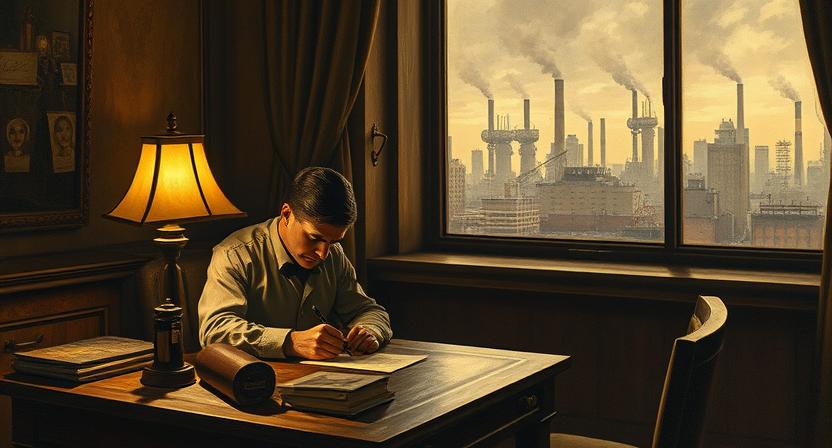
15th October, 1919
Hotel Statler, Detroit, Michigan
My beloved Nellie,
The autumn wind carries whispers of change through these industrial streets, and with each gust, I am reminded of the prairies of your South Dakota home—how the golden wheat must be dancing now beneath that endless sky you so often described in your letters. It is here, amongst the clanging machinery and the hurried footsteps of men rebuilding a world forever altered, that I find myself compelled to take pen to paper and bare my soul to you once more.
I confess, my darling, that the months since our last correspondence have weighed heavily upon my conscience. The harsh words I wrote in my previous letter—born of frustration and the lingering shadows of war—were unworthy of the extraordinary woman you have always been. The trenches of France taught me many things about survival, but they failed to teach me how to preserve the tender mercies that make life worth living. For this failing, I am deeply and profoundly sorry.
You must understand, dearest Nellie, that my time in the American Expeditionary Forces changed me in ways I am still discovering. The boy who left for Europe in 1917 returned a man haunted by memories of Belleau Wood and the Argonne, carrying within him a restlessness that I mistook for strength. When I wrote those foolish words about your involvement with the suffrage movement, dismissing your passionate advocacy as mere folly, I was speaking from a place of fear—fear that the world I knew was disappearing, fear that I might not find my place in this new order of things.
But I have come to understand, through sleepless nights and days of honest reflection, that you were not part of the change I feared—you were the beacon guiding us towards something far more beautiful than what we left behind. Your courage in standing before the courthouse in Pierre, speaking for women’s rights whilst I was overseas, fills me with an admiration so profound that words seem inadequate vessels for its expression.
I am writing to you now from Detroit, where I have secured a position with the Ford Motor Company. The work is honest and the pay fair, though the city holds little charm compared to the wide horizons of your homeland. Each day I watch the assembly lines produce these remarkable motor cars, marvelling at how swiftly our world transforms, and I think of you—how you embraced change with such grace whilst I clung to the familiar like a drowning man to driftwood.
The influenza that swept through our camp in the final months of the war took many good men, and I count myself blessed to have survived not only the German guns but also that invisible enemy that claimed so many. Perhaps it is this brush with mortality that has finally given me the courage to write these words: I love you, Nellie Baker, with a devotion that has only grown stronger in our separation.
I love your fierce intelligence, the way your eyes light up when you speak of justice and equality. I love your gentle hands that could tend a wounded bird with the same care you showed when binding my injured ankle that summer before the war. I love your laugh—that wonderful, uninhibited sound that could chase away the darkest of moods. Most of all, I love your unwavering belief in the possibility of a better world, even when that world seems determined to disappoint us.
I know I have no right to ask for your forgiveness after the callous manner in which I dismissed your convictions, but I am asking nonetheless. The man who returns to you now is not the same one who left, but perhaps that is as it should be. We are all of us changed by these extraordinary times, and I believe that change, rather than diminishing us, has the power to make us more worthy of the love we seek.
If you would have me, dearest Nellie, I propose to return to South Dakota when the winter snows begin to thaw. I have saved enough to make a modest beginning, and I know of good land available near your father’s farm. We could build something together—not a return to the past, but a bridge to the future. I envision a home where your voice would be heard and respected, where your dreams would be nurtured alongside my own.
I close this letter with a promise: should you grant me the extraordinary privilege of your forgiveness, I shall spend the remainder of my days proving worthy of the remarkable woman who captured my heart beneath the South Dakota stars all those years ago. You are my compass, my anchor, and my hope for tomorrow.
Until I hear from you, I remain, with all the love and devotion a humbled heart can hold,
Your devoted,
Louis Morgan
P.S. Enclosed you will find a small piece of fabric from my army uniform—not from sentiment for the war, but because it was with me during the long nights when I would lie awake thinking of you. I thought perhaps you might keep it as a token of my steadfast devotion, until I can replace it with something far more worthy of your gentle hands.
Bob Lynn | © 2025 Vox Meditantis. All rights reserved.

 Vox Meditantis
Leave a comment