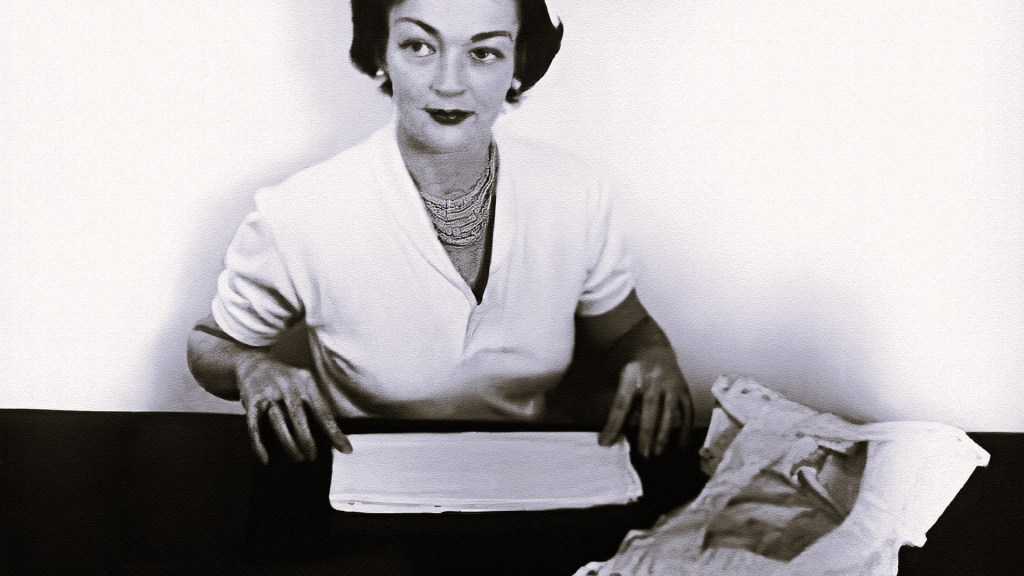
Behind every fundamental shift in how we live lies an inventor whose vision was bold enough to challenge the status quo. Marion Donovan stands as a towering example of the brilliant minds overlooked by history – a woman whose innovations transformed modern childcare yet remained largely unknown beyond the industry she revolutionised.
The Making of an Inventor
Born on 15th October 1917 in Fort Wayne, Indiana, Marion O’Brien grew up in a household where innovation was as natural as breathing. Her father Miles O’Brien and his identical twin brother John weren’t merely entrepreneurs – they were inventors who had created the revolutionary “South Bend lathe,” a machine that transformed the production of automobile gears and gun barrels. The success of this invention was so overwhelming that their factory manufactured nothing else, generating significant wealth and establishing the O’Brien family as industrial innovators.
When Marion’s mother died in 1925, the seven-year-old found herself spending countless hours in the family’s manufacturing plant. Rather than seeing this as a burden, her father Miles encouraged her innate curiosity and problem-solving instincts. When young Marion wanted to create a new type of tooth powder, he didn’t dismiss her ambition – he helped her design and develop the product. This early collaboration established a pattern: Marion would identify a problem, and she would engineer a solution.
After graduating from Rosemont College in Pennsylvania with a degree in English Literature in 1939, Marion moved to New York City to work as an Assistant Beauty Editor at Vogue magazine. It was a prestigious position for a young woman, but domestic expectations of the era soon intervened. In 1942, she married James Donovan, a leather importer, resigned from her position, and moved to Westport, Connecticut to start a family. What appeared to be a retreat from professional life was actually the beginning of her most significant engineering career.
The Problem That Sparked Innovation
The post-war years brought new challenges to American motherhood. In 1946, Marion found herself wrestling with the same exhausting routine that plagued mothers worldwide: dealing with cloth diapers that functioned “more like a wick than a sponge”. The existing solutions were woefully inadequate. Cloth diapers leaked constantly, necessitating frequent changes of bedding, clothing, and endless laundry. The only waterproof option – rubber pants – caused painful diaper rashes and chafed against babies’ delicate skin.
Marion’s engineering background wouldn’t allow her to accept these design failures. In a moment of inspiration that would reshape an entire industry, she looked at her bathroom shower curtain and saw potential. She pulled it down, cut it into pieces, and began experimenting with her sewing machine. After numerous iterations and many destroyed shower curtains, she created a waterproof diaper cover that was both effective and comfortable.
But Marion wasn’t content with a quick fix. She systematically improved her design, moving from shower curtain material to breathable nylon parachute cloth. This material allowed air circulation, preventing the diaper rash that plagued rubber alternatives. She replaced dangerous safety pins with metal and plastic snaps, eliminating the risk of accidentally pricking either baby or parent. The design included an insert for an absorbent diaper panel, creating a complete system that kept babies dry and comfortable.
She called her invention the “Boater” – both because its boat-like shape helped babies “stay afloat” and because it reminded her of marine vessels. The name was playful, but the engineering was serious.
Confronting Corporate Sexism
What happened next reveals the entrenched sexism that plagued American industry in the 1940s. Marion approached major manufacturers with her revolutionary design, expecting them to recognise its obvious advantages. Instead, she encountered a wall of dismissal that would be familiar to countless women innovators.
“I went to all the big names that you can think of, and they said, ‘We don’t want it. No woman has asked us for that. They’re very happy, and they buy all our baby pants,’” Marion later told television journalist Barbara Walters. The executives’ response wasn’t based on market research or technical analysis – it was rooted in the assumption that women’s domestic problems weren’t worth solving.
These men, who had likely never changed a diaper in their lives, couldn’t comprehend the daily struggles Marion was addressing. They saw her innovation as unnecessary because they fundamentally didn’t understand the problem it solved. The manufacturing industry was controlled by men who viewed women’s domestic work as insignificant, treating Marion’s engineering breakthrough as a trivial household convenience rather than a serious technological advancement.
Faced with this systematic rejection, Marion made a decision that would define her career: “So, I went into manufacturing myself”. Rather than accepting defeat, she leveraged her intelligence, determination, and family resources to bring her product to market independently.
Triumph Through Self-Determination
Marion’s decision to manufacture the Boater herself proved inspired. She partnered with a lingerie manufacturer and debuted her product at Saks Fifth Avenue in 1949. The response was immediate and overwhelming – the Boaters were an instant success, with customers recognising the revolutionary improvement they offered.
Adam Gimbel, president of Saks Fifth Avenue, wrote to Marion: “It is not often that a new innovation in the Infants’ Wear field goes over with the immediate success of your Boaters”. By 1950, the Boater had reached £1.25 million in sales. The vindication must have been sweet – the same product that male executives had dismissed as unnecessary was flying off shelves.
Marion’s success wasn’t just financial. She had received her first patent in 1951 and promptly sold her company and patents to the Keko Corporation for $1 million – nearly $10 million in today’s currency. This wasn’t merely a business transaction; it was proof that women’s innovations could be both technically superior and commercially viable.
The Next Frontier: Disposable Diapers
Success with the Boater only fueled Marion’s ambition. She had solved the leakage problem, but she envisioned something even more revolutionary: a completely disposable diaper that would eliminate the need for washing entirely. She began experimenting with different types of paper, seeking materials that were not only absorbent but also pulled moisture away from babies’ skin to prevent rashes.
Marion’s approach was methodical and scientific. She toured major US paper companies, presenting her vision for a disposable diaper that would transform childcare. Her prototypes used a special composition of sturdy, absorbent paper that accomplished both her technical goals: containing moisture and protecting delicate skin.
Once again, she encountered dismissal bordering on mockery. Paper company executives laughed at her proposal, telling her it was “unnecessary and impractical”. The pattern was depressingly familiar – male executives who had never dealt with the practical realities of childcare couldn’t envision a market for her innovation.
The Irony of Recognition
Marion’s vindication came a decade later, but not in the way she had hoped. In 1961, Procter & Gamble introduced Pampers, the first mass-produced disposable diaper. The product was developed by Victor Mills, a chemical engineer who either developed the concept independently or, more likely, built upon Marion’s earlier work. Whether Mills directly encountered Marion’s research remains unclear, but by 1961, the idea of disposable diapers was “in the air” thanks to her pioneering efforts.
The success of Pampers was staggering. Today, an estimated 95% of American babies wear disposable diapers, creating a multi-billion-dollar industry. The technology that Marion had envisioned and developed became the foundation for one of the most successful consumer products of the 20th century – yet she received no credit for her foundational contributions.
A Life of Continuous Innovation
Marion’s story could have ended with bitterness over missed opportunities, but her innovative spirit proved irrepressible. She returned to formal education, earning a master’s degree in architecture from Yale University in 1958, where she was one of only three women in her graduating class. This achievement was remarkable in itself – a woman returning to university at age 41 to pursue a traditionally male-dominated field.
She channeled her architectural training into designing her own home in Greenwich, Connecticut, in 1980. But her true passion remained invention. Between 1951 and 1996, Marion received an impressive 20 patents for various household innovations. Her inventions demonstrated the same practical intelligence that had driven the Boater’s success.
Among her notable creations was the “Zippity-Do,” an elastic cord that could be temporarily attached to a dress zipper, allowing the wearer to pull it up by reaching over her shoulder. She invented a soap dish that drained directly into the sink, eliminating the problem of soap scum accumulation. Her “Big Hangup” was a compact hanger that could hold 30 garments, revolutionising wardrobe storage.
Perhaps most ingeniously, Marion created the “DentaLoop” – a pre-cut circle of dental floss that could be manipulated without wrapping it around one’s fingers. She recognised that the traditional method of using dental floss was both painful and awkward, so she engineered a better solution. Like her other innovations, the DentaLoop addressed a real problem that others had simply accepted as unchangeable.
The Broader Impact
Marion’s work extended beyond individual inventions to include consulting for major manufacturers. Companies began recognising her unique ability to identify and solve practical problems that others overlooked. Her approach was consistently user-focused – she didn’t invent for the sake of innovation but to address genuine needs she observed in daily life.
Her daughter Christine recalled growing up in a house that doubled as a research and development laboratory: “Mum was always drawing or working with materials – wire or plastic or nylon or paper. She had an office above the garage, but frankly, everywhere was her drawing board. The kitchen was often where Mum was, and something was always cooking, but not food – heating irons and sealants and so on”.
This domestic setting for serious engineering work challenges traditional notions of where innovation occurs. Marion proved that groundbreaking technological advancement didn’t require sterile laboratories or institutional support – it required intelligence, persistence, and the willingness to challenge accepted limitations.
Recognition and Legacy
Marion’s contributions were finally acknowledged when she was inducted into the National Inventors Hall of Fame in 2015. The recognition came 17 years after her death from heart disease in 1998, at age 81. While this honour was significant, it also highlighted how long society took to recognise women’s contributions to technological advancement.
Her legacy extends far beyond the specific products she invented. Marion demonstrated that domestic concerns could drive serious technological innovation. She proved that women’s experiences and perspectives were valuable sources of engineering insight, not trivial inconveniences to be dismissed by male-dominated industries.
The modern disposable diaper industry, worth billions annually, traces its origins to Marion’s vision and determination. Every parent who has ever changed a diaper without worrying about leakage or rashes owes a debt to her pioneering work. Yet most remain unaware of her contributions, illustrating how women’s innovations have been systematically minimised or erased from public consciousness.
The Continuing Relevance
Marion Donovan’s story remains strikingly relevant in contemporary discussions about women in STEM fields. Her experiences with corporate sexism mirror challenges that women inventors and entrepreneurs continue to face today. Research shows that women inventors still encounter scepticism and dismissal when presenting unconventional ideas, particularly those that challenge established industries.
Her approach to innovation – identifying problems in daily life and engineering practical solutions – offers a model for how technology can serve human needs rather than existing merely for its own sake. Marion’s inventions weren’t driven by abstract scientific curiosity but by genuine desire to improve people’s lives.
Furthermore, her story demonstrates the importance of persistence in the face of systematic rejection. Marion could have accepted the initial dismissal of her ideas and returned to conventional domestic life. Instead, she chose to prove her critics wrong through commercial success, creating a pathway for other women to follow.
The Measure of True Innovation
Marion Donovan’s life challenges us to reconsider what constitutes important innovation. Her work didn’t involve exotic materials or complex theoretical frameworks – it involved recognising that everyday problems deserved engineering solutions. She saw inefficiency and discomfort where others saw inevitable inconvenience.
Her story also forces us to confront the gendered nature of technological recognition. The same innovations that male executives dismissed as trivial household conveniences were actually sophisticated engineering solutions that improved millions of lives. The problem wasn’t with Marion’s inventions – it was with a system that failed to recognise the value of addressing women’s needs and experiences.
When we consider the broader impact of Marion’s work, it becomes clear that she was not simply an inventor but a catalyst for social change. The disposable diaper industry she pioneered didn’t just offer convenience – it fundamentally altered the balance of domestic labour, giving parents more time for other activities and reducing the physical burden of childcare.
Conclusion
Marion Donovan deserves recognition not just as an inventor but as a pioneer who challenged the boundaries of what engineering could address. She proved that innovation could emerge from domestic settings, that women’s experiences could drive technological advancement, and that persistence could overcome systematic discrimination.
Her story is both inspiring and infuriating – inspiring because it demonstrates human creativity and determination triumphing over prejudice, infuriating because it reveals how many brilliant minds have been overlooked or dismissed due to gender bias. Marion’s achievements remind us that true innovation often comes from those who refuse to accept that problems are unsolvable simply because they affect people whose voices haven’t been heard.
In celebrating Marion Donovan, we celebrate not just her individual brilliance but the principle that good ideas can emerge from anywhere. Her legacy challenges us to listen more carefully to voices that have been marginalised, to take seriously the problems that affect women’s daily lives, and to recognise that the most transformative innovations often address the most fundamental human needs.
The next time someone changes a diaper without a second thought, they’re benefiting from the vision of a woman who refused to accept that wet bedding and uncomfortable babies were inevitable parts of parenthood. Marion Donovan saw a better way forward and had the courage to make it reality. That is the true measure of an inventor worth remembering.
Bob Lynn | © 2025 Vox Meditantis. All rights reserved.

 Vox Meditantis
Leave a comment