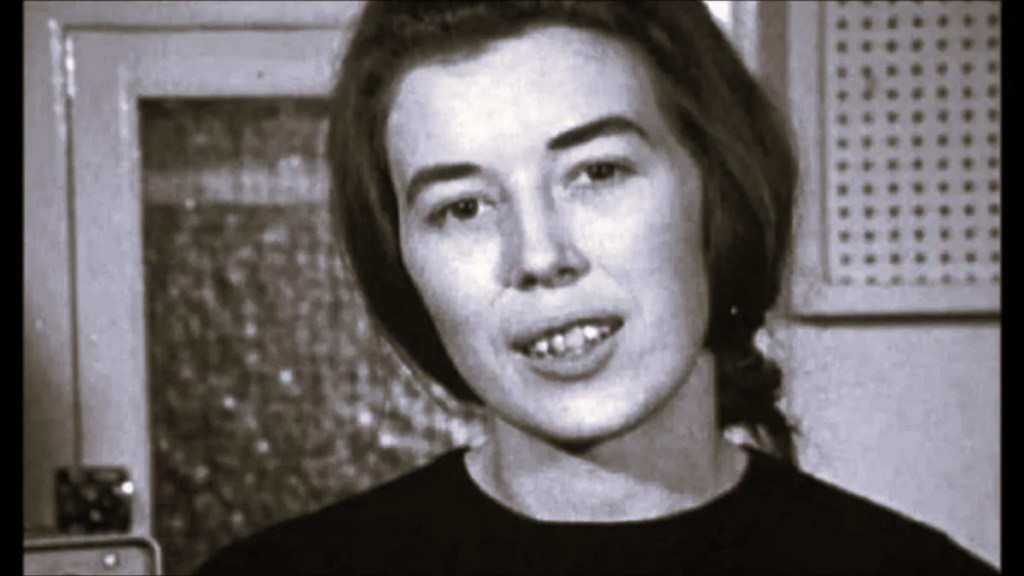
Delia Derbyshire never set out to become a revolutionary. Yet from her cramped studio in the BBC Radiophonic Workshop, cutting and splicing tape with surgical precision, she would transform the very language of music itself. Her story—one of brilliance repeatedly dismissed, of innovation systematically overlooked, of a woman who persevered despite being told “studios were no place for a woman”—reveals the grotesque machinery of institutional sexism that has silenced so many voices throughout history.
Born on 5th May 1937 in Coventry to a working-class family, Delia Ann Derbyshire grew up against the soundtrack of war. Her father Edward was a sheet-metal worker, her mother Emma a homemaker. The haunting wail of air raid sirens during the Coventry Blitz of 1940 would later echo through her electronic compositions—what she called her first encounter with “abstract sound”. As she reflected in later life: “I was there in the blitz and it’s come to me, relatively recently, that my love for abstract sounds [came from] the air-raid sirens: that’s a sound you hear and you don’t know the source of as a young child… then the sound of the ‘all clear’ – that was electronic music”.
This early exposure to the alien beauty of electronic sound would prove prophetic. But first, there was the grinding reality of class barriers to overcome.
Breaking Through the Glass Ceiling of Genius
Delia’s exceptional intellect manifested early. By age four, she was teaching other children to read and write in primary school. At eight, her parents bought her a piano, on which she quickly excelled. Her academic prowess was equally remarkable—she won scholarships to both Oxford and Cambridge, “quite something for a working-class girl in the ‘fifties, where only one in 10 students were female”.
She chose Cambridge, initially studying mathematics at Girton College before switching to music, graduating in 1959 with degrees in both mathematics and music. The mathematical precision that would later characterise her electronic compositions was already evident—for Delia, music and mathematics were inextricably linked.
Yet when she approached the careers office at Cambridge, seeking work “in sound, music and acoustics,” they recommended careers in “either deaf aids or depth sounding”. The establishment had no vision for what a brilliant woman might achieve in the emerging field of electronic music.
The Doors That Slammed Shut
In 1959, Delia applied to Decca Records for a recording position. The response was brutal in its simplicity: “the studio was no place for a woman”. They didn’t employ women in their recording studios, full stop. This rejection—delivered with the casual certainty of institutional sexism—would have crushed a lesser spirit.
Instead, it galvanised her. After working briefly for the UN in Geneva and then for music publishers Boosey & Hawkes, Delia joined the BBC in 1960 as a trainee studio manager. In 1962, she made an unprecedented request: transfer to the BBC Radiophonic Workshop, the corporation’s experimental electronic music department.
The Workshop, established in 1958, was initially conceived as a service department for radio drama. But under Delia’s influence, it would become something far more revolutionary—a laboratory where the future of music was being forged with razor blades, tape loops, and primitive oscillators.
The Architecture of Innovation
Working with equipment that would seem laughably primitive by today’s standards, Delia developed techniques that were decades ahead of their time. She had no synthesisers, no samplers, no multi-track recorders. Instead, she worked with sine wave generators, white noise sources, and tape manipulation—cutting, splicing, and layering sounds with mathematical precision.
Her method was painstaking. She would record individual sounds, manipulate their pitch and speed, filter them through homemade circuits, then splice the tape with razor blades to create seamless joins. Multiple tape machines would be used to build up complex layered compositions, with each element carefully timed and tuned.
This was not merely technical wizardry—it was a complete reimagining of how music could be created. Delia understood that in the electronic realm, every sound was malleable, every frequency a building block for something entirely new.
The Theme That Conquered Time
In 1963, Delia was asked to realise Ron Grainer’s composition for a new science fiction series: Doctor Who. What she created would become one of the most recognisable television themes in history—and one of the first pieces of electronic music heard by millions of ordinary people.
Grainer had written the basic melody, but it was Delia who transformed it into something otherworldly. Using oscillators and tape manipulation, she crafted the haunting, ethereal sounds that would define the show’s sonic identity for decades. When Grainer first heard the result, his response was immediate: “Did I really write this?” “Most of it,” Delia replied.
Grainer insisted she deserved co-composer credit and half the royalties. She received neither. The BBC’s policy at the time was to keep Radiophonic Workshop staff anonymous, crediting work simply to “BBC Radiophonic Workshop”. Delia’s revolutionary contribution was buried under institutional anonymity—a pattern that would define much of her career.
Beyond the TARDIS: The Breadth of Genius
While the Doctor Who theme brought Delia’s work to millions, it represented only a fraction of her output. She created music for over 200 radio and television programmes, ranging from children’s shows to avant-garde experimental works.
Her collaboration with playwright Barry Bermange on the “Inventions for Radio” series (1964-1965) showcased her artistry at its most sophisticated. These four programmes—The Dreams, Amor Dei, The After-Life, and The Evenings of Certain Lives—combined electronic soundscapes with interviews with ordinary people discussing profound philosophical questions. The result was a new form of audio art that was both technically innovative and deeply human.
As Brian Hodgson, her Workshop colleague, observed, these works showed Delia at “her elegant best”. Yet again, her contributions were often uncredited, with the works attributed to Bermange and the Workshop rather than recognising her central role.
The Underground Revolution
Beyond her BBC work, Delia was instrumental in establishing the UK’s electronic music underground. In 1966, she co-founded Unit Delta Plus with colleague Brian Hodgson and electronic music pioneer Peter Zinovieff. This was one of Britain’s first organisations dedicated to promoting electronic music, predating Kraftwerk by four years.
When Unit Delta Plus dissolved in 1967, Delia and Hodgson joined forces with David Vorhaus to form White Noise. Their 1969 album “An Electric Storm” would prove deeply influential, cited by artists from The Chemical Brothers to Orbital as a foundational text of electronic music.
The trio also established the Kaleidophon studio in Camden, creating electronic music for London theatres and experimental projects. This was pioneering work—establishing the template for independent electronic music production that wouldn’t become widespread until the 1980s.
The Institutional Betrayal
By 1973, Delia had grown disillusioned with the BBC. She felt the corporation was “increasingly being run by committees and accountants” rather than creative vision. Her work was considered “too sophisticated” by the new management. The Workshop’s golden age was ending, replaced by a more commercial, less experimental approach.
Delia left the BBC and, in many accounts, seemed to vanish from music entirely. The standard narrative suggests she withdrew completely from creative work, taking a series of “unsuitable jobs” and battling alcoholism.
Recent archival research reveals a more complex picture. Far from completely abandoning music, Delia continued working on film soundtracks, art installations, and experimental projects throughout the 1970s. She worked with Chinese artist Li Yuan-chia at his LYC Museum and Art Gallery in Cumbria, contributing to an experimental arts community that included over 300 artists.
The Silence That Speaks Volumes
What drove Delia from the spotlight wasn’t creative exhaustion—it was systematic institutional failure. The same BBC that had benefited from her genius for over a decade refused to credit her work properly. The broader music industry remained largely closed to women, particularly in technical roles. The sexism that had greeted her at Decca Records in 1959 persisted throughout her career in subtler but equally damaging forms.
Her retreat from public music-making wasn’t artistic decline—it was the predictable result of a system that consistently undervalued her contributions. The woman who had revolutionised electronic music found herself working in bookshops and art galleries, her genius squandered by an industry that never learned to recognise it properly.
The Posthumous Recognition
Delia died on 3rd July 2001, aged 64, from renal failure. In her final years, she had begun collaborating again with musicians like Peter Kember (Sonic Boom), suggesting that her creative fire had never truly dimmed.
Only after her death did the full scope of her influence become clear. Artists from Aphex Twin to The Chemical Brothers began citing her as a major influence. Her techniques—tape manipulation, sound layering, electronic soundscaping—were recognised as foundational to modern electronic music.
The Delia Derbyshire Archive, now housed at the University of Manchester, contains 267 audio tapes documenting her working methods and unreleased compositions. These recordings reveal the full extent of her innovative techniques and creative vision, much of which had remained hidden for decades.
The Legacy That Endures
Today, Delia Derbyshire is finally receiving recognition as “the unsung heroine of British electronic music”. Streets in Coventry bear her name. A posthumous honorary doctorate from Coventry University acknowledges her “longstanding contribution to the field of electronic music”. The annual Delia Derbyshire Day celebrates her influence on contemporary artists.
Yet this belated recognition cannot erase the fundamental injustice of her story. Here was a woman whose innovations laid the groundwork for entire genres of music—from ambient to techno to modern electronic dance music—yet who was systematically denied credit, recognition, and fair compensation throughout her career.
Her influence on modern electronic music is undeniable. The core elements of EDM—synthesised beats, looping, sound manipulation—all trace their lineage directly to Delia’s early innovations. Artists continue to cite her work as inspiration, recognising in her compositions a fearless exploration of sonic possibilities that remains relevant decades later.
The Revolution Continues
Delia Derbyshire’s story exposes the appalling waste of talent that occurs when institutional sexism meets creative genius. How many other women’s contributions have been minimised, ignored, or forgotten? How much innovation has been lost to systems that refuse to recognise brilliance when it doesn’t fit their predetermined moulds?
Yet her legacy also demonstrates the unstoppable power of true innovation. Despite the barriers placed in her path, despite the lack of recognition and credit, despite the institutional indifference to her genius, Delia’s revolutionary work endures. Every electronic composition, every synthesised beat, every manipulated sample carries forward her vision of what music could become.
The woman who was told that studios were “no place for a woman” went on to reshape the very language of music itself. The revolution she sparked—quiet, methodical, conducted with razor blades and tape loops in a cramped BBC studio—continues to reverberate through every electronic note played today.
Delia Derbyshire didn’t just break barriers—she demolished them completely, creating new possibilities for every artist who followed in her wake. Her story reminds us that true innovation often comes from those the establishment overlooks, and that the most profound revolutions sometimes begin with nothing more than a brilliant mind, a pile of tape, and the audacity to imagine something entirely new.
Bob Lynn | © 2025 Vox Meditantis. All rights reserved.

 Vox Meditantis
Leave a comment