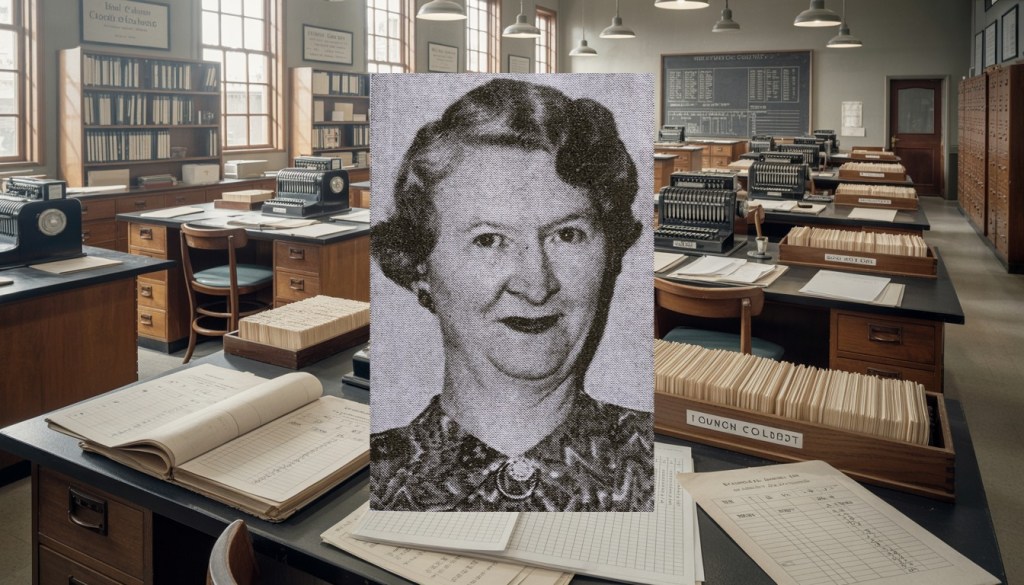
In 1905, when Mary Clem was born in the modest town of Nevada, Iowa, few could have imagined that this young woman—who would later protest that mathematics was her “poorest subject” in high school—would revolutionise the very foundations of computational accuracy. Yet her story epitomises a fundamental truth about innovation: sometimes the most transformative insights come not from those steeped in formal training, but from those bold enough to see patterns that experts have missed.
Clem’s tale is one of quiet determination triumphing over academic orthodoxy, of practical ingenuity solving problems that theoretical knowledge had failed to address. Her invention of the ‘zero check’ technique stands as a powerful reminder of the value of fresh perspective in scientific discovery. More importantly, her story illuminates a broader pattern of women’s contributions to early computing—contributions that have been systematically overlooked as the field evolved from human calculation to electronic automation.
The Making of a Human Computer
Mary A. McLaughlin was born on 19th October 1905 in Nevada, a small town in Story County, Iowa. After completing her secondary education, she worked for six years with the Iowa State Highway Commission and Iowa State College as a computing clerk, auditing clerk, and bookkeeper. These early roles provided her with practical experience in data management and calculation—skills that would prove invaluable in her later career.
In 1931, Clem joined the Mathematics Statistical Service of Iowa State College’s Mathematics Department, working as a human computer under the supervision of George Snedecor. Snedecor had established what would become the nation’s first Statistical Laboratory in 1933, creating a pioneering institution that combined advanced statistical methods with cutting-edge computational technology. The laboratory became one of the most sophisticated computing facilities of its time, utilising punch-card machines and human computers to solve complex statistical problems.
The world Clem entered was one where computation was fundamentally a human endeavour. Before electronic computers transformed the landscape, teams of “human computers”—predominantly women—performed the mathematical calculations that powered scientific research. These workers used mechanical calculating machines, tabulating equipment, and, crucially, their own mathematical skills to process vast amounts of data. The Statistical Laboratory at Iowa State represented the cutting edge of this pre-electronic computing world, where punch cards stored data and human intelligence provided the processing power.
The Art of Error Detection
Clem’s most significant contribution emerged from her responsibility for verifying the accuracy of statistical calculations. In an era when a single computational error could invalidate months of research, the detection and correction of mistakes was paramount. Traditional verification methods were labour-intensive and error-prone themselves, requiring manual comparison of results or complete recalculation of problems.
It was whilst confronting these challenges that Clem developed her revolutionary “zero check” technique. The method was elegantly simple yet profoundly effective: she devised additional calculations that, if the original computations were correct, would always yield zero as their result. This innovation transformed error detection from a tedious comparison exercise into a straightforward verification process—if the zero check produced any result other than zero, an error had occurred somewhere in the calculations.
The brilliance of Clem’s approach lay not just in its effectiveness, but in its psychological insight. As she herself recognised, her lack of formal mathematical training was precisely what enabled her to notice these computational patterns. Formally trained mathematicians, focusing on the theoretical aspects of their work, had overlooked the practical patterns that emerged from routine calculations. Clem’s outsider perspective allowed her to see what the experts had missed.
This technique proved so valuable that it became a standard practice in the Statistical Laboratory and influenced computational methods far beyond Iowa State. The zero check principle demonstrated that reliability in computation required not just accurate calculation, but systematic approaches to verification—a insight that would prove crucial as computing evolved towards automation.
The Laboratory Revolution
Under Clem’s operational leadership, the Statistical Laboratory at Iowa State became a powerhouse of computational innovation. By 1940, she had been promoted to technician and chief statistical clerk, placing her in charge of the Computing Service of the Statistical Laboratory. This role made her one of the most senior women in American computational sciences, overseeing a team that processed statistical calculations for researchers across the university and beyond.
The laboratory’s work extended far beyond routine number-crunching. Clem and her team developed new formulae and created punch-card programs for complex statistical analyses. Their methods were pioneering applications of what would later be recognised as algorithm development—creating systematic procedures for solving computational problems. The laboratory became a testing ground for early computational scientists, including John Atanasoff, who would later create the world’s first electronic digital computer at Iowa State.
The significance of Clem’s leadership becomes clear when we consider the broader context of women’s roles in early computing. Whilst men dominated the theoretical and engineering aspects of computation, women like Clem were developing the practical methods and operational procedures that made complex calculation feasible. Their work was creating the intellectual infrastructure that would later be translated into electronic systems.
In 1962, Clem transferred to Iowa State’s new Computation Center, bridging the gap between the era of human computers and the age of electronic machines. This transition symbolised the broader transformation occurring in computational sciences, as electronic computers began to replace human calculators. Yet the principles Clem had developed—particularly the emphasis on systematic error detection—remained crucial to ensuring computational reliability.
International Recognition
Clem’s expertise gained international recognition when she served as a junior statistician on the Second Allied Mission to observe the 1946 Greek elections. This mission was groundbreaking in its application of modern statistical sampling methods to election monitoring, representing one of the first systematic attempts to use probabilistic techniques for democratic oversight.
The mission’s work in Greece demonstrated the global applicability of the statistical methods pioneered at Iowa State. Teams of experts conducted sophisticated surveys to assess the conditions surrounding the elections and plebiscite on monarchy that followed Greece’s civil conflict. Clem’s participation in this mission highlighted how the computational techniques developed in Iowa laboratories could address real-world political and social challenges.
In 1952, Clem’s statistical expertise was called upon again when she served as a consultant to the Atomic Bomb Casualty Commission in Hiroshima, Japan. This commission, established to study the long-term effects of radiation exposure among atomic bomb survivors, required sophisticated statistical analysis of medical data. Clem’s work contributed to groundbreaking research into the health impacts of nuclear weapons—research that would influence both medical understanding and nuclear policy for decades to come.
These international assignments underscore the practical importance of the computational methods Clem had helped develop. The statistical techniques and error-checking procedures pioneered at Iowa State were proving essential for addressing some of the most significant challenges of the post-war world.
The Forgotten Pioneer
Despite her remarkable contributions, Clem’s story illustrates a broader pattern of historical amnesia regarding women’s roles in early computing. As the field evolved from human calculation to electronic automation, the contributions of human computers—predominantly women—were systematically erased from the historical record The rise of electronic computers created new narratives that emphasised the genius of individual inventors and engineers, obscuring the collective work of the teams who had developed the computational foundations.
This erasure was particularly pronounced for women like Clem, whose work bridged multiple domains. Her contributions to error detection were fundamental to computational reliability, yet they were overshadowed by the dramatic emergence of electronic machines. Her international work demonstrated the global significance of statistical methods, yet it was forgotten as attention shifted to technological rather than methodological innovations.
The overlooking of Clem’s contributions reflects deeper patterns in how scientific history is constructed and remembered. Women’s work in science has been consistently undervalued, often because it was seen as supportive rather than creative, practical rather than theoretical. The computational techniques that Clem pioneered were essential to scientific progress, yet they were viewed as craft rather than innovation, assistance rather than leadership.
Legacy and Lessons
Mary Clem died in January 1979 in Ames, Iowa, having witnessed the complete transformation of the field she had helped create. The human computers of her era had been replaced by electronic machines capable of performing millions of calculations per second. Yet the principles she had established—particularly the emphasis on systematic error detection and verification—remained fundamental to computational practice.
Her zero check technique prefigured many of the error-correction methods that became essential in digital computing. Modern computer systems employ sophisticated error-detection and correction algorithms that embody the same principles Clem had identified: the use of redundant calculations to verify computational accuracy. From the Hamming codes developed for punch-card systems to the quantum error correction methods being developed today, the logic of systematic verification that Clem pioneered continues to underpin computational reliability.
More broadly, Clem’s story challenges conventional narratives about innovation and expertise in science and technology. Her lack of formal mathematical training was not a disadvantage to be overcome, but an asset that enabled fresh perspective. Her practical approach to problem-solving proved more effective than theoretical sophistication. Her collaborative leadership style created an environment where innovation could flourish.
The Statistical Laboratory that Clem helped build became a model for computational facilities worldwide. The methods she developed influenced generations of statisticians and computer scientists. The international work she undertook demonstrated the global significance of systematic approaches to data analysis. Yet her name appears in few histories of computing, her techniques are rarely attributed to her, and her leadership is largely forgotten.
Restoring Recognition
Recognising Mary Clem’s contributions is not merely a matter of historical justice, though that is certainly important. Her story offers crucial insights into the nature of innovation and the importance of diverse perspectives in scientific progress. It demonstrates how practical problem-solving can generate insights that theoretical approaches miss. It shows how systematic thinking can create enduring solutions to fundamental challenges.
Perhaps most importantly, Clem’s story illustrates the collaborative nature of scientific and technological progress. The transformation from human to electronic computing was not the achievement of isolated geniuses, but the result of collective effort involving thousands of workers—many of them women—who developed the methods, procedures, and insights that made automation possible. Their contributions deserve recognition not just for their historical significance, but for their continuing relevance.
As we advance further into the digital age, facing new challenges in computational reliability, data verification, and algorithmic accountability, the principles that Mary Clem pioneered remain as relevant as ever. Her emphasis on systematic error detection, her collaborative approach to problem-solving, and her recognition that diverse perspectives drive innovation offer valuable guidance for contemporary challenges.
The zero check technique that made Clem’s reputation may seem simple by today’s standards, but it embodied a profound truth: that reliability in computation requires not just accurate calculation, but systematic approaches to verification and correction. This insight, developed by a woman who claimed mathematics was her weakest subject, helped establish the foundations upon which our digital world is built. It is time we remembered her contribution and honoured the pioneer who made computing dependable.
Mary Clem’s legacy challenges us to look beyond conventional narratives of technological progress, to recognise the collaborative nature of innovation, and to value the insights that emerge from diverse perspectives. In celebrating her achievements, we not only restore justice to a forgotten pioneer, but enrich our understanding of how human ingenuity creates the foundations for technological transformation.
Bob Lynn | © 2025 Vox Meditantis. All rights reserved.

 Vox Meditantis
Leave a comment