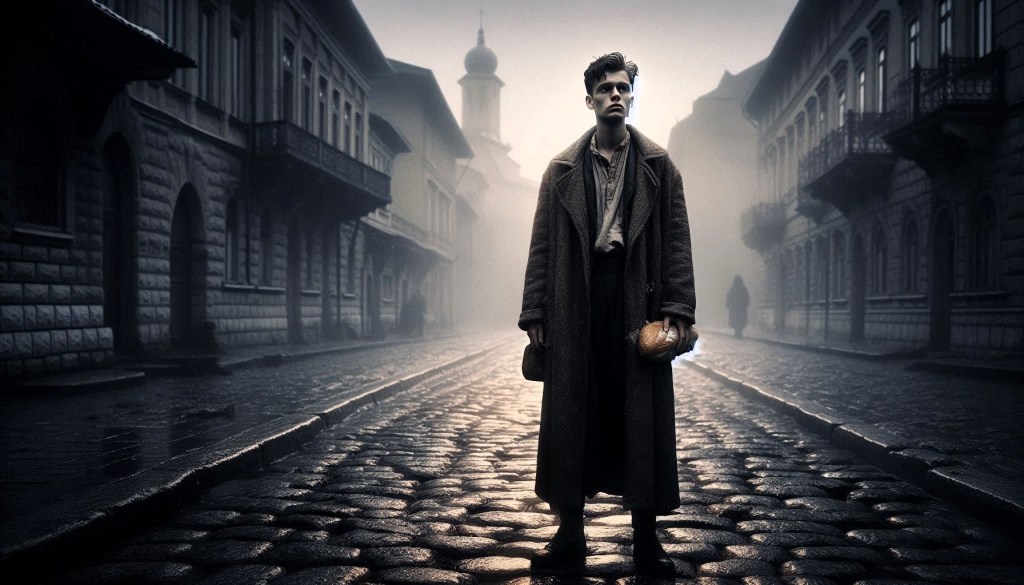
Sarajevo, Austria-Hungary (Bosnia and Herzegovina) – June 1914
The cobblestones beneath Gavrilo’s worn boots still held the morning’s chill as he made his way through the narrow streets of Sarajevo on the twenty-fourth of June, 1914. Four days until the Archduke’s visit. The city stirred around him with its familiar rhythms—the clatter of horse-drawn carriages over uneven stones, the calls of vendors opening their stalls, the measured footsteps of Habsburg officials making their way to the administrative buildings that loomed like stern guardians over the Bosnian capital.
He pulled his threadbare coat tighter against the morning air, feeling the weight of the few coins in his pocket. Enough for bread, perhaps a small portion of cheese if he was careful. The money from his construction work on Karađorđeva Street in Belgrade had sustained him through his studies, each kreuzer earned with aching back and calloused hands. The irony was not lost on him—building the very infrastructure of the empire he had come to despise.
The library beckoned as it always did, its promise of knowledge and escape drawing him like a beacon. Inside, amongst the leather-bound volumes and hushed whispers of other scholars, Gavrilo found his sanctuary. Today he selected a collection of Serbian poetry, running his fingers along the spine before settling at his usual table by the tall windows. The morning light fell across the pages as he read, absorbing each verse with the intensity that had made him an excellent student throughout his academic life.
“What are your daily habits?” The question had been posed by his friend Nedeljko just yesterday, asked with the casual curiosity of youth. How could he explain that his days were a careful choreography of survival and aspiration? That each routine—the early morning walk, the hours spent reading, the meticulous notes he took in his small, neat handwriting—served as both anchor and preparation for something he could scarcely name?
His stomach growled, interrupting his thoughts. The poetry would have to wait. Gavrilo closed the book carefully, marking his place with a strip of paper torn from his notebook. Outside, the city hummed with increasing activity as merchants and officials went about their business, oblivious to the currents of change that ran beneath the surface like underground rivers.
At the bakery, he purchased a small loaf with careful deliberation, counting out the coins twice before handing them over. The baker, a stout man with flour-dusted apron, nodded curtly. There was no warmth in the exchange—Gavrilo’s threadbare appearance marked him as one of the struggling students who frequented the shop, young men with more ambition than means.
The bread was still warm as he walked towards the bridge, tearing off small pieces and chewing slowly to make it last. Below, the river moved with quiet persistence, carrying away the detritus of the city whilst reflecting the grey sky above. How many times had he stood here, watching the water and thinking of home, of his family’s small farm where his gentle nature had been nurtured alongside his fierce sense of justice?
That afternoon brought correspondence—a letter from a friend in Belgrade who had fallen behind on his rent. Without hesitation, Gavrilo counted out half his remaining money and prepared it for posting. His own circumstances were hardly better, his lodgings basic and his meals irregular, but the habit of generosity ran deeper than self-preservation. It was who he was, this contradiction of tenderness and determination that few understood.
The evening found him at his small desk, a candle flickering as he bent over his notebook. Poetry came to him in fragments, images of his homeland mixing with dreams of freedom that seemed both urgent and impossibly distant. The words flowed from his pen in careful script, each line a small rebellion against the empire that sought to diminish his people’s voice. He thought of the girl he loved but had never kissed, her face a sweet torment that appeared in his verses like a recurring melody.
The twenty-fifth dawned with the promise of rain, the air heavy with moisture that seemed to press down upon the city’s red-tiled roofs. Gavrilo’s morning routine remained unchanged—the walk through awakening streets, the careful purchase of bread, the hours spent in the library’s embrace. Today he read Njegoš, the great poet whose words seemed to speak directly to his soul, each stanza a clarion call to those who yearned for liberty.
The rain began as he emerged from the library, fat drops that darkened the stones and sent people scurrying for shelter. He pulled his coat over his head and continued walking, relishing the way the water washed the dust from the air and brought out the earthy smell of the city. Rain made everything seem more real, more immediate—the colours more vivid, the sounds more distinct.
In his lodgings that evening, he wrote another letter to his family, his pen moving slowly across the paper as he chose each word with care. How to convey his love without revealing his struggles? How to speak of hope whilst standing on the precipice of irreversible action? His mother’s face rose in his memory, weathered by work and worry but still beautiful in its expression of unconditional love. She had named him after the Archangel Gabriel, never imagining that her gentle son would carry such weight upon his narrow shoulders.
The twenty-sixth brought news that set the city abuzz—the Archduke’s route had been confirmed, the details spreading through coffee houses and meeting places like ripples on water. Gavrilo heard the discussions as he made his way through the streets, his expression carefully neutral whilst his mind raced through possibilities and contingencies. The normalcy of his routine—the morning walk, the library, the frugal meal—took on new significance, each familiar action perhaps among his last.
That afternoon, he sat in the park and watched children playing, their laughter a counterpoint to the gravity of his thoughts. What legacy would his daily habits leave? The hours spent reading, the poetry written by candlelight, the small kindnesses extended to friends—would any of it matter when weighed against the magnitude of what was to come?
The twenty-seventh dawned grey and uncertain, matching Gavrilo’s mood as he performed his morning ablutions with extra care. Today there would be final preparations, last conversations with his fellow conspirators, the transformation from student to something harder and more purposeful. Yet even now, his gentleness asserted itself—he helped an elderly woman carry her market basket, pausing in his urgent mission to offer assistance with the same quiet courtesy that had marked his character since childhood.
The library called to him one final time, and he answered, selecting a volume of philosophy that spoke to questions of duty and sacrifice. The words seemed to dance before his eyes as he read, their meaning both crystal clear and mysteriously opaque. Around him, other students bent over their books, pursuing knowledge with the same dedication he had shown throughout his academic life. How many of them would remember him after tomorrow? How many would understand?
His final evening was spent writing—not poetry this time, but careful letters to those he loved. To his family, words of gratitude and affection that he prayed would sustain them through the dark days he sensed were coming. To friends, expressions of friendship that carried the weight of farewell without its explicit acknowledgement. Each sentence was crafted with the precision of someone who understood that words, once written, become permanent monuments to the moment of their creation.
The twenty-eighth of June, 1914, arrived with deceptive tranquillity. Gavrilo woke before dawn, his body automatically following the rhythms established through months of routine. The morning walk felt different today—each step measured, each breath conscious, each moment pregnant with possibility. The city around him continued its ancient patterns, unaware that history was about to pivot on the actions of a gentle young man who wrote poetry and helped his friends and had never kissed the girl he loved.
As he made his way through the streets where the Archduke would soon travel, Gavrilo carried with him all the accumulated weight of his daily habits—the discipline of study, the generosity of spirit, the quiet contemplation that had shaped his character. Today, those habits would culminate in a single moment that would echo through generations, transforming the poetry-writing student who paved streets for book money into a figure whose name would be remembered long after the last person who knew his gentleness had passed from the earth.
The morning mist clung to the cobblestones as he took his position, the weight of history settling upon his shoulders like a mantle he had been unconsciously preparing to wear through all those ordinary days of reading and writing and dreaming of a different world.
The End
Bob Lynn | © 2025 Vox Meditantis. All rights reserved.

 Vox Meditantis
Leave a comment