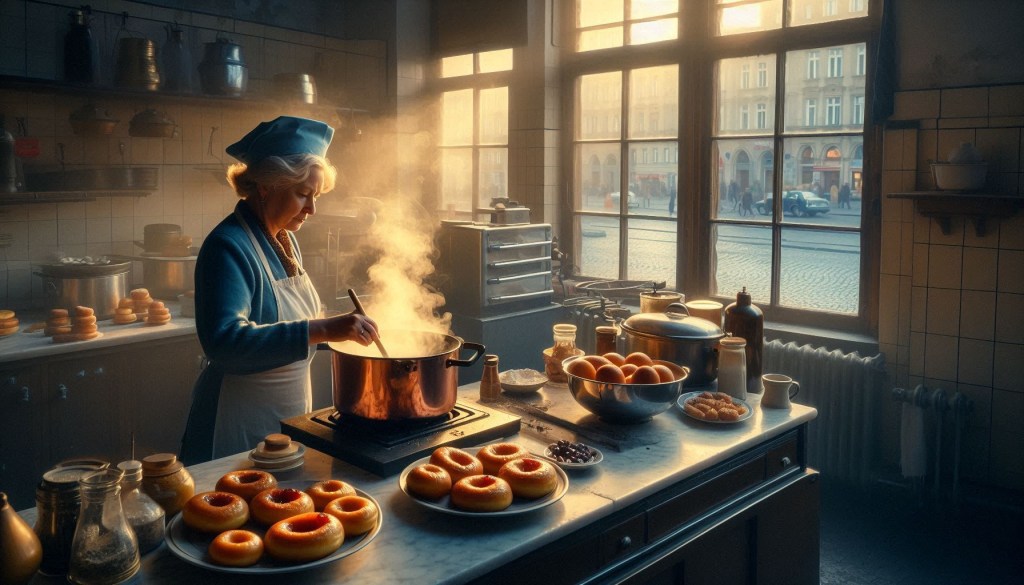
West Berlin – 26th June 1963
The clock above my Konditorei reads twenty minutes past four when I push through the door into the pre-dawn darkness of Schöneberg. Twenty-six years I’ve been waking at this hour, first in my family’s bakery in Prenzlauer Berg, then here in the West, where the streets smell different—less coal smoke, more hope, though I wouldn’t have believed such a thing had a scent ten years ago.
This morning feels different. The very air seems to vibrate with anticipation, as if the city itself knows what’s coming. President Kennedy will speak today at Rudolph Wilde Platz, just eight streets from where I stand, and I’ve been chosen to provide Pfannkuchen for the American journalists who’ve descended upon our neighbourhood like hungry sparrows.
I switch on the lights in my shop, and the familiar warmth embraces me. The glass cases stand empty, waiting to be filled with the day’s offerings, but my mind is already focused on the task ahead. Three dozen Pfannkuchen—Berlin’s answer to the world’s jam doughnuts, though we’d never call them by such a common name. These will be perfect, each one a small rebellion against everything that sought to crush the spirit of this city.
I tie my apron, the same blue cotton one I’ve worn for seven years now, and begin. The recipe lives in my hands rather than in any book. My grandmother, Oma Müller, taught it to me when I was barely tall enough to peer over the marble counter of our old bakery. “Greta,” she’d say, her weathered fingers guiding mine through the dough, “baking is memory made edible. Every loaf, every pastry carries the soul of who made it.”
I didn’t understand her then. I was nineteen and thought I knew everything about bread and life. That was before the war, before the Soviets, before the night I climbed through a basement window in Bernauer Straße with nothing but the clothes on my back and my grandmother’s silver mixing spoon sewn into my coat lining.
The yeast froths in warm milk, releasing that ancient, earthy smell that connects every baker across time. I measure flour by feel rather than weight—six handfuls for this batch, just as Oma taught me. The eggs I crack with one hand each, a skill that took me months to master again after the shaking in my fingers finally stopped.
Outside, Berlin begins to stir. I hear the rumble of early trams, the whistle of the milkman, the distant sound of American journalists practising their German pronunciation. One voice stumbles over the unfamiliar syllables, the words clumsy but earnest. I smile despite myself. He’ll get it right when it matters.
As I knead the dough, I let my mind wander to that October night in 1953 when I made my choice. The bakery had been my world for twenty-six years—first as a child underfoot, then as my father’s apprentice, finally as the woman who kept the ovens burning even when Russian soldiers demanded half our daily bread for “the people’s redistribution.”
But when they came that evening, demanding not just bread but information about our customers, about who bought what and when, I knew I couldn’t stay. They wanted me to become their eyes and ears, to turn my warm sanctuary into a place of suspicion and betrayal. I looked at the ovens where four generations of Müllers had baked their love into loaves, and I chose freedom over heritage.
The escape itself remains a blur of terror and cold—crawling through sewers, hiding in abandoned buildings, the taste of fear so metallic it overwhelmed everything else. I remember thinking I’d never taste anything sweet again, that I’d lost the ability to create joy when I left behind my family’s recipes, hand-written on cards yellowed with flour and time.
I was wrong, of course. Here I am, a decade later, my hands creating the same magic they always have, though now I measure ingredients with American cups alongside my grandmother’s European scales, and my customers pay with Deutsche Marks instead of the worthless paper money the Soviets printed like promises they never intended to keep.
The dough beneath my palms is perfect—silky and elastic, responsive to touch. I can feel it coming alive, the gluten strands forming their invisible web of possibility. This is what Oma meant about memory made edible. Every fold of the dough carries forward the techniques passed down through generations, even across walls and wars and the terrible choices that shape our lives.
I set the dough to rise and turn my attention to the filling. Today calls for Pflaumenmus—thick plum jam that cooks down to a deep purple sweetness. I made it last autumn when the local plums were at their peak, standing over the copper pot for hours, stirring and watching and remembering the way Oma used to test for doneness by dropping a spoonful onto a cold plate.
The jam releases its perfume as I warm it gently—concentrated summer, bottled hope. I think of the American journalists who’ll bite into these pastries later today, probably their first taste of authentic Berlin baking. Will they understand what they’re eating? Will they taste the centuries of tradition, the defiance baked into every grain of sugar?
By six o’clock, the dough has doubled, and I begin the delicate work of rolling and cutting. Each circle must be perfect—not too thin, or the jam will burst through during frying, not too thick, or the dough will remain heavy and crude. I place a generous spoonful of plum jam in the centre of each round, then fold the edges together, sealing them with a careful crimp.
The oil heats slowly in my large copper pot, the same one I managed to buy from a retiring baker in Charlottenburg three years ago. It reminds me of home, of the pot Oma used every Friday to make fresh Pfannkuchen for the weekend. I test the temperature with a small piece of dough—it should sizzle immediately but not violently, dancing in the oil like a tiny yellow boat on a golden sea.
The first batch slides into the oil with satisfying whispers. I watch them bob and turn, their surfaces blooming into perfect golden brown. The scent fills my kitchen—yeast and sweetness and the indefinable smell of something being born from simple ingredients and careful attention.
This is when I always think of her—my grandmother, gone now five years, who died in that cold flat in Prenzlauer Berg, still waiting for me to come home. I sent letters when I could, packages of Western coffee and chocolate when the postal service allowed them through. But I could never send what she really wanted: her granddaughter’s return, the continuation of our family’s tradition in the place where it began.
She never understood my choice. “Bread is bread,” she wrote in her final letter. “Borders cannot change flour into something else.” But she was wrong about that, as she was wrong about so many things in her final years. Bread made in freedom tastes different. It rises differently. It carries different hopes.
The first batch emerges from the oil, golden and perfect. I dust them with powdered sugar while they’re still warm, watching the white crystals melt slightly into the crispy surface. One perfect Pfannkuchen for each journalist, each foreign correspondent who’ll witness history today and then return to their own countries carrying stories of Berlin’s resilience.
I cannot resist. I break open the first one, releasing a puff of sweet steam. The jam inside is perfectly set, no longer liquid but not yet firm, that precise moment when fruit becomes something more than the sum of its parts. I take a bite, closing my eyes to concentrate on the flavours.
The dough is light as air but substantial enough to hold the filling. The jam provides bursts of tartness that play against the sugar dusting. But there’s something else—something I can taste but not name. It’s the flavour of mornings like this one, of small acts of creation in the face of enormous uncertainty.
Through my shop windows, I watch Berlin wake up. The streets fill with people heading towards the plaza where Kennedy will speak. Some carry small American flags, others German ones. Children dart between the adults, their excitement infectious. A group of young people passes, singing something I don’t recognise, their voices bright with anticipation.
This is what I left everything for—not just the freedom to bake what I choose, but to be part of moments like this one. In East Berlin, I would be watching from behind curtains, if I were allowed to watch at all. Here, I’m contributing my small part to history, feeding the people who’ll tell the world what they witnessed.
I continue frying, batch after batch, until thirty-six perfect Pfannkuchen rest in their boxes, ready for delivery. The Americans arrive at nine o’clock sharp—three men and one woman, all with cameras slung across their shoulders and notebooks protruding from their jacket pockets.
“Mrs Müller?” The woman steps forward, her German accented but clear. “I’m Sarah Collins from the Washington Post. These look absolutely wonderful.”
I pack their order carefully, adding a few extra pastries because I cannot help myself. “For strength,” I tell them in my careful English. “Long day ahead.”
They disappear into the growing crowds, and I find myself alone again with my thoughts and the lingering scent of frying dough. I clean my equipment methodically, the ritual as comforting as prayer. But my ears are tuned to the sounds from the street, waiting for the moment when history will speak.
It comes at half past one. Kennedy’s voice, amplified and carrying across the neighbourhood, reaches me even through my closed door. I abandon my cleaning and step outside, joining the hundreds of others who’ve spilled from shops and flats to listen.
“Ich bin ein Berliner!”
The words hit me like a physical force. Here is the President of the United States, the most powerful man in the world, declaring himself one of us. Not merely an ally or a supporter, but a Berliner. The crowd erupts, and I find tears streaming down my face.
I duck back into my shop and unwrap the last Pfannkuchen I saved for myself. I hold it carefully, this simple creation of flour and eggs and jam, and I bite into it as Kennedy’s words continue to echo through the streets.
This is the most delicious thing I’ve ever eaten. Not because the ingredients are exotic or the technique particularly complex, but because I can taste everything it represents. The traditions I thought I’d lost but found again in my own hands. The freedom to choose what to create and when to create it. The possibility that someday, those walls that divide my city might come down, and I might walk the streets of my childhood again.
But mostly, I taste hope. Sweet, warm hope, dusted with sugar and filled with the promise that small acts of creation—a perfect pastry, a well-chosen word, a moment of connection across languages and borders—can outlast even the mightiest walls.
The jam bursts across my tongue, and I understand finally what my grandmother meant about memory made edible. This Pfannkuchen carries forward everything I am and everything I’ve chosen to become. It tastes like home—not the home I left behind, but the one I’ve built with my own hands, one batch at a time.
Outside, Berlin celebrates. Inside my little Konditorei, I finish my pastry and begin planning tomorrow’s bread.
The End
Bob Lynn | © 2025 Vox Meditantis. All rights reserved.


 Vox Meditantis
Leave a comment